



Let’s start with what was lost: the 1691 Massachusetts charter, which merged Massachusetts Bay and Plymouth into a single royal colony. The document contains 9,755 words, but here’s the gist of it:[1]
The Crown appointed a governor, but he would not govern alone. “Upon every last Wednesday in the Month of May, every yeare for ever and at all such other times as the Governour of Our said Province shall think fit,” the governor was to convene “a great and Generall Court of Assembly.” This general court consisted of:
An assembly, with delegates “elected or deputed by the Major parse of the Freeholders and other Inhabitants of the respective Townes or Places who shall be present at such Election . . . Said Townes and Places being hereby impowered to Elect and Depute Two Persons and no more to serve for and represent them.”
A council: “Eight and Twenty Assistants or Councillors to be advising and assisting to the Governour,” selected “once in every yeare” by “the Generall Court or Assembly newly chosen.”
The people had a hand in choosing two of the three arms of provincial government—one directly, the other by their chosen representatives.
This General Court, convening every year in May, was charged with “ordering and directing the Affaires of Our said Province.” To do so, it exercised a full range of powers: appointing “Civill Officers,” imposing fines and punishments, and levying “proportionable and reasonable Assessments Rates and Taxes.” To enforce its measures, the General Court would “Erect and Constitute Judicatories and Courts of Record or other Courts . . . for the Hearing Trying and Determining of all manner of Crimes Ordences Pleas Processes Plaints Accons Matters Causes and things whatsoever ariseing or happening within Our said Province or Territory or between persons Inhabiting or resideing there.”
There was one explicit restriction on acts of the General Court: “For the greater Ease and Encouragement of Our Loveing Subjects Inhabiting our said Province or Territory of the Massachusetts Bay . . . there shall be a liberty of Conscience allowed in the Worshipp of God to all Christians (Except Papists).”
The people’s authority, however, was not absolute. The governor “shall have the Negative voice . . . Without his consent or Approbation signified and declared in Writeing, no such Orders Laws Statutes Ordinances Elections or other Acts of Government whatsoever . . . shall be of any Force effect or validity.” And even if the governor granted his consent, Parliament had a three-year window in which it could “negative” any measure. This was, after all, a royal colony. But diverse seats of authority did give citizens considerable say in the everyday functioning of their government.
Too much of a say, the British Parliament decided in 1774. Of the four punitive acts passed in response to the Boston Tea Party, closing the port of Boston receives most attention in textbooks today—but at the time, with 95 percent of the colony’s population living outside Boston, it was “An Act for the Better Regulating the Government of the Province of the Massachusetts Bay”—known today as the Massachusetts Government Act—that sparked the people’s fury and led them to cast off British rule.[2]

Under the 1691 Charter, “freeholders” could call a town meeting whenever they saw fit—but no longer: “Whereas a great abuse has been made of the power of calling such meetings, and the inhabitants have, contrary to the design of their institution, been misled to treat upon matters of the most general concern, and to pass many dangerous and unwarrantable resolves,” the 1774 act declared, “no meeting shall be called by the Selectmen, or at the request of any number of freeholders of any township, district, or precinct, without the leave of the Governor, or, in his absence, of the Lieutenant Governor, in writing, expressing the special business of the said meeting.”
Likewise, on the provincial level, power was wrested from the people. No longer would the incoming “general court or assembly” choose the Governor’s Council:
Whereas the said method of electing such counsellors or assistants. . . hath been so far from contributing to the attainment of the good ends and purposes thereby intended, and to the promoting of the internal welfare, peace, and good government of the said province, or to the maintenance of the just subordination to, and conformity with, the laws of Great Britain, . . . the said method of annually electing the counsellors or assistants . . . should no longer be suffered to continue . . .
Be it therefore enacted . . . that the council, or court of assistants, shall be composed of such of the inhabitants or proprietors of lands within the same as shall be thereunto nominated and appointed by his Majesty.
All other officers would also be appointed by the governor, who could remove them at will:

It shall and may be lawful for his Majesty’s Governor for the time being of the said Province, or, in his absence, for the Lieutenant Governor, to nominate and appoint, under the seal of the Province, from time to time, and also to remove, without the consent of the Council, all Judges of the Inferior Courts of Common Pleas, Commissioners of Oyer and Terminer, the Attorney General, Provosts, Marshals, Justices of the Peace, and other officers to the Council or Courts of Justice.
The Massachusetts Government Act, as we call it today, was to take effect on June 1, 1774. Ironically, on June 6 the Boston Gazette published news that Parliament was considering the act—and it wasn’t until mid-July that colonists learned it had actually passed.[3]
The Act prompted outrage, for its tone as well as its substance. “Just subordination” and “just dependance of the said province upon the crown and parliament of Great Britain” did not play well in Massachusetts. It generated immediate response—more widespread than the Boston Port Act, which preceded it. In Boston and environs, reliant on trade, the Port Act was huge, but elsewhere, where 95 percent of the people resided, yanking away their charter triggered an irreversible break from Crown and Parliament.[4]
Of the thirty-six Crown-appointed council members, the so-called “Mandamus Councillors,” only twenty-five accepted their commissions. These were then hounded by crowds and in some cases physically abused. Those who could do so retreated to Boston, seeking protection by British troops. In the end, on August 8, only eleven took their oaths.[5]
Town meetings continued, in direct defiance in the new act. The business at hand: how best to resist. That spring, in Worcester, radicals had organized a caucus within the town meeting—the “American Political Society”—which tussled on several issues with an entrenched local elite. For the most part, the APS prevailed, but only by narrow margins. Frustrated by a string of defeats, fifty-two of the “government men” signed a dissenting statement they termed a “Protest,” which the town clerk, Clark Chandler—son of the town’s most prominent citizen, John Chandler IV—entered in the official record and published in the Boston press. With a haughty manner, men who had once wielded power groused that uneducated militants were “spending their time in discoursing of matters they do not understand” while “neglecting their own proper business and occupation, in which they ought to be employed for the support of their families.” These agitators were “enemies to our King and Country, violators of all law and civil liberty, the malevolent disturbers of the peace of society, subverters of the established constitution, and enemies of mankind.” Patriots might command a slim majority in Worcester, but defiant and unrepentant Tories refused to concede.[6]
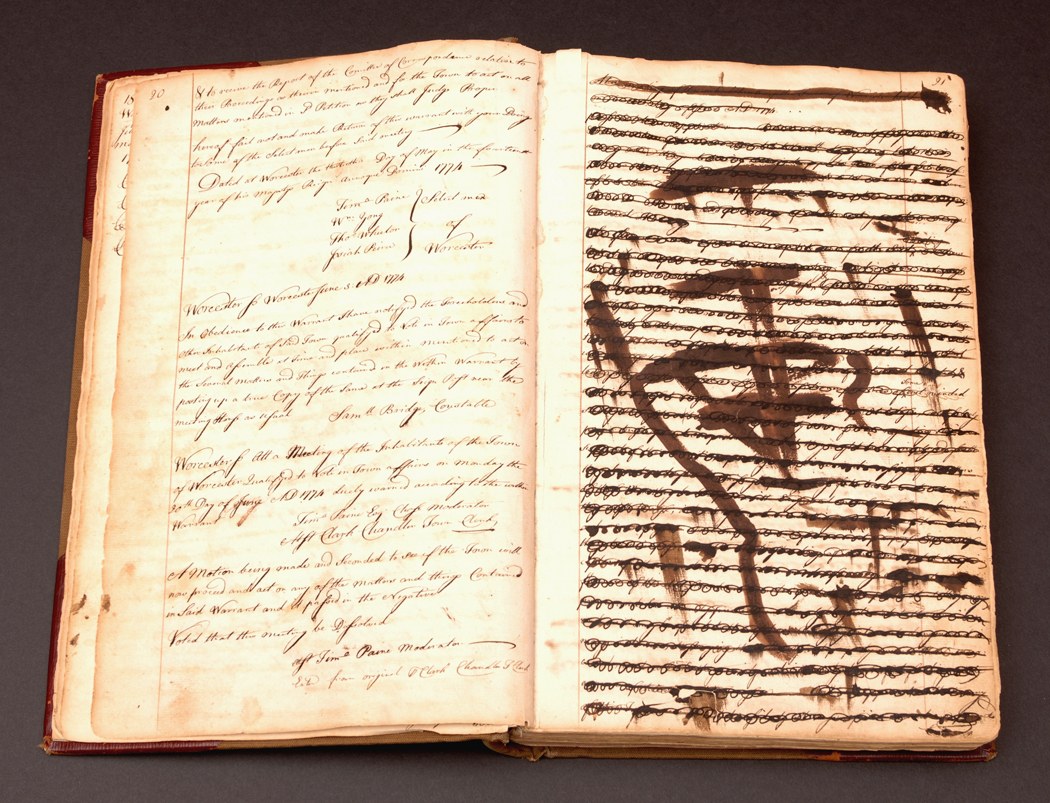
That is how matters stood when news of the Massachusetts Government Act, in an instant, altered the terms of political engagement. How could self-respecting citizens support a government that disenfranchised them? Diehard Tories found themselves alone, unable to muster support from those of moderate persuasion. From that moment onward, the American Political Society ruled. On August 22, the APS caucus forced the fifty-two “protestors” to “beg forgiveness” in a formal recantation at the town meeting. But that alone would not suffice. They then compelled each one to strike a line through his signature at the bottom of the protest, which Clark Chandler had entered in the official journal. Then, unhappy with even the appearance of dissent, patriots ordered the clerk to “obliterate, erase, or otherwise deface” the “protest” from the record. Left with no other option, Chandler inked his pen and drew it across the Tories’ protest, line by line, in full public view. But even this was not enough. A few words could still be deciphered in the record book, so the APS townsmen made him do it again—this time with continuous loops of tight spirals that rendered the protest unintelligible.
Certainly that should have ended the matter, but it didn’t. We do not know exactly what provoked the last dramatic humiliation, but we do know that in full view of the town meeting, Worcester’s town clerk was forced to dip his own fingers in a well of ink and drag them over the first page of the Protest. The short, irregular changes of direction in the defacements on this document suggest that Chandler’s hand was forced.[7]
Province-wide, in each county, quarterly sessions of the Court of Common Pleas and the Court of General Sessions administrated the rule of law. Formerly, they had served as the farthest outposts of British authority—but after passage of the Massachusetts Government Act, no longer. In each shiretown (county seat), great assemblages of people gathered to shut down the courts.
The first courts scheduled to meet under the Massachusetts Government Act were in Great Barrington, shiretown of westernmost Berkshire county, on Tuesday August 16. But that never happened:
We hear from Berkshire that vast numbers of the people assembled to attend the last Session of the County Court in Great Barrington and, unarmed, filled the Court House and Avenues to the Seat of Justice, so full that no Passage could be found for the Justices to take their Places. The Sheriff commanded them to make way for the court, but they gave him to understand that they knew no court on any other establishment [legal basis] than the ancient laws and usages of their country, & to none other would they submit or give way on any terms.[8]
The Berkshire County courts could not, and did not, convene.
The next courts were scheduled for Springfield, shiretown of Hampshire County, two weeks later, on August 30—but some 1,500 citizens made sure they did not sit. One eyewitness, Joseph Clarke of Northampton, gave a vivid account: “The people of each town being drawn into separate companies marched with staves & musick . . . The trumpets sounding, drums beating, fifes playing and Colours flying, struck the passions of the soul into a proper tone, and inspired martial courage into each.” The judges and justices of the peace offered no resistance to “the body of the county,” as Clarke called the men who marched with their town’s militia companies. When a committee asked them “whether they meant to hold their commissions and exercise their authority according to the new act of parliament for altering the constitution of the province,” they all said they would not. But the people wanted more. “Amidst the Crowd in a sandy, sultry place, exposed to the sun,” eighteen judges, justices of the peace, and lawyers were forced to submit in writing:
We, the Subscribers, do severally promise and solemnly engage to all People now assembled, in the County of Hampshire, on the 30th Day of August 1774, that we will never take, hold, execute, or exercise any Commission, Office, or Employment whatsoever, under, or in Virtue of or in any Manner derived from any Authority, pretended or attempted to be given by a late Act of Parliament, entitled, ‘An Act for better regulating the Government of the Province of Massachusetts-Bay, in New England.’[9]
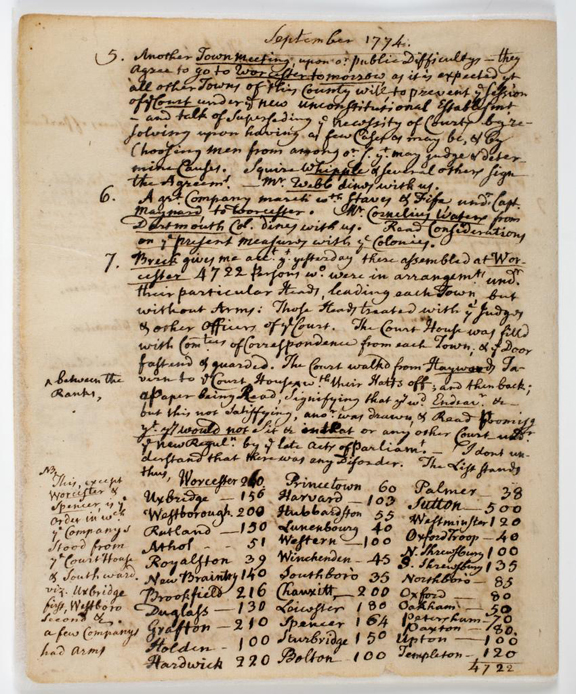
One week after that, on September 6, came the town of Worcester, shiretown of Worcester County. In Boston, “the body of the people” assembled in a single, and sizeable, group. Here “the body” was a composite of thirty-seven discrete units—each an individual town’s militia company. Breck Parkman, one of the participants, recorded the turnout for each: 45 militiamen from Winchendon on the New Hampshire border, 156 from Uxbridge on the Rhode Island line, and so on—a total of 4,622 men. Half the adult males of this sprawling rural county, many walking and riding through the night, showed up at one place and time to shut down a government they regarded as oppressive.[10]
With such a turnout, how to proceed? Each company chose a special representative, distinct from the military captain, “to wait on the judges.” This ad hoc committee then walked down Main Street to Daniel Heywood’s tavern, where, after being barred from the courthouse, the court officials had retreated. The committee and court officials hammered out the terms of surrender: a formal recantation, which Breck Parkman characterized as “a paper . . . signifying that they would endeavor &c.” The draft was then taken back to the separate companies for their approval—or disapproval. The judges’ statement, in Parkman’s words, “was not satisfying,” no more than an empty promise. Told to devise a stringent, binding contract, representatives returned to Heywood’s tavern. The process was democratic but cumbersome and time-consuming, and when some militiamen grew impatient, the Committees of Correspondence appointed three men to inquire about the delay.[11]
Finally, in mid-afternoon, militiamen arranged themselves along Main Street, half on the Mill Brook side and the other half under the embankment to the west. The lines stretched for a quarter-mile, each company in formation, Uxbridge in front of the courthouse, Westborough next, and so on, down to Upton and Templeton, stationed outside Heywood’s tavern. When all were in place, two dozen court officials emerged from the tavern one at a time— judges, justices of the peace, court attorneys, and any whose power had been sanctioned by the Crown. Hat in hand, signaling deference, each in turn publicly disavowed British authority before the first company of militiamen. Others, however, could not hear, so as each made his way through the gauntlet, he was ordered to repeat his recantation—some thirty times or more. The officials pledged “that all judicial proceeding be stayed . . . on account of the unconstitutional act of Parliament . . . which, if effected, will reduce the inhabitants to mere arbitrary power.” With this daylong display of the people’s power, climaxed by the humiliating submission of court officials and noted Tories, all British authority, both political and military, disappeared from Worcester County.[12]
Every other county followed suit except Suffolk. With British troops stationed in Boston, its shiretown, this would be the only remaining outpost of British authority in Massachusetts. On October 4, after an aroused citizenry had prevented the Plymouth County courts from sitting, spirited patriots took their celebration to the next level:
Yesterday met at Plymouth, the body of that county, to the number of four thousand, when they proceeded to make all of the addressers there make a public recantation. After which, they attempted to remove a Rock (the one on which their fore-fathers first landed, when they came to this country) which lay buried in a wharfe five feet deep, up into the center of the town, near the court house. The way being up hill, they found it impracticable, as after they had dug it up, they found it to weigh ten tons at least.[13]
Also on October 4, the town meeting of Worcester issued instructions to blacksmith Timothy Bigelow, whom it had chosen as its representative to the forthcoming Provincial Congress:
You are to consider the people of this province absolved, on their part, from the obligation therein contained [the 1691 Massachusetts Charter], and to all intents and purposes reduced to a state of nature; and you are to exert yourself in devising ways and means to raise from the dissolution of the old constitution, as from the ashes of the Phenix, a new form, wherein all officers shall be dependent on the suffrages of the people, whatever unfavorable constructions our enemies may put upon such procedure.[14]

Exactly twenty-one months before the Continental Congress would declare independence, the citizens of the town of Worcester had decided it was time to start anew, no matter what anybody else might say. This is the first recorded declaration of the intent to form an independent government by a public body in British North America that has come to light.[15]
Henceforth, the Provincial Congress would be the de facto government for rebellious Massachusetts. It collected taxes, procured armaments, and prepared for the military engagement that would inevitably follow.
The following spring, when Gov. Thomas Gage prepared to take back a colony the Crown had just lost, he would start by seizing rebel armaments, stored primarily at Worcester and Concord. Gage dispatched spies to determine where to strike. Not Worcester, they advised, too distant. His soldiers would face an endless barrage of enemy fire en route. Understandably, Gage opted for Concord, accessible in a single night’s march.
“The shot heard ’round the world”—Lexington and Concord, along with Boston, get all the press, while the hinterlands of Massachusetts are largely neglected. Yet there, much more than taxation was at stake. This was a constitutional crisis. The people, collectively and dramatically, determined they would fashion their own rules for how to be governed.
[1] avalon.law.yale.edu/17th_century/mass07.asp
or www.consource.org/document/charter-of-massachusetts-bay/.
[2] avalon.law.yale.edu/18th_century/mass_gov_act.asp .
[3] Boston Gazette, June 6, 1774; Boston Evening-Post, July 18, 1774.
[4] For detailed discussions of the resistance to the Massachusetts Government Act, see Ray Raphael, The First American Revolution: Before Lexington and Concord (New York: The New Press, 2002), chapters 3-5, and Ray Raphael and Marie Raphael: The Spirit of’74: How the American Revolution Began (New York: The New Press, 2015), chapters 3-8.
[5] “Mandamus Councillors, 1774.” American History Channel: www.americanhistorycentral.com/entries/mandamus-councillors/. For detailed narratives of crowd actions against mandamus councillors, see Raphael, First American Revolution, 75-89
[6] Franklin P. Rice, ed., Worcester Town Records from 1753 to 1783 (Worcester: Worcester Society of Antiquity, 1882), 230–233; Boston News-Letter and Massachusetts Gazette, June 30, 1774; Boston Gazette, July 4, 1774.
[7] The inked-out page of the Worcester Town Records from August 22, 1774, is reproduced in www.rayraphael.com/documents/Worcesters_inkpage.htm.
[8] Boston Newsletter, September 1, 1774.
[9] James R. Trumbull, History of Northampton, Massachusetts, from its Settlement in 1654 (Northampton: Gazette Printing Co., 1902), 346–348. For the size of the crowd, see Boston Gazette, September 12, 1774; Franklin B. Dexter, ed., The Literary Diary of Ezra Stiles (New York: Charles Scribner’s Sons, 1901), 1: 479; Jonathan Judd, Jr., Diary, v. 2 (1773–1782), Forbes Library, Northampton, entry for August 31, 1774.
[10] Ebenezer Parkman, Diary, September 6 and 7, 1774, American Antiquarian Society. The diary can be accessed on the documents page of rayraphael.com. Note that Parkman’s total of 4,722 is slightly off—the numbers he lists yield 4,622.
[11] Parkman, Diary, September 7; Lincoln, Journals of Provincial Congress/County Convention, 635–637.
[12] Parkman, Diary, September 7; Lincoln, Journals of Provincial Congress/County Conventions, 637. A more detailed narrative of the day’s proceedings appears in Raphael, First American Revolution, 130-38.
[13] John Andrews to William Barrell, October 6, 1774. Letters of John Andrews esq. of Boston, 1772-1776, Cambridge, 1866, 373-4.
[14] An image, from the Town Records for Worcester, appears on the document page of rayraphael.com: www.rayraphael.com/documents/decloration_independence.htm
[15] This declaration foreshadowed the ninety instructions in the spring of 1776 from state and local bodies, pushing their representatives to higher bodies to vote for independence. See Pauline Maier, American Scripture: Making the Declaration of Independence (New York: Alfred A. Knopf, 1997).

Recent Articles
James Bass & William Taburn, Nansemond Indian Nation Patriot Warriors: A Call for Research
My Family Arrived at this Place: A Loyalist Ranger’s Road from Saratoga
Freedom Round the Globe: A World History of the American Revolution
Recent Comments
"Hero to Zero? Remembering..."
Arnold was the hero of Saratoga "the best general on either side"...
"From Roxbury to Exeter:..."
Hello Otis, Thank you for your kind note. I was interested to...
"The Milford Connecticut Cartel"
Elizabeth, unfortunately none of the accounts of this incident identify any Milford...