

Visitors to the Monmouth Battle Monument in Freehold, New Jersey, cannot help but be taken by its majesty. Its sheer size (ninety-four feet tall), its ornate design on top with Liberty Triumphant crowning its towering column which is also adorned with a cornice of flying eagles, and a base decorated with the coats of arms of the thirteen original states, connected by bronze laurel leaves between them, altogether presents a truly spectacular scene.
What must have been most impressive to visitors between the 1880s and 1920s, but lamentably less so today, is the ring of bronze bas relief panels that encircle the base of the shaft of this centennial memorial. Sculpted by New York artist James E. Kelly, each of these creations measures five by six feet and depicts a scene specific to the battle and the campaign leading to it. One hundred and forty years of erosion has wiped away the intricacies of all of them. Regardless, the inscription at the bottom of each panel identifies its importance to the campaign. Vistors will see the weatherworn panels “Washington Rallying the Troops” and know who is depicted within it. Revolutionary War aficionados as well as frequent southbound travelers on the New Jersey Turnpike will also recognize Molly Pitcher’s name attached to another panel (and to a service area between exits 8 and 8A). But the most dramatic scene in all the bas relief panels highlights a one-on-one fight to the death between two soldiers, each with blade in hand. The title of the scene—“Ramsay Defending His Guns”—provides no familiarity to anyone except the most ardent of buffs of this battle.
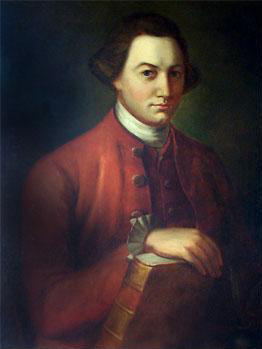
“Ramsay” was Nathaniel Ramsey, a Marylander thirty-six years old in June 1778 (transplanted from his birth home in Lancaster, Pennsylvania). He usually signed his name “Nat Ramsey,” although his surname appears more frequently in historical literature as “Ramsay” due to his prominent brother, David, adopting the latter spelling. Although he left no written first-hand account of his harrowing minutes on the Monmouth battlefield, Nathaniel Ramsey did the next best thing for posterity. He relayed, in scintillating detail, exactly what happened to him both during and shortly after the battle to influential and informal “publicists,” including Washington’s assistant military secretary, James McHenry, and to his good friend who was also his wife’s older sibling—Charles Willson Peale, the most prolific portraitist and artist of miniatures living in America in the late 1770s. By the early summer of 1778, Peale had captured his brother-in-law’s likeness in at least two paintings created during the decade, the first one around the time Ramsey married Peale’s sister in 1771.[1] This image remains a valuable visual aid two-and-a-half centuries later. More valuable for understanding the gripping experience of fighting the Battle of Monmouth is Peale’s (and McHenry’s) recounting of Ramsey’s battlefield experience in the artist’s autobiography, a valuable yet underutilized account first provided to Peale shortly after the battle.[2]
Lt. Col. Nathaniel Ramsay marched from Englishtown southeastward toward Monmouth Courthouse throughout an alarmingly hot Sunday morning, June 28,1778. He did not proceed toward battle as part of his 3rd Maryland Regiment, but instead as second in command of a picked battalion of infantry––one of seven such creations of elite fighting troops which formed the bulk of an Advanced Corps under Maj. Gen. Charles Lee. Brig. Gen. Anthony Wayne commanded three battalions of picked troops, including the one in which Ramsey belonged, as well as a section of artillery. Col. James Wesson (9th Massachusetts) headed Ramsey’s unit.[3] In all, the battalion approached 400 infantry and artillery officers and privates. The fact that Lieutenant Colonel Ramsey marched in the company of only fourteen regimental peers and superiors leading the seven picked battalions of the Advanced Corps bore testament to the high regard bestowed upon him as one of the most reputable field officers in Gen. George Washington’s Continental Army.
By 12:30 P.M., Ramsey found himself in charge of the battalion after Colonel Wesson suffered a grievous injury from a British cannonball which scraped off a huge swath of skin and muscle from his upper back. (Wesson fortunately had been facing toward the ground, bent at the waist, when he was struck by the solid round––a rare survivor of an artillery wound.)[4] Shortly before 1:00 P.M., Ramsey led his picked men in retreat. Wayne’s three battalions brought up the rear of a mass retrograde by the entire force which had numbered 6,000 soldiers when it departed Englishtown more than six hours earlier, and was now directly pursued by 2,500 British troops, including cavalry of the 16th Light Dragoons and brigades of Guards and Grenadiers.[5] Ramsey’s retreat began from his most advanced position about half a mile northwest of Monmouth Courthouse; it proceeded westward across farmland bordered on the north by a vast body of woods enveloping the Englishtown-Freehold road to Ramsey’s right. After crossing a morass formed by a southward feeding tributary of Spotswood’s South Brook, all three of Wayne’s battalions halted near or at the lane running to the William Wikoff farm from the main road on which they advanced to confront the enemy.[6]
It was here, shortly after 1:15 P.M. that Ramsey met General Washington, perhaps not for the first time, but at a most crucial moment of the battle. Washington had personally taken charge of the battle half an hour earlier, stopped the mass retreat with the help of a large family of headquarters personnel, confronted General Lee about the disturbing retrograde of the best troops in the Continental Army. The commanding general then rode eastward where he learned from his military secretary that the redcoats were fifteen minutes east of them (about a mile) and closing in. Washington received this news with General Wayne at his side just below a jutting woodlot, one that protroded southward toward the morass from the main body of woods which enveloped the Englishtown-Freehold road for a mile eastward from Wikoff’s lane.
Washington determined to establish a series of temporary defenses to delay the British advance while he established the main defensive line of infantry and artillery on Perrine’s Hill, a little more than a mile northwest of the point of woods where Washington and Wayne stood. Promising to fortify Wayne with infantry, this would be the first line of defense, designed as an ambush position intended to surprise and delay the incoming enemy column by inflicting as much chaos and as many casualties as possible.
Ramsey commanded a third of Wayne’s picked troops. The other two battalions, commanded by Col. Henry Beekman Livingston (originally in charge of the 4th New York) and Col. Walter Stewart (from the 2nd Pennsylvania in Wayne’s original brigade), tarried near Ramsey and his men. Likely due to limited space in the jutting timbers, Washington chose two battalions—Ramsey’s and Stewart’s—to join General Wayne in the point of woods. To emphasize the importance of the mission, Washington grasped Ramsey’s hand and emphasized to both him and Colonel Stuart his expectation of them to check the progress of the enemy. According to Washington’s assistant secretary who witnessed the scene at the side of his commander, Ramsey assured the general, “We shall check them!”[7]

The two battalion commanders hustled northeastward into the point of woods with their respective commands and deployed them between the trees. At 1:30 P.M.—with temperatures within five degrees of the century mark—redcoated troops appeared southeast of them advancing westward across farmland. With the collective British attention focused on negotiating the morass while under artillery fire from four guns—two of them directed by Lt. Col. Eleazer Oswald—Wayne’s battalions ambushed the British right flank with small-arms volleys. Within mere minutes the well-trained British troops redirected the right flank of the advance toward the woods in an effort to root out and vanquish this unsuspecting threat. Ramsey, Stewart, and upwards of 700 Continentals suddenly confronted more than their numbers penetrating the woods from south to north. The Brigade of Guards formed the bulk of the British assault, with elements of the 16th Light Dragoons on each flank.[8]
Although Baron de Steuben’s several weeks of training at Valley Forge steeled hundreds of these picked Americans to stand their ground, the broken formations in the woods combined with the sudden response and weight of numbers of the elitely-trained and experienced Britons forced hundreds of Continentals to pour out of the trees in retreat. Colonel Stewart went down early in this contest, and was replaced by Lt. Col. Lewis Farmer. A counterweight casualty was inflicted upon Col. Henry Trelawney, comanding one of the two Guards battalions, wounded severely enough to end his battle.[9]
Nathaniel Ramsey remained at the southern end of the woods and took on his attackers. What happened next was the stuff of legend, but this legend was born from Ramsey himself as no other participant—British or American—who witnessed the event recounted it verbally or on paper. Ramsey’s version was first relayed to Col. Otho Williams, a fellow Maryland commander who was not in the woods, the day after the battle. Historians have referenced Williams’s version in twentieth and twenty-first century battle histories. But his is merely a three-sentence narrative. A more descriptive version comes from James McHenry, a member of Washington’s headquarters “family” who reported in a letter to the editor of a Philadelphia newspaper what Ramsey told him.[10] Even more revealing is Ramsey’s later 1778 testimony to his brother-in-law, Charles Willson Peale—an account possibly relayed during a late-October hunting trip, if not earlier.[11] The artist recorded the details of the conversation(s) in his autobiography.[12] The following amalgamates all three versions:
On foot, Ramsey was a conspicuous target, partly due to his height—he stood as tall as George Washington. He was armed with a small blade and no pistol as he appeared at the forefront of a disintigrating battle formation. He challenged an oncoming horse soldier of the 16th Light Dragoons who raised his broadsword to chop down the Marylander. But Ramsey thrust first with his lighter, short-bladed sword which unhorsed the redcoat with a piercing wound. Ramsey attempted to gain control of the Briton’s horse but was lit upon by at least two of the fallen man’s comrades before he could mount it. One of the supporting dragoons aimed the muzzle of his pistol at Ramsey’s head and fired. The shot was inadvertently diverted by another horse soldier’s thrusting sword. Still, the ball grazed Ramsey’s right cheek severely enough to slice and burn it, as well as discolor it for the rest of his life; the sword blade that altered the bullet’s path was true to its target as it penetrated Ramsey’s shoulder nearly simultaneously with the bullet wound. Ramsey dropped, stunned and in pain, writhing briefly while postrate until he regained his senses and stilled his bleeding body to prevent receiving multiple bayonet wounds.

With his hand covering his powder-burned, bloody face, and amidst the melee of advancing and retreating soldiers all around him, Ramsey turned his head, kept his eyes open and fixed his gaze upon a British officer within calling distance. He shouted out to him, announcing his wounded state and begging for quarter as an officer in the Continental Army. To Ramsey’s relief, the enemy officer complied to his request. He garnered personnel to carry Ramsey eastward from the woods to a farmhouse (perhaps the William Ker home). By the time Ramsey was carried indoors, he had bled so much that he was awarded a bed by the sympathetic resident. Ramsey remained alert and strong enough to resist being stripped of most of his uniform by nefarious enemy soldiers.
Ramsey was initially oblivious to the dramatic change in momentum gained by the Americans on the battlefield. The point of woods defense, in combination with a brief fight at a hedgerow fence 600 yards east of it, bought enough time for Washington to establish a strong, dozen-gun defensive position on Perrine’s Hill. After a two-hour artillery duel between opposing armies positioned 1,300 yards apart, Washington’s series of counterstrikes drove Clinton from the contested portion of the field by sunset. Washington pushed troops eastward and prepared to renew offensive thrusts on Monday morning.
As night enveloped the battlefield, Ramsey underwent an interrogation by officers sent to his sickbed by General Clinton. Interestingly, the line of questioning began with pinpointing where Washington was; Ramsey discerned they did not believe him when he truthfully answered that the general had been with the army on the battlefield. After the interrogators were left ignorant about the number of American soldiers confronting them, they notified their wounded prisoner that Clinton was about to depart the region and lead the Crown Forces to New York, and that Ramsey would be joining them. Ramsey assured them that he would not survive the trip in his current state. This convinced them to leave him at the farmhouse, but as their prisoner. Ramsey agreed to the arrangement, took an oath as a British prisoner of war, and was discovered by the Americans later on Monday.[13]
Ramsey relayed his story to headquarters and to friends on June 29, prior to being transferred to Princeton to recuperate in the home of fellow lawyer, Jonathan Dickson Sergeant, under the care of his wife, Margaret Sergeant.[14] Col. Otho Williams first documented Ramsey’s Point of Woods fight in a letter to a confidant the day after the battle. Sent personally by Washington to Ramsey’s bed to convey his compliments to him, Williams obtained and relayed the story in three sentences.[15] James McHenry, one of Washington’s secrertaries, expanded the story in a letter he penned three days after the battle which claimed that Clinton released Ramsey on parole to pay “proper attention to such uncomman prowess,” rather than the more obvious reason that Ramsey was too injured to move.[16] Ramsey corrected this misperception to Peale later that year.
After recuperating in Princeton, Ramsey adhered to his oath by relocating to Long Island as a prisoner of war, joining other captives of the Maryland line. His was a comfortable setting—his wife was allowed to join him and her artist brother sent them money.[17] By autumn he was paroled, but was not exchanged until November 1780. By then the Maryland Line had been consolidated by attrition to a single regiment. Ramsey’s supernumerary status and perhaps lingering injuries swayed him to resign on the first day of 1781. President Washington honored his sacrifice at Monmouth by appointing him a U.S. Marshal for Maryland in 1790, and a naval officer for the district of Baltimore, the city where he died on October 23, 1817. The Baltimore Patriot published his obituary, not failing to include a word portrait of his exploits at the Battle of Monmouth, slightly embelished from the versions documented before his death.[18]
Accounts of short and moderate lengths of Ramsey’s heroic efforts in the Point of Woods appeared in biographical sketches of his life, but the most detailed account to reach the public eye was James McHenry’s version. McHenry’s Ju1y 1, 1778 letter was intended for newspaper publication that summer, but no newspaper published it. A century later, The Magazine of American History published it at a time when it appears to have had a greater, lasting impact than had it been published shortly after the battle. Included in the 1879 publication were other letters by McHenry as well as marginalia transcriptions recounting Washington’s personal instructions to Ramsey before sending him to the woods, a meeting McHenry witnessed at Washington’s side.[19]
By the early 1880s a designated commission in Freehold planned the Monmouth Battle Monument, rendering decisions on initiating and completing a several-year construction project that would finalized by the completion of the five bas relief panels, portraying campaign and battle moments such as the council of war at Hopewell, Molly Pitcher, Washington’s epic rally, Anthony Wayne’s charge, and Nathaniel Ramsey’s hand-to-hand combat against British dragoons. These panels were the brainchild of James E. Kelly, the commissioned New York artist who also became the sculptor of the images he envisioned. According to committee meeting minutes published in a Freehold newspaper in early July 1883, the Ramsey panel was not as popular as the other four ideas. One of the members made a motion to replace the Ramsey-featured panel with one depicting the Washington- Lee confrontation, “at an expense not exceeding $50.” The motion was approved: Ramsey was officially out of the picture.[20]
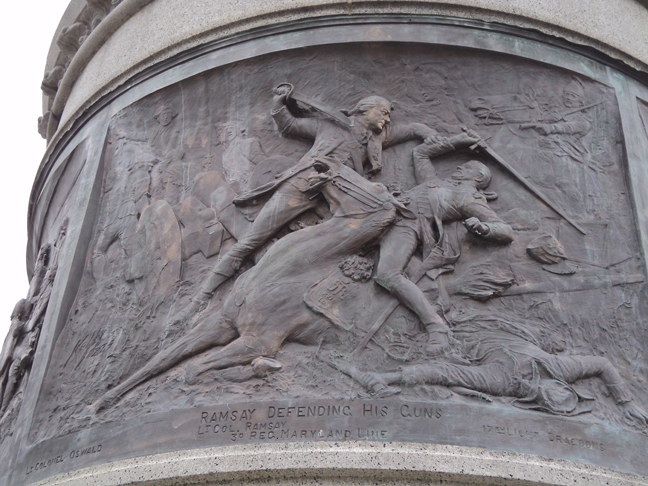
By the time Kelly started to sculpt the panels later in 1883-1884, the Ramsey scene was back in for reasons unknown. Kelly completed the panel in time for Harper’s Weekly magazine to feature an image of it in their November 15, 1884 issue. William S. Stryker, historian and adjutant-general of New Jersey, provided a description for each panel, including two that were not yet completed. Norman Leslie Coe, a New York photographer, took pictures of the three completed panels.[21] Fortunately for posterity, “Ramsay Defending His Guns” was one of the three bas reliefs captured by Coe in pristine condition, within months if not weeks of its completion.
The military artistry of the panel is extraordinary. Two figures dominate the foreground at the center of the panel. On the left side stands a fierce and determined Nathaniel Ramsey, with a prominent chin in profile and hair tied back in a queue, his short-bladed sword in his right hand prepared to deliver a death blow as he towers over his adversary with his left hand tightly gripping the forearm of his opponent to prevent him from swinging his saber toward Ramsey. Below the dominated dragoon is his fallen horse, eye widened in fright with an apparently dead soldier to the right of the grounded animal.
Much of this foreground scene is still visible on the panel today, although present in much coarser outlines and void of the detail present in the 1884 image. The background scene of the panel is much more faded today. It depicts two British soldiers, one on foot ahead of another on a horse—all in the upper right side of the panel—chasing a quintet of American artillerists attempting to hustle two cannons to safety in the upper left. According to Harper’s Weekly and published newspaper descriptions of what each panel depicts, Ramsey “tried with his gallant regiment to defend the guns of Lieutenant-Colonel Oswald, until, having become dismounted, he was overwhelmed by the superior numbers of the British dragoons.” The description identified the cannoneers in the background as the crew led by Oswald “directing the men in their attempt to carry off the guns.” The piece ended with a fictional reason for Ramsey’s release: “Sir Henry Clinton, in soldierly admiration of so brave a man, ordered his release on parole the following day.”[22]
At the time of its unveiling, the panels were praised for their dedication to accuracy, “at great expense and trouble.” For Ramsey’s image, his portrait was obtained from surviving family members residing in St. Louis to use as a model to sculpt him in bronze.[23] Notwithstanding the efforts, both the written description and the sculpture of the scene contain historical inaccuracies and misleading features. Ramsey’s defense was in the woods, yet no trees appear in the image. The attention paid to the hat and trappings specific to the 17th Light Dragoons was admirable, but in fact it was the 16th Light Dragoons that attacked Ramsey at Monmouth—not the 17th, who were not engaged that day. Oswald and his two guns briefly held a position on a low rise near the Wikoff house, 300 yards southwest of the woods and they did indeed pull away westward due to approaching Guards, Grenadiers, and Dragoons, before Wayne’s brief ambush of the British thrust. Washington personally placed Wayne and his battalions there to check the enemy advance long enough to establish a strong defense on Perrine’s Hill, not to protect cannons that were threatened as they faced southward from the jutting woods they occupied.
So, Ramsay was not “Defending His Guns” as the panel title suggests, or anyone’s guns for that matter, when British dragoons lit upon him. James Kelly originated the panel and was the one responsible for titling it. The sculptor mentioned in his memoirs that he “found a reference” by James McHenry about Ramsey’s role in the battle. The version that Kelly described appears nowhere in the reproduced McHenry accounts published in the Magazine of American History five years before he created the panel, nor in any retelling by other sources relying on McHenry’s version. A new and wildly fabricated version of Ramsey’s story documented by Kelly completely explains why his sculpture links Ramsey to cannons and why there is no hint to any battle in the woods––he apparently and erroneously placed this one-on-one scene at the ravine near the West Morass Bridge, 700 yards northwest of the actual fight in the Point of Woods:
[Washington] turned to Ramsey and ordered him with two guns, to sweep the narrow causeway, cross the swamp, and keep the British in check while he formed a new line of battle. This he did until the repeated charges of the British Dragoons wore on his men; Ramsey feared they would give way. Ordering the guns to the rear, dismounted, he stepped in the narrow pass all alone, closed on the advancing horsemen, and in the melee stalled the charge long enough to save his guns. Strange to say, although over-powered, he was unwounded. He was taken before the British General Howe who was so impressed with his action that he released Ramsey and sent him back next day with a letter to Washington commending his bravery.[24]
Incredibly, Kelly’s panel is based on fiction upon fiction—Ramsey was in charge of the guns and then stepped into a narrow pass? Unwounded? General Howe sent Washington a commendation letter?—yet the foreground of his image with a focus upon Ramsey and the dragoon somehow maintains the consistently repeated history conveyed by Ramsey to Otho Williams, James McHenry, and Charles Willson Peale.
The gripping display of heroism by Nathaniel Ramsey, cast in bronze, continues to fascinate most who gaze upon that particular panel. The disturbing degree of degradation in this and the rest of the bas relief panels suggests that James Kelly’s sculptures on the Monmouth Battle Monument will be far less appreciated two or three generations from now. Fortunately, the photographs appearing in an 1884 pictorial allow us to retain the visual appearance of a truly selfless deed, captured in a marvelous work of martial art.
[1] Charles Coleman Sellers, “Portraits and Miniatures by Charles Willson Peale,” Transactions of the American Philosophical Society, Volume 42, part 1 (1952), 176.
[2] Lillian B. Miller, ed., The Selected Papers of Charles Willson Peale, Volume 5, The Autobiography of Charles Willson Peale (Yale University Press, 2000), 125-126.
[3] Mark Edward Lender and Garry Wheeler Stone, Fatal Sunday: George Washington, the Monmouth Campaign, and the Politics of Battle (University of Oklahoma Press, 2016), 452.
[4] “Reminiscences from Dr. William Read, Arranged From His Notes and Papers,” in R. W. Gibbes, ed., Documentary History of the American Revolution (New York, NY: D. Appleton & Co., 1857), 258.
[5] For the numerical strength of the Englishtown force, see Appendix B in Gary Ecelbarger, George Washington’s Momentous Year: Twelve Months That Transformed the Revolution, Volume 2 (Yardley, PA: Westholme Publishing, 2025), 303-311.
[6] Anthony Wayne, Walter Stewart, John Laurens, and Robert H. Harrison, testimonies, in Proceedings of a General Court Martial … for the Trial of Major General Lee, Collections of the New-York Historical Society for the Year 1873, Vol. 6 (Printed for the Society, 1874), 22, 41, 53, 75,
[7] Ibid.; Anthony Wayne to his wife, July 1, 1778, Wayne Papers, Historical Society of Pennsylvania, Philadelphia; Thomas H. Montgomery, ed., “The Battle of Monmouth: Described by Dr. James McHenry, Secretary to General Washington,” The Magazine of American History, with Notes and Queries, Vol. 3, no. 6 (June 1879), 363; W. F. Brand, A Sketch in the Life and Character of Nathaniel Ramsay (Baltimore, MD: John Murohy & Co., 1887), 50.
[8] Lender and Stone, Fatal Sunday, 299-302.
[9] William S. Stryker and William Starr Myers, ed., The Battle of Monmouth (Princeton, NJ: Princeton University Press, 1927), 185-86, 296.
[10] James McHenry’s July 1, 1778, letter reproduced in Montgomery, “The Battle of Monmouth,” 357-360 (Ramsay description on page 359).
[11] Charles Willson Peale diary, October 30, 1778, in Lillian B. Miller, ed., The Selected Papers of Charles Willson Peale, Volume 1, Charles Willson Peale: Artist in Revolutionary America, 1735-1791 (Yale University Press, 1983), 295.
[12] Miller, The Selected Papers of Charles Willson Peale, Volume 5, 125-126.
[13] Ibid., 126.
[14] Ibid.
[15] Otho Williams to Philip Thomas, June 29, 1778, Williams Papers (MS 908), Maryland Historical Society, Baltimore.
[16] James McHenry’s July 1, 1778 letter reproduced in Montgomery, “The Battle of Monmouth,” 357-360 (Ramsay description on page 359).
[17] Miller, The Selected Papers of Charles Willson Peale, Volume 5, 126.
[18] “Nathaniel Ramsey (1741-1817), MSA SC 3520-1029, Archives of Maryland (Biographical Series), msa.maryland.gov/megafile/msa/speccol/sc3500/sc3520/001000/001029/html/01029bio.html; obituary reproduced in Brand, A Sketch in the Life and Character of Nathaniel Ramsay, 58.
[19] Montgomery, “The Battle of Monmouth,” 355-363.
[20] “Meeting of the Commission,” [Freehold] Monmouth Inquirer, July 5, 1883.
[21] William S. Stryker, “The Monmouth Battle Monument,” Harper’s Weekly Illustrated Newspaper, November 15, 1885.
[22] “Monmouth’s Battle. To Be Commemorated To-Morrow,” Trenton Evening Times, November 13, 1884.
[23] “Finishing the Monmouth Monument,” Monmouth Inquirer, September 24, 1885.
[24] Kelly memoir of “Ramsey Defending his Guns” in William B. Styple, ed., Generals in Bronze: Interviewing the Commanders of the Civil War (Kearny, NJ: Belle Grove Publishing Co., 2005), 94.

Recent Articles
Trade, Land, Speculation: William Kerin Constable in the Age of Revolution
David Steele’s Macabre Medal
The Loyalist Experience and Aftermath in Revolutionary Philadelphia
Recent Comments
"David Steele’s Macabre Medal"
Excellent article. Most interesting. Well done.
"La Petite Guerre and..."
This is a fascinating examination of the distinction between European *petite guerre*...
"James Wilson and Popular..."
Kelly – thanks for this contribution to the growing body of work...