



The 1781 defeat of British forces at Yorktown Virginia is often cited as the pivotal battle of the American Revolution, winning American independence. General George Washington with the support of French ground and naval forces under General Rochambeau and Admiral de Grasse, along with the expertise of French engineers, conducted a siege at Yorktown forcing the surrender of more than seven thousand British, German and Loyalist soldiers. While the story of the Yorktown campaign, including the maneuver from New York and the collaboration of the American–French alliance, has been superbly recorded by historians and interpreted by the National Park Service at Yorktown, the events and actions on the other side of the York River at Gloucester are lesser known.
Historians hate “what ifs.” But what if British general Charles Cornwallis had done what Washington did in 1776 at Brooklyn, New York, by crossing a river undetected at night, in order to fight another day. The events at Gloucester combined by the inability to timely plan and conduct an escape from Yorktown made the allied victory inevitable.
The Importance of Geography
To fully understand the Yorktown campaign, one must understand the geography that influenced the choices made by the American and British commanders. Yorktown by 1781 was a ghost town and a shadow of its former prosperity as a major trading port for both tobacco and enslaved people. Less than fifteen miles from the colonial capital of Williamsburg, Yorktown is situated on a cliff above a deep-water port on the York River. Opposite Yorktown is Gloucester Point, approximately 3,750 feet (about 7/10 of a mile) across the river, long recognized as an important military position. The town of Gloucester Courthouse lies approximately fourteen miles to the north.
The York River is a navigable saltwater estuary approximately thirty-four miles long flowing into the Chesapeake Bay. As an estuary, the flow and ebb of the tides influence transit, but it was deep enough for the biggest ships of the line and today is used by the U.S. Navy. Formed by two smaller freshwater rivers, the York River begins at West Point, which is twenty-five to thirty miles upstream where it is fresh water. Cornwallis, tasked with establishing a base of operations in the tidewater area of Virginia, chose Yorktown for several reasons, namely, it had easy access to the ocean, didn’t freeze in the winter, and most importantly, according to his staff, it was more defensible than Old Point Comfort, modern day Fort Monroe, or the other available choices in southeast Virginia.[1]

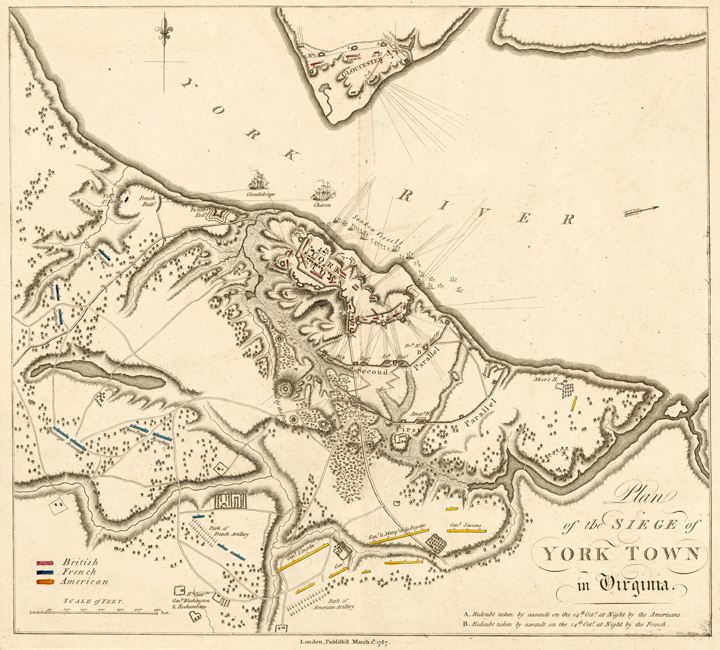
Based on his knowledge of the area and his recent experiences against British naval forces in New York, Washington was well aware of the danger of stationing forces at Yorktown and the difficulty of preventing transit by the British navy up the York River. Writing to the local Virginia militia leader Gen. Thomas Nelson, Washington cautioned:
I can by no means think it would be prudent to have any considerable stationary force at Hampton and York. These by being upon a narrow neck of land, would be in danger of being cut off. The enemy might very easily throw up a few ships into York and James’ river, as far as Queens Creek; and land a body of men there, who throwg up a few Redoubts, would intercept their retreat and oblige them to surrender at discretion.” [2]
Preventing the British navy from transiting the York River was, according to Washington, “scarcely possible . . . unless the Water is narrow—and there are an immense number of Heavy Cannon, near which they are obliged to run from the course of the Channel.”[3]
Cornwallis saw the advantages and disadvantages of the terrain differently based on his faith in the superiority of the British navy. While opposing the establishment of any stationary defensive positions in Virginia as ordered by his superior, Gen. Henry Clinton, Cornwallis assumed the Royal navy would rescue, resupply, or reinforce him as necessary, once adequate defenses were constructed at Yorktown. Cornwallis’s assumption would be proven wrong.

Meanwhile, the allies consolidated and moved their forces to Yorktown in the last days of September with officers and engineers reconnoitering the British lines around Yorktown. The allies had the right conditions to conduct a successful siege with favorable weather, adequate water and wood supplies, non-rocky soil for digging trenches, sufficient tools and labor, and a superiority of heavy siege guns and other artillery with an ample supply of ammunition. The only limitation Washington had according to siege practices of the day was that his force was supposed to be four times that of the besieged, especially for a final assault.[4]
While surprise and deception were often keys to a successful siege, in the case of Yorktown, Cornwallis was well informed of the allied approach but again placed his faith in receiving timely naval support as promised from British headquarters in New York. Furthermore, Cornwallis, an experienced soldier, was well aware that the French and Americans would attempt to close every possible means of escape. One of those escape routes was over the York River to Gloucester and beyond.
British Defensive Actions at Gloucester
Once Cornwallis made the decision to establish his main camp at Yorktown, he realized the importance of Gloucester in controlling shipping transiting the York River as well as preventing French ships from cannonading British positions. Also, the route across the river served as an escape route and a useful avenue for forging supplies for the main body at Yorktown. Lastly, as a minimum, the area had to be secured to prevent Continental or militia forces from establishing a base at Gloucester Point to operate against Yorktown.[5]
Preparing for an enemy attack required manpower to build fortifications and remove obstacles to fields of fire and observation, and the tools and materials to do so. Cornwallis had sufficient manpower, but given the heat, humidity and the exertions experienced by his soldiers during the campaigns that brought them to Yorktown, progress was slow. The British recruited enslaved people to help them construct the redoubts and positions necessary. On August 22, 1781, the entire British force arrived at Yorktown and work began.

Cornwallis first began digging fortification on the Gloucester side of the York River. As described by Lt. Col. Bansastre Tarleton:
Upon the arrival of the first division of the King’s troops, Earl Cornwallis gave directions to Lieutenant Sutherland, of the engineers, to trace out a chain of redoubts to cover Gloucester. This village is situated on a point of land on the north side of York river and consisted at that time of about a dozen houses. A marshy creek extends along part of the right flank: The ground is clear and level for a mile in front: At that distance stands a wood: The space which it occupies is narrowed by the river on the left, and a creek on the right: Beyond the gorge the country is open and cultivated.[6]
Prior to the arrival of Washington’s main force, Cornwallis dispatched the 80th Regiment and elements of a German regiment to begin building fortifications at Gloucester. Work was eventually completed, with four redoubts and number of artillery positions—three redoubts primarily covering the approaches from Gloucester, one covering the beach and the river. The bulk of the artillery of ten 18-pounders and one 12-pounder covered the river with two other batteries covering potential avenues of attack from enemy forces coming from Gloucester.[7]
While the infantry constructed fortifications, cavalry from Lt. Col. John Graves Simcoe’s Queen’s Rangers combed the north side of the York River towards Gloucester and beyond, collecting supplies and cattle for British use.
Lt. Col. Thomas Dundas of the 80th Regiment of Foot was appointed overall commander in Gloucester, with elements of the British Legion, the 17th Light Dragoons, Queen’s Rangers (cavalry and infantry, 23rd and 80th Regiments of Foot, German Jӓger Corps and North Carolina Loyalists under his command.[8] As the siege began around Yorktown, approximately a thousand British and Hessian soldiers were stationed at Gloucester Point.
Allied Situation at Gloucester
With the Marquis de Lafayette’s American soldiers shadowing Cornwallis’s forces in Virginia throughout the month of August 1781, the allies were aware of British movements although their overall intentions remained unclear. Writing to Washington on August 11, Lafayette noted, “Lord Cornwallis is Entrenching at York and Gloucester. The Sooner we Disturb Him the Better. But Unless our Maritme friends give us Help we Cannot much Venture Below.”[9] Washington received this intelligence on August 16, noting in his diary, “Letters from the Marqs. de la Fayette & others, inform that Lord Cornwallis with the Troops from Hampton Road, had proceeded up York River & landed at York & Gloucester Towns where they were throwing up Works on the 6th.”[10]
Initially opposing the British at Gloucester was a militia brigade under the command of the experienced Brig. Gen. George Weedon. Weedon wrote to Washington, “The first object that struck my attention on joining the Army was to circumscribe if possible the Enemies Foraging Parties.”[11] Weedon initially formed a legion of sixty militia cavalry and four hundred infantry, augmented by Lieutenant Colonel Mercer’s force of two hundred men—many former experienced Continental soldiers.
Washington, prior to his arriving in Williamsburg in mid-September, ordered Duc de Lauzun’s Volunteers, a French force consisting of three hundred light infantry and three hundred cavalry, to depart from the Head of Elk and join General Weedon’s command at Gloucester.[12] On September 29, General Rochambeau sent Brig. Gen. Gabriel de Choisy with eight hundred French marines to take command of the Gloucester force. Arriving on October 1, Choisy realized the militia had positioned themselves about fifteen miles from the British. Dismayed at this distant position, Choisy’s intent was to close the gap between his own and the British force as soon as possible.
Battle of the Hook
On October 3, British forces emerged from their defensive positions at Gloucester Point to forage for supplies. Lieutenant Colonel Dundas was leading the British foraging party and was about three miles north of Gloucester Point when the largest cavalry engagement of the Revolutionary war ensued. British soldiers escorting loaded wagons full of Indian corn back to their defensive positions were unexpectedly attacked by cavalrymen from Lauzun’s Legion at mid-morning. As recorded by Tarleton,
At this point of time, Brigadier-general de Choisy was moving down the road with a corps of cavalry and infantry, to sustain his people in front, and the English rear guard was forming at the edge of a wood upwards of a mile distant in fight of the skirmish upon the intermediate plain; when a dragoon’s horse of the British legion, plunged, on being struck with a spear by one of the hussars and overthrew Lieutenant-colonel Tarleton and his horse.[13]
Tarleton, although injured, escaped on another horse and when more militia arrived, he ordered a retreat. The Battle of the Hook was over by 2 p.m. While both sides suffered casualties, the significance of this battle was felt more by the British forces at Yorktown. As noted by historian J. Britt McCarley:
Shortly afterward Choisy’s troops arrayed themselves before Dundas’s earthworks and prepared to encamp to form a land blockade. In doing so, the allies completed their lines of circumvallation and contravallation as a precondition for the overall siege to start on both sides of the river. At last, Washington and Rochambeau could focus on opening the parallels and beginning the bombardment.[14]
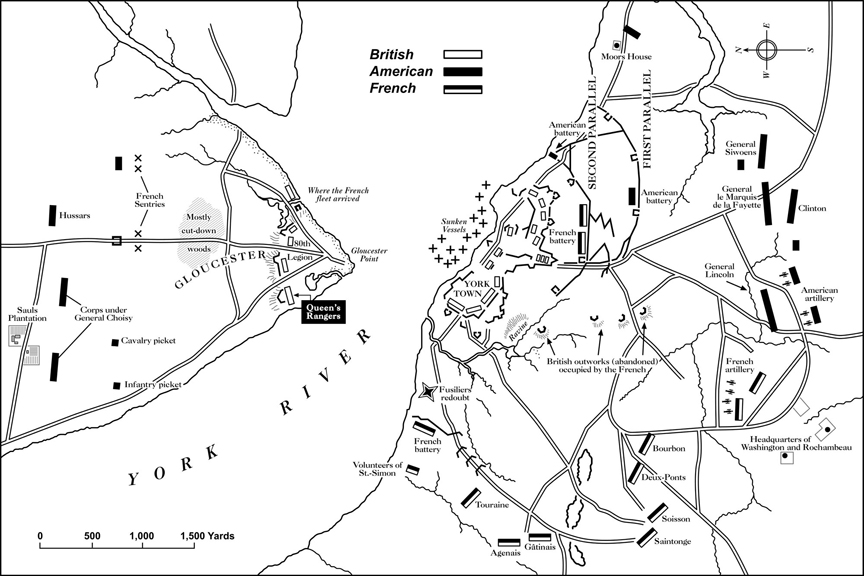
To prevent the British from using the York River to circumvent the allied positions, Weeden dispatched a militia battalion above Gloucester as a counter and to provide early warning. On October 4, the general order issued from Washington’s headquarters wrote:
The General Congratulates the Army upon the brilliant success of the Allied Troops near Gloucester—He requests the Duke de Lauzan to accept his particular thanks for the Judicious disposition and the decisive Vigour with which he charged the Enemy . . . the Enemy amounting to six hundred Horse and foot were compleatly repulsed and Reconducted to their very lines.[15]
At the end of the battle, British forces of about 1,100 were behind their defensive positions arrayed against a 2,900 man allied force.
Escape
From the beginning of the campaign, Washington knew the importance of Gloucester. He recognized it as a potential escape route for the British. Shortly after arriving in Williamsburg, Washington and other key leaders met with Admiral de Grasse aboard his flagship on September 17. Washington requested de Grasse place ships above Yorktown to deny the British use of the river for resupply and escape, but his request was refused.[16]
Washington again raised the issue of moving ships into the York River, writing to de Grasse on October 1:
I have only one proposition to submit to Your Excellency on the subject of naval dispositions—and the objects of it are too essential not to be exposed to Your Excellency in their fullest light—I mean the stationing two or three Ships above the Enemys posts on York R. for want of this only means of completing the investment of their works—the british remain masters of the navigation for 25 Miles distance above them, and have by their armed Vessels intercepted supplies of the greatest value on their way to our Camp—The loss is redoubled by diminishig our means and augmentg those of the enemy—at a most critical time.[17]
Again, Admiral de Grasse refused due to the danger to his ships, but Washington’s fears were well ground. For example, on October 10, French artillery prevented ten British boats from moving upstream.
With the failure of General Clinton in New York to mount a timely rescue, Cornwallis knew the completion of the allies’ second parallel entrenchment would spell disaster for his force. Meanwhile at Gloucester, things were also bleak with widespread sickness even striking Lieutenant Colonels Simcoe and Dundas, forcing Tarleton to take command. By October 14, Cornwallis was forced by allied artillery to move some of his wounded to Gloucester and positioned the few remaining ships and boats on that side of the river.
With the collapse of two redoubts near his inner defense line on October 14, Cornwallis realized the end was near; allied artillery pounded his meager defenses day and night. Under cover of darkness, on October 16, Cornwallis attempted a desperate effort to escape across the York River. His plan was to land sufficient troops to break through Choisy’s lines before daybreak and retreat to the Rappahannock River and points further north.
Using sixteen large boats, Cornwallis loaded his light infantry and part of the 23rd Regiment, but as other units attempted to cross a severe storm blew in, scattering the boats and making it impossible to continue. Forced to recognize the inevitable, Cornwallis ordered the attempted escape to stop, returning the force back to Yorktown. On October 17, Cornwallis proposed a ceasefire and sought terms for surrender from Washington.
Lieutenant Colonel Simcoe sought permission to escape, but Cornwallis denied his request. Simcoe and many of the loyalist members of the Queen’s Rangers later sailed after the formal surrender on the British ship Bonitta, thus escaping American retribution.[18] Cornwallis, as part of the surrender negotiation process, highlighted that the forces at Gloucester were still in their defensive position and were allowed to surrender with trumpets blaring and cavalry with swords displayed—an honor denied to the Yorktown defenders.
Failure to Visualize, Anticipate, and Plan
Throughout 1780–81 the relationship between the two general officers, Clinton and Cornwallis—senior and subordinate commander—was tense. Cornwallis had ignored Clinton’s instructions to confine his operations in the Carolinas and to protect Charlestown. Once Cornwallis moved to Virginia, Clinton ordered Cornwallis to establish a post at a defensible deep water port on the Virginia coast. While disagreeing with the order, Cornwallis complied. Once the allied force arrived, Cornwallis also was led to believe by Clinton that a rescue force would arrive in sufficient time.
Cornwallis, writing to Clinton the day after the surrender on October 20, stated that given the strength of the American and French forces, he “’would either have endeavoured to escape to New York . . . on the arrival of General Washington’s troops at Williamsburg, or I would, notwithstanding the disparity of numbers, have attacked them in the open field.” But “being assured by your Excellency’s letters that every possible means would be tried by the navy and army to relieve us, I could not think myself at liberty to venture on either of those desperate attempts.”[19]
Cornwallis, as an experienced soldier, should have understood the principles of siege warfare. He should have realized that once the first enemy parallel trench was completed, military doctrine held that either a counterattack or escape had to be launched before the opening of the second parallel in order to avoid almost certain defeat.[20] Students of military history may debate the question of whether an escape was feasible, but some like the noted historian of the battle, Charles E. Hatch, concluded, “Had he attempted it earlier, he might have succeeded.”[21]
Tarleton wrote that he advocated for a retreat prior to the completion of the second allied parallel. Stating his case, Tarleton felt that a rescue from New York was unlikely and with the crumbling British fortifications being pounded by superior allied artillery, escape to Gloucester was “honorable and judicious.”[22] Covered by the Yorktown cliffs and possessing adequate small boats, Tarleton estimated that 1,200 to 2,000 men at a time could quickly cross the river at night and once the crossing was complete they would burn the boats.
He further argued that the British forces at Gloucester were not under siege and the mixed allied forces of French and poorly trained militia presented no real obstacle. Tarleton argued that with sufficient provisions available, experienced and hardened soldiers who were used to marching long distances, along with the availability of horses to mount infantry and supplies, and the favorable autumn climate, could have enabled more than 3,500 soldiers to escape.
But what of the allies’ reaction? Tarleton estimated it would have taken the allies three days to react to the escape. He postulated they would most likely have divided their forces– one part following the escaping army; one part up the James, and one heading to Baltimore. The French navy would most likely leave the Chesapeake and return to the West Indies. Even if the British were stopped and forced to surrender after escape, “they would fall later and with increased reputation.”
Today, we can only speculate as to whether the British could have escaped, but it is certain that the flawed relationship between Clinton and Cornwallis lead to a failure of what today the U.S. Army calls “mission command.” The concept of mission command “empowers subordinate decision making and decentralized execution appropriate to the situation.”[23] In essence, mission command requires subordinate leaders to understand the intent of their commander and synchronize their forces in time, place, and purpose to accomplish the mission against a thinking and adaptive enemy.
In hindsight, blame for the British surrender at Yorktown rests with many including the two commanders, senior political leaders, and the British navy, but on the question of escape, Cornwallis owns the blame. He knew siege tactics and failed to plan for a potential escape until it was too late. He argued that he was following his higher commander’s intent in remaining at Yorktown until the promised support arrived. But, as the allies closed the noose around him, his argument is only believable if the Clinton’s intent was for Cornwallis to be encircled, destroyed, and forced to surrender. His failure to visualize, anticipate, plan and execute an escape across the York River made the allied victory inevitable.[24]
[1] While not a focus of this article, much of the controversy after the surrender was on the selection of Yorktown. General Clinton noted Yorktown was chosen by Cornwallis, while Cornwallis claimed he was directed to Yorktown by default given Clinton’s desire for a deep- water port capable of being defended with the forces available. For a detailed examination see Middleton, Richard. “The Clinton–Cornwallis Controversy and Responsibility for the British Surrender at Yorktown,” History, 98, (3) (July 2013): 370-389.
[2] “George Washington to Brigadier General Thomas Nelson, Jr., 2 September 1777,” Founders Online, National Archives, https://founders.archives.gov/documents/Washington/03-11-02-0129.
[3] “George Washington to Brigadier General Thomas Nelson, Jr., 2 September 1777,” Founders Online, National Archives, https://founders.archives.gov/documents/Washington/03-11-02-0129.
[4] Wright, John W. “Notes on the Siege of Yorktown with Special Reference to the Conduct of Siege in the Eighteenth Century, The William and Mary Quarterly 12, (4) (October 1932): 230.
[5] Hatch, Charles E. Jr. “Gloucester Point in the Siege of Yorktown 1781,” The William and Mary Quarterly Historical Magazine 20, (2) (April 1940): 268.
[6] Lieutenant-Colonel Tarleton,. A History of the Campaigns of 1780 and 1781 in the Southern Provinces of North America. (London: Cadell, 1787), 361-362.
[7] Hatch, 269.
[8] J. Britt McCarley. The War in Virginia 1781. (Washington D.C. Center of Military History, U.S. Army, 2025), 65.
[9] “To George Washington from Marie-Joseph-Paul-Yves-Roch-Gilbert du Motier, marquis de Lafayette,” 11 August 1781,” Founders Online, National Archives, https://founders.archives.gov/documents/Washington/99-01-02-06661.
[10] “Diary entry: 16 August 1781,” Founders Online, National Archives, https://founders.archives.gov/documents/Washington/01-03-02-0007-0004-0012.
[11] “To George Washington from George Weedon, 18 September 1781,” Founders Online, National Archives, https://founders.archives.gov/documents/Washington/99-01-02-06981.
[12] “History of Lauzun’s Legion | Volontaires-etrangers de Lauzun,” https://www.americanrevolution.org/history-of-the-volontaires-etrangers-de-lauzun/
[13] Tarleton, 377.
[14] McCarley, 67.
[15] “General Orders, 4 October 1781,” Founders Online, National Archives, https://founders.archives.gov/documents/Washington/99-01-02-07088.
[16] “Washington Diaries September 1781,” Founders Online, National Archives, https://founders.archives.gov/documents/Washington/01-03-02-0007-0005.
[17] “From George Washington to François-Joseph-Paul, comte de Grasse-Tilly, 1 October 1781,” Founders Online, National Archives, https://founders.archives.gov/documents/Washington/99-01-02-07064.
[18] Per the surrender terms, the British ship Bonitta was allowed to sail to New York without inspection enabling many of the Queens Rangers and others who would have been subject to civil penalty to escape American justice.
[19] Middleton, Richard. “The Clinton–Cornwallis Controversy and Responsibility for the British Surrender at Yorktown,” History , Vol. 98, (3) (July 2013): 381.
[20] McCarley, 65.
[21] Hatch, 279.
[22] Tarleton 349.
[23] Headquarters, Department of the Army. ADP 6-0 Mission Command: Command and Control of Army Forces, July 2019, 1-3.
https://armypubs.army.mil/epubs/DR_pubs/DR_a/ARN34403-ADP_6-0-000-WEB-3.pdf
[24] The author would like to thank Robert Kelly Gloucester’s Historic Resources Supervisor for his review and providing materials to support this article.


5 Comments
Advised by Benedict Arnold, Clinton clarified his order to Cornwallis to place his winter quarters in Portsmouth VA. They were quite sure that Portsmouth was safe from serious attack by the Americans and the French. Cornwallis, a friend of the King, was sure that he would not be punished for disobeying orders. Perhaps he thought the night-life at Yorktown was superior to that at Portsmouth (he did go to Portsmouth to take a look at it). It is highly likely that if Cornwallis had selected Portsmouth instead of Yorktown his forces would have survived the winter intact, and he could have pacified Virginia in 1782 to the point of signing a treaty with Virginia, and the rest of America would have been forced to follow suit.
There is amassive study on events on the Gloucester side of the York River on the website of Gloucester County which seems to have escaped Mr. Marsella. It consists of about 180 pages of text, dozens of maps and photographs and a second volume with almost 400 pages of American, French and British primary sources.
‘“No Regular Corps could have maintained its Ground more firmly.” Site Documentation and Preservation Plan for the Battle of the Hook, October 3, 1781. American Battlefield Protection Program Grant prepared for Gloucester Parks, Recreation and Tourism by Wade P. Catts, RPA, Robert A. Selig, Ph.D., Lt. Col. Lewis H. Burruss (ret.), and Kevin Bradley, RPA (Newark, DE: South River Heritage Consulting LLC, 2021).
https://www.gloucesterva.info/1352/Battle-of-the-Hook
Thanks for an interesting article! A number of books and articles on the siege at Yorktown note that Cornwallis had an expectation that Clinton would arrive with a relief force from New York. Would you care to comment on the units Clinton did, or could have, embarked for the relief force and where they might have landed? I think this could lead to an interesting what-if discussion or war game. Thanks.
Good article overall. There’s one statement I question: “The French navy would most likely leave the Chesapeake and return to the West Indies.” Is there contemporary evidence to support that?
Author’s Response:
I appreciate those who read and commented on the article. In researching the article, I was provided the extensive work cited by Mr. Bob Selig (one of the authors) and do recommend it for those interested in the Battle of the Hook.
While the engagement was reported to Washington, Rochambeau and Cornwallis, it wasn’t apparent that it influenced Cornwallis’s tactical and operational calculus to escape. Tarleton in his journal dismissed the abilities of the allied forces defending Gloucester Courthouse. Furthermore, Tarleton carefully considered the allied response to the British crossing the York to include assessing the French fleet would not have remained in the Chesapeake given the priority to protect French interests in the Caribbean.
I do agree, as a former Army wargamer, it would be an interesting exercise as to whether Cornwallis’s escape would have been successful but given the state of readiness of the British Navy and the apparent complicated command decision making process in New York, I suspect it would have made success problematic.