

William Penn founded the Province of Pennsylvania to be a haven for the Religious Society of Friends, “The People Called Quakers” as they described themselves. The new colony was intended as a “holy experiment,” an example to the world that people could govern themselves according to principles of truth, peace and harmony.[1] Friends’ dissenter religion had suffered persecution in the British Isles because of its demonstrative assertion of moral principles and its adherents’ refusal to cooperate with what they saw as “worldly” behaviors. Their scrupulous comportment—the rejection of conventional modes of dress, refusal to doff their hats to social superiors, insistence on addressing all people as equals, their repudiation of tithing to the Anglican Church, and especially their refusal to support war in any way—angered their neighbors. Especially infuriating was the way Friends defiantly confronted the agents of government, disputing their morality when they attempted to enforce any dictate of the state which they saw as sinful.
Finding refuge in Pennsylvania, for the better part of a century Friends were able to govern themselves and their community according to their strict moral code. The “experiment,” as it turned out, proved to be quite profitable. Possessed of abundant and fertile land, the colony grew under benevolent and honest Quaker guidance into an economic powerhouse. Their policy of religious toleration attracted so many non-Quakers that the Friends eventually found themselves in the minority, surrounded by people who did not share their religious principles.
Though the reins of political power had gradually slipped from their hands, Quakers still wielded strong social and economic influence. They continued, whenever possible, to assert the moral superiority of their religious views to those who had usurped control over what they still viewed as their own colony. During the latter part of the eighteenth century, Pennsylvania’s Friends viewed the move toward American political independence with increasing alarm. As much as Philadelphia’s Quaker establishment wished to remain apart from the fray, the American Revolution had a way of intruding on their peaceable intentions. Shortly after the Continental Congress’s declaration of independence from Great Britain, the Quakers’ testimony against war was challenged directly and forcibly by elements of the country’s new government.

By the spring of 1776, a military confrontation was brewing around Manhattan, as the British targeted the port city for subjugation. On June 3, at the request of George Washington, the Continental Congress authorized a strategic reserve of mobile troops, known as the Flying Camp, to be raised from the middle colonies.[2] Soon troops from Pennsylvania, Delaware and Maryland began streaming northward on their way to join the army near New York. Maryland’s Council of Safety directed Col. William Smallwood’s Battalion to sail from Annapolis up the Chesapeake to the Head of Elk, then to march on to Philadelphia, where they would be provisioned and sent along to the Jersies.[3] Congress realized that the capital could become a choke point, jammed with soldiers needing transportation upriver to Trenton, so they directed most of Pennsylvania’s militia to march for Trenton or New Brunswick. On July 8, they elected Philadelphian Clement Biddle to the post of deputy quartermaster general for the Flying Camp to handle the logistics.[4]
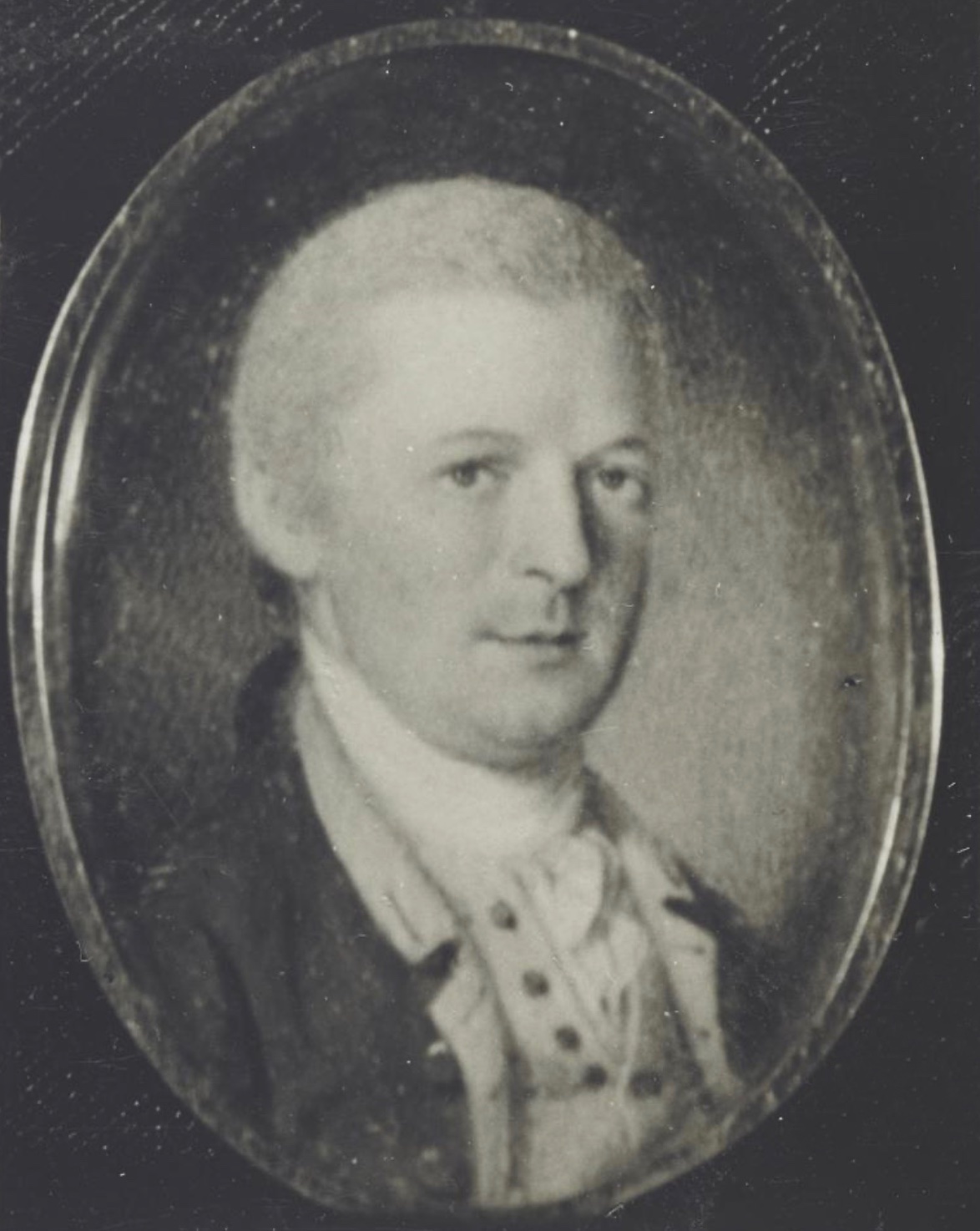
Clement Biddle was a Philadelphia merchant who dealt in both foreign imports and intercolonial trade. Though a practicing Quaker, he became an active revolutionary, and, having joined a militia unit, was disowned by the Society of Friends in March, 1776 for “engaging in training & military service.”[5] Biddle had his hands full outfitting the troops mustering at Philadelphia, providing them with tents, military accoutrements and food. Soldiers were put up in many of the city’s public buildings, such as the Philadelphia Barracks and the College of Philadelphia, till transport up the Delaware could be arranged.[6] Anticipating the arrival of the Marylanders in Philadelphia, Congress authorized Biddle to arrange to quarter the troops in “some house of public worship to cover the troops during their short stay in this city” until they could be sent onward.[7] Biddle directed his assistants to “apply for & obtain the Keys of the Presbyterian Meeting House & Friends Meeting House both in Market Street, & there Quarter the Troops which will arrive here this Evening or Tomorrow”. Biddle did not single out the Quakers out of vindictiveness, but rather made clear the extraordinary nature of the American government’s demand by further instructing his subordinates, “when Necessity requires your making use of places of Worship that you take them in turns without partiality, & Only when the service absolutely requires it Charging the Troops to refrain from damaging the Buildings in any way whatsoever.”[8]
As might be expected given Friends’ strong opposition to warlike enterprises, obtaining entry to the Friends’ meetinghouse turned out to be a difficult proposition. When Biddle and Howell personally visited an influential Friend to notify the Meeting of the order for quartering, “The Friend let him know that if he did quarter any troops in our Meeting House it would be taken very unkind.” Asking for the keys, Biddle “was informed that Friends could not deliver the keys and if he used it for that purpose he must take it by force or break it open.”[9]
On Tuesday, July 16—Third Day in the parlance of Quakers, who refused to accept the names of pagan gods for days of the week—the Marylanders crossed the Schuylkill River and marched into Philadelphia en masse. John Adlum, a young York County militiaman, saw them: 1,100 fine-looking soldiers uniformly attired as they trudged up Market Street. Adlum watched as the troops halted a while in front of the Friends’ meetinghouse, “owing to a delicacy on the part of the officers, seeing they were about to be quartered in a place of worship.”[10] Finally, the officers moved to the door, ordered the men to take up their muskets, then stood with their hats off while the men filed into the building.

Next day, the Friends leadership got together, ostensibly to investigate whether some member had let the soldiers into the meetinghouse, but found that the gates had been broken open. Deliberating how they should confront this provocation, “after sometime of conversation it was agreed to be most consistent with our Christian Privileges and the Testimony of Truth to endeavour to hold our Meeting at the usual place unless by force prevents.” Accordingly, they sent three Friends to inform Colonel Smallwood politely that they intended to hold their meeting for worship there the next morning “not being easy to hold it at any other place.”[11]
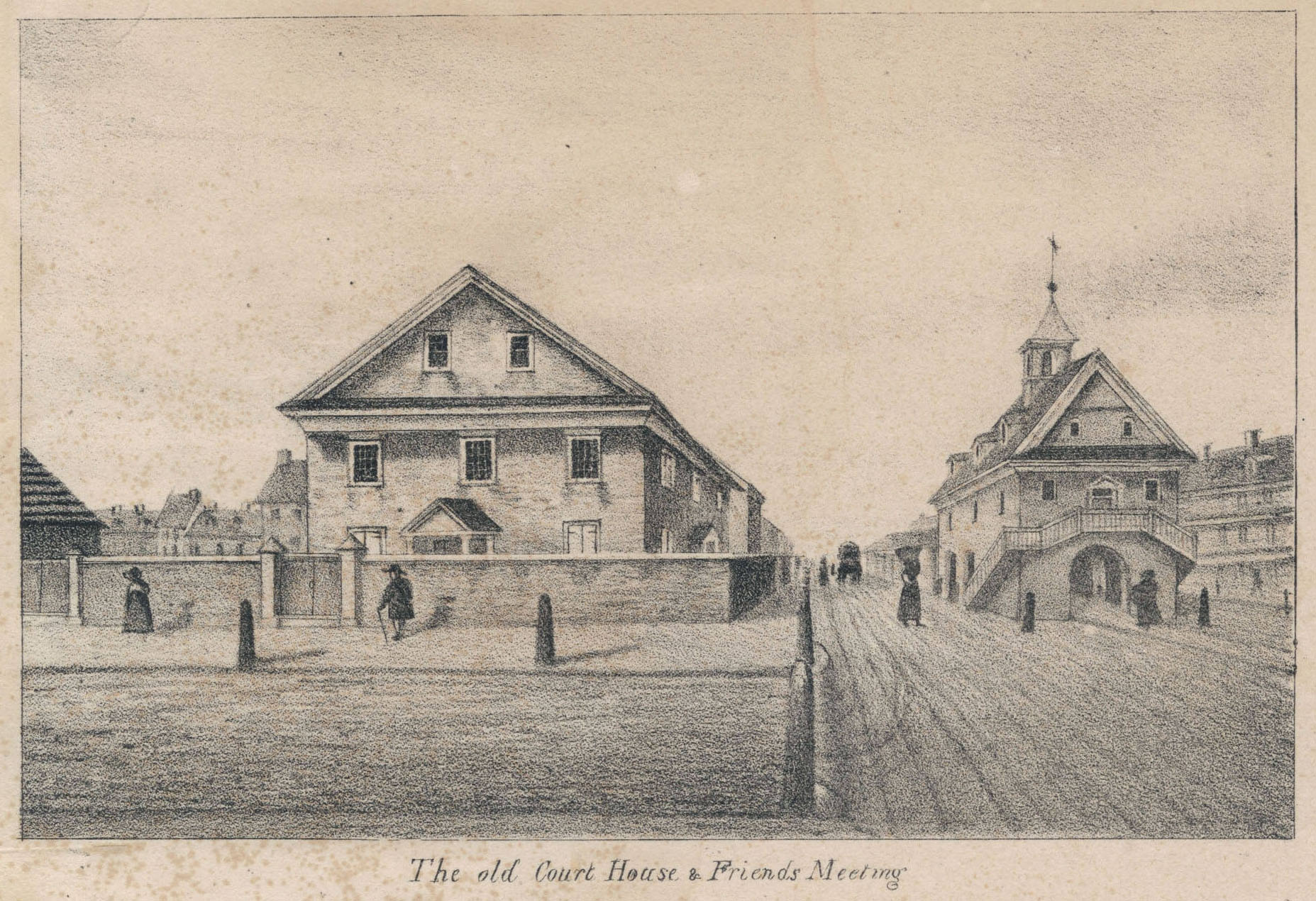
Smallwood “received them very civilly”, explaining apologetically that he had not been happy about forcing the gates, but had done so at the direction of the quarter master and insisting that he had no desire to interfere with people’s “religious duty.” He said he would order the soldiers away early next morning, so the Friends could use the meetinghouse for worship. The Friends “then told him if his soldiers were inclined to be at Meeting with us we thought there might be room for them, but desired they should be enjoined to behave in a manner becoming the solemnity of the occasion on which we met.” In the event, a few soldiers actually did attend, whether out of piety or curiosity, “behaving as well as we could expect.”[12]
From their earliest days, Friends patiently recorded the outrages they found themselves subjected to—their “sufferings,” in Quaker jargon—but they were never known to suffer in silence. Rather, they publicly protested their injuries, often loudly and longly. Complaints about this new affront to their religious principles soon reached the ears of Congress, which did its best to speed things along, ordering the Marylanders to leave the city quickly, resolving on the 17th “That colonel Smallwood from Maryland be ordered to repair as soon as possible with the troops under his command to New-York.”[13] But for some reason, the troops lingered at the meetinghouse.
Two days later, a frustrated Congress tried nudging the soldiers again, resolving this time “That the delegates of Maryland be directed to inform the commanding officer of the Maryland troops, that Congress expect he will immediately march with his troops to New York.”[14] Finally, on Saturday the 20th, the cause of the delay became evident: the troops needed supplies. Congress now ordered, “That the deputy quarter-master general for the flying camp, be directed to deliver to colonel Smallwood, for the use of the Maryland troops, such necessaries in his possession, belonging to the continent, as the said troops may want.”[15] This command being fulfilled, the Marylanders headed north the very next morning, just in time to clear the premises before the Quakers’ First Day (Sunday) meeting for worship. That day, Christopher Marshall, who periodically visited Philadelphia’s wharves to watch the soldiers going northward, saw “twelve shallop loads of the troops from Maryland, with fair wind and tide for the Jersey.”[16] Arrived in New York by the end of July, the Marylanders performed valiantly at the Battle of Brooklyn the following month, where scores of them were killed and wounded.[17] Later, when the regiment saw action at White Plains, Colonel Smallwood was himself wounded twice, but kept the field throughout the fight.[18]


In the aftermath, four Quaker leaders were directed to conduct an inquiry to determine exactly how the soldiers had “obtained possession” of the meetinghouse. Their report laid the blame on the former Friends, Clement Biddle and John Ladd Howell, and, as no damage had been done, there the matter rested. But Pennsylvania’s revolutionaries were not soon to forgive Quaker intransigence. The following year, through the publication of a set of scurrilous documents known as “the Spanktown Papers,” the Quaker establishment was accused of actively aiding and abetting the British army.[19] As a result, several prominent Quakers were banished to Virginia, including James Pemberton, one of the four leaders who inquired into the opening of the meetinghouse, and Owen Jones, Jr., whose father had also been part of the “enquiry.” Though not selected for exile, the other two men, Hugh Roberts and Quaker educator Anthony Benezet, were placed on the young state’s “hostiles list.”[20] Many of these so-called hostiles were later accused of treason, jailed, had their properties confiscated, and in two cases were actually executed. In after years, as revolutionary fervor dimmed, Friends once again took their places as valued members of the new society. Left with a favorable impression of William Smallwood, some Friends believed that he had actually tried to intervene on their behalf by investigating and dismissing the Spanktown Papers as fraudulent.[21] Quakers felt that they had found in Smallwood, if not a Friend, at least a friendly man of honor who respected their faith and religious principles.
[1] William Penn to James Harrison, August 25, 1681, quoted in Edwin B. Bronner, William Penn’s Holy Experiment; the Founding of Pennsylvania, 1681-1701 (New York: Temple University Publications, 1962), 6n1.
[2] Journals of Congress Containing the Proceedings from January 1, 1776, to January 1, 1777, Volume II (JCC) (Yorktown, Pennsylvania: John Dunlap, 1778), 198.
[3] Journal and Correspondence of the Maryland Council of Safety, Volume 12, July 7, 1776.
msa.maryland.gov/megafile/msa/speccol/sc2900/sc2908/000001/000012/html/am12–5.html.
[4] JCC, 253.
[5] This was Biddle’s second disownment. He had been disciplined in 1773 for “disorderly conduct &c.” and had been successfully reinstated by acknowledging his errors the following year. Whitfield J. Bell, Jr., Patriot-Improvers: Biographical Sketches of Members of the American Philosophical Society, Volume One (Philadelphia: American Philosophical Society, 1997), 322-323.
[6] Christopher Marshall, Extracts from the Diary of Christopher Marshall, Kept in Philadelphia and Lancaster, during the American Revolution, 1774–1781, ed. William Duane (Albany: Joel Munsell, 1877), 1776, 84-85. Constructed during the Seven Years War, the Philadelphia Barracks were located between Second and Third Streets north of Callowhill. The College of Philadelphia was on the southwest corner of Fourth and Mulberry (today’s Arch) Streets.
[7] JCC, 265.
[8] Clement Biddle to Gustavus Risberg and John Ladd Howell, July 14, 1776, quoted in Frances Howell, The Book of John Howell and His Descendants, with Supplementary Accounts of the Families Related to Them by Marriage, Volume I (New York: Frances Howell, 1897), 125.
[9] US Quaker Meeting Records, Philadelphia Yearly Meeting Minutes (PYMM), 398-400.
[10] National Intelligencer, October 12, 1833, 4. Adlum’s account, published fifty-seven years after the event, says the Marylanders occupied the Friends’ small, dilapidated Bank Street meetinghouse, which was located on Front Street, north of Mulberry. But contemporary Quaker Meeting Minutes clearly state that the meetinghouse in question was their capacious main building on the southwest corner of Second and Market Streets. PYMM, 399.
[11] PYMM, 399-400.
[12] PYMM, 400.
[13] JCC, 271.
[14] JCC, 275.
[15] JCC, 277.
[16] Marshall, Extracts from the Diary, 85.
[17] Patrick K. O’Donnell, Washington’s Immortals: The Untold Story of an Elite Regiment Who Changed the Course of the Revolution (New York: Atlantic Monthly Press, 2016), 67-71.
[18] “Extract of a Letter from White-Plains,” October 28, 1776, American Archives, series 5, vol. 2, 1271.
[19] Spanktown Papers: General John Sullivan to John Hancock, August 25, 1777, in Letters and Papers of Major-General John Sullivan, Continental Army, Volume One, Otis G. Hamilton, ed. (Concord, NH: New Hampshire Historical Society, 1930), 443-444. Dunlap’s Pennsylvania Packet, September 9, 1777, 3.
[20] Hostiles List: see Norman E. Donoghue, Prisoners of Congress: Philadelphia’s Quakers in Exile, 1777-1778 (University Park: The Pennsylvania State University Press, 2023) xvii-xviii, 28-29, 101.
[21] John Drinker, “A Short Vindication of the Religious Society Called Quakers,” Pennsylvania Packet, September 2, 1780, 1.

Recent Articles
Trade, Land, Speculation: William Kerin Constable in the Age of Revolution
David Steele’s Macabre Medal
The Loyalist Experience and Aftermath in Revolutionary Philadelphia
Recent Comments
"The Battle of Burke..."
With relationship to Waynesboro, GA, 2026, where was the Burke County Jail...
"James Wilson and Popular..."
Hey Eugene, I couldn’t agree more! I agree with much of your...
"David Steele’s Macabre Medal"
Excellent article. Most interesting. Well done.