



Recently returned from imprisonment in England, respected Capt. John Manley succeeded Samuel Nicholson in command of the Continental Navy frigate formerly known as Deane and recently renamed Hague on September 16, 1782. All of the vessel’s principal officers returned to service under Captain Manley including: 1st Lt. Benjamin Page, 2nd Lt. Arthur Dillaway, Sailing Master Robert McCaver, Capt. of Marines Elijah Smith, 1st Lt. of Marines Jeremiah Reed and 2nd Lt. of Marines William Waterman; as well as wardroom officers Surgeon Pierre St. Medard and Chaplain George Richards.[1] Reunited on a familiar ship with new name, all stood present for Manley’s introductory address to the frigate’s “Gentlemen” officers and “Good Lads and Jolly Seamen” prior to Hague sailing from Boston on September 25.[2]
Riding at anchor in Nantasket Road until October 10, the frigate “Made our Departure” bound for the West Indies in company with two French ships-of-the-line, two brigs, one small ship and two sloops.[3] Two days out Hague “made to the Southward,” reporting two days later “Part of the fleet (remained) in Sight.” The frigate “Entr’d the Gulph Stream” on October 15 greeted “with Black flying Clouds” precursing “a Heavy Gale of wind & Heavy Showers of Rain & Large Swells.”
Little of note occurred over the following week except one chase abandoned due to darkness on the seventeenth and on October 23, a “Hard Gale & Rain” with increasing winds which required the crew to house all guns for the night. Surgeon’s mate Silas Barnard recorded a violent storm about the latitude of Bermuda on Friday October 25, when Hague “Lost Fore Top mast Overboard with the Loss of One man overboard And five wounded with a fall from the Top. All hands Imployed in Getting in the Rigging and Refitting of T.M. [Top Mast].”[4] Captain of Marines Smith fell from the top gallant yard by which he severely broke his leg.[5] In addition, Hague “Lost her main Stay, Sprung her Mizzen mast” and “Lost her Mizzen Boom. But after the Rage of the Sea was Abated we Soon per Her in Order fit for Sailing.”[6]
The following Sunday, Hague’s men “Spy’d a Strange Sail . . . of three masts” and at three o’clock in the afternoon “Gave her A bow Gun” which was returned before “She Lay too.” Manley found the vessel to be one of the ships which sailed from Boston Harbor accompanying the Hague. On Wednesday October 30, while seemingly chasing her tail, the frigate met up yet again with the same ship from Boston.[7]

Hague’s first prize was taken on November 11, a “Brigg from Scotland.”[8] Frigate Hague “gave chace” almost daily to “Strange” sails including a sixteen-gun ship flying under Spanish colors on Saturday November 16, one hoisting Danish colors on the following day and a Portuguese vessel bound from Lisbon to St. Thomas on Wednesday November 20.[9]
Many of Hague’s days at sea passed uneventfully, Dr. Barnard frequently noting “No remarkable seen this Day” or “Nothing particular this Day.” In the fourteen days between November 11 and November 25, Hague steered a course to Antigua “Where we run within Two Gun Shotts of the Land of their Own harbor And Took out One brigg And One Sloop in plain Sight of the harbor.”[10] Barnard’s entry of November 26 reveals that Hague’s crew awakened on that Saturday morning to “Some Squall of Rain in Company the Prize Ship Taken Yesterday in Sight of St. Kitts and Statia.” On the following day, while just three leagues off St. Kitts and still in sight of Statia and Monserrat, Hague parted company with her latest prize sent into St. Pierre at Martinique. The frigate briefly pursued a “Very Large Ship” flying Danish colors initially appearing to threaten Hague’s prize.
On Monday November 28, at six in the morning, Hague sighted a “Brigg to the Windward of Us” and gave chace until three in the afternoon. Then “being in Sight of Angilla And St. Martin,” her officers and men “Lost sight of Our prize Ship.”
At four o’clock in the morning of Tuesday November 29, Hague’s watch officers “Spy’d a Large Ship Close a Board of Us” and “Immediately Call’d all hands To Clear Decks and prepare for Action, Expecting it was Not for long before we Should Engage.” Coming nearer, they “Saw her to be a frigate but Spoke to her But She Not proceeding to give Any intelligence Who she was or where she was from—We Finally Gave her a Shot.” Showing Danish colors in the early morning light, the vessel finally “Lay too for Us” and after boarding and interrogation of her commander, Captain Manley “Could not find any thing that would Condemn her—gave her a Discharge” and “Left her a Stern.” By noon, Hague had given a second potential prize flying Danish colors “her Liberty” before pursuing an unsuccessful chace of a third. The day ended with Hague’s men witnessing “a sail a Stern of Us Giving Chace” to which they responded with “as much Speed as possible” until both vessels “Lost Light.”

The following day, Hague again “Spy’d a Sail ahead of Us . . . They some time giving Chace to Us.” Turning the table, her crew “made sail And gave Chace to the other,” coming up on the brig and giving her a shot. “An officer went On board of her” but “Didn’t find Anything to Condemn her, She being bound to a port in Europe.” They parted with the vessel at six o’clock in the evening of November 30.[11]
Prior to making port at St. Pierre on December 12, 1782, Manley’s officers and men of the Hague took four prizes in total including brigs Eliza and Jane and sloop Christiana, all libeled at Martinique.[12] Hague’s fourth prize taken just four days earlier, brig Maria Theresa, was sent to New Hampshire for libel after an initial hearing before the Admiralty Court at Martinique. The 130-ton brigantine conveying a cargo of sugar, cotton, coffee and cocoa had initially sailed on a homeward bound voyage to France from St. Pierre on December 5 under Capt. Price Fremont. Owned by merchants in Marseilles, the vessel was taken three days later between Antigua and Monserrat by the eight-gun English privateer brig Quaker sailing out of Antigua under the command of William Evans. First sighted at ten o’clock at night on December 7, Maria Theresa made a course to leeward of St. Bart’s but was unable to shake the pursuing Quaker. About three o’clock in the morning of Sunday December 8, the privateer fired three shots and shadowed Maria Theresa until daybreak when the French merchantman struck her colors. The English privateer had no sooner seized her papers, crew and master and placed prize-master William Barre with ten men on board when the frigate Hague bore down on the scene. Quaker “made off immediately & left her prize, which was retaken at half past eleven of the same morning.” The French vessel’s lieutenant Anthony Perraut and mate Stephen Allies were both retaken with the brig, as well as a woman passenger who was also left on board. Manley appointed Hague’s Master’s mate Henry Wellstead Jackson of Boston as Maria Theresa’s prize master with instructions to sail her to Portsmouth. Among Jackson’s prize crew were Hague’s Peter Fremio and Alexis Bremont, both deponents in Maria Theresa’s libel case, along with Quaker mariner John Brady of New Castle on Tyne.[13]
Writing home upon Hague’s arrival at St. Pierre on December 14, 1782, Surgeon’s mate Silas Barnard observed “Nigh 200 Sail in the Harbor at this time, the greater part of them Trading Vessels.” Barnard also revealed Manley’s intentions: “We Expect Not to Tarry in this port More than Ten Days. Take in Provisions for Six weeks Cruise And Make this Port Again. Give the Ship a new Bottom then Repair to Boston.” The doctor added that Hague’s complement was “Very healthy now On board—But four Sick, Lost Two By Sickness.”[14]
On December 26, the day after Christmas, Hague sailed from Martinique on a cruise in company with the privateer ship Grand Turk under Capt. Joseph Pratt of Salem and ship Hunter from New London under Capt. King Sage.[15] On New Years Day 1783, the American frigate captured the 340-ton British twenty gun privateer Baillie under the command of Capt. William Paxton, and her 1,800 barrels of provisions consisting of pork, beef, flour, bread, porter, etc. The vessel was sailing from St. Lucia bound to St. Martins when taken.[16] According to Peter Powers, Hague “exchanged about 8 broad sides with the Bailiff . . . before she struck to us.”[17] Marine Oliver Holden testified he was placed on the Baillie under prize master Captain Daniels, a volunteer serving on Hague, with mates Isaiah Audeburt and Luther Dana.[18] The prize crew sailed Baillie into Boston, arriving on Wednesday January 29, 1783. Her cargo was sold at auction on Tileston’s Wharf on February 21, Baillie’s libel trial scheduled for March 25. The case was prosecuted by New England’s Deputy Continental Agent Thomas Russell on behalf of Captain Manley and Hague’s “agents to the officers, marines & mariners” Andrew Johonot and Francis Mulligan. The libel proceeding was subsequently postponed to April 15 and on following day, the jury decided the proceeds of the sale of the ship and appurtenances were to be “equally divided between the United States and the captors.” Interestingly the case was reheard in the Court of Appeals at Philadelphia on May 13 with a June 20, 1783 decree affirming the earlier adjudication.[19]

About 300 miles east of Antigua on the morning of Thursday January 9, 1783, the frigate Hague was spied by the forty-four gun British frigate Dolphin. The following morning after passing by the island of Desirade, the Dolphin was joined in the chase by four seventy-four-gun vessels belonging to the British Leeward Islands fleet: Hercules, Conqueror, Fame and Royal Oak. Making for the safety of French forts at Guadeloupe, Hague fired her stern-chaser at the approaching enemy before running aground on a sand bar in the gap between two offshore reefs at Baie Mahault.
On Saturday January 11 about noon, Hercules’ Capt. Henry Savage got his warship within a half mile and commenced bombarding Hague, and was soon joined by Dolphin. Both fit springs—lines that prevented the ships from turning as winds and tides changed—on their anchor cables, allowing them to keep their guns pointed at their target. A merciless attack continued until five o’clock the following morning when Dolphin attempted to warp closer to Hague, while Hague employed the same technique utilizing small boats to maneuver her anchor to kedge the American frigate closer to the safety of French guns. After grounding and attempting two assaults by boarding parties, Dolphin abandoned her pursuit and began inching back out to deep water. Both Dolphin and Hercules continued their unrelenting cannonade until eleven o’clock on the morning of January 13, when they sailed off to rejoin the British fleet.[20] Manley summed up the engagement:
I have been drove on shore, after a thirty-six hrs chase, by a 50 gun ship, and lay at the mercy of her incessant fire for two days; who, with the assistance of a seventy-four and two other sail of the line to back her, were not sparing of a heavy and brisk cannonade; however, without a man killed, and only one slightly wounded.[21]
A newspaper account of the action published on the occasion of Manley’s death, corroborates several reports in the pension records of Hague’s crewmembers:
The second day, they threw out their boats, and manned them with marines and sailors, to the amount of two or three hundred. At a signal they formed the line, and rowed rapidly on for boarding. A French flag had hitherto been flying, in order to interest the islanders in his fate, and the guns were so completely housed, that the British possibly supposed her to be a large letter of marque. Captain Manley having allowed the boats to range up within fair shot, brought his guns to bear on a side, and poured upon the boats a most deadly fire. They returned in confusion, attended with some loss, and ever after contented themselves on board their own ships.[22]
Peter Wakefield’s pension testimony indicates British parties “attempted twice to board the Hague and were repulsed . . . They attempted twice to Board with 15 Boats at each time—which were beaten off with great loss.” Wakefield added that Hague’s crew “then lightened the Ship—& by the help of boats from the Island got out of the reach of the Enemy.”[23] Hague mariner Peter Powers recollected the enemy
played upon us for a time, but could not approach near enough to do us essential injury, having thrown over all our guns except eight, to lighten our ship, we were enabled to proceed beyond the reach of the enemy’s guns from their heavy ships. Then they approached us in their boats, which we were successful in beating off with our 8 guns loaded with chain shot . . . finally we had the good fortune to get out of the mud and arrived safely in Town.[24]
Another report indicated that French “allies rendered every assistance in their power, and the officers of Baie Mahaut, in particular, merit every commendation, as they came off to the frigate, through the fire of 100 pieces of heavy artillery, which for above an hour, was directed at their open boats.”[25] A letter penned by governor of Guadeloupe, Viscount de Damas, after the engagement acknowledges Manley’s January 13 request “for eight or ten cannon, English nines” to replace those thrown overboard.[26]
On the following day and fourth since her detection, Hague was floated, towed off the reef and taken down the Salt River about ten or twelve miles for repairs.[27] Before making their escape, Hague’s crew fired a defiant thirteen-gun “continental salute,” said to have been feebly answered by the enemy in “cutting up all the fishing nets, and burning the huts of a few poor fellows, who cured their fish, on the adjacent islands.”[28] Governor Damas commended Captain Manley for his actions in the engagement:
it was with the greatest pleasure I heard of your good conduct, courage and bravery, that you shewed in defending a frigate trusted to your care. You have perfectly fulfilled the duty of a brave officer, and it is with the utmost satisfaction that I pay this tribute to your valour.[29]
During the second half of January 1783, the journal of Surgeon’s mate Silas Barnard reveals a preoccupation with the roll of men sick onboard the Hague. Five were reported sick on January 17 and while eight were returned to the vessel from Pointe-a-Pitre’s hospital on the following day, a total of ten were also numbered as sick on board. Eight were recorded sick the next day and ten noted as “remaining unfit for duty” on January 20 when Dr. Barnard “Went on Shore with the sick.” Nine were reported sick on the following day and ten sick on board on January 22 when Josiah Barkly (or Barker) “parted from the Ship.” The number had risen to eleven when Barnard again accompanied the sick on shore on January 23. Additionally, Barnard reported that the deserter Barkly was “Apprehended and Confin’d in Gaol.” The following day the surgeon’s mate yet again took his eleven men on the sick roll ashore, returning with Josiah Barkly from prison.[30] His journal records that Barkly received “one dozen stripes as a punishment for desertion,” the maximum punishment permitted to be meted out to a seaman without a court-martial.[31] Understandably, the sailor’s pension application bears no account of this incident.[32]
The medical issues threatening Hague erupted into a crisis on January 25 with Barnard’s revelation, “broke out with the small pox,” naming Edmund Blood and Zaccheus Blanchard as afflicted while also noting twelve others “remaining sick on board.” As the frigate prepared to leave Guadeloupe on the following day, the medical professionals decisively sent the two infected with small pox to the hospital and “sent the sick on shore being fourteen in number.”[33] Rules for leaving sick sailors behind in foreign ports were well established: “NONE are to be sent into Hospitals . . . but whose Distempers or Hurts are such, as may render it inconvenient to have them kept on Board their own Ships.” “They must be sent a-shore with their Clothes, Bedding, and a Ticket.” In addition, “They are to be sent a-shore under the Charge of a discreet Officer, and the Surgeon or one of his Mates” and to be visited at least twice a week by a commissioned officer from the vessel. “When the Sick are ordered to the Hospitals, he is to send with them to the Surgeon, an Account of the Time and Manner of their being taken ill, and how they have been treated.”[34] As Captain Manley prepared to depart Guadeloupe imminently, intent on “heaving down” in Martinique, he presumably left some behind at the hospital to recuperate and to avoid communicating disease among those remaining onboard.[35]
The spotlight of frigate Hague’s medical team focused on veteran Surgeon Pierre St. Medard. A naval physician with experience on French ships involved in the triangular slave trade since his training and formal credentialing in 1773, St. Medard was captured by the British on the merchantman Le Francois off the Virginia coast in April 1778.[36] Confined on a prison ship before entering the Continental Navy at Boston, St. Medard first served on the frigate Providence under Capt. Abraham Whipple.[37] Assigned to Deane as surgeon’s mate in November 1779, the doctor first put to sea with the frigate in early 1780.[38] Upon returning from another cruise later that year, St. Medard successfully passed oral examination by Boston physicians Joseph Gardner and John Warren, qualifying the Frenchman to serve as chief surgeon in the Continental Navy. His warrant for Deane was issued by the Marine Committee on October 24, 1781.[39] The surgeon sailed again on Deane as she cruised in company with the frigates Confederacy and Saratoga in the West Indies during the winter of 1781 and again in 1782. Pierre St. Medard would serve on Hague until August 29, 1783, sixteen weeks after her return to Boston.[40]
Assisting Pierre St. Medard with medical duties on Hague were “Chirurgeon’s Mates” Silas Barnard and Joseph Trigance. Having returned to duty on the frigate after formerly serving as her chief surgeon between December 1777 and April 1779; Dr. Barnard appears to have rejoined his old vessel after surgeon’s mate Enoch Hurbutt left the ship on May 31, 1782.[41] Despite publishing his intention to marry Miss Phebe Russell of Cambridge on February 5, Doctor Barnard would postpone marriage plans until after the Peace and Hague’s return from her final cruise.[42] Joseph Trigance, who first entered service as assistant surgeon’s mate on the vessel then known as Deane under Capt. Samuel Nicholson on November 30, 1781, continued with the renamed Hague until her return to Boston in May 1783. Trigance was paid off for his final voyage eleven weeks after his return on July 26. Within three weeks of that payment, intentions of marriage between Joseph Trigance and Sally Melony were published at Boston on August 14, 1783.[43] Completing Hague’s team was the youngster Samuel Sprague, who St. Medard referred to as “My boy or assistant.”[44]
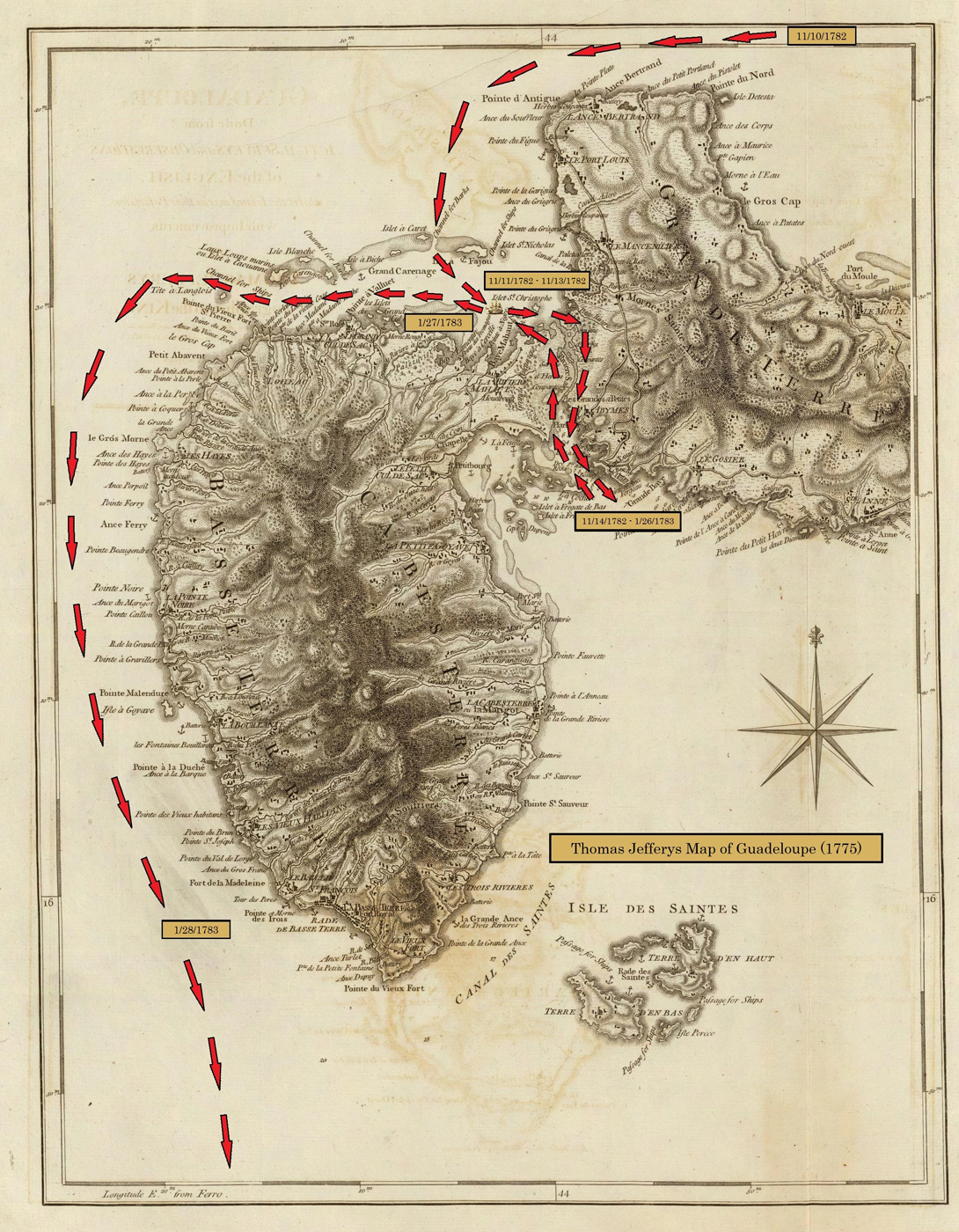
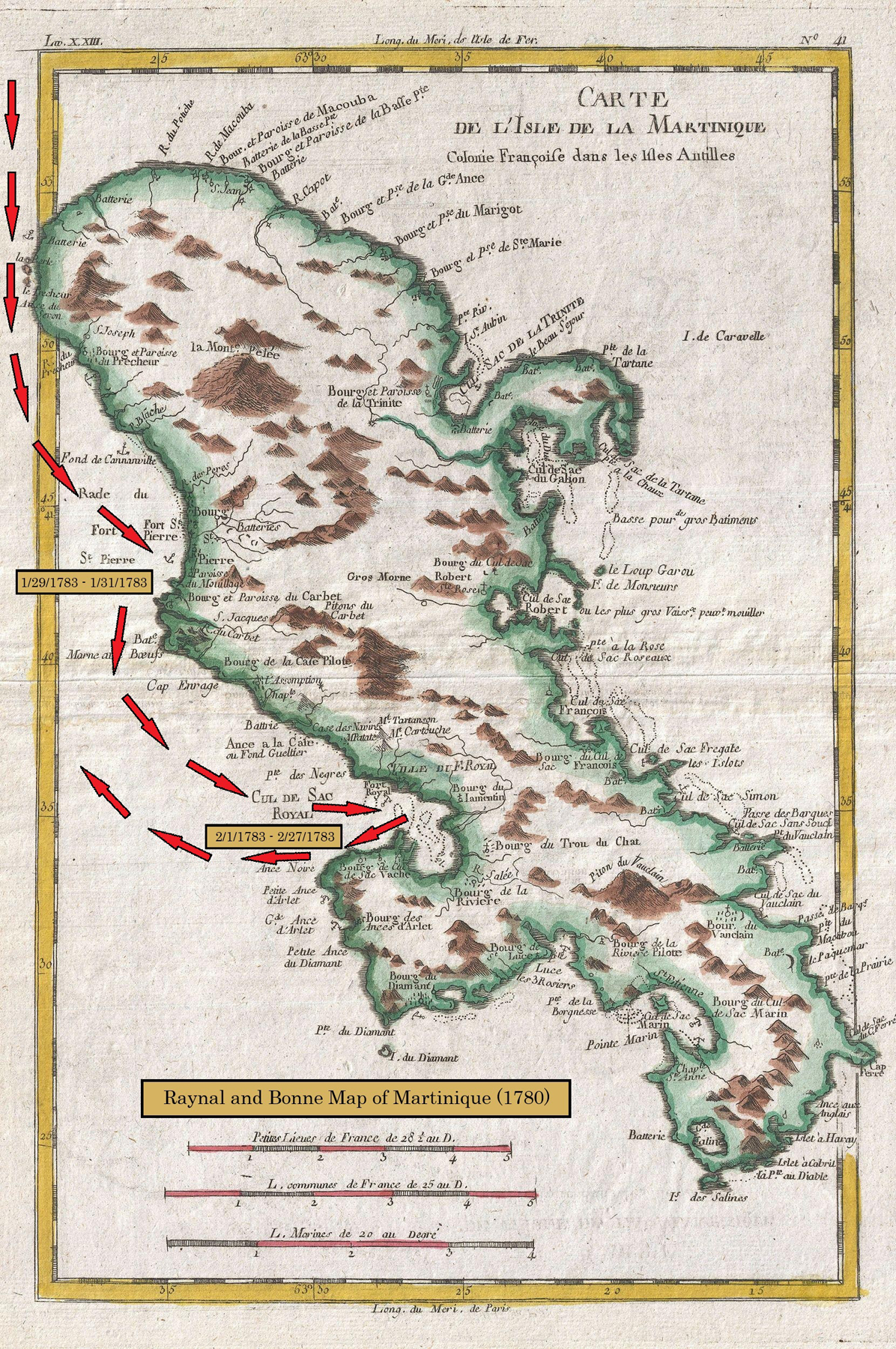
Sailing from the temporary sanctuary of Pointe-a-Pitre at Guadeloupe and bound for Martinique for additional repairs early on Monday, January 27, 1783, Barnard’s entry indicates Hague retraced her route up the Salt River and “came to the Sholes” where she lay at anchor overnight nearby the site of her earlier engagement.[45] Dr. Barnard went ashore at Bay Mahaut that evening—“at 7 P.M. Departed from the Ship With the Small Cutter with Four or Five Hands” and leaving “12 Sick on Board.” The ship weighed anchor at eight o’clock the following morning, “Got over the Rief and Rocks” and at four in the afternoon “Came Round the Windward Part” of the island. Sailing in the island’s lee, by six o’clock that evening Hague passed Basseterre on the southwest end of Guadeloupe. Passing Dominica halfway to her destination on the morning of January 29, Hague arrived at the port of St. Pierre six o’clock that evening, anchoring in the open roadstead fronting the town. The following day, Hague’s doctors sent eight sick sailors to the hospital at St. Pierre, acknowledging two men lost to “Small Pox.” Departing Saint Pierre at seven o’clock on the morning of January 31, frigate Hague continued sailing south hauling all wind possible, shaving Pointe des Negres and navigating the shoal which protects Port Royal harbor from this approach before anchoring “within a Small Distance of the Land Battery.” A French possession for all but one of the previous hundred and fifty years, it was from this harbor that the French fleet sailed ten months earlier to meet their humiliating defeat to British warships under Admiral Rodney four days later on April 12, 1782. Hague was greeted in the sheltered and fortified anchorage of Flamingo Bay by a “Number of Ships of War Now Lying in the harbor with Other Ships to the Number of 100 or more.” At six o’clock the following morning, Hague “Weighed Anchor And Came Close to Shore In Order for heaving Down the Ship to Clean” at the careenage located just under the protection of the French citadel’s guns.[46] After completing repairs on the vessel, Hague embarked “on another cruise on the same Coast” and “on the News of the Peace returned to Martinique & took in the sick & wounded, left there & on the 8 April sail’d for Boston” where most of the crew were discharged on May 10, 1783.[47]
Some of Hague’s men were left behind at Martinique when the frigate sailed for home, like steward Joseph A. Crossman who was “left sick at the Hospital at St. Pierre in the West Indies” and did not return home until August 10, 1783.[48] Others of Hague’s crew never came home. Records for the military hospital at Fort Saint Pierre include at least five deaths associated with Hague during March and April 1783.[49]
Acknowledgement: National Archives inventory records indicate Log of the Ship HAGUE 1782 is to be found in their collection under RG 45, Entry 608. A disappointing August 2025 visit to the National Archives resulted in archives staff unable to locate the log, which apparently was lost for some time. Thanks to the persistence of Supervisory Specialist Katherine L. Vollen, the unlabeled and misfiled log was later found and made available. Additionally, the generous assistance of Fort-de-France genealogist Gilles Jeanne with French records at Martinique is acknowledged.
[1] “Roll of Officers and Men of the Frigate Hague,” October 18, 2017 post, also “Roll of Men on the Frigate Hague’s Final Cruise (May 1783),” June 2, 2018, continentalnavy.com. List of officers and men of Continental Navy frigate Hague compiled from the seventeen-volume collection of Massachusetts Soldiers and Sailors of the Revolutionary War. A Compilation from the Archives (Massachusetts Office of the Secretary of State, 1896).
[2] Manley’s introductory address is published in full in the Independent Chronicle, September 26, 1782.
[3] Log of the Continental Frigate Hague, Commanded by Capt. Samuel Nicholson Sept 1782-Feb 1783, National Archives, Record Group 45.8.4, hereafter cited as Journal of Dr. Silas Barnard of the Frigate Hague. Entry dated September 25, 1782. This source is incorrectly identified by the National Archives, being a twelve-page partial personal journal of Hague’s surgeon’s mate Dr. Silas Barnard written between September 25, 1782 and February 1, 1783. The journal is incomplete with no entries between November 2, 1782 and November 15, 1782; between December 1, 1782 and January 14, 1783 or after February 1, 1783. The last page confirms Barnard as the author and its existence is noted in 1842 by Barnard’s widow Phebe Fillebrown in her pension application W-24192. Entries for times of great interest like prize captures and Hague’s engagement with the enemy are inexplicably missing. The lack of entries after February 1, 1783 leaves us with little detail about the last several months of Hague’s cruise. Peter Wakefield Pension Application S-3476 indicates Hague stood in Nantasket Road until October 11, 1782
[4] Journal of Dr. Silas Barnard of the Frigate Hague; also Phebe Fillebrown (wife of Silas Barnard) Pension Application W-24192, December 14, 1782 letter from Silas Barnard.
[5] Elijah Smith Pension Application R-9676.
[6] Phebe Fillebrown Pension Application W-24192, December 14, 1782 letter from Silas Barnard.
[7] Journal of Dr. Silas Barnard of the Frigate Hague, October 27 – 30, 1782. This vessel was under the command of Captain Davis.
[8] Phebe Fillebrown Pension Application W-24192, December 14, 1782 letter from Silas Barnard.
[9] Journal of Dr. Silas Barnard of the Frigate Hague, November 16 – 20, 1782.
[10] Phebe Fillebrown Pension Application W-24192, December 14, 1782 Letter from Silas Barnard.
[11] Journal of Dr. Silas Barnard of the Frigate Hague, November 27 – 30, 1782.
[12] Accounting of Prize Monies Due the Estate of Michael Knies, June 30, 1783, Knies Collection, Navy Department Library.
[13] U.S. Revolutionary War Prize Cases, NARA Record Group 267, Publication M162 U.S. Revolutionary War Prize Cases- Captured Vessels, 1776-1787, NH Case 97.
[14] Phebe Fillebrown Pension Application W-24192, December 14, 1782 letter from Silas Barnard; also Journal of Dr. Silas Barnard of the Frigate Hague and wage receipts in Massachusetts Soldiers and Sailors, 12:400 suggest one of the two lost was James Pike who died on December 14, 1782.
[15] Salem Gazette, January 23, 1783; also Alan O. Clancy, “Patriotism, Profit, and the Derby Privateers: Patriotic Capitalism in the American Revolution,” Capstone, The UNC Asheville Journal of Undergraduate Scholarship 31(2) (May 1, 2019), 902.
[16] Independent Ledger (Boston), February 3, 1783. Date of Baillie capture on January 1, 1783 based on U.S. Revolutionary War Prize Cases, NARA Record Group 267, Publication M162 U.S. Revolutionary War Prize Cases- Captured Vessels, 1776-1787, MA Case 93, also J. Worth Estes, Naval Surgeon: Life and Death at Sea in the Age of Sail (Science History Publications, 1998), 24 suggests Baillie was taken on December 28, 1782. Estes also claims Baillie “was the last major prize taken during the Revolutionary War.”
[17] Peter Powers Pension Application W-5559.
[18] Oliver Holden Pension Application S-29899; Luther Dana Pension Application W-24042; Anthony Spencer Pension Application S-39855; Tilden Crooker Pension Application W-22862.
[19] U.S. Revolutionary War Prize Cases, NARA Record Group 267, Publication M162 U.S. Revolutionary War Prize Cases- Captured Vessels, 1776-1787, MA Case 93.
[20] Isaac John Greenwood, Captain John Manley, Second in Rank in the United States Navy 1776-1783 (C. E. Goodspeed, 1915), 129-32. Greenwood reconstructed the events around this engagement from the logbook of HMS Dolphin and the journals of her master and lieutenant. Other details were published on the occasion of Manley’s death in the Massachusetts Mercury, February 16, 1793.
[21] Captain Manley’s letter to Hague’s agents at Boston, Andrew Johonnot and Francis Mulligan, from Bay Mahaut, Guadeloupe, January 26, 1783, Independent Chronicle & Salem Gazette, February 27, 1783. A note in the Essex Institute Historical Collection suggests Moses Richardson of Cambridge died as a result of this action.
[22] Massachusetts Mercury, February 16, 1793.
[23] Peter Wakefield Pension Application S-3476.
[24] Peter Powers Pension Application W-5559.
[25] Massachusetts Mercury, February 16, 1793.
[26] Damas to Manley, January 1, 1783 (sic) at Basseterre, Salem Gazette February 27, 1783.
[27] Riviere Salee, or Salt River, is a navigable channel separating the two islands of Guadeloupe, Basse Terre and Grande Terre. This transit took the Hague from Baie Mahault, or Mangrove Bay, on the northerly coast of Basse Terre to the protected harbor adjoining Pointe-a-Pitre on the southerly coast of Grande Terre.
[28] Massachusetts Mercury, February 16, 1793.
[29] Damas to Manley January 1, 1783 (sic) at Basseterre, Salem Gazette, February 27, 1783.
[30] Journal of Dr. Silas Barnard of the Frigate Hague, January 17 – 24, 1783.
[31] William Mountaine, The Seaman’s Vade-Mecum and Defensive War by Sea (J. Mount, T. Page and W. Mount, 1778), 69. Vade mecum is Latin for “go with me” and refers to a compact manual with standard practices of naval procedure to be carried in one’s pocket.
[32] Josiah Barker Pension Testimony S-30257.
[33] Journal of Dr. Silas Barnard of the Frigate Hague, January 25 – 26, 1783. Edmund Blood Pension Application S-21072 indicates Blood survived Hague’s last cruise. Zaccheus Blandard’s disposition is less clear as his father Joseph Blanchard collected his wages at the conclusion of Hague’s cruise.
[34] The Seaman’s Vade-Mecum, 69-71.
[35] Independent Chronicle, February 27, 1783.
[36] J. Worth Estes, Naval Surgeon: Life and Death at Sea in the Age of Sail (Science History Publications, 1998), 9-10.
[37] John F. Radloff Pension Application W-3599. St. Medard served under frigate Providence’s Surgeon John Radloff and Surgeon’s Mate Jacob Stoddard and is likely the surgeon’s yeoman mentioned in John Warner’s Pension Application S-39875.
[38] An unpublished medical journal kept in part by St. Medard on board Deane during this time was recently sold at auction on September 28, 2017. The eighty-four-page manuscript medical journal sold by Swann Auctions is reposited in the Robert Charles Lawrence Fergusson Collection of the Virginia Society of the Cincinnati. The journal was kept by a succession of naval surgeons, including Pierre St. Medard, aboard the Continental frigate Deane and other vessels. St. Medard’s first entries were in a ten-page “Sick Journal for the Continental Frigate Deane” from November 20, 1779 to February 10, 1780. St. Medard followed the previous writer’s format but kept his log in French. St. Medard’s other entries include a two-page “Sick Journal for de Deane,” August 18, 1780 – January 8, 1781 and five two-page inventories of medicine aboard Deane between February 1780 and April 1782.
[39] Estes, Naval Surgeon, 20.
[40] Receipt signed December 5, 1783, Massachusetts Soldiers and Sailors, 15:39.
[41] Massachusetts Soldiers and Sailors, 8:564.
[42] George A. Rice, Vital Records of Pepperell Massachusetts to the Year 1850 (New England Historic Genealogical Society, 1985); also dunhamwilcox.net/ma/woburn_ma_m9.htm.
[43] Massachusetts Soldiers and Sailors, 16:51; also accessgenealogy.com/massachusetts/boston-ma-intentions-of-marriage-1783.htm.
[44] Samuel Sprague Pension Application W-15366.
[45] Independent Chronicle, February 27, 1783. Manley’s letter confirms Hague’s presence at Bay Mahaut by the posting date and place.
[46] Journal of Dr. Silas Barnard of the Frigate Hague, January 27 – February 1, 1783. Barnard’s list of sick sent to the hospital at St. Pierre includes: Peter Wakefield, Jerathmeel Bowers, James Ellinwood, Noah Blood, Jonathan Johnson, John Corkran, Benjamin Haywood and John Larrabee. Based on wage receipts and pension records it is concluded that Ellinwood likely died on February 29 and Blood on March 21, while the others survived.
[47] Peter Wakefield Pension Application S-3476; Peter Powers Pension Application W-5559.
[48] Joseph A. Crossman Pension Application W-1565.
[49] Fort-de-France genealogist Gilles Jeanne has determined that Oliver Wilterlay (Witherell) died March 3, Stevenson (William Stephenson) died March 27 (paid to March 24), Samuel Noel (Samuel Hastings) died March 20 (paid to March 28), Solomon William (Whitney) died April 14, and Nathaniel Lovejoy (Nathan Lovejoy) died December 20, 1783 (paid to April 17, 1783). Deaths of mariners associated with American privateers Porus, Holker and Marquis de Lafayette are also recorded during this time.


2 Comments
I’ve read a number of histories regarding the War at Sea in general, and the Continental Navy in particular, and I don’t recall any mention of the Hague. The name Deane sounds familiar, but my recollection is a generally dismal one of American Frigates getting snapped up shortly after running the blockade, John Paul Jones being the principal exception. This cruise by the Hague strikes me as one of the most successful, and I am flummoxed as to why this is not mentioned in any of the histories I’ve read–the usual suspects, it’s not like there’s a lot, so I think I’ve read them all, as well as articles. All aspects of Colonial America and the Revolution has always piqued my interest, and I did my Graduate work at UNC-Chapel Hill, Don Higginbotham was my adviser. If anyone can recommend a volume that expands on the cruises of the Deane and Hague I would appreciate it.
Built in France in 1777, frigate Deane sailed for America in early 1778. The vessel made a number of cruises under Continental Navy Captain Samuel Nicholson, including one under his brother, between that time and Samuel Nicholson being relieved of Deane’s command in September 1782. The frigate Deane remains fertile ground for research and writing. A brief history of her cruises can be found on pages 5 through 10 of Captain Samuel Nicholson A Monograph by J. Phillip London (2012), accessible online at: https://www.history.navy.mil/content/dam/nhhc/research/library/online-reading-room/war-and-conflict/revolutionary-war/images/Nicholson_Monograph.pdf