



During the American Revolution, a defiant miller’s wife hurled freshly made dumplings into the Mianus River in Greenwich, Connecticut, rather than surrender her family’s dinner to a group of enemy Redcoats. From that moment, the section of the river where she cast her dumplings became known as Dumpling Pond. Every Greenwich elementary school student learns this cherished local legend. It explains the name of an area of the Mianus River and that of a former village and school district in what is now North Mianus. But is the tale more folklore than fact?
Over the centuries, reasons for Dumpling Pond’s name have been retold in various ways, shaped by changing times and changing storytellers.
A story of sunken dumplings was likely part of Greenwich oral tradition for many years before this version, written by Joseph Dixon—known in his day as the “Sage of Dumpling Pond”—appeared in the local newspaper Graphic in 1886.[1] Dixon’s poem “A Sketch. Of the Hamlets in Greenwich, Conn.,” recounts a seventeenth-century event in which the town’s women prepared a meal of “dumplings, sauce, and meat” for the men working on the highway. (In the New England colonies, adult males were required to work a certain number of days each year on road maintenance.) After eating their fill, the men, seemingly in jest, tossed their leftover dumplings into the river, thus giving the pond its name.
Other explanations circulated as well, each with its own humorous or defiant account of how the dumplings met their watery fate. A story contributed by an anonymous high school student appeared in the Graphic in 1899.[2] In this version, boardinghouse residents complained to their landlady that they were fed up with her monotonous menu of apple dumplings served every evening. Infuriated, the woman chased the boarders from the house, flinging dumplings after them across the nearby pond.

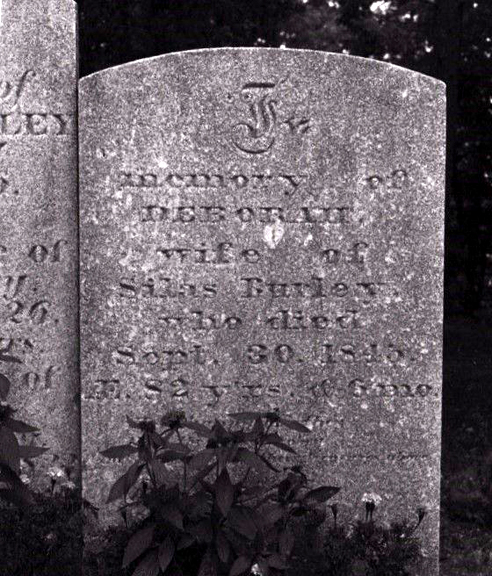
Yet another variation involving an irate cook was passed down through the Burley family. The Encyclopedia of Connecticut Biography describes the following story of a marital spat between Deborah and Silas Burley that ostensibly occurred around the turn of the eighteenth century:
when her husband and his farm hands came in from the fields late for dinner, Silas Burley complained that the dumplings . . . which had been standing for some time were water-soaked. This remark greatly offended his wife, who replied that they would stay water-soaked and threw them in the pond.[3]
The now-familiar narrative of a courageous woman defying the Redcoats likely emerged alongside the colonial revival fervor of the early twentieth century. Sparked by the American Centennial, the movement reflected nostalgia for the nation’s past amid industrialization and rapid social change. In 1908, a Greenwich Graphic article described the heroine as a “colonial dame who was intensely patriotic.”[4] Tired of enemy soldiers raiding her larder, she lifted the lid of a steaming kettle, revealed the dumplings, and then, turning swiftly to the window, dumped them into the pond below.
A more dramatic version emerged in 1911. The Graphic maintained that the heroine was a spirited colonial maiden—a so-called “Priscilla” archetype—determined to protect the dinner she had prepared for her Patriot beau and some of his fellow soldiers from the nearby Stamford fort.[5] According to the story, this Priscilla “shook her tiny fists” in the faces of British troops and defiantly threw the dumplings into the pond. When a soldier attempted to kiss her, she slapped him and sent the Redcoats away in humiliation.

In his 1913 book The Old Boston Post Road, Stephen Jenkins may have been the first writer to identify the heroine in print as a miller’s wife.[6] But Greenwich News and Graphic editor Erwin Edwards was not quite ready, it seems, to let go of his Priscilla. Instead, he retold the tale in 1920 with a “winsome daughter of the tavern keeper” in the starring role.[7] “It was the tavern,” he insisted, “that helped more than any other one thing to give Dumpling Pond a name and prestige.”
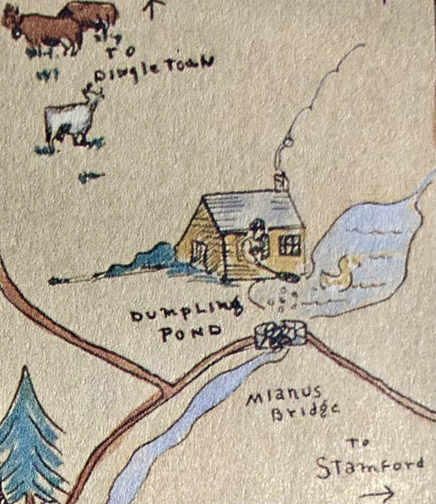
By 1935 the brave miller’s wife had become firmly fixed in local lore. That year, she was pictured in a cartoon alongside other key historical events on a map of Fairfield County published by the Connecticut League of Women Voters for the state’s tercentenary celebration.[8] The town’s tercentenary committee book Greenwich 1640: The Gateway to New England referred to her as a miller’s wife,[9] a designation repeated in the 1935 essay collection Greenwich Old and New.[10] Later that decade, the Federal Writers’ Project enshrined her in both its Connecticut travel book[11] and its guide to key East Coast sites along U.S. Route 1.[12] In 1942, the national magazine House and Garden reprised the anecdote,[13] which Trinity College language scholar Arthur H. Hughes had collected for his forthcoming dictionary of more than 25,000 Connecticut place-names. Hughes’s reference book, finally published by the Connecticut Historical Society in 1976, coincided with renewed public interest in the American Revolution during the Bicentennial. That year, the Woman’s Club of Greenwich began its annual town-history tours for third graders, with Dumpling Pond remaining a favorite destination.
In 1990, the year the town celebrated its 350th anniversary, dozens of local-history essays written by schoolchildren were featured in the Greenwich Time. The dumpling legend was among the most beloved topics. One such example is this charming interpretation:
Two British soldiers rang the doorbell. A woman, who was on the colonists’ side, opened the door. The British soldiers said, ‘Give us your dinner!’ But the woman said, ‘Dinner isn’t ready yet.’

It was really ready, but would she want to feed them? No! So she threw the dumplings in the pond.[14]
Legends thrive on drama, but place names often have practical roots. Like a long-running game of telephone, the details evolved over time. Passed from teacher to student and from parent to child, the tale exemplifies the persistence of myth and folk tradition. But if the story is folklore, it raises a fundamental question: How did Dumpling Pond really get its name? For that matter, how did the Dumpling Ponds in Maine and Texas get their names? What about the Dumpling Islands in Long Island Sound, Dumpling Rock in Buzzards Bay, Dumpling Neck in Delaware, or Dumpling Brook in New Hampshire?
Most likely, the names derived from their shape: lumpy and round, like dumplings dropped into a boiling pot of soup. The Dumpling Pond section of the Mianus River—before a downstream dam altered it—was, fittingly, round.
And the Native American name for the area? It was Petuhkqui-paug, which translates to “round pond.”[15]
[1] Joseph Dixon, “A Sketch. Of the Hamlets in Greenwich, Conn.,” The Greenwich Graphic, July 24, 1886, 3.
[2] A high school student, “Curious Colloquialisms,” The Greenwich Graphic, November 18, 1899, 1.
[3] Encyclopedia of Connecticut Biography (The American Historical Society Inc.,1917), 115-116.
[4] “18th Anniversary Greenwich Academy Shakspere[sic] Club,” The Greenwich Graphic, January 25,1908, 1.
[5] “Quaint were the Names of Revolutionary Times,” The Greenwich Graphic, April 29,1911, 1.
[6] Stephen Jenkins, The Old Boston Post Road (G. P. Putnam’s Sons, 1913), 163-164.
[7] Erwin Edwards, “Greenwich Life As It Is – And Was,” Greenwich News and Graphic, August 20, 1920, 4.
[8] “Pictorial Maps in Celebration,” Daily News-Graphic, February 6, 1935, 3.
[9] Greenwich Tercentenary Committee, Greenwich 1640: The Gateway to New England, (Tercentenary Committee of Greenwich, Conn., 1935), 24.
[10] Lydia Holland, Margaret Leaf, Greenwich Old and New (Greenwich Press, 1935), 76.
[11] Federal Writer’s [sic] Project for the State of Connecticut, Connecticut: A Guide to Its Roads, Lore, and People (Houghton Mifflin Company, 1938), 330-331.
[12] Federal Writers’ Project of the Works Progress Administration, U.S. One Maine to Florida (Modern Age Books, Inc., 1938),112.
[13] “Bulletin Board,” House and Garden (February 1942), 19.
[14] Oliver Collins, “The Legend of Dumpling Pond,” Greenwich Time (June 23,1990), A8.
[15] J. Hammond Trumbull, “The Composition of Indian Geographical Name, Illustrated from the Algonkin Languages,” (Case, Lockwood & Brainard, 1870)14, Project Gutenberg.



3 Comments
I grew up in the 80s & early 90s living @320 palmer hill rd. Basically across the street from Dumpling Pond. I remember learning about it while attending North Mianus School(next door to my house) was very interesting. Also the taught us a lot about the native Americans(we were the North Mianus Indians) and have actual native people teach us. Birch beer sticks and drums. Was cool as a kid. Neat to see this article today. Thanks
I love a good myth busting article! This is an excellent example of a well researched historiography. Well done!
Much appreciated, Michael.