

BOOK REVIEW: The Lost Founder: James Wilson and the Forgotten Fight for a People’s Constitution by Jesse Wegman (New York: Celadon Books, 2026) $30.00 hardcover
The Broadway play 1776 depicts James Wilson, a Pennsylvania delegate to the Continental Congress, as a cowardly, spineless understudy of John Dickinson, who opposed the Declaration of Independence. This portrayal is flat-out wrong, yet it reflects the lack of public and scholarly attention to Wilson’s life. Jesse Wegman, a former member of the New York Times editorial board, makes a compelling case that Wilson made substantial contributions to the nation and left an enduring democratic legacy.
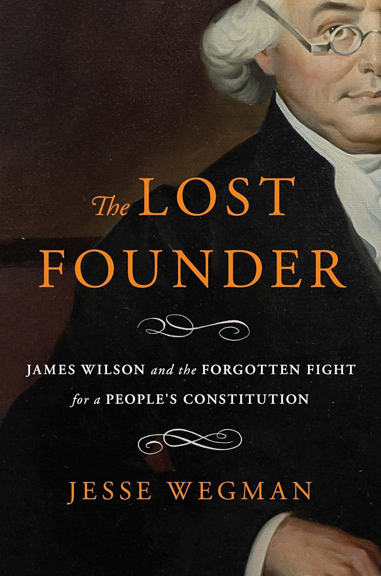 The lack of scholarly interest in Wilson’s life and contributions is striking. The Supreme Court scholar’s work is the first James Wilson biography published by a non-academic press and only the third published in more than a hundred years. The two previous biographies were published by academic presses in 1956 and 2021.
Wegman demonstrates a journalist’s eye for storytelling. He opens with the tragic account of Wilson, then a US Supreme Court justice, dying from malaria in an obscure North Carolina tavern while hiding from debt collectors. This vignette highlights the central conundrum in Wilson’s life. He contributed significantly to the US founding documents but was spectacularly unsuccessful in business and at times engaged in shady dealings, which diminished contemporaries’ regard for him. The author characterizes Wilson as a “complicated man” (page 169) who lacked political savvy and held himself in too high regard. In academic lectures, Wilson referred to himself as the “American version of William Blackstone, the renowned British jurist” (p. 230).
Born in Scotland to a poor farming family and educated in Enlightenment philosophy at leading Scottish universities, Wilson emigrated to America during the Stamp Act crisis in 1765. With family funding, the Scottish immigrant trained as a lawyer under John Dickinson, one of the premier colonial lawyers. Wilson quickly became a successful attorney with many wealthy clients, including the powerful Penn family. Entering politics, Wilson published an essay in 1774 asserting that Parliament had no authority over the colonies because Americans were not represented.
Given his growing influence, the Pennsylvania legislature appointed Wilson as a delegate to the Continental Congress. On the question of independence, Wilson’s reputation first suffered. As a representative of the Penn family-dominated legislature, he believed he was bound by their instructions not to vote for independence. However, when Pennsylvanians deposed the Penn regime and installed an independence-friendly legislature, Wilson changed his vote and ultimately signed the Declaration of Independence. Despite a Congressional resolution to the contrary, Wilson would be dogged by allegations that he was a closet Tory for the rest of his life.
Wilson played a larger role in the 1787 US Constitutional Convention. It was here that he earned a reputation for advocating a democratic form of government. Wegman argues that Wilson was the only voice to invoke the Declaration of Independence phrase “created equal” during the drafting of the US Constitution. Demonstrating his Scottish Enlightenment education, the Pennsylvania lawyer believed that popular sovereignty was the best and most enduring form of government. As a result, he proposed the phrase “We the people” in the Constitution’s introduction (p.190).
Additionally, Wilson proposed the Electoral College, the Three-Fifths clause, and the Treason clause (p. 179). When it came to preparing the final product, Wilson served on the Detail Committee, which drafted the Constitution. During this process, he added the “necessary and proper” clause, which enabled Congress to make laws to execute its powers. Given these outsized contributions, the author places Wilson on equal footing with James Madison in shaping the US Constitution (p. 9-10).

At times, Wegman, a keen observer of today’s US Supreme Court, tries too hard to elevate Wilson’s stature and accomplishments. He argues that “In short, without Wilson’s energy, clarity, and eloquence, there might not have been a United States of America after 1788” (p. 210). He also cites Wilson’s Pennsylvania State House speech advocating ratification of the US Constitution as being as influential as the Federalist Papers (p. 195). These assertions would be more credible if Wilson’s contemporaries had made them. Additionally, the author assesses that Wilson possessed the greatest and most celebrated legal mind in the country (p. 229, 153) without specifying a yardstick. Certainly equally strong cases could be made for other attorney-founders, such as John Jay, John Adams, and John Dickinson. These grand assertions lack objectivity and contemporary evidence.
One reason history has not elevated Wilson’s stature is his reckless business conduct and undistinguished jurisprudence after his appointment to the first US Supreme Court. The author characterizes Wilson as the country’s “most prodigious speculator” (p. 254) with “too much ambition and not enough money” (p. 248). While many founders engaged in western land speculation, Wilson took extreme risks and engaged in ethically questionable transactions. The author quotes Thomas Blount, a North Carolina lawmaker, who said, “If you rely on his honor, or trust him in anything, he will certainly deceive you” (p. 266). Members of Congress recognized the risks to the integrity of the court and were moving toward impeachment when Wilson died in that North Carolina tavern.
To deepen his understanding of Wilson’s jurisprudence, Wegman sought out law professors with notable expertise in Wilson’s legal and political works. In particular, the influence of William Ewald, a professor of law and philosophy, is apparent throughout the book. However, the author misinterprets or minimizes the legal contributions of the revolutionary state constitutions. For example, he asserts that the 1776 Pennsylvania constitution “remains the most democratic state constitution in American history” (p. 75). Notwithstanding modern state constitutions, the 1777 Vermont Constitution expanded Pennsylvania’s suffrage of taxpaying freemen to all men. The author further claims that Wilson was the only founder advocating for the direct election of the chief executive (p. 164). State constitution framers established direct gubernatorial elections in the constitutions of New York (1777), Vermont (1777), Massachusetts (1780), and New Hampshire (1784). Importantly, the author overlooks the state constitutional-framing experience in the writing of the US Constitution. At least twenty, not fifteen, convention delegates had experience drafting state constitutions, resulting in the incorporation of democratic features from Massachusetts and other state constitutions into the US Constitution (p. 20).[1]
The Supreme Court editorialist would have benefited from input from historians of the American Revolution. A better understanding of Revolutionary America would have prevented the portrayal of Wilson’s gains from the sale of two farms as windfall profits (p. 40-41),[2] the overestimation of the size of the American economy vis-à-vis Britain (p. 49),[3] and the misinterpretation of the reason for only a few Quakers attending the 1776 Pennsylvania State Constitution Convention (p. 78).[4]

While all books contain errors, some raise thought-provoking questions. For example, Wilson was born into a devout Presbyterian family, and Wegman reports that he married at St. Gabriel’s Episcopal Church in 1771 (p. 40). Before the Revolution, St. Gabriel’s was an Anglican church. It did not rebrand as an Episcopal church until the 1790s. While this oversight by itself is meaningless, it obscures a larger aspect of Wilson’s life. It is highly unusual that a man from a “deeply religious family” who educated him to become a Presbyterian minister (p. 21) would marry in an Anglican Church. The Presbyterians and Anglicans were bitter theological and political rivals. This raises questions about Wilson’s religiosity and other matters. What were his religious beliefs? Was his willingness to marry outside his family’s religion the result of a poor relationship with his mother and family? Why did he have little contact with his mother after moving to America?
Additionally, the veteran editorialist could have omitted the epilogue’s ending, which reveals his views on contemporary politics. Speculating about which side Wilson would support in current political debates goes beyond historical interpretation and will turn off readers. Alternatively, allowing people to draw their own conclusions about the relevance of Wilson’s political philosophy would engage 100 percent of readers in the author’s main mission: discovering the overlooked founder and better recognizing his influence.
The author concludes that Wilson wrestled with competing passions: pecuniary temptations on the one hand and the duties of democratic self-rule on the other (p. 43). Wegman deems this conflict “irreconcilable” (p. 45). While readers may agree or disagree, recovering and illustrating James Wilson’s life is a useful reminder that many contributors shaped America’s founding. Wilson’s infusion of democratic provisions into constitutional law helped establish a durable foundation for the Constitution. His life also illustrates that contemporaries can be the best judges of people. Perhaps President George Washington’s reluctance to elevate Wilson to Chief Justice reflects the best assessment of his contributions and character: a solid contributor, but not a first-tier founder.
•PLEASE CONSIDER PURCHASING THIS BOOK FROM AMAZON IN HARDCOVER OR KINDLE.
(As an Amazon Associate, JAR earns from qualifying purchases. This helps toward providing our content free of charge.)
[1] Gregory E. Maggs, “A Guide and Index for Finding Evidence of The Original Meaning of The U.S. Constitution in Early State Constitutions and Declarations of Rights (May 11, 2020),” GWU Legal Studies Research Paper No. 2020-28, GWU Law School Public Law Research Paper No. 2020-28 98 N.C. L. REV. 779 (2020) (May 2020): 780–836, ssrn.com/abstract=3598487, 805-6.
[2] The author asserts that Wilson purchased a farm in 1772 for £700 and another in 1775 for £200 and sold them for £5,500 in the summer of 1778, a six-time windfall (p. 40-1). However, Wilson did not general windfall profits. Pennsylvania currency suffered rampant depreciation during this period, in the range of 8 to 1. Therefore, in nominal dollars Wilson, likely broke even with the sale or even lost money. For estimates of the worth of Pennsylvania currency see, www.continentalline.org/CL/article-960203/.
[3] The author asserts that the American GDP was 40 percent of the British GDP (p. 49). In comparison to Britain’s roughly £105 million nominal output, the aggregate GDP of the thirteen American colonies in 1775 is estimated to have been roughly £25 million to £30 million (in sterling values)—making the British home economy roughly 3.5 to 4 times larger than the colonies it was fighting. For estimates of the size of the American economy, see Edwin J. Perkins, The Economy of Colonial America, 2nd ed (Columbia University Press, 1988), 234. For the size of the British economy see a data set at www.measuringworth.com/calculators/ukcompare/ukcompessay.php. Other estimates of American versus British GDP at the outset of the Revolution range from 19 percent to 33 percent.
[4] The author states that the absence of Quakers at the 1776 Pennsylvania Constitutional convention was due to their refusal to swear oaths. While the 1776 Pennsylvania Constitutional Convention was structurally designed to strip the traditional Quaker establishment of its political monopoly, procedural rules allowed for “affirmations” out of respect for Pennsylvania’s historic religious demographics. While the official Friends religious body boycotted the convention, a few individual delegates with Quaker backgrounds who favored the Revolution did attend. They chose their political and patriotic convictions over church discipline.


9 Comments
Gene,
Excellent review. Thank you! I haven’t crossed more than tangential paths with Wilson and always thought I should dig a little deeper. If I only read one biography of Wilson, which of the three you mentioned should be at the top of my list?
Thanks,
Eric
Eric, thank you for your feedback and question. From a selfish perspective, I would be interested to know whether you share my take on the Wegman biography. The other option would be James Wilson: The Anxious Founder by Michael H. Taylor, published in hardback in 2021 and paperback in 2023. I have not read this peer-reviewed book. It was not cited by Wegman. My guess is that it will not contain the scholarship errors in Wegman’s work. It is also recommended by William Ewald, the law professor whom Wegman consulted.
As a brilliant legal mind and a primary architect of the U.S. Constitution, he possessed supreme confidence in his intellectual abilities, against the aristocratic tendencies of his peers, but his overreach ultimately destroyed him. Yet, because of his haughty demeanor and his own elitist social views, he was widely distrusted by the public and died a political pariah.
James Wilson’s modern anonymity is a result of his ignominious death. His clients were the elite of Pennsylvania. His bag-case
was the continuous depository of deal making among his constitutional duties. Wilson was a walking-talking business of “real estate” within the conventions.
Wilson continued his life-long practice of land speculation, the vocation of some among the American elite, and the avocation of most others, elite or not-so-elite. The country was land-rich and people-poor. Investors gambled that, after peace was restored, the British pro-Indian and anti-settlement policy of the Proclamation of 1763, which had prohibited American settlement of the interior, would be overturned. Western lands finally would be opened to immigrants. Wilson, along with Robert Morris and many other prominent Americans and some foreigners, had organized the largest of the land companies, the Illinois-Wabash Company, even before the war. Wilson eventually became its head and largest investor. The intrigue among the Company, politicians in various states, delegates to Congress, and agents of foreign governments to gain access to large tracts of trans-Appalachian lands presents a fascinating tale of its own.
In the late 1780s and 1790s, Wilson borrowed heavily to finance enormous purchases of western wilderness tracts, operating through land development syndicates like the Illinois and Wabash Company and the Yazoo land companies. He envisioned immense wealth from a growing American economy, but his faith in rising land values backfired terribly.
Outside of politics, Wilson thought he could outsmart the burgeoning American economy through reckless land speculation. In the 1790s, he took on crushing debt to buy up massive tracts of frontier land, betting that the population would expand to settle them. The scheme backfired catastrophically, ruining him financially.
The Illinois-Wabash Company was not Wilson’s only venture in land speculation. He co-founded another company and also purchased rights to large tracts individually or in partnership with others. It has been estimated that, directly or through investment entities, Wilson had interests in well over a million acres of Western land. Much of this land bounty was financed through debt.
Creditors want cash payment, and highly-leveraged debtors are particularly vulnerable to economic contractions. Land values drop as land goes unsold. Like his business associate and political ally Robert Morris, Wilson was hit hard by the Panic of 1796-7. He was briefly incarcerated twice in debtor’s prison, even after fleeing Pennsylvania for North Carolina to avoid his creditors. More astounding even was that these events occurred while he was on the U.S. Supreme Court and performing his circuit riding duties…after George Washington appointed him to the country’s highest court.
James Wilson, a Founding Father and U.S. Supreme Court Justice, did not avoid jail for his massive land debts. In the 1790s, he faced financial ruin from aggressive, over-leveraged land speculations. Fleeing creditors, he was jailed twice for debt, becoming the only Supreme Court Justice to sit in prison while on the bench.
James Wilson, an Associate Justice on the first U.S. Supreme Court, deeply embarrassed President George Washington in the late 1790s when he was twice imprisoned for massive debts caused by reckless land speculation. Despite serving as a sitting federal judge, Wilson was jailed and fled to avoid his creditors.
Wegman writes that “By 1790, he was one of the wealthiest and most respected men in the country, sitting atop the pinnacle of American political and legal life. Less than a decade later, he was dead, a victim of malaria he caught while hiding out in the back room of a tavern in coastal North Carolina. A reckless and compulsive speculator in lands, Wilson spent his last years buried under a mountain of debt, on the run from his creditors and the law, even while he was still a sitting justice of the Supreme Court.”
Isn’t it true that Washington believed Wilson was professionally qualified for the court, even attending Wilson’s first law lecture in Philadelphia with other top officials. However, as Wilson’s extreme land speculation debts spiraled out of control and his reputation suffered, Washington purposely denied him a second chance at the Chief Justice seat in 1795 to protect the integrity of the judiciary?
Wegman continues that “His friend Benjamin Rush wrote that Wilson was “deeply distressed; his resource was reading novels constantly.” He skipped the entire fall term of the Supreme Court. By December, the biggest speculators in Philadelphia were leaving town or getting locked up.” When others questioned Wilson’s qualifications for the Supreme Court because of his speculative reputation, fellow founder Benjamin Rush famously defended him, saying, “But where will you find an American landholder free from embarrassments?
Thanks for the review and look forward to your comments…
Russell, I agree with you that Washington respected Wilson’s legal and constitutional acumen but believed the justices’ business practices would stain the court’s reputation. Certainly, skipping a court term does not engender trust.
Another reason for the lack of trust might be Wilson’s use of insider influence and access to make money in land speculation. Michael A. Blaakman, in his book “Speculation Nation,” asserts that Wilson engaged in lobbying activities to gain advantage for his land deals (p. 175-77).
Both Robert Morris and James Wilson ended up in debtor’s prison due to failed land speculation. History has been kinder to Morris. However, other founders such as Franklin and Washington engaged in land speculation, but it did not bring on financial ruin. Blaakman believes that Wilson dramatically ramped up his speculation ventures in 1785 and got caught in a massive bubble. There are tragic elements in Wilson’s life. He was legally brilliant, made substantial constitutional contributions, but exhibited poor business judgment.
As a scholar with more than a passing interest in James Wilson, it is exciting to see a full-length biography published that is accessible for general audiences and forceful in its assertion of Wilson’s importance to the founding era. Regarding your argument about the lack of recognition of Wilson by contemporaries, I think that speaks to Wegman’s central contention about Wilson’s understated place in history relative to his importance. As scholars like Mary Sarah Bilder (Madison’s Hand: Revising the Constitutional Convention) have shown, Madison’s “father of the Constitution” epithet, our reliance on his convention notes, and even the dominance of The Federalist in constitutional interpretation were the product of a long campaign of work, revision, lobbying, and erasure that extended far past the 1787 convention. Wilson’s ignominious death precluded him from making similar efforts on his own behalf and discouraged others from elevating his work. Even so, fellow delegate William Pierce’s Sketches of Members of the Constitutional Convention labeled Wilson as “among the foremost in legal and political knowledge” at the Convention. Similarly, Benjamin Rush, while writing John Adams to support Wilson’s appointment as chief justice singled out “His Abilities & knowledge in framing the Constitution, & his zeal in promoting its establishment,” while noting that Pennsylvania had refrained from nominating Wilson to serve in the House or Senate because he was expected to be named chief justice.
Kevin, your comments and quotes from contemporaries supporting James Wilson’s contributions to the US Constitution are well taken. I agree that other founders definitely respected Wilson’s legal abilities and constitutional contributions. And I agree that Madison had a better PR campaign.
My conclusion, after reading Wegman’s book, is that the author did not convince me of his argument that without Wilson, there would be no US Constitution or that his PA State House speech was as influential as the Federalist Papers. John Adams sums it up for me. He agreed with Rush that Wilson should be on the US Supreme Court, but not as the Chief Justice. Adams believed John Jay was a stronger candidate. Hence, my conclusion that Wilson was an important founder, just not in the top tier such as Washington, Adams, Jefferson, and Franklin.
Hi Gene, and thank you so much for your thoughtful review and critique of the book. I look forward to responding to all your points but for the moment I want to focus on the State House Yard speech v. the Federalist. My claim that the former was not only “as influential as” the latter at the time but more so comes from three sources: Maier and Bailyn are both listed in the endnotes (the page number for Bailyn was accidentally transposed, my apologies — it’s 328, not 238, where he wrote “it was not so much the Federalist papers that captured most people’s imaginations as James Wilson’s speech … the most famous, to some the most notorious, federalist statement of the time.” Additionally, in Creation of the American Republic, Wood referred to the Wilson speech as providing “the basis of all Federalist thinking” during the ratification period. If you disagree with these assessments or believe I’ve misunderstood them, I’d be interested to learn why; I provide them here to explain why I felt comfortable making the claim.
Jesse, thank you for the dialogue, which provides a better understanding for all. Certainly, secondary sources provide evidence supporting your arguments, especially when coming from the eminent historians you cite. Additionally, you provide primary source references to period newspaper articles that disseminated Wilson’s speech and popular reactions. As to my “more credible” comment, primary source evidence that contemporaries believed that Wilson’s speech was more influential than the Federalist Papers in the ratification process would be beneficial. Did any members of ratification bodies cite Wilson’s speech as influential in their position on the proposed constitution? As to Wilson’s speech being disseminated broadly, you provide solid evidence.