


Prior to the outbreak of war at Lexington and Concord in April 1775, New Jersey had not been a hotbed of revolution. With open war, however, followed by the British invasion of 1776, civil strife engulfed the rebellious province. Patriots (Whigs) struck hard and fast against Loyalists, harassing and intimidating anyone suspected of allegiance to the old regime. They purged them from the militia and from judicial and civil posts and frequently resorted to brute force to establish rebel ascendancy. By late 1776—and certainly after the Patriot victories at Trenton and Princeton—the likelihood of any successful counter-revolution in the state was remote. Still, New Jersey Loyalists numbered in the thousands, and facing persecution at home, legions decamped to safety in and around British-occupied New York. Hundreds enlisted in Loyalist regiments, while many others became irregular raiders. These bands, sometimes in company with detachments of regulars, struck into their old neighborhoods, plundering and sometimes killing former friends, business associates, church members, and even relatives. Whigs, of course, answered with equal brutality, and local cycles of revenge and retribution engendered truly fratricidal bitterness.
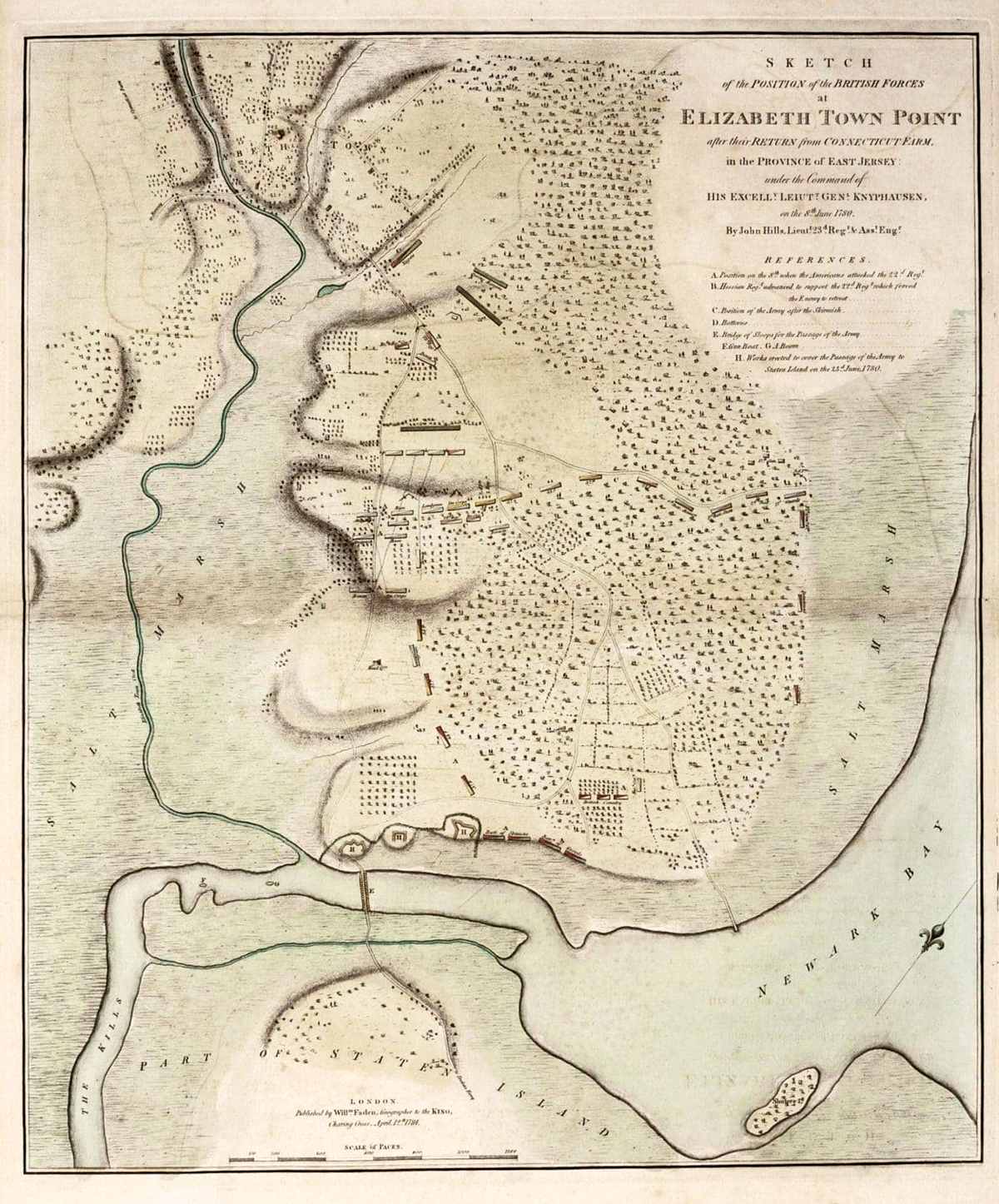
Still, grim as the civil strife was generally, particular incidents retained a singular power to shock. Such was a case in 1779 in Elizabethtown, and specifically that section that after the war emerged as the separate town of Rahway, in what was then Essex County. Located directly across from British-occupied Staten Island, the area was the scene of endemic tit-for-tat hostilities between Whigs and Loyalists. This local warfare led to the hanging of a Loyalist “spy,” a common-enough occurrence during the war years. But what followed was extraordinarily uncommon—ghoulish even—and probably unique in the War for Independence. Among Patriots the episode involved one Henry Williams, an Essex County militiaman with extensive Revolutionary service, and a number of his family members and friends. Then there were three Loyalists, or supposed Loyalists: Thomas Long, an active Royal partisan, captured and hanged after a militia court martial, and Richard Cozens and Ellis Thorp, suspected confederates of Long who would pay prices of a different nature. Finally, there were the Hatfields—Cornelius and John Smith—both committed Loyalists, also of another numerous Elizabethtown family, who would seek to avenge Long. The fates of all concerned—Whig and Loyalist—would painfully reflect the depth of the social fragmentation that afflicted New Jersey during the war years and, startlingly, well beyond.
* * *
Henry Williams is the key figure here. Williams was born on December 19, 1755 in Elizabethtown, one of ten Williams brothers in a solidly Patriot family. Of the ten brothers, eight saw militia duty by war’s end, a fact of which Henry was extremely proud.[1] Henry entered the militia as a private in the spring of 1776, serving for three months on Staten Island (before the British landing), New York City, and in Bergen County, New Jersey. He then enlisted for five months in the New Jersey state troops, which saw longer terms of service than the “common militia,” serving as a sergeant in postings around Elizabethtown and seeing action in numerous skirmishes. He then saw duty in militia tours for a total (he claimed) of three years. (Years later, the War Department Pension Office would credit him only with twenty-two months—but more on that shortly.) He was in larger actions as well, including Staten Island (1777), Monmouth (1778), and Connecticut Farms and Springfield (1780). Thus, by 1779 Henry Williams was nothing if not an experienced citizen-soldier.

What we know of the incident that concerns us here—the circumstances of Thomas Long’s demise and its gruesome aftermath—derives from Williams’ application for a military pension under the federal pension legislation of 1832. Without the documentation presented in that application, the full story of Long’s fate would have escaped real notice. In fact, knowledge of the peculiar nature of Long’s execution came to light only after the Pension Office rejected Williams’ initial application of August 17, 1832. Williams, like so many other old soldiers, had never received discharge papers after tours of militia duty, or over the years had lost those he had received, and in late 1832 (or early 1833) the Pension Office was insisting on further documentation.[2] Accordingly, in July and November 1833 Williams submitted supplemental statements in which he tried to flesh-out details of his service. They did no good. On November 30, 1833 the Pension Office informed him that his application still would “require further proof of … services after the year 1777.”[3] At seventy-six years old, with his memory admittedly hazy and facing a daunting bureaucratic process, the old militiaman was wise enough to seek help.
He enlisted the aid of one of New Jersey’s leading citizens, Dr. Lewis Condict (1772-1862), of Morristown. Doctor Condict was nothing if not accomplished. He was a graduate of the University of Pennsylvania and was variously sheriff of Morris County, a respected member of the New Jersey State Medical Society, a Latin scholar of reputation, a railroad entrepreneur, an anti-slavery advocate, a periodic member of the state assembly, and active in a variety of civic roles. He was a nine-term congressman (from 1811 to 1817 and from 1821 to 1833) and was well-connected with national political luminaries of the day, corresponding with the likes of Henry Clay, Edward Everett, and John C. Calhoun.[4] Condict also took an interest in revolutionary veterans, and over the mid-1830s he assisted over 120 of them in documenting pension applications.[5] We don’t know how Williams, then living in Rahway (by then an independent town), made the connection with the Morris County congressman. But Condict’s work in behalf of pension applicants was well-known, and we can assume that anyone trying to assist Williams would have helped make the connection. In any event, Condict met with Williams in April 1834, which resulted in yet another supplement to his application. This time it satisfied the Pension Office. Williams received an annual pension of $81.00, with $244.50 in arrears dating from 1832.[6] It had been an arduous battle for the old soldier; but it was from his final, successful application that the full story of Thomas Long emerged.
* * *
So who was Thomas Long? There were few contemporary accounts of the man, all in period newspapers. On November 16, 1779, the New-Jersey Journal printed a short paragraph, dated “Chatham, November 9,” which the Connecticut Journal (New Haven) and the Providence Gazette (Rhode Island) quickly reprinted.[7] The brief notice conveyed some sense of Long and whig reactions to him:

Last Monday morning was taken at Rahway, concealed in a barn, Thomas Long, alias Bunkeye, a villain noted for his cruelties to many of our prisoners, and who has been active in carrying off several of the inhabitants. He was found without arms, therefore could be considered in no other light but as a spy, for which he was tried, found guilty, and received sentence of death, which was duly executed on Thursday last.[8]
Counting backwards from the November 9 report, we can place Long falling into Patriot hands on or about Monday, November 1, meeting the hangman on Thursday, November 4. We can also gather that Whigs were happily rid of him. Beyond these few details the account appeared to be nothing special—a tory hanged was hardly major news by 1779.
Historians have added little more. Long is mentioned only briefly in Loyalist biographies compiled by Lorenzo Sabine and E. Alfred Jones. In fact, Sabine’s account is the definition of brief: “Long, Thomas. Of New Jersey. Executed in that State, in 1779.”[9] Jones does better. He mistakenly puts Long’s death in 1781, but he does note Long’s profession as a schoolmaster, his success as a partisan, and the grim nature of his end: “It was said he was brutally tortured before hanging, and that later his body was dug up and made sport of.”[10] Jones was partially correct in that observation, which brings us back to the Williams pension application.
The application documents note that Henry Williams and Thomas Long both hailed from Elizabethtown. Williams was native-born while Long was an “Englishman.” We don’t know when Long arrived in town, but it was time enough so that by 1779 he supposedly “knew every body in it” and knew the lay of the land. We can assume his local knowledge included the Williams family if not Henry himself. Long established a school in Elizabethtown, and during the war at least some former students would see their erstwhile teacher as a mortal enemy. They had reason. In late 1776 Long decamped to British-occupied Staten Island, just across the narrow Arthur Kill from Elizabethtown. Then, instead of opening another school, as at least one other displaced Elizabethtown teacher did, he took up arms.[11] Rather than enlist in one of the New Jersey Loyalist regiments, Long began a career as an irregular, striking repeatedly into his old Essex County neighborhood.[12] Long was effective, and as the New-Jersey Journal noted, he had reputation enough to earn the nom de guerre of “Bunkeye.”

“Bunkeye’s” intimate knowledge of Essex County served him well in targeting active Patriots. The “kidnapping & carrying off of active and influential Whigs, by the Tories & Refugees, was very common,” Henry Williams recalled, and Long was one of the most successful (from a British perspective) in this regard.[13] Others shared Williams’ opinion. Frazer Craig, twelve years old in 1779, whose father commanded a company in which Henry Williams served, vividly recalled the depredations of his former schoolmaster. “In the nights,” Craig remembered, Long “would surprise and carry off leading Whigs & active soldiers, & throw them into the Sugar house & prison ships in N. York.” Indeed, Craig’s status as a former student offered no protection. In one nocturnal foray Long
broke into my father’s house, with an armed force, & demanded of my mother, where ‘was the damned old Rebel, her husband’! I was a boy in bed, & heard & saw all that passed. My Mother replied, that her husband was then a prisoner in New York—which was true—he having been taken at the battle of Long Island, & not yet exchanged. They plundered the house & went off.[14]
Wrenching as this experience was for the Craigs, things could have been worse.
Long’s assault on the Williams family proved as much. Indeed, he was a particular bête noire for the Williams household. The small-scale raids that plagued Essex County kept local militia on virtually constant alert—which meant that at any given time at least one of the Williams brothers would be on active duty. Long knew as much, and he singled out the family. In early 1777 he crossed from New York with a Loyalist band, surrounded the Williams home, “& took off my brother John Williams, & lo[d]ged him in the Sugar house. He took also 6 or 7 others at the same time, viz: Caleb Potter, John Hains, James Lambert & 3 or 4 others.” Henry was home when Long struck, but avoided capture by hiding under a bed. As it was cold, John asked to take his “great coat,” but Long refused. John and ten others somehow escaped during the summer “and got back to their friends.” Others were not so lucky. “It was known that Caleb Potter, John Hains, & Lambert, all three of them, died in the prison.”[15] For the Williams brothers, then, dealing with Thomas Long was a personal matter—although their anger was tacit admission that Long, loathsome as they saw him, was a talented guerilla. That is, until he wasn’t.
* * *
By late 1779 Patriots considered it long past time to settle with Long, and they moved quickly when an opportunity arose to catch him. In early November, probably on the 1st, Long had slipped back to Elizabethtown under circumstances indicating he was on an intelligence-gathering mission rather than a raid. He was alone. This was unusual, as Long generally operated as part of a small group. He was also unarmed, a point that would tell against him later, as without arms he could not claim to be a prisoner of war—militia would consider him a spy. Whatever Long’s intended mission, while hiding in a Rahway barn he relied on “one Ellis Thorp, a very ignorant & weak man, to carry letters to some friends.” It was a mistake: Whigs intercepted Thorp (were they tipped off?), found the letters, and converged on the barn. Long stood no chance. With militia colonel Moses Jaques presiding, a court martial convicted Long as a spy and sentenced him to hang. Henry Williams’ militia company stood security for the proceedings and remained on duty for the execution—there being a very real suspicion that Loyalists from Staten Island would mount a rescue attempt.[16]
There was no such attempt, and Long faced the noose on November 4. It is here that events became truly macabre.
Patriots decided to use the hanging as a lesson for suspected Loyalists, and as noted earlier they singled out Richard Cozens and Ellis Thorp. We know little about Cozens, only that Patriots knew him as an “English man, & an enemy to the whig cause.” He may have been an immigrant from Britain, as was Long; and like Long, Cozens lived in the Rahway section of Elizabethtown. Unlike Long, he had remained in town, probably trying to remain neutral. But Whigs obviously suspected him of connections with the Loyalist raider, and they planned the execution accordingly. Young Frazer Craig helped cut wood for the gallows and haul it to the place of execution, which the militia sited in a corner of Cozens’ garden—the gallows “in full view from his window.” Then they brought Thorp to the scene and, in what must have been torture for the “very ignorant & weak man,” compelled him to be the hangman. After this horrid duty Thorp disappears from the historical record—it is easy to imagine him fleeing Elizabethtown as quickly as possible. A party then buried Long’s body under the gallows. That is, Patriots buried Long in Richard Cozens’ garden.
Thus was Thomas Long well and truly dead—but even so he had a further part to play. Here is the account, directly from Henry Williams’ pension application:
Some wags, willing to sport with Long’s carcass & with Cozens, a few nights after the hanging, they dug up the body & placed it on its feet, against Cozens’ entry door, with a milk pail, bottom upward, on the head. It soon froze stiff—& on Cozens opening the door next morning early, it fell into his entry.
Williams never owned up to being involved in the business. Was he there, perhaps hiding, when Cozens “next morning early” opened his door? We’ll never know—but it is hard to believe he wasn’t in on it. He knew too much, and the Williams family had an ax to grind with Long.
One wonders as well about Frazer Craig. At twelve years old, he seems to have been more than a little involved. Having cut and carried timber for the gallows, he witnessed the hanging, and then years later admitted he was aware of Long’s disinterment and of the body being deposited (he named no names, hiding behind the passive tense) at Cozens’ door. He also recalled he was there to help rebury Long. He just happened to be there? Really?
It was a ghoulish and unusual episode, and we will never know exactly who decided “to sport with Long’s carcass.” Whoever it was, perhaps we should not be surprised, as Long’s fate mirrored the grim relations between Whigs and Loyalists. There was no love lost on either side. Yet we can be certain of one thing: Elizabethtown Patriots, including his old neighbors, wasted no sympathy on the dead Loyalist partisan.
* * *
There were those, however, who did morn for Long, or at least felt his execution should not go unavenged. Among his fellow irregulars were the Hatfields (often Hetfields), also of Elizabethtown. The Hatfields were a large family of farmers and tradesmen whose ancestors numbered among the earliest settlers in Elizabethtown. Hatfields fought on both sides during the Revolution, but the Loyalist Hatfields garnered the most attention. Their exploits were such that Joseph Plumb Martin, a Connecticut Continental posted on the “Elizabethtown station,” considered them “notorious rascals.”[17] Chief among the “rascals” were Cornelius Hatfield, Jr., and his cousin John Smith Hatfield. Both went over to the British in 1776 and emerged as daring partisans. Whigs hated them, and they returned the sentiment, especially after the state confiscated Hatfield properties, including the “houses and lands” of John Smith Hatfield. In February 1779 Cornelius and John Smith guided a British incursion intended to capture Gov. William Livingston, who lived just outside Elizabethtown.[18] The mission failed, but nevertheless British commander-in-chief Henry Clinton commissioned Cornelius a captain in the King’s Militia Volunteers.[19] For a time he led the loosely organized Hatfield’s Company of Partisans—“associators” who served without pay, earning what they could by raising supplies (often pillaged) and cutting wood for the British. They also plundered for themselves. As Loyalist scholar Todd Braisted wrote, “They were difficult to control and often fell outside the bounds of military discipline.”[20] They would prove as much in avenging Long.
Revenge would be a family affair: in January 1781, Cornelius, John Smith, three additional Hatfields (including a father and son), and two other Loyalists arrested one Stephen Ball on Staten Island.[21] Ball was an Elizabethtown “London Trader,” one of many who, breaking New Jersey law, surreptitiously sold goods to the British—often foodstuffs and meat—for hard cash. When the Hatfields arrested him, Ball had just delivered four quarters of beef, and as a regular trader he had no reason to suspect he was in any danger. But the Hatfields insisted Ball was a rebel spy and “a very great villain,” that he had been acting suspiciously, and that he had been “very active in the Execution of Thomas Long.”[22] In fact, the London Trader had nothing to do with Long’s death. Senior British and Loyalist officers knew as much, and refused demands from Cornelius and John Smith that they prosecute Ball.[23]
Furious at the rebuff, the Hatfields took matters into their own hands. They ferried the terrified man back to New Jersey, to Bird’s Point in Bergen County. There, a witness saw the Hatfield party “land, take a man who was tied, out of the boat, and lead him to a tree, place him on a table, and one of the number tie a rope that was round his neck to a limb of the tree, and take the table from under him, whereby he was left hanging.” Later in the day, the same witness insisted he “heard [John Smith] Hatfield say, that he had hanged Ball, and wished he had many more rebels, he would repeat it with pleasure.” The British vigorously disavowed the act,[24] but they took no action against the Hatfields.
Still, Ball’s murder (or execution, depending upon one’s perspective) created a furor among Patriots, who bitterly denounced the proceeding. (Although their objections reeked with hypocrisy. Ball was, after all, illegally supplying the enemy.) This in turn prompted a rejoinder from the Hatfields, which they placed in the New-York Gazette and Weekly Mercury of March 5. Ignoring the fact that British authorities had refused to prosecute Ball, and that there were witnesses to the summary hanging, the Hatfields claimed to have conducted a formal court martial with eleven members sitting in judgment. They also insisted that Ball confessed to being a spy. Yet despite all of this, they made no bones about the real purpose of Ball’s hanging: He was “one of the murderers of the late Mr. Thomas Long, a loyal subject.” It was a matter of retribution. Indeed, the claims they leveled against Ball were extraordinary:
It also appeared on his trial, that Ball had acted a principal part in the late tragedy of Mr. Long’s sufferings and death, and that he was the identical person who stripped Mr. Long of his boots and stockings, and while one of the party with the but[t] end of a musket stamped on the toes of this unfortunate Loyalist, until his nails were bruised off, and wounded him in no less than thirteen different places with a bayonet, one of those wounds being in the head, it was dressed with a paper steeped in spirits, and afterwards set on fire by this inhuman monster Ball; not content with these acts of cruelty, this poor victim was compelled to march a considerable distance upon his wounded feet, and then put into a hog-pen, where Indian corn was thrown him for food, as to a dumb beast.—After undergoing these and various other tortures for several days, he was by the said Ball and others, put to death under pretense of his being a spy, whereas it was well known that he was on business of a very different nature [the Hatfields never said what business], and could not with any propriety fall under that denomination.
Doing their best to take the high moral ground, they informed readers Ball was hanged “with a decent solemnity, and without any of those marks of cruelty . . . for which the rebels themselves are so conspicuous.”[25] It was all nonsense, and no sources corroborate the horrendous accusations. But the publication probably was the basis for the hint by historian E. Alfred Jones that Patriots may have tortured Long. However, we can say this: The Thomas Long affair followed a pattern familiar to much of the Revolution at the local level. Long had fled Patriot ire, then returned to wreak vengeance on his old neighbors. This included the assault on the Williams family, for which, in turn, Henry Williams had the satisfaction of seeing Long hanged and his body ghoulishly insulted. In response, the Hatfields had hanged Ball to even the score. It was all a text-book cycle of insult, revenge, and retribution—and a demonstration of the ferocity characterizing the Revolution’s civil war. And the story wasn’t quite over . . . . .
* * *
Fast forward to 1789. The war was over, the peace treaty peace ratified, and the new federal government functioning. Cornelius and John Smith Hatfield, after escapades worthy of a movie script, had escaped to Canada. One other Hatfield, having remained in America and wanting to distance himself from the infamy of his relatives, in 1784 gathered friends willing to swear in depositions that he had had nothing to do with the hanging of Stephen Ball.[26] It would seem that local memories of the Thomas Long affair and its aftermath remained raw. Thus, local inhabitants were shocked when, on or about January 6, 1789, none other than John Smith Hatfield briefly returned to Elizabethtown.
It was an involuntary return. Hatfield had landed in New York, perhaps hoping to see about recovering confiscated property. The provisions in the Treaty of Paris seemed to hold out such a possibility; the treaty also discouraged reprisals against Loyalists. But Hatfield was wrong if he thought the treaty would protect him from arrest. A New York magistrate had him seized and escorted to Bergen County, the scene of Ball’s execution. Charged with murder, Hatfield’s attorney had him before a court on a Writ of Habeas Corpus. The judge, seeing the implications of the Treaty of Paris in the case, passed the buck. He ordered Hatfield confined in Newark until a new court convened. It was on his way to Newark that he passed through Elizabethtown—his old home town. Once in Newark, authorities jailed him aboard the prison ship Standfast; there he was “to remain (In a region as dreary as the one he came from, viz. Nova Scotia [actually, it was New Brunswick]) until he takes his trial for his offences against the good people of this state, which are said to be of an enormous nature.”[27]
During nine months in prison, according to the New Jersey Journal, Smith “nearly lost his life by his debaucheries.” He languished until August, when the new court called his case. But Hatfield was lucky. Witnesses slated to testify against him never showed—we don’t know why—and, to the consternation of many, he granted the accused bail! To no one’s surprise, and probably to the relief of a judge who didn’t relish a case with the Treaty of Paris in play (did the treaty terms really protect the hated Loyalist?), Hatfield skipped bail and never again set foot in the United States. Case closed? Not yet.
Even with Hatfield gone, his case assumed an international dimension. In 1792, in a letter to Secretary of State Thomas Jefferson, British ambassador George Hammond explained the Crown’s refusal to relinquish a number of frontier forts and outposts on territory conceded to the United States in the Treaty of Paris. Included in Hammon’s list of grievances was the detainment of John Smith Hatfield. New Jersey authorities had arrested Hatfield, according to Hammond, “for the murder of a citizen of the United States [Stephen Ball] found under suspicious circumstances within the Royal lines.” After an inordinate delay, the indignant ambassador noted, a judge finally released Hatfield on bail. But “as his friends doubted the disposition of the Court to determine according to the terms of the Treaty, they thought it more prudent to suffer the forfeiture of the recognizances, than to put his life again into jeopardy.”[28] As Hammond saw it, Hatfield’s arrest of had violated the treaty terms.
By the time Hammond’s letter arrived, however, Jefferson was briefed on the situation. in In January 1789, while Hatfield was in court in Bergen County, by coincidence so was attorney Elias Boudinot. Boudinot, a major New Jersey politico, former president of the Continental Congress, and sitting member of the new Congress, witnessed the entire proceeding. As to why he wrote to Jefferson on the matter three years later, we must assume he had got wind of Hammond having made an issue of Hatfield’s arrest. In any event, in April 1792 he wrote Jefferson of Long’s execution, the retaliatory hanging of Ball, the fact that British authorities had disowned the murder, the uneasiness of New Jersey judges about the Treaty of Paris, and that Hatfield had jumped bail.[29] Jefferson knew everything.
The Secretary of State reprised all of this responding to Hammond. He did, however, take issue with any defense the treaty offered Hatfield. The judges involved, he wrote—the New York magistrate who ordered Hatfield’s apprehension and the Bergen County judge who charged him with murder—probably thought the treaty terms applied to “the honest Soldier and Citizen only, and not for the Murderer,” and “that the paragraph of the Treaty against future prosecutions meant to cover authorized acts only, and not Murders and other atrocities.” Jefferson then informed Hammond that the status of Hatfield’s forfeited bails remained unsettled, and he dropped the matter.[30] John Smith never did recover any property.[31]
Cornelius Hatfield also put in an appearance—twice. His father, Cornelius, Sr., had sided with the new whig regime; at his death in 1795, however, his will named Cornelius, Jr., heir to his estate of “upwards of 300 acres.”[32] But when the Loyalist son returned in 1797 to claim the inheritance, he became embroiled in an accusation of having committed an armed robbery in 1783—an accusation vengeful New Jersey authorities promoted. After weeks of wrangling, he managed to clear his name before retreating to Canada. He tried again in 1807, only to be arrested for Ball’s murder when someone recognized him in Newark. Old Patriots called for his scalp. But this time a judge clearly stated that the Treaty of Paris negated any prosecution, and Cornelius, Jr., again walked away (and one supposes quickly). From abroad, he managed to sell part of the Elizabethtown farm and then to transfer the rest to his son, who later sold it. Hatfield eventually settled in London, living in part on a military pension, where he died in 1823.[33]
And what of Henry Williams? The widespread Williams kinship network—between the brothers and cousins there were a lot of Williamses—was active well into the nineteenth century. The Williams name was connected to civic affairs and to ventures in timber, real estate, saw milling, nail manufacturing, and wool.[34] But not Henry. He apparently lived quietly in Rahway, at one point setting up as a weaver. He took on an “apprentice boy”—who turned out to be “very fond of tobacco and rum” and ran away in July of 1793. But Henry could offer only a reward of six pence for his return,[35] and after this any notice of Henry’s business disappears and he faded into obscurity. In his old age, one hopes he got by with his $81 per annum pension. We don’t even know when he died. The date has to be buried in the Essex County civil, church, obituary, and other records. Perhaps some doggedly determined genealogist can dig it out, but I couldn’t. But whenever Henry went to his final reward, we can hope he slept in peace—and undisturbed. Unlike Thomas Long.
[1]Henry Williams, Application for Pension, Aug. 17, 1832 [hereafter cited as WPA], Revolutionary War Pension and Bounty-Land Warrant Application Files, 1800-1900, S. 1153, Archive publication no. M804, Archive roll no. 2588, NAI 572-74; Williams, Supplemental Statement, Apr. 25, 1834, ibid., NAI 585; War Department, Pension office, “A Statement showing the service of Henry Williams, 1834, ibid., NAI 590. National Archives Microfilm Publications image numbers are noted thus: “NAI xxx.” Unfortunately, the images (NAI 569-620) are not in date order: https://www.ancestry.com/search/collections/1995/records/ 82716?tid=&pid=&queryId=6a8589b3-8f62-410b-ae9a-14ae0a85d92a&_phsrc=RNJ10&_phstart =successSource , accessed Mar. 17, 2026.
[2]Henry Williams, Deposition, Apr. 25, 1834, WPA, NAI 583; J. L. Edwards to Henry Williams, n.d. [1832?], ibid., NAI 590; “This claim is suspended,” [May 17, 1834], ibid., NAI 618-619.
[3]Henry Willians, Depositions, July 9, 1833 and Nov. 2, 1833, ibid., NAI 579, 615, 583.
[4]“Condict, Lewis (1772-1862),” Biographical Directory of the United States Congress, https://bioguideretro.congress.gov/Home/MemberDetails?memIndex=C000668, accessed Mar. 23, 2026;
[5]Lewis Condict Papers, 1833-1837, New Jersey Historical Society, Newark, NJ. Condict’s notes for 122 pension applications are in a MS volume, and serialized in the Proceeding of the New Jersey Historical Society [PNJHS] in the 1920s. See “The Condict Revolutionary Record Abstracts, Record of Henry Williams, Apr. 22, 1834,” PNJHS, New Ser., 7 (1922):25-26.
[6]Ibid., 25; Certificate of Pension, WPA, Mar. 27, 1834, NAI 571. The final settlement was complicated. Condict called in “reinforcements” in behalf of Williams—notably one of New Jersey’s senators, Theodore Frelinghuysen, and other New Jersey notables. Frelinghuysen received copies of Williams documents as late as May 1834 (NAI 600-601, 608, 619). Condict also secured supporting testimonials from other veterans, including former Continental quartermaster officer Matthias Williamson, and former New Jersey governor Aaron Ogden (also a former Continental). Aaron Ogden to Theodore Frelinghuysen, May 7, 1834, ibid., NAI 598-599; Affidavit of Matthias Williamson, May 8,1834, ibid., NAI 602-603; Affidavit of Thomas Lawrence, Apr. 3, 1834, ibid., NAI 609; Affidavit of Richard Lee, Apr. 5, 1834, ibid., NAI 613. The pension certificate obviously was back-dated to March 27.
[7]The original source, while not attributed in Archives of the State of New Jersey [hereafter cited NJA]: Documents Relating to the Revolutionary History of the State of New Jersey, Ser. 2 (Trenton, NJ: State Gazette Publishing Co., 1914), 4:54, was “Chatham, November 9,” New-Jersey Journal (Chatham, NJ), Nov. 16, 1779.
[8]“Chatham, Nov. 9,” Connecticut Journal (New Haven), Dec. 1, 1779; and “Chatham, November 9” [appears an indistinct 2; it is actually a 9], Providence Gazette (Providence, RI), Dec. 18, 1779.
[9]Lorenzo Sabine, Biographical Sketches of Loyalists of the American Revolution : With an Historical Essay, 2 vols. (Boston: Little, Brown and Company, 1864), 2:26.
[10]E. Alfred Jones, The Loyalists of New Jersey: Their Memorials, Petitions, Claims, Etc., from English Records (Boston, Gregg Press, 1972), 132.
[11]Henry Williams Deposition, Apr. 25, 1834, WPA, NAI 583-584; Mary Shackerly to Henry Clinton, Nov. 26, 1779, Royal Historical Manuscripts Commission, Report on American Manuscripts in the Royal Institution of Great Britain, 4 vols. (London: Printed for H. M. Stationery Office by Mackie & Co., 1904-1909), 2:67.
[12]Long is not found on the rolls of any Loyalist regiments; William S. Stryker, “The New Jersey Volunteers” (Loyalists) in the Revolutionary War (Trenton, NJ: Naar, Day & Naar, 1887).
[13]Henry Williams Deposition, April 25, 1834, WPA, NAI 584.
[14]Frazer Craig Deposition, May 16, 1834, WPA, NAI 587
[15]Henry Williams Deposition, April 25,1834, WPA, NAI 584.
[16]Ibid.
[17]Joseph Plumb Martin, Private Yankee Doodle: Being a Narrative of Some of the Adventures, Dangers, and Sufferings of a Revolutionary Soldier, ed. by George F. Scheer (Boston: Little Brown, 1962), 180.
[18]“Notice,” New-Jersey Gazette (Trenton), Feb. 24, 1779; “Extract of a Letter from an Officer at Elizabeth-Town, Dated March 1, 1779,” New-Jersey Gazette (Trenton), Mar. 3, 1779.
[19]“This was the predecessor to [Royal Governor William Franklin’s] Associated Loyalists. The officers got commissions signed by Clinton to protect them in case of capture, but the group received nothing else: no arms, ammunition, food, uniforms, camp equipage or anything . . . .” Todd Braisted to the author, Apr. 26, 2026.
[20]“Loyalist Regiments,” “Refugees and Associators,” in The Online Institute for Advanced Loyalist Studies, https://www.royalprovincial.com/military/rlist/rlist.htm and https://www.royalprovincial.com/ military/rlist/establish.htm#refs, accessed Apr. 5, 2026.
[21]Robert Walsh and Charles Brockden Brown, eds., The American Register, or General Repository of History, Politics and Science, 7 vols. (Philadelphia, PA: C. & A. Conrad, 1807-1811), 2: 323-24.
[22]“To the Loyal Refugee Volunteers,” New-York Gazette and Weekly Mercury, Jan. 29, 1781; “New York, March 1,” ibid., Mar. 5, 1781; Royal Gazette (New York), Feb. 3, 1781.
[23]Edwin F. Hatfield, History of Elizabeth, New Jersey: Including the Early History of Union County (New York: Carlton & Lanahan, 1868), 501.
[24]Elias Boudinot to Thomas Jefferson, Apr. 11, 1792, American State Papers: Documents, Legislative and Executive, of the Congress of the United States [hereafter American State Papers], 38 vols. (Washington, DC: Gales and Seaton, 1832), 1:232.
[25]“New York, March 1,” New-York Gazette and Weekly Mercury, Mar. 5, 1781, 2. In July the Gazette reported the capture of militia captain Amos Morse, supposedly a “notorious villain” in the Thomas Long incident, although there is no proof Morse was involved. “New-York, July 2,” ibid., July 2, 1781.
[26]“Staten-Island, May 11, 1784,” New-Jersey Gazette (Trenton), May 7, 1784.
[27]“Elizabethtown,” New-Jersey Journal, Jan. 7, 1789.
[28]George Hammond to Thomas Jefferson, Mar. 5, 1792, Founders Online, National Archives, https://founders.archives.gov/documents/Jefferson/01-23-02-0180 , accessed Apr. 9, 2026.
[29]Elias Boudinot to Thomas Jefferson, Apr. 11, 1792, American State Papers, 1:232.
[30]Thomas Jefferson to George Hammond, May 29, 1792, Founders Online, National Archives, https://founders,archives.gov/documents/Jefferson/01-23-02-0506, accessed Apr. 11, 2026.
[31]Mark Edward Lender and James Kirby Marttin, War Without Mercy: Liberty or Death in the American Revolution (Oxford, UK: Osprey, 2925), 100.
[32]“To be Let,” New-Jersey Journal, Feb. 15, 1795.
[33]Joanna McKinnon, “Cornelius Hatfield, Jr., Loyalist, of Elizabeth Town and London, and Some of His Descendants,” Genealogical Magazine of New Jersey, 21 (2026): 119; Eric Wiser, “The Outlaw Cornelius Hatfield: Loyalist Partisan of the American Revolution,” Journal of the American Revolution, Oct. 8, 2020, https://allthingsliberty.com/2020/10/the-outlaw-cornelius-hatfield-Loyalist-partisan-of-the-american-revolution/ accessed Apr. 5, 2026.
[34]E.g., “Conditions,” New-Jersey Journal, Mar. 26, 1788; “A List of Letters,” ibid., Aug. 19, 1789; ibid., June 14, 1797; “Notice,” ibid., Dec. 19, 1797; ibid., Apr. 18, 1815. In 1792 someone may have stolen Henry’s horse, although we can’t be certain the “Henry Williams, Jr.” offering a $4 reward for the return of the horse and tack was our Henry. But see “Four Dollars Reward,” ibid., Dec. 19, 1792.
[35]“Six Pence Reward,” ibid., July 31, 1793, with the same advertisement running through mid-August.


One thought on ““To sport with Long’s carcass”: An Instance of Terror, Revenge, and Retribution”
This is a fascinating and well sourced article that vividly describes the partisan hostilities in northern New Jersey. My family has an account written by the granddaughter of multiple Rev War era ancestors which describes similar events in Bergen County including hanging of an ancestor who was a ferryman by either the Americans or the British (depending on the account), torture of a British “spy”, escapes from prison ships and many other ventures. Your article provides the context!