



Monday, November 17, 1777. The men started their march north through Westchester County at six o’clock, more than an hour after nightfall. The afternoon’s clouds had given way to wind and freezing rain. After a few hours the sleet turned to snow. Roughly one hundred men marched in silence. Their green coats disappeared in the darkness, leaving only the white facings dimly visible.[1] The Loyalist corps of Emmerich’s Chasseurs was on the move.
Their commander was Capt. Andreas Emmerich. Despite being short and fat, the dark-haired German’s look was fierce. His swarthy face was stained by gunpowder, his bearing stiff and military. He was said to be deadly with a rifle. Among the rural people of New York his “appearance inspired dread.” A boy remembered one night opening the house door to see Emmerich ranging on foot in front of his troops, rifle on his shoulder. Emmerich harshly ordered the door closed and was instantly obeyed.[2]
Captain Emmerich was forty and hoping to make his mark in America. A veteran of the Seven Years’ War, he was a proud Hessian partisan officer who after the peace had been reduced to working in England as deputy surveyor general of His Majesty’s Parks and Woods. In 1776 he had served as a volunteer in command of a corps in the New York campaign and earned praise from Gen. Sir William Howe. Emmerich returned to England, proposing to raise a corps of one thousand Germans to fight in America. His proposal was turned down. By the summer of 1777 he was back in New York, and in late August Gen. Sir Henry Clinton appointed him to the command of a company of one hundred “good rifle men,” drawn from five provincial units.[3] Thus was born the Loyalist corps Emmerich’s Chasseurs, in its nascent state a small infantry unit patrolling lower Westchester County, guarding the outposts of British headquarters on Manhattan.
Emmerich was determined to mold his Loyalists into the ideal light infantry corps. He demanded alertness and instant obedience. In September when some of his new chasseurs were swimming near Kingsbridge he ordered a drummer to suddenly beat to arms. The men dashed from the water to their firelocks and drew up naked and streaming, ready to meet the foe. Delighted, Emmerich awarded each man a dollar. When displeased, however, his temper could be volcanic. An observer recalled, “Emmerick was a severe disciplinarian and often whipped his men for disobedience and plundering.” Even civilians found him irascible. When a farmer tried to reclaim his plundered cattle, Emmerich thrashed him with a cane, roaring in his accented English, “To you call my mens cow tieves?”[4]

In October Emmerich’s company had served with distinction in Clinton’s campaign in the Hudson Highlands, winning praise at the taking of Forts Montgomery and Clinton. Now, however, it was mid-November and for weeks the corps had been almost idle, confined to skirmishing around the lines and preventing desertion from the provincial and Hessian troops.
Emmerich was restless. He heard of a rebel outpost at a hamlet—today’s Elmsford—in Philipsburg Manor. He wrote to Maj. Gen. William Tryon, requesting permission to attack it: “there is a pretty Large Nest of Rebels, consisting of Committees, Cols, Majrs. Capts &c such a Commixture of People to the amount of Eighty or Ninety in Number are now at that place.” He outlined his plans. “I beg your Excelly. would be pleased to Grant me this request,” he wrote, “that my People may have a little Work.”[5]
Emmerich may have heard of the rebel outpost through an officer Tryon himself had recommended to the corps. Capt. Joshua Barnes had been driven by mobs from his home a few miles from Elmsford the year before. He’d fled by water, bringing with him fifty-six fellow Loyalists. He was commissioned a lieutenant in the New York Volunteers and then appointed to command a company in Beverley Robinson’s Loyal American Regiment.[6]
When detached to Emmerich’s Chasseurs in August, Captain Barnes had brought with him thirty of his Loyal Americans, making nearly a third of the new corps. There were complaints that in the October 6 assault on Fort Montgomery, Barnes had hung back and then engaged in plundering. Although Emmerich privately promised to “endeavour to get rid of him,” the corps was so small that perhaps he couldn’t afford to do so—yet.[7] Meanwhile surely Barnes would be useful in a raid on his own neighborhood.

Now the corps marched up the Saw Mill River valley in the dark as snow stung their faces. “In all marches of a light corps, silence is commendable; but in night marches, the profoundest silence is absolutely necessary,” Emmerich would write in his manual, The Partisan in War.[8] After the turn-off for Croton, in the last miles of valley between the forested ridges there were no roadside farmhouses to show candlelight in a window.
Emmerich planned to reach the target by 2:00 AM.[9] There he hoped to capture a detachment of the rebels’ short-term levies under Col. Henry Ludington and Lt. Col. James Hammond.
In 1776 and early 1777, Ludington had commanded the militia of the 7th Regiment of Dutchess County, and Hammond that of the 1st Regiment of Westchester County. In August, New York governor George Clinton ordered Ludington to raise a new combined unit of 310 men drawn from both counties to protect Westchester from the enemy below. The levies were promised Continental pay plus a bounty. Still, it does not appear the ranks ever filled. In October Ludington reported their combined force to be just over 180 present and fit for duty, out of a total of 233.[10]
The officers did their best. Only six weeks earlier they had been faced with 3,000 soldiers landed under Tryon at Tarrytown. Realizing “our Little partey” was too small to engage, Ludington, a French and Indian war veteran who in pre-Revolutionary days had once accepted a captain’s commission from Tryon, sent the regiment back and rode forward alone to meet a man approaching under a flag of truce. He wrote,

The purport of his arrend was that governer Tryon Had Sent him to acquaint me that if we would give up our arms and Submit they would Show us mersy or otherways they were determined to take us and Strip the Contre [country.] Sent in answer that as Long as we had a man alive I was determined to apose them and they might Come on as so[o]n as they pleased.
Instead the enemy had reembarked the next morning, soon to attack to Fort Montgomery.[11]
With their handful of men in a large territory Ludington and Hammond had to be strategic in their defenses. As the Saw Mill River road was a main artery north, as a matter of routine the available troops were divided. Half were stationed as an outguard at two farms flanking the road where the river valley widened; the other half encamped two miles further north at an east-west crossroad.[12]
It was the southern guard, “Eighty or Ninety in Number,” that Emmerich planned to surprise and capture. He had arranged with Tryon to have a detachment of an additional one hundred Loyalist troops march at 1:00 AM from Kingsbridge to the house of Col. Frederick Philipse in Yonkers, “to be there posted by at break of Day, in order to cover my retreat.”[13] Emmerich expected to be back in camp with his host of prisoners by noon.
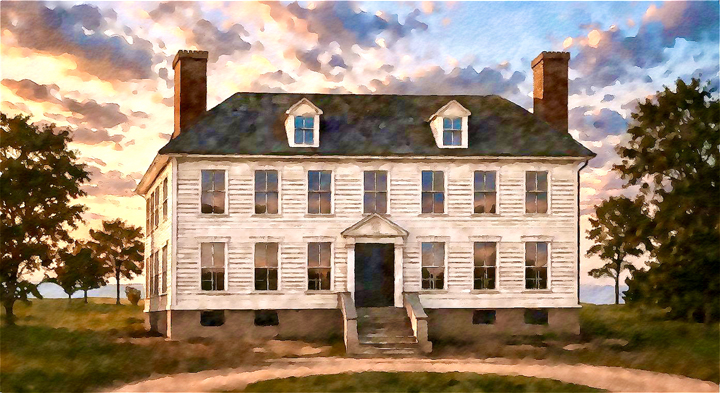
 There is no record of the exact hour Emmerich’s troops reached the target. As the narrow valley opened, the first of the outguard farms lay on a hill to the right. It belonged to Peter Van Tassel, a member of the Westchester Committee of Safety. Across the road and closer to it was the home of a cousin, Cornelius Van Tassel, a 2nd lieutenant in the militia. Like most of their neighbors, the Van Tassels were of Dutch extraction (Peter’s gravestone reads “Petrus Van Tessel”).[14] Both were tenant farmers on the vast manor of the Philipse family, living in modest farmhouses built by their grandfathers.
After their fifteen-mile march through sleet and snow, the men of Emmerich’s Chasseurs must have been soggy and cold. They had been drilled to rapidly form divisions, and now would have split quietly to surround the two farms at the same time.
Did they break in the doors? There was a “tumult” of shouting and screaming. At what point did Emmerich realize that his intelligence was out of date? There were not eighty to ninety of the enemy at these houses or in these barns. In fact, the only people present were the two men, their wives, and their four children. The Patriot troops had been withdrawn to another location.
The frustration must have been intense. Joshua Barnes shouted, “The houses are both owned by damned rebels—burn them!”[15]
Most of what we know about what happened next comes from interviews almost seventy years later with John Romer, who married the daughter of Cornelius Van Tassel in 1793. Given his family connection, we know something of what happened in the home of Cornelius; he can be forgiven for believing Cornelius was a focus of the raid. In fact, a 2nd lieutenant in the militia was no one’s idea of a prize. The sole prize, if any could be found in such a crushing disappointment, was Peter Van Tassel, the member of the Westchester Committee of Safety.
Since 1775 Committees of Safety had proliferated across the colonies, acting as pseudo-legal authorities, not only organizing local militias but investigating, disarming, and jailing anyone suspected of maintaining loyalty to the Crown. Though most committees strove to work within the laws of their fledgling states, new laws multiplied and violent mobs rushed to enforce them. Loyalists fled from persecution only to have wives and children turned out of their homes and their properties confiscated. In the early years of the war, Committees of Safety were the oppressive hand of local power. Naturally, committeemen, as the face of this new scourge, were reviled by British and Loyalists alike.
In the attack on Peter Van Tassel, Loyalists in uniform—many of them, like Joshua Barnes, hounded from Westchester—smashed doors and windows, plundered the house of provisions and clothing, drove livestock out of their enclosures, and managed the frightened animals in the road. Others set fire to the house and barn. Joshua Barnes “with his own hand took the Traitor Van Tassel,” Tryon noted approvingly.[16] We know nothing about what happened to Peter’s terrified wife Catriena or their boys Peter and John, aged eleven and nine.
Across the road the same blitzkrieg struck the farm of Cornelius Van Tassel. Like Peter, Cornelius was given only enough time to pull on breeches with his shirt before he was wrestled out into the dark, a prisoner. In the bedlam of crashing and shouting, his wife Elizabeth, clad only in her shift, searched in a frenzy of terror as the house began to burn. Where was Leah, their two-year-old? At last a Loyalist heard her panicked screams and led her to where he had carried the child outside, wrapped in a blanket, and placed her safely in the snow.[17]
Meanwhile their son Cornelius, Jr., at eighteen a private in Hammond’s regiment, fled upstairs. As the choking smoke rose he managed to climb out onto the house roof. In his nightshirt he clutched the chimney until the flames burned close. He then leapt to the ground, evading the soldiers, and ran for the river. When he splashed through the icy, rocky shallows in the dark his pursuers turned back. He would spend the night wet and huddled in a small cave on the side of Beaver Mountain.[18]
Brigadier General Samuel H. Parsons would write indignantly to Congress of the raid’s “most savage barbarity, strip[p]ing the clothing from women and children and turning them almost naked into the street in a most severe night.”[19]
By now houses, barns, and haystacks were all blazing. Livestock milled in the road. Peter and Cornelius Van Tassel each had his hands bound and a rope knotted around his neck; Parsons’ brigade major recalled that they were “barefoot, on the icy ground.”[20]
In coming centuries the burning of other houses and buildings around Philipsburg would be mistakenly ascribed to this raid. The Van Tassel farms were always the objective, and the Continental lines were only four miles away.[21] Moreover Ludington and Hammond’s men—the outguard Emmerich had hoped to capture—were out there somewhere and might attack at any moment, drawn by the glow of the fires.
Now it was time for the long return march to Kingsbridge. In nearby Rye a man recorded, “By much the coldest day we have had this season,—the sleet and Snow of yesterday, & the severety of this day indicates an early approach of Winter.” The column formed; the ropes of the stumbling prisoners were taken up. Over the hours of the march the Van Tassels were, Parsons wrote, “led with halters about their necks, with no other clothes than their shirts and breeches, in triumph to the enemy’s lines.”[22]
It was far from the triumph Emmerich had hoped for. His chagrin must have been acute on meeting his waiting reinforcements, and with two hundred troops escorting to camp two prisoners. Still, the night’s work must be celebrated. Rivington’s New-York Loyal Gazette reported:
On Tuesday evening, was deposited in the custody of the Provost of this city, Peter Van Tassell, commonly stiled the Indian King [a slurring reference to a Van Tassel’s interracial marriage 150 years earlier] . . . Van Tassell has long distinguished himself as an active committee-man, and a furious persecutor of the friends to the constitution. Captain Emmerick’s party brought to their encampment a considerable quantity of live stock and other provisions.[23]
In the stone provost the cousins were thrust into an upper cell crowded with eighteen other prisoners. One was John Fell, a judge and the chairman of the Bergen County, New Jersey Committee of Safety, himself captured for his reputation as “a great Tory hunter.” For the two days before the Van Tassels arrived, the judge wrote in his journal, “Jail exceeding disagreable—many miserable & shocking objects nearly starved with cold & hunger—miserable prospect before us”; and, “Last night exceeding cold.”[24] In shirts and breeches the Van Tassels must have suffered.
Two days later, at the Continental headquarters in Mamaroneck, Parsons received intelligence that Tryon had issued orders for Tarrytown to be burned that night. Ludington’s militia must have been alerted and a party sent from Mamaroneck to patrol against the enemy. Parsons also passed the information to Col. Samuel B. Webb, whose regiment at Rye would lie on its arms, ready to be called out in Tarrytown’s defense.[25] In the meantime Parsons wrote a letter to Tryon, hoping to forestall more destruction.
A month earlier had seen Sir Henry Clinton’s campaign up the Hudson under Maj. Gen. John Vaughan. To provide an attention-grabbing diversion in support of the embattled northern army under Burgoyne, 1,600 troops were landed in flat boats at different places for one hundred miles up the river to wreak destruction. While laying waste to the Continental cantonment at Peekskill made strategic sense, as did destroying rebel sloops and grain mills, the burning of hundreds of civilian homes seemed wanton. The entire town of Kingston, third largest in the state, was reduced to ashes. “Is it thus your King’s Generals think to make converts to the royal cause?” Gen. Horatio Gates wrote to Vaughan. Two days after the ruin of Kingston, the British had burned Clermont, the elegant Livingston family mansion at Livingston Manor.
Now Parsons wrote to protest the burning of the Van Tassel farms as another example of the British forcing noncombatants into poverty and despair:
Had any apparent Advantage been derivd. from burning the Houses on Phillips’s Manor last Monday Night, there would have been some Appearance of Reason to justify the measure; but when no Benefit can result from destroying those Buildings, and Striping the Women & Children of necessary Apparel to cover them from the Severity of a Cold Night, & leading off the captivated Heads of those Families in Triumph to your Lines in a most ignominious Manner, I cannot assign a justifiable Cause for this Act of Cruelty. Nor can I conceive a Reason for your further Order to destroy Tarry-Town.[26]
Tryon must be aware, Parsons wrote, that on any given day he could order the burning of the houses and buildings on the Westchester estates of wealthy Loyalists Frederick Philipse and the DeLancey family. In fact Tryon could not protect a single building north of Kingsbridge, should the Americans choose to destroy it. It was not fear or lack of opportunity that had kept those buildings safe, but “a sense of the Injustice & Savageness of Such a Line of Conduct.”[27]
He had no desire to make war on civilians, Parsons explained, but in justice he would be forced to retaliate if Tryon did not explicitly disavow the destruction by Captain Emmerich and Captain Barnes and convince him that the farmhouses were burned without Tryon’s knowledge or orders.[28]
Tryon’s reply on Sunday, November 23, dripped with contempt. “Could I possibly conceive myself accountable to any Revolted Subject of the King of Great Britain, I might answer your Letter received by the Flag of Truce yesterday, respecting the Conduct of the Party under Captn. Emmericks Command upon the taking of Peter and Cornelius Vantassel.” He continued:
I have however candor enough to assure you, as much as I abhor every principle of Inhumanity or ungenerous Conduct, I should, were I in more Authority, burn every Committee Man’s house within my reach, as I deem those Agents the wretched Instruments of the continued Calamities of this Country, and in Order the sooner to purge this Colony of them, I am willing to give Twenty Silver Dollars for every Acting Committee Man who shall be delivered up to the King’s Troops. I guess before the end of the next Campaign they will be torn to pieces by their own Countrymen whom they have forcibly dragged, in Opposition to their principles and Duty, (After fining them to the extent of their Property) to take up Arms against their lawfull Sovereign, and compelled them to Exchange their happy Constitution for Paper, Rags, Anarchy and Distress.
The Ruins in the City of New York, from the Conflagration by the Emissaries of your Party Last Year, remain a Memorial of their tender regard for their fellow beings, exposed to the severity of a cold Night.[29]
Tryon’s letter was received by flag at Mamaroneck and read on Monday, November 24.[30] There is no doubt the letter rankled.
In Congress, William Ellery of Rhode Island read it and found it both impudent and threatening, “an insolent haughty letter.”[31] In the Hudson valley, Robert Livingston, his son-in-law James Duane, and the loyalist lawyer William Smith, Jr. also discussed it.
Livingston mused, “Is it a violent letter?”
“It is warm,” said Smith.
“It is a silly letter,” James Duane said. “He is mad. I believe he drinks.”
“He has a warm zeal,” Smith repeated.
“He is a disappointed man. He must have been drunk or mad.”[32]
But Tryon was perfectly satisfied. He sent copies of both letters to the Secretary of State Lord George Germain in England, writing coolly, “By the inclosed correspondence between me and Genl Parsons, your Lordp may judge of the tone I think should be held toward the rebels.”[33]
Someone closer to hand, however, had more insight into likely American reaction to that tone. Both letters were given to Samuel Loudon’s New-York Packet in Fishkill, and over the next month they would be reprinted across the states, accompanied by what seems to have been Loudon’s own commentary (edited by Loyalist newspapers).
“The following two letters which passed between Gen. Parsons and Gen. Tryon, show the line of conduct the [British] mean to pursue,” the editor warned. “Some instruction may be learnt from the scope—it exhibits their determined intention to burn and lay waste our habitations and imprison our persons. They will drive us to retaliate with equal severity, if they go on this way.”[34]
[1] Sunset that day was 4:38 PM, timeanddate.com. Departure time: Andreas Emmerich to William Tryon, November 15, 1777. University of Michigan, William L. Clements Library, Sir Henry Clinton Papers, (“SHC Papers”) Vol. 26, item 40. Courtesy of Todd W. Braisted.
[2] Descriptions of Emmerich: “McDonald Papers, 1844-1850,” manuscript, Westchester County Historical Society, Elmsford, NY. (“McDonald Papers”) interviews with: Mrs. Daniel Edwards, 111; Andrew Corsa, 132; Daniel Odell, 215; John Williams, 836. Dread: Rebecca Odell interview, ibid, 447; a boy: Frederick Post interview, ibid., 424.
[3] Emmerich background: Todd W. Braisted, Grand Forage 1778: Battleground Around New York City, Westholme (Yardley, PA: 2016), 18; “good rifle men”: Henry Clinton to William Howe, October 15, 1777, SHC Papers, Vol. 263, Miscellaneous Correspondence 1776-1782. Courtesy of Todd W. Braisted. Only 50 of the first 100 were furnished with rifles.
[4] Dashed from the water: Independent Chronicle, Boston, October 16, 1777; severe disciplinarian: Philemon Fowler interview, “McDonald Papers,” 510. Cow tieves: Frederick Post, whose father was caned, ibid., 421.
[5] Emmerich to Tryon, November 15, 1777.
[6] Tryon himself: Clinton to Sir William Howe, August 23, 1777, SHC Papers, Vol. 263, Miscellaneous Correspondence 1776-1782. Courtesy of Todd W. Braisted.
[7] nearly a third: Tryon to Sir Henry Clinton, December 8, 1777, SHC Papers, Vol. 28, item 17. Courtesy of Todd W. Braisted. Emmerich testified at Barnes’ court martial for cowardice in 1779 that he’d been informed of Barnes’ plundering at Ft. Montgomery and been urged to arrest him, but replied that Barnes “belonged to another Corps, & had a large family, and he would endeavour to get rid of him.” Great Britain, Public Record Office, War Office Papers, Class 71, Volume 88, Pages 373–392, courtesy of Todd Braisted.
[8] Andreas Emmerich, The Partisan in War, of the Use of Light Corps to an Army (London: H. Reynell, 1789), 32.
[9] 2 AM: Emmerich to Tryon, November 15, 1777.
[10] Hammond commanded: Col. Joseph Drake resigned July 24, 1776; Hammond served in command and was commissioned colonel in 1778. founders.archives.gov/documents/Washington/03-06-02-0191; Clinton ordered: Clinton to Henry Ludington, August 1, 1777, Public Papers of George Clinton, First Governor of New York (Albany: Wynkoop Hallenbeck Crawford Co, 1900), 153. In October Ludington reported their combined force: “One Colonel, 1 Lt. Colonel, 5 Captains, 10 Leutennants, no Ensign, no Chaplain, 1 Adjutant, 1 Quartermaster, 1 Surgeon, no Surgeons mate, 19 Sergeants, 9 Drummers and Fifers, 182 present fit for duty, 19 sick present, 3 Sick Absent, 19 on command, 10 on Furlough, Total 233 present fit for duty.” The major was on furlough. Willis Fletcher Johnson, Colonel Henry Ludington, A Memoir, printed by his grandchildren Lavinia Elizabeth Ludington and Charles Henry Ludington (New York: 1907), 104.
[11] Ludington to Israel Putnam, October 4, 1777, Michael J. Crawford, ed., Naval Documents of the American Revolution, Vol. 10 (Washington, DC: Naval Historical Center, 1996), 36. The same letter is in the memoir above, with spelling corrected.
[12] The troop division was described by Samuel Youngs, militiaman and son of Joseph Youngs (at whose house at the crossroad the northern half was stationed) in multiple pension applications, e.g.: Abraham Requa, New York, No. W17521, Collection M-804, Pension and Bounty Land Application Files, National Archives and Records Administration. 6.
[13] Emmerich to Tryon, November 15, 1777; Tryon confirmed approval of reinforcements: Tryon to Clinton, November 17, 1777, SHC Papers, Vol. 28, item 6. Courtesy of Todd W. Braisted.
[14] www.findagrave.com/memorial/275089630/petrus-van_tessel.
[15] Tumult, burn them: “McDonald Papers,” 1845 interview, Capt. John Romer. 176.
[16] From Westchester: two names in Emmerich’s first extant muster roll are Jacob Storms, part of Barnes’ detachment, and Abraham Storms, enlisted February 2, 1778. National Archives of Canada, RG 8, “C” Series, Vol. 1891, courtesy of Todd W. Braisted; own hand: Tryon to Clinton, December 8, 1777. The wife of Cornelius Van Tassel was Elizabeth Storms.
[17] In the snow: “McDonald Papers,” 1845 interview, John Romer. 276.
[18] Little is known of Cornelius Van Tassel, Jr. (b. 1759) beyond his military record. I use the testimony of his post-mortem brother-in-law, John Romer, ibid., adding the local story of the cave. Romer mentions his escape, but only says “he caught a cold of which he never recovered and died of consumption.” Though many histories state Cornelius Jr. died in 1780, he served through the war and died in 1785, seven years after the attack. In 2012 an enterprising blogger retraced Junior’s steps and found the cave on Beaver Mountain. archivesleuth.wordpress.com/2012/02/02/the-search-for-farcus-hott/.
[19] Samuel H. Parsons to Henry Laurens, December 2, 1777, Charles S. Hall, Life and Letters of Samuel Holden Parsons (Binghamton, NY: Otseningo Publishing: 1905), 128.
[20] Barefoot: Col. David Humphreys, The Life and Heroic Exploits of Israel Putnam (Hartford: Silas Andrus and Son, 1850), 156.
[21] Other places: John Romer (McDonald Papers, 1061) stated that the home of Capt. Israel Honeywell, Jr. was burned on this raid. Honeywell descendants petitioned Congress until 1860 for compensation and specified the house burned in 1778. U.S. Congress, Senate Report 36-240, The Committee on Revolutionary Claims to whom was referred the petition of the heirs of Israel Honeywell, deceased …, www.govinfo.gov/app/details/SERIALSET-01040_00_00-037-0240-0000; the Storms tavern is likewise said to have been burned at this time. It was not. Lucille and Theodore Hutchinson, Storm’s Bridge: A History of Elmsford, 1700-1976 (Elmsford Historical Society, 1980), 35. Four miles: Parsons to Laurens, December 2, 1777, Life and Letters, 128.
[22] Coldest: Worthington Chauncey Ford, ed., Correspondence and Journals of Samuel Blachley Webb, Vol. I (New York, 1893), 236; led with halters: Parsons to Laurens, December 2, 1777.
[23] Rivington’s New-York Loyal Gazette, November 22, 1777, says Peter was captured “with two others.” There is no record of a third prisoner. “Indian King”: In the 1620s a Van Tassel ancestor married the daughter of the chief of the Montauk tribe; from 1680 descendants—not Peter—had sued for the bride’s share of land, today known as Eaton’s Neck, Long Island. The ancient background as “part-Indian” was familiar to many in Philipsburg. Daniel Van Tassel, Van Texel … Van Tassel: The Descendants of Jan Cornelissen Van Texel 1625-1704, A Family History (Holland Society of New York, 1941), 1-2.
[24] John Fell, “Memorandum in the Provost Jail, N.Y. from Ap 23 1777 to Jan 7, 1778.” Unpaged ms., Center for Brooklyn History, Brooklyn, NY. Fell notes the arrival of the Van Tassels; no third man.
[25] Received intelligence, lie on arms: here is source of story that Tryon ordered the burning of Tarrytown — evidently a spy report. Nothing resulted. Correspondence and Journals, 237.
[26] There are three versions of Parsons’ letter, all slightly different: a copy Tryon sent to Germain, a copy Parsons sent to Congress (Samuel H. Parsons to William Tryon, November 21, 1777. Henry Laurens Correspondence 1762-1780, Folder: Vol. 1, 22-27, Historical Society of Pennsylvania, Philadelphia) (HSP), and a copy published in the Fishkill New-York Packet (December 18, 1777) and then around the country. The last is the most polished and most widely read. I quote the copy Parsons sent to Congress.
[27] Ibid.
[28] Ibid.
[29] William Tryon to Samuel Parsons, November 23, 1777, E.B. O’Callaghan, ed., Documents Relative to the Colonial History of the State of New-York. Vol. VIII (Albany: Weed, Parsons, and Co., 1857), 736.
[30] Read on Monday: Though the Fishkill paper says it “came out” on Sunday, Webb’s journal above indicates he and Parsons rode that afternoon to Fairfield. Parsons specifies receiving it Monday. Parsons to unidentified “Colonel,” December 4, 1777, Henry Laurens Correspondence 1762-1780, Folder: Vol. 1, 43-47, HSP.
[31] Insolent, haughty: William Ellery to William Whipple, December 21, 1777, Paul H. Smith, ed., Letters of Delegates to Congress, 1774-1789 (Washington, DC: Library of Congress, 1981), 8:454.
[32] Drunk or mad: William H. W. Sabine, ed., Historical Memoirs of William Smith from 12 July 1776 to 25 July 1778 (Colburn & Tegg, 1956), 275.
[33] Tryon to Lord George Germain, December 1, 1777, Documents, 735.
[34] Royal Gazette (New York), December 27, 1777.


7 Comments
Excellent article as as all that I have read
Some trivia is that John Paulding served in Luddington’s Regiment of Levies and Isaac Van Wart served in Cormelius Van Tassell’s militia company. Both went on to capture Major John Andre 9/23/1780.
Excellent and insightful article!
It gives me an idea of what my ancestor, Benjamin Lattimore, might have gone through as he was held captive by Capt. Emmerich and Capt. Barnes after the capture and burning of Fort Montgomery. Benjamin was freed when Emmerich’s Chasseurs were captured in early 1778 near Tarrytown NY. He was subsequently sent back to his regiment, Col. Louis Dubois/5th NY lying in New Windsor, and fought in the Clinton-Sullivan expedition until his 3 years enlistment was up.
Thank you, Terry. I’m writing a follow-up article to this one that I hope to close with that January 1778 attack that captured Barnes and his men. I have considerable difficulty keeping the articles short enough.
Ms. West,
Please let me know when you write your new article.
Thank you!
Thanks, Terry. I turned in the follow-up article a couple of months ago and it should appear here soon. Space was so tight that the January 1778 episode would require a third article. Maybe eventually! I’m working on some Connecticut articles now.
Well researched and written in a style that made the history not only informative but enjoyable to read.