


“If I have erred in Construing the words or meaning of Genl Arnolds orders I hope it will be considered as an error in Judgement, a Defect in the head and not in the heart”[1]
Col. Timothy Bedel made this request while facing trial in July 1776. He had been charged with “quitting his post” at Fort Cedars during the disastrous final weeks of the Canadian campaign. Despite his appeal, the court found him guilty. He was removed from Continental service and sent home in disgrace.
But Bedel proved too valuable to remain sidelined from the war. Within months he began providing vital intelligence to Northern Army leaders. By the end of 1777, he once again commanded a Continental regiment. Timothy Bedel’s rise to prominence at the start of the Revolution, his sudden fall into disgrace, and rapid redemption, provide the framework of an illuminating Patriot’s journey. Bedel’s story also manifests several underlying complexities of the Revolutionary War in the north.
Rise
Timothy Bedel’s beginnings are obscure; by an aggregation of documentary sources, he appears to have been born in Salem, New Hampshire, around 1737. The pronunciation of his last name, sounding like “beetle,” is made clear by the many phonetic spelling variations found in records and correspondence surrounding his military career. Timothy Bedel first found his place in the historical record during the French and Indian War. From the age of seventeen, he served each year of the conflict, 1754 to 1763. Bedel’s duties took him to Halifax, Louisbourg, Quebec, and from Lake Champlain to Montreal. He took part in ranging, sieges, combat, and road-cutting. Rising from the ranks, he was eventually commissioned as a ranger lieutenant under William Stark and John Hazen. In 1762 he was captain of a company garrisoned at Crown Point.[2]

Timothy Bedel also carved out an important civilian role in colonial settlement on the upper Connecticut River valley. While returning from the capture of Montreal in 1760, he and fellow New Hampshire officers John Hazen and Jacob Bayley were enthralled by the rich oxbow meadows of the valley’s Co’os Country. Hazen and Bayley spearheaded regional settlement. Bedel joined as an original grantee in the townships of Haverhill, Bath, and Newbury. In 1763, Timothy Bedel and his wife Elizabeth established themselves in Haverhill. Over the next several years, fellow townsmen elected him as assessor, town clerk, moderator, and selectman.[3]
By the time the Revolutionary War began, Timothy Bedel emerged as the man that New Hampshire neighbors turned to for leadership. John Hazen had died a year earlier, and Jacob Bayley was focused on Vermont politics across the river in Newbury. In May 1775, Bedel represented Bath township in a Co’os regional assembly and was elected colonel of the local militia regiment.[4]
Later that month, Bath townsmen sent Bedel to the New Hampshire Patriots’ capital in Exeter as their representative to the Fourth Provincial Congress. That assembly soon received reports that Canada’s indigenous Seven Nations confederation had been persuaded to take up arms against the Americans. The congress commissioned Bedel to enlist a ranger company that would guard against a repetition of those Indians’ deadly colonial-war raids on the northern frontiers. That summer he was given command over two additional ranger companies, with the commensurate New Hampshire provincial rank of colonel. The congress also asked Bedel to pursue diplomatic solutions to “gain and keep the friendship of the Indians.” Scattered primary source statements show that Bedel and Jacob Bayley coordinated with friendly western Abenakis and Seven Nations Kahnawakes that summer.[5]
By early August 1775, the New Hampshire Committee of Safety grew confident that the immediate military threat to the frontiers from Canada’s Seven Nations had been overblown, so it offered Colonel Bedel and his rangers up for service with the Continental Northern Army. The committee specifically recommended Bedel as “a person of great experience in War, and who is well acquainted with Canada.” Maj. Gen. Philip Schuyler accepted the offer, ordering the colonel and his rangers to join the imminent invasion of Canada. A fourth volunteer ranger company joined Bedel’s command as it headed north.[6]

On September 17, the very evening that Bedel and his New Hampshire rangers entered Canada, Brig. Gen. Richard Montgomery launched an operation to invest the key British frontier post at Fort St Johns. Bedel and his men played a key battle role, cutting the fort’s communications with the rest of Canada to open its siege. According to reports, Bedel “behaved exceeding well in that affair.”[7]
For the next six weeks, Montgomery focused his attention inward from Fort St Johns siege lines. He gave Bedel responsibility for overseeing operations outside the lines, ranging out to the St. Lawrence River. Bedel guarded against British relief efforts, coordinated Canadian provisions, and fostered local relations. His efforts directly contributed to the fall of Fort St. Johns and Montreal, culminating in the capture of eleven British ships on the St. Lawrence on November 19. Immediately after that last crowning victory, Bedel’s rangers headed home. Their 1775 enlistments complete, the New Hampshire companies disbanded.[8]
Throughout the fall campaign, Timothy Bedel had also been playing a critical diplomatic role. He acted as a key liaison with Canada’s Seven Nations Indian confederation. Bedel advised Montgomery on proper Native protocol, regularly visited with friendly chiefs, and delivered a speech with accompanying gift to the central council fire at Kahnawake, revitalizing the confederacy’s neutrality. An American associate claimed Bedel “had the greatest influence over the Indians of any man.” Sadly, there are only faint hints of how he might have developed his particular acumen for Native relations.[9]
The colonel continued his Indian diplomacy even while homeward bound from Canada. He escorted a Kahnawake delegation across Lake Champlain on its way to Albany for a treaty conference with Continental Indian commissioners. Before Bedel and the Native ambassadors parted ways, he promised to meet them again at Cambridge. That was where the Kahnawakes intended to hold a post-treaty council with Gen. George Washington.[10]

By the time Timothy Bedel returned home to Co’os country in late December 1775, he was a proven Continental leader: he had exhibited battlefield and operational command skills, supported Canadian civil-military affairs, and played an essential role in Native diplomacy. Even though Washington did not have a direct relationship with Bedel, he acknowledged that by the end of the war’s first year, the colonel had developed a reputation as a man of “spirit and influence.”[11]
Disgrace
Bedel’s fortunes shifted dramatically in early 1776. The colonel had only warmed by his home hearth for a couple weeks before news arrived that General Montgomery had died in a failed attempt on Quebec City. Congress and the colonies scrambled to shore up the Continental Cause in the north. Bedel soon faced competing demands. Just as he prepared to rejoin the Kahnawake delegation at Cambridge, the New Hampshire committee of safety delivered a colonel’s commission. Bedel was appointed commander of a new eight-company regiment to immediately join the army in Canada.[12]
Formation of this regiment proved far more complicated than the committee imagined. Colonel Bedel needed three times as many men as he had in the last campaign, yet with the unit’s late establishment, many of the valley’s best soldiers were already recruited into other regiments. Essential money, muskets, and supplies were extremely slow to reach the Co’os muster point at Orford. As weeks slipped by, the committee started questioning the unanticipated delays. Bedel grew testy in his correspondence. His relationship with key leaders in Exeter frayed.[13]
Meanwhile, the Kahnawake diplomatic delegation lingered at Cambridge under Washington’s care, waiting for Bedel “before they open[ed] themselves fully.” When it became apparent that the colonel was preoccupied with his new regiment and would not be coming anytime soon, Washington finally persuaded the chiefs to complete their diplomatic formalities without Bedel. Yet Washington still tasked the colonel with ensuring the Kahnawakes’ safe return to Canada. Bedel rejoined them at Exeter, making travel arrangements and encouraging the committee of safety to give diplomatic gifts to the chiefs. At that time, Bedel wrote that he had “the affairs of the Indians . . . much at heart.”[14]
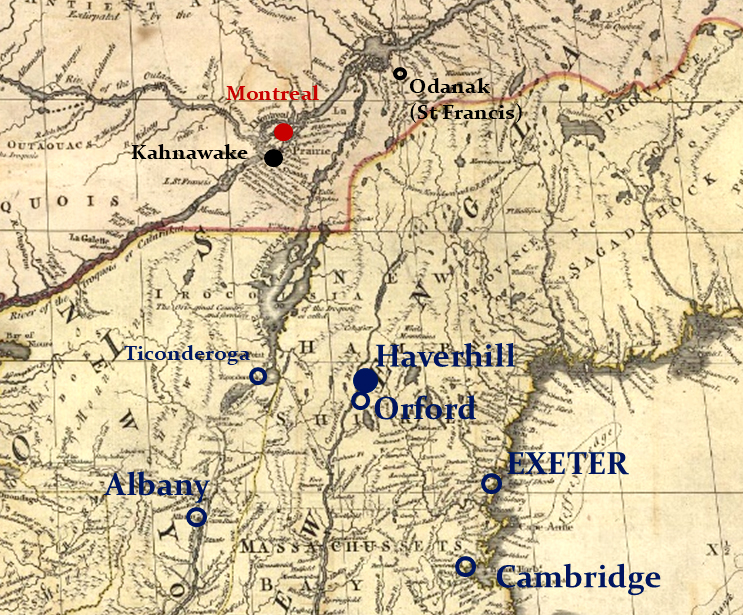 With the urgent military crisis in Canada, Washington ordered Colonel Bedel to send his individual ranger companies to Canada as soon as they were ready. The regiment marched north piecemeal. The first waves of rangers went past Montreal to join the army outside Quebec City. Meanwhile, the colonel remained behind in New Hampshire to ensure the last companies were mustered. As a result, he did not reach Montreal until April 20.[15]
Continental commanders in Montreal had been warned that a combined British and Indian attack was coming from the Great Lakes, so Brig. Gen. Benedict Arnold promptly dispatched Bedel to defend the western St. Lawrence and Ottawa River approaches. Arnold wrote: “I have found it necessary to order Colonel Bedel . . . to the Cedars, a very important post, fifteen leagues above [Montreal] . . . to guard against a surprise from the enemy or their Indians.” Bedel only had 260 of his own rangers with him, so Arnold augmented the command with various Continental detachments. This brought the colonel’s task force to about four hundred men. Bedel also recruited his own Kahnawake Indian scout company to better warn of the enemy’s approach.[16]
Meanwhile, the American army was fighting an invisible enemy: smallpox. At any time, about one fifth of Bedel’s soldiers were rendered ineffective by the disease. Some contracted it by natural contagion, others through inoculation—including Bedel himself. As a result, the colonel was incapacitated by the worst smallpox symptoms for a few critical weeks. He was indisposed the entire time that his men constructed their fort at the Cedars.[17]
Colonel Bedel had recovered sufficiently to travel to Fort Cedars on May 6, 1776. Coincidentally this was the very day that a much-anticipated British relief fleet appeared two hundred miles down the St. Lawrence, at Quebec City. The enemy’s arrival sent the main Continental army into a panicked retreat from their northern St. Lawrence valley posts back toward Montreal. The rapidly deteriorating American position triggered legitimate alarm among friendly Kahnawake chiefs. They urgently called Bedel to join them in council. The colonel believed Arnold’s orders included a responsibility “to Cultivate a friendship with the Indians,” so he left Fort Cedars for Kahnawake on May 15. Bedel was well aware that the enemy might attack any day, but with the fort and its defenders in reasonable order, he assessed little risk in leaving the post to his inexperienced deputy, Maj. Isaac Butterfield.[18]
Conditions evolved rapidly from there. Timothy Bedel was busy with the Kahnawake council when two scouts interrupted. They announced that hundreds of enemy warriors and redcoats had been spotted upriver from Fort Cedars. The colonel’s heart told him to rush back to the fort before they attacked, but Kahnawake chiefs implored him to go to Montreal first. They wanted him to share their immediate security concerns with senior Continental leaders in the city before going off to the fort. Bedel weighed the options; his choice to appease his Native allies ultimately set him on the path to his undoing.[19]
Colonel Bedel rushed downriver to Montreal and discussed the situation with military commanders and Congressional commissioners there. They set reinforcements off to Fort Cedars. Bedel intended to join them, but resurgent smallpox symptoms forced him to abandon the march. While the colonel was again laid up, word reached Montreal that Major Butterfield had already surrendered Fort Cedars and all his men to the British with nary a fight. This major military catastrophe was capped by reports that Indian enemies tortured and murdered some prisoners. Americans were outraged by this shameful defeat. The court of public opinion—in the army and back in the colonies—rushed to condemn both Butterfield and Bedel as cowards. A few voices even suggested execution was an appropriate punishment.[20]
General Arnold placed Bedel and Butterfield under arrest, but the army’s retreat from Canada delayed a court martial for two months. Bedel faced charges of “quitting the Post at the Cedars.” Since the colonel had never received written orders explaining his full range of responsibilities, his legal defense hinged on interpretation of Arnold’s verbal direction. Bedel believed he had not just been responsible for the fort, but “all that part of the Country—and in Particular to attend to the Cultivation of a friendship with the savages.” Being responsible for much more than just the one fort, he maintained that attendance at the Kahnawake council was a perfectly legitimate place for him to have been. His arguments proved to be in vain.[21]
With widespread expectations that Bedel and Butterfield must be held to account, the court found the colonel guilty and sentenced him to be cashiered from the army—meaning he was stripped of both his rank and regimental command. This was not the harshest verdict. For timidly surrendering Fort Cedars, the court cashiered Butterfield and he was explicitly “incapacitated forever . . . to hold a commission in the Army of the United States.” The major’s sentence implicitly impugned him with cowardice in battle. When Maj. Gen. Horatio Gates confirmed the judgment on August 1, 1776, it seemed Timothy Bedel’s military career must surely be over.[22]
Redemption
In the course of wartime events, it was just a mere matter of months before Northern Army leaders again called for Bedel’s assistance. His unique set of talents and connections seemed indispensable. By early 1777, he was coordinating spy operations from the Co’os into Canada. Native partners—including Louis Cook, Joseph Louis Gill, and Lewis Vincent—and Canadian Joseph Traversie brought him valuable intelligence on British forces and intent. Bedel diligently forwarded their spy reports to Schuyler and Gates.[23]
Bedel also implemented a novel strategy to defend the northern frontier. He encouraged and supported St. Francis-Odanak Abenakis to voluntarily settle on the Connecticut valley’s northern reaches. Bedel saw their presence as a means to deter or provide early warning of any Native raids from Canada. Additionally, the resettled Abenakis would be removed from immediate British influence. They might even provide warrior allies. Continental Indian commissioners supported his efforts. [24]
By September 1777, forty-four Abenaki families relocated to the Connecticut Valley under Bedel’s scheme. On October 4, just days before the final battlefield showdown at Saratoga, Gates called for Bedel to bring all available Abenaki warriors to join the American army. The colonel gathered thirty-three warriors, but the campaign concluded before they could join the decisive victory.[25]
In a surprising development, on November 10, 1777, Gates followed up by commissioning Bedel as colonel of a Continental volunteer regiment. This came just fifteen months after the same general had approved Bedel’s stinging Cedars court-martial verdict. It was an exceptional turn of events. Bedel appears to be the only senior Continental officer to return to active command after being cashiered for combat performance. Gates had presumably gathered confidence in the colonel’s skills and importance in the Co’os Country that year. The general tasked Bedel with recruiting five hundred of the region’s “best woodsmen, hunters, and Indians” for five months’ service, ostensibly to help retake New York City. Secretly, their intended mission was a winter raid on Canada’s Fort St. Johns.[26]
By early 1778 however, the Gates-led Continental Board of War transformed the already audacious St. Johns scheme into an outlandish plan for another Canadian invasion. Bedel redoubled intelligence-gathering efforts and pre-positioned provisions in Co’os country. But when the Marquis de Lafayette reached Albany as the invasion commander, the Frenchman realized the Board of War had “shamefully deceived” him. His would-be army was completely inadequate. Lafayette immediately ordered Bedel to hold his men in position on the Co’os. Then in late March, just before the volunteers’ short enlistments were due to expire, the French commander directed Bedel to extend his regiment under Continental service to a full year. They were “to Guard the frontiers and to scout.” Bedel’s command received an extended lease on life.[27]
By the summer of 1778, Bedel had to face a new set of complications rooted in regional politics. New Hampshire’s Connecticut Valley townships felt unrepresented by the state government in Exeter, operating under a constitution they had never ratified. The towns decided to join neighbors on the other side of the river and requested incorporation in the self-declared state of Vermont. Meanwhile, Bedel cooperated with that unrecognized state’s leaders for common defense of the northern frontier, fueling Exeter officials’ suspicions of him and his odd regiment. Politically, New Hampshire president Meschech Weare credited Bedel with “a great share in the disorders” taking place on his state’s western border.[28]
Even with the political complications, General Gates still saw Bedel as a vital contributor to New England’s frontier defense. The colonel regularly reported that his men were quite busy in the Co’os, guarding supply magazines, scouting, and cutting a military road to Canada. Yet Bedel’s immediate commander, New Hampshire’s Gen. John Stark, shared the Exeter party’s suspicions that Bedel never had all the men listed on his rolls. The colonel’s home-state detractors assumed he must be cheating the Continental government of ghost soldier’s wages and rations. Stark tried to force a complete regimental muster in Albany; but his scheme came to naught when Bedel’s Continental volunteers insisted that their enlistments applied only for northern frontier duty. The Connecticut Valley men would not leave their territory just to report to Stark. Finally, Washington recommended that Bedel send Lt. Col. John Wheelock, the regiment’s second-in-command, to Philadelphia for resolution. On November 28, 1778, the Continental Congress solved all the confusion and complications by simply disbanding the unit.[29]
Congress’s solution did nothing to change the military facts on the ground that winter, though. With an omnipresent raiding threat from Canada, someone had to man northern frontier fortifications and guard magazines and communities. With local support, Bedel leveraged imprecise guidance from generals James Clinton and Jacob Bayley to keep between fifty and two hundred men under arms until Continental forces could arrive to properly relieve them. When Col. Moses Hazen finally reached the valley with Continental troops in April 1779, it marked the end of Bedel’s Continental army commands.[30]
Bedel still contributed to northern frontier defense over the next couple years. He continued intelligence operations, conducted Native diplomacy across the New England-Canadian borderlands, posted militia guard detachments at key points, and prepared supplies for another proposed invasion of Canada. Even though he only had local militia forces at hand, Bedel assured nearby Continental leaders that “If any Troops sho’d march into Canada, I am & shall be ready with a Number of Men & Indians to assist.”[31]
As Bedel stepped away from military command, he returned to politics. Haverhill townsmen soon elected him to local office. He served as a moderator or selectman from 1780 to 1784. When Connecticut Valley townships formally joined the state of Vermont in 1781, he represented Lyman, Morristown, Bath, and Haverhill in two assembly sessions that year. Bedel also served on his new state’s standing Board of War.[32]
The eastern township union with Vermont proved short-lived. In August 1781, the Continental Congress resolved that an “indispensable preliminary” for recognizing Vermont statehood within the American confederation was that it explicitly relinquish jurisdiction east of the Connecticut River. Vermont cut the eastern townships loose. Co’os Country representatives rejoined the New Hampshire legislature in 1783, with a new state constitution in development. Bedel returned to the capital in Exeter the following year as Haverhill’s representative. That was his last recorded government service.[33]
A Patriot’s Life in Retrospect
 Timothy Bedel died just a few years later, in February 1787. After a life of just fifty years, he departed as a well-respected Connecticut Valley leader. His Cedars disgrace was seemingly forgotten by all but his most ardent Exeter enemies. The upper Connecticut Valley was still distant from New Hampshire newspaper presses, so none of them published death notices, much less obituaries, to honor Bedel’s contributions to Co’os settlement and the American cause.
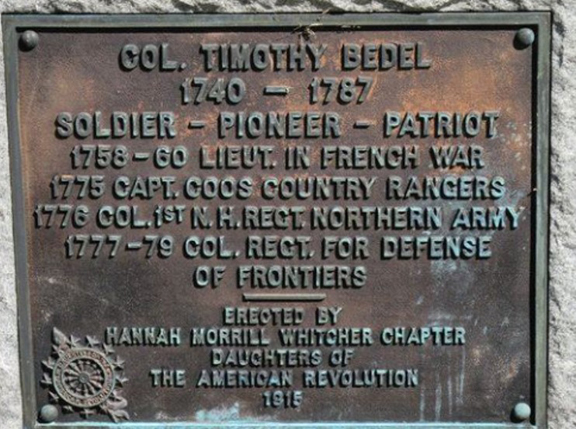
Significant public remembrance waited until 1915, when New Hampshire Patriots installed a memorial plaque for Bedel in Haverhill. As part of a commemorative address, historian Judge Edgar Aldrich summarized the Co’os leader’s life by rhetorically asking: “Who was Timothy Bedel?” He answered: “Soldier, Pioneer, Patriot, a man of the People, self-sacrificing servant of the People, a man of far-sighted vision, of unyielding purpose, of heroic achievements.” Timothy Bedel’s biography provides a micro-historical perspective of the upper Connecticut Valley in the Revolutionary Era. The colonel’s rise, fall, and redemption, serve as reminders that American leaders were in fact fallible. Good Patriots could still be at odds with each other, and that the war often called for great individual perseverance, resilience, and adaptation on the bumpy road to American independence.[34]
[1] Colonel Bedel’s Defence, Timothy Bedel Papers, New Hampshire Historical Society (NHHS).
[2] Biographical Information and October 3, 1762 commission, Bedel Papers, NHHS. Descendant accounts, repeated by many biographers, suggested that Bedel was a captain in the 1762 Cuba campaign. The author found no documentary evidence for this, and the documented milestones in Bedel’s 1762 timeline make it highly improbable.
[3] William F. Whitcher, History of the Town of Haverhill, New Hampshire (Concord, NH: Rumford Press, 1919), 15, 18, 21, 23, 42; John Q. Bittinger, History of Haverhill, N.H. (Haverhill, 1888), 418, 423; Biographical Information, Bedel Papers, NHHS.
[4] May 2, 1775 Committee Record, Bittinger, History of Haverhill, 166.
[5] New Hampshire State and Provincial Papers (NHSPP) (1878-1891), Nathaniel Bouton, Isaac Hammond, Albert S. Batchellor, eds., 7: 665; Committee of Safety to Timothy Bedel, June 6, 1775 and July 7, 1775, Bedel Papers, NHHS.
[6] George Washington to Philip Schuyler, July 27, 1775, Peter Force, ed., American Archives, 4th Series (AA4) and 5th Series (AA5), (Washington, DC: M. St. Clair Clarke and Peter Force, 1837–53), AA4 2:1736; Committee of Safety to Schuyler, August 7, 1775, NHSPP, 7:572; Richard Montgomery to Bedel, August 19, 1775, Philip Schuyler Orderly Book, Huntington Library.
[7] Bedel to Committee of Safety, September 23, 1775, AA4 3:779; Israel Morey to Committee of Safety, October 6, 1775, NHSPP, 7: 621.
[8] Bedel to Committee of Safety, September 23, 1775, AA4 3:779; Mark R. Anderson, “Stratagem and Hard Fighting: The Improbable Capture of Eleven British Ships,” allthingsliberty.com/2023/01/by-stratagem-and-hard-fighting-the-improbable-capture-of-eleven-british-ships/.
[9] Frye Bailey, “Colonel Frye Bailey’s Reminiscences,” Proceedings of the Vermont Historical Society (1923-1925): 38.
[10] Bedel to James Holmes, December 16, 1775, Military Papers, Philip Schuyler Papers [PSP], New York Public Library [NYPL]; December 15 entry, David Wooster account, r49, f49 p45, Revolutionary War Rolls, M246, U.S. National Archives and Records Administration [M246].
[11] Washington to Schuyler, January 27, 1776, AA4 4:873.
[12] New Hampshire House, January 20, 1776, AA4 5:14-15.
[13] Committee of Safety to Bedel, March 13, 1776, NHSPP, 8: 90; Bedel to Committee of Safety, March 19, 1776, AA4 5:428.
[14] Washington to Schuyler, January 27, 1776, AA4 4:873; Mark R. Anderson, Down the Warpath to the Cedars: Indians’ First Battles in the Revolution (University of Oklahoma Press, 2021), 40-41; Bedel to Eleazar Wheelock, February 17, 1776, Ms 776167, Eleazar Wheelock Collection, Dartmouth University.
[15] George Washington to Timothy Bedel, February 1, 1776, AA4 4:908-9; Benedict Arnold to Schuyler, April 20, 1776, AA4, 5:1099.
[16] Benedict Arnold to Schuyler, April 20, 1776, AA4, 5:1099; Payroll, Capt Lewi’s Company of Indians, r49 p43, M246.
[17] Anderson, Down the Warpath, 56. Continental leaders’ orders regarding inoculation changed very frequently during this period. It is unclear whether Bedel believed he was following or defying orders by being inoculated—none of the extant contemporary sources identify inoculation as a charge against him.
[18] Bedel’s Defence, Bedel Papers, NHHS.
[19] Ibid; Anderson, Down the Warpath, 70-71.
[20] Bedel’s Defence, Bedel Papers, NHHS; Anderson, Down the Warpath, 71-72.
[21] Bedel’s Defence, Bedel Papers, NHHS; General Orders, August 1, 1776, AA5 1:1801.
[22] Ibid.
[23] Bedel to Schuyler, February 16, February 24, April 22, and June 22, 1777, NHSPP, 17:128-30, 132, 133; Bedel to Ebenezer Thompson, March 18, 1777, NHSPP 8:510; Bedel to Gates, November 29, 1777, NHSPP, 17:152.
[24] Bedel to Gates, July 13, 1776, AA5 1:261; Bedel to Schuyler, February 16, 1777, NHSPP, 17:128-29; Gates to Bedel, October 4, 1777, Horatio Gates Papers [HGP], NYPL, 5:871; Commissioners of Indian Affairs to Colo. Timothy Bedel, account October 18, 1777 to January 18, 1778, Indian Papers, PSP.
[25] Philip Schuyler and Volkert P. Douw to Timothy Bedel, September 11, 1777, Letter Book 3, PSP; October 27, 1777, Eleazar Wheelock Diary, in Chase, History of Dartmouth College, 1:387.
[26] Commission, November 10, 1777, Bedel Papers, NHHS; A Plan of an Expedition, November 1777, HGP, 6:205. The author found six other Continental colonels and generals cashiered from the main army and Northern Army for field performance, none of them returned to command.
[27] Lafayette to Washington, February 16, 1778, and Lafayette to Bedel, March 16, 1778, Stanley J. Idzerda, ed., Lafayette in the Age of the American Revolution, Selected Letters and Papers, 1776-1790 (Cornell University Press, 1977), 1:300, 358-59; Bedel to Schuyler, May 25, 1778, NHSPP, 17:229.
[28] George F. Willey, ed., State Builders: An Illustrated Historical and Biographical Record of the State of New Hampshire (New Hampshire Publishing, 1903), 18-20; Thomas Chittenden to Bedel, June 12, 1778, NHSPP, 17:234-35; Meschech Weare to New-Hampshire Delegates at Congress, August 19, 1778, Vermont State Papers, William Slade, ed. (Middlebury: J.W. Copeland, 1823), 90. Bedel had been the chairman of valley committees that met with Weare and an assembly delegation in Lebanon regarding state representation, February 13, 1777; Frederick Chase, A History of Dartmouth College . . ., volume 1 (Cambridge, MA: J. Wilson and son, 1891), 450.
[29] John Stark to Gates, June 20 and July 7, 1778, Correspondence of John Stark, 166, 179; John Wheelock to Bedel, July 11, 1778, NHSPP, 17:239-40; Gates to Stark, May 30, 1778, Wheelock to Gates, July 16, 1778, and Gates to Bedel, July 23, 1778, HGP, 7:501, 1257-58, 1281; November 28, 1778, Journals of the Continental Congress, 1774-1789, Worthington C. Ford, ed. (Washington, DC: 1904-1937), 12:1166.
[30] James Clinton to Bedel, February 6, 1779, and Bayley to Bedel, February 17, 1779, NHSPP, 17:317, 318-19; Bedel to Gates, January 27, 1779, HGP, 8:1079-80.
[31] Bedel to Hazen, February 8, 1779, NHSPP, 17:316-17.
[32] Bittinger, History of Haverhill, 389, 418, 423; April 6 and 13, 1781, E.P Walton, ed., Records of the Council of Safety and Governor and Council of the State of Vermont, Vol. 2 (Montpelier: J. & J. M. Poland, 1874), 89, 295-96; October 13, 1781, Walter H. Crockett, ed., Journals and Proceedings of the General Assembly of the State of Vermont, vol. 3, part 2 (1928), 8-9.
[33] August 21, 1781, Journals of the Continental Congress, 21:892-93; House of Representatives from June 2 to June 15, 1784, NHSPP, 20:61.
[34] Aldrich, “Memorial to Col. Timothy Bedel,” Granite State Monthly 47 (November-December 1915): 505.

Recent Articles
James Bass & William Taburn, Nansemond Indian Nation Patriot Warriors: A Call for Research
My Family Arrived at this Place: A Loyalist Ranger’s Road from Saratoga
Freedom Round the Globe: A World History of the American Revolution
Recent Comments
"Hero to Zero? Remembering..."
Arnold was the hero of Saratoga "the best general on either side"...
"From Roxbury to Exeter:..."
Hello Otis, Thank you for your kind note. I was interested to...
"The Milford Connecticut Cartel"
Elizabeth, unfortunately none of the accounts of this incident identify any Milford...