

Though Quakers were admonished by their religious leaders to remain neutral and refrain from participation in the American Revolution, some did lend active support to one side or the other. One man who did so paid the ultimate price for his involvement. When the British army occupied Philadelphia in the Fall of 1777, they built a chain of redoubts across the neck of land between the Delaware and Schuylkill Rivers. The military government commissioned Abraham Carlile to supervise civilian access through the city gates at the main roads heading north. Carlile’s cooperation with Howe’s military, and his religious affiliation as a Quaker—a member of the Religious Society of Friends—put him in extreme jeopardy once the British evacuated Philadelphia.[1]
Born about 1720, Carlile belonged to a prosperous family from Burlington, New Jersey, eighteen miles upriver from Philadelphia. Friends’ careful adherence to their Testimony of Truth rendered them eminently trustworthy and reliable; often making them successful businessmen. Carlile became a house carpenter and lumber merchant, acquiring a fine property along Front Street, the main thoroughfare paralleling the Delaware waterfront. A master builder and active member of The Carpenters Company, in the 1770s he was one of the largest contributors toward the construction of Carpenters’ Hall, which became the meeting place of the First Continental Congress. As the revolutionary conflict grew, many from the Carpenters Company—men like Benjamin Loxley, Thomas Proctor and Robert Smith—became committed patriots. Carlile took a different path.[2]
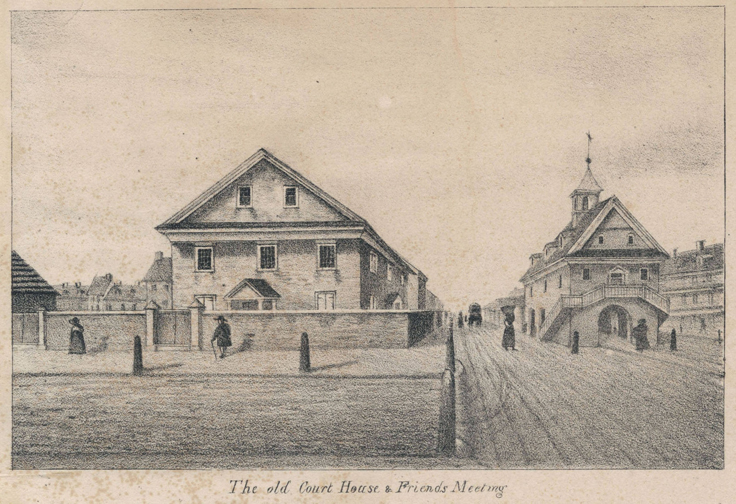
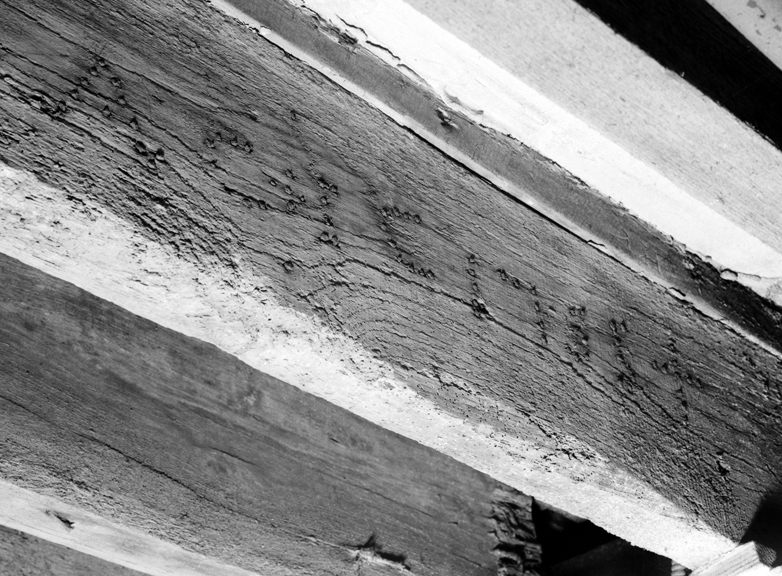
Though a Quaker from birth, Carlile’s name does not stand out in Friends’ records. His chief association with the Philadelphia Meeting was in a practical, secular capacity as a carpenter and builder. In 1753, he was reimbursed for repairs to the aging Bank Street Meeting House. He constructed the large and commodious Friends Meeting House at Second and High Streets in 1755, leaving his initials by hammering rose head nails into a joist. Because of his technical expertise, he was later included on a committee to decide whether to expand the existing meeting house or build an additional one. But, in a statement near the end of his life, that “he had always had a Regard for the Society,” he seemed to distance himself from active membership.[3]
Friends dominated public life in Pennsylvania during its early years, but their policy of religious tolerance and the colony’s rapid prosperity attracted many non-Quakers, shifting the political and population balance by the mid-1750s. Throughout the eighteenth century, animosity had grown toward the Quakers, who held the reins of political, economic and social power. Frontier inhabitants, predominantly Presbyterian, resented Friends’ pacifist stand in the Pennsylvania Assembly, which left them without military aid to defend their settlements against Indian attacks. The ensuing struggle for power weakened the Quaker grip on government as many powerful Friends chose to withdraw from active political involvement rather than support the colony’s militarization. Sectarian hostility was magnified with the coming of the Revolution, when radical Patriots seized control of the government, while Friends held themselves aloof from the conflict.[4]
Presbyterian rivalry and animosity toward their Quaker hosts is exemplified by the case of former Dubliner George Bryan, who, after serving a term in the Pennsylvania Assembly, was defeated in his bid for reelection by a prominent Friend, James Pemberton. He got his own back with a vengeance during the Revolution. As the British army approached Philadelphia in 1777, Pennsylvania’s radical new government, at the behest of the Continental Congress, arrested Quakers they feared might collaborate with the enemy and exiled them to the Shenandoah Valley in Virginia. In violation of Pennsylvania’s new Constitution, which forbade warrantless arrests, Bryan, Vice President of the state’s Supreme Executive Council, supervised the roundup, which included his former rival, Pemberton. A year later, Bryan was to play a pivotal role in deciding the fate of Abraham Carlile.[5]
As dissatisfaction with Britain’s economic policies grew, the extralegal Continental Congress, meeting in Philadelphia, became the focal point of united colonial resistance. Having seized New York in 1776, British Gen. William Howe received London’s approval for his proposal to take the rebel capital during the campaign of 1777, a plan that stood a strong chance of drawing American forces into the field where they might be defeated decisively. In August, Howe landed a considerable army at the Head of Elk, on the Chesapeake, threatening both Philadelphia and its sources of supply in the hinterland near Lancaster and Reading. Washington’s stand along Brandywine Creek in September failed to halt the British juggernaut. By the end of September, Howe was in possession of the city, Congress having fled to York.
Howe and his staff were no strangers to the requirements of an urban occupation. He had assumed the role of commander in chief at Boston in October, 1776. The following year, he took New York and made that city his base of operations. Since both these earlier locations were largely surrounded by water, responsibility for security lay primarily with the navy; the army needed to guard limited ground. A hundred miles upriver from the Atlantic, Philadelphia rested on a peninsula between the Delaware and Schuylkill Rivers. The British established a line of defensive works stretching for two miles between the rivers just north of the city, requiring a substantial portion of the army to man them.
Howe’s supply problem was complex. The Delaware River was initially blocked by patriot fortifications, making it difficult to supply the army by sea. The city was not under close siege—Washington’s main camp was several hours’ march away—but the patriot cordon, with outposts as close as four miles near Rising Sun, made it difficult for provisions to get through. Though the surrounding countryside was notable for its agricultural abundance, the British could not easily grab its food or forage without sending a considerable armed body to commandeer them.

When the two armies descended on the Delaware Valley, the area’s population more than doubled. While many people fled the city, most did not go far. Opening the Delaware navigation in late November eased the supply problem somewhat, but provisions were still needed from the hinterland, especially to feed the city’s remaining populace. Rather than distributing food to civilians, it was simpler for the British to let people leave the city in search of their own provisions.
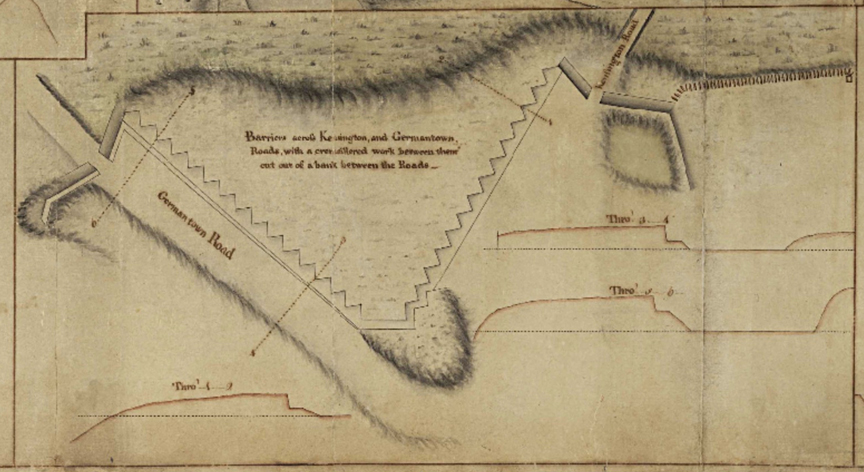
To manage civil administration of the city, Howe appointed a Loyalist, Philadelphia politician Joseph Galloway, as superintendent general. Galloway enlisted a corps of assistants to serve in various capacities—managing the police, the night watch, the ports and markets. He solicited the aid of Abraham Carlile to oversee civilian passage through the city gates. Carlile would handle the press of business, issuing most passports for people leaving the city, though some passes would continue to be issued through British headquarters. Galloway also prevailed on miller Peter Deshong to control passage through the less-travelled gate out the Wissahickon Road, northwest of the city. Both men agreed to do this work reluctantly, finding it troubling in many ways. Not only was it a great imposition on their time, but it involved them in daily conflict as they made decisions about which persons and goods should be allowed to leave town. Neither man felt free to refuse the work. The duty also placed them firmly in the pro-British camp, branding them as Tory collaborators in the eyes of the revolutionary government, a fact of which they were well aware, but which may have seemed of little importance if they believed that British arms would ultimately prevail.[6]
Carlile sought advice from the Quaker establishment before accepting the position. He felt he would be in a position to do good for people, especially those less well off, by easing their passage between the lines as they sought to buy food at affordable prices or to visit relatives. His neighbor, Henry Drinker, one of the inner circle of the Meeting for Sufferings which had been guiding the Friends’ reactions to the growing revolution, was not available to him for counsel, having been exiled to Virginia with many other Quaker leaders. The lesser luminaries Carlile consulted hinted that taking such a post might not be a good idea, but failed to express themselves clearly or forcefully. Carlile came away from the conversation having heard nothing to dissuade him.
Passing through the British line of fortifications were a pair of roads springing from the north end of Front Street, the city’s main throughfare paralleling the Delaware waterfront. One road led northwest to the village of Germantown; the other headed northeast toward Frankford. The gates for these two roads were about two hundred yards apart, each protected by a nearby redoubt.[7]

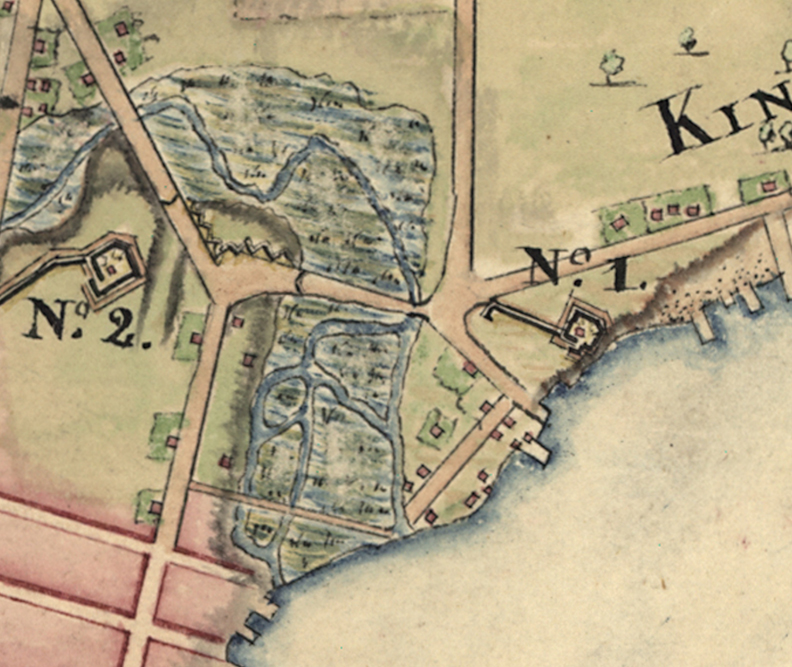
The scramble for winter housing among the officers was resolved more or less according to rank, with higher ranking officers claiming the best residences, sometimes preempting lower ranks who had gotten to a desirable house first. Such was the case with the house near the top of Front Street where the tanner Jacob Weaver lived. Because it was just by the gates, Carlile began using part of it as an office to manage the business of granting passes and examining outgoing people for contraband. When the British attempted to evict Weaver in favor of a Hessian officer, Carlile intervened on Weaver’s behalf, allowing him to continue living in the house alongside the officer, an arrangement common in many homes appropriated by the army. After three weeks, however, Carlile was preempted by a Captain Thomas. This was probably when Carlile, experienced house carpenter and lumber yard owner that he was, erected a two story “office” on Weaver’s property, allowing him to continue doing business at the gates.[8]
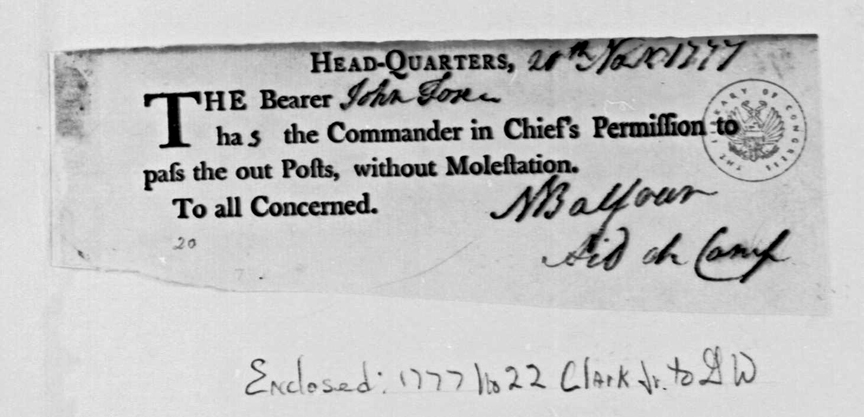
A person wishing to pass through the lines would first visit Carlile’s office, referred to by some as “the search house,” where a pass, presumably a printed form, was made in out in the person’s name and signed. Then the person handed the pass over to the piquet at the gate, who kept it. They would inquire if the traveler had any contraband items, especially guns, gunpowder or salt, and would search the person to ensure they were telling the truth. If they found anything, they would take the person back to the office to have Carlile decide whether or not to let the items pass out through the gates.
The British Army did little or nothing to help feed the civilian population, who were left to fend for themselves for provisions. Since there was little food available within the limits of the cordoned-off city, people needed to pass the gates in search of sustenance. The press of business was more than Carlile had bargained for. Each day, hundreds of people lined up for passes. On November 24 Elizabeth Drinker wrote, “the poor people have been allow’d for some time past to go to Frankford Mill, and other Mills that way, for Flour, Abraham Carlile who gives them passes, has his Door very much crowded every morning.” The gates were so busy that Carlile even employed his thirteen-year-old son, Abraham, Jr, to distribute passes, few questions asked. According to witnesses, Carlile acted humanely toward most individuals seeking food, the poor people saying “it was a blessing he was on that road.”[9]
While Carlile displayed consideration in championing the poor who were affected negatively by the British occupation, he may have had other motives as well. Money could have been a factor. The building trade, and the lumber business dependent on it, had come to a virtual standstill with the occupation. It appears that the soldiers who seized contraband, and possibly Carlile himself, were eligible to receive prize money when confiscated goods were sold at auction.[10]
To his detriment, many of Carlile’s words and actions revealed him to be a decided Tory sympathizer. On several occasions he used his position of authority to lambaste those he deemed rebels, zealously preventing them from sneaking contraband through the lines. The testy Carlile verbally abused those he suspected of Patriot sympathies, calling one a “terrible Rebel,” and another a “Rebel son of a bitch,” while bragging that Gen. George Washington had put a price of 500 dollars on his head and that he could kill a hundred rebels and not pity them. He took it upon himself to denounce those he thought disloyal to the Crown, even going so far as accosting them in the streets and trying to arrest them.[11]
By the time the British decided to abandon Philadelphia in June 1778, the city was in a shambles. Galloway advised those who had worked for him to sail for New York. But the incorrigible Carlile felt he had done nothing to merit sanction by his returning countrymen. Imprudently, he did not reckon on Patriots’ deep thirst for vengeance. That spring, Pennsylvania authorities had identified numerous Loyalists accused of treason against the state. Carlile’s name, it turned out, was near the top of the list.[12]
A triumvirate of the state’s radical Presbyterian politicians, Vice President of Pennsylvania’s Supreme Executive Council George Bryan (effectively acting as the governor), Chief Justice Thomas McKean, and politico Joseph Reed pursued the charges. Through trials, most men on the bills of attainder were eventually acquitted or discharged. But two Friends were singled out for zealous prosecution: prosperous miller John Roberts and Abraham Carlile, the house carpenter. By making examples of these notorious British collaborators, the politicians sought to cement their faction’s political power while punishing their former rivals in government for their professed neutrality in the conflict.[13]
In the weeks following reoccupation, Carlile was arrested. His trial began on September 25. The stakes were high: the penalty for treason was death. The prosecutor was Reed, who had recently turned down an offer of the chief justice job. He had his eye on Bryan’s position as de facto governor, to which, on the heels of this prosecution, he would be elected in the coming months. Though the forces of the state arrayed against him were formidable, Carlile was defended by two able and politically prominent men, James Wilson and George Ross. Both signers of the Declaration of Independence, their Patriot bona fides were impeccable.

Lawyers for both sides argued from English common law and the new and untested state constitution. Despite vigorous and cogent legal opposition, Reed’s arguments, though frequently contradictory, were wont to find favor with McKean, the presiding judge. The charges specified that Carlile had committed his alleged crimes “with force and arms,” in other words, that he had actively supported the British Army as a combatant. The court ignored testimony that the appointment was a civil one and the pacifist Quaker had never borne arms. Reed focused attention primarily on a pair of incidents where Carlile had seized contraband salt, preventing it from leaving the city. This might seem like thin gruel, but after testimony by ten witnesses for the prosecution and a dozen for the defense, jurors found Carlile guilty of high treason, as charged. McKean lost little time pronouncing a sentence. Though the exact wording does not survive, presumably McKean followed the same words he used in condemning John Roberts to death a few days later: “You shall be taken back to the place from whence you came, and from thence to the place of execution, and there to be hanged by the neck until dead.”[14]
Counselling the men prior to execution, weighty Friends were able to prevail on Roberts to meet his fate with resignation. Carlile, however, remained uneasy as his end approached. Visiting Friends managed to extract from him a written acknowledgement of his errors, but that was aimed more at protecting the Religious Society’s reputation than the prisoner’s spiritual comfort. Still, their families hoped for a last-minute reprieve.[15]
Though the public was inured to executions for burglary and robbery, they were horrified by such harsh sentences for respected members of the community whose infractions were, after all, political, rather than crimes against person or property. Hundreds signed petitions begging mercy for the condemned men, including not only numerous warm patriots who served with distinction in the American military, but most of the jurors who had adjudged them, and even Thomas McKean himself, the man who had pronounced their sentences.[16]
Reprieve could come only from the supreme executive council, and they were having none of it. It was no accident that an inflammatory article appeared on the front page of John Dunlap’s Pennsylvania Packet, the council’s official news organ, the day before the execution was to take place. Immediately following an account of several treason verdicts, the newspaper published the deposition of William McMichael, a caulker living in the city’s Northern Liberties, who stated that he had personally witnessed the British burning wounded American prisoners to death after the Battle of Crooked Billet the previous spring. The intent was to keep justification for vengeance foremost in the public eye. The council deliberated the issue of a pardon: “the Question being put, shall a Reprieve be granted to John Roberts and Abram Carlisle, or either of them? The same was carried in the Negative.” Acting president Bryan, who had signed the death warrants, reportedly said that rather than agree to a pardon, he would hang the men himself.[17]
Accordingly, near noon on November 4, the unhappy pair were walked behind a cart with halters around their necks to the gallows on the city’s commons. At the last, Roberts appeared composed and spoke at length “with the greatest coolness imaginable.” “Poor Carlisle, having been very ill during his confinement, was too weak to say anything.” After hanging for an hour, his body was brought back to his home and laid out. Shocked, Elizabeth Drinker, along with many others, rushed to support her widowed neighbor. Next day, amidst a large funeral, Carlile was laid to rest in the Friends burying ground, directly opposite College Hall, where his trial and condemnation had taken place.[18]
Pennsylvania’s radicals were not yet done with the Carliles. Three months after the execution, a pair of agents showed up at his widow’s front door to inventory his personal effects in preparation for seizure by the state. Though it took nearly two years, with Ann Carlile still living in it, the property was finally sold at sheriff’s sale for £20,000. The purchaser, ship captain Robert Bethel, appears to have been connected to or sympathetic with the Carlile family, but, after nearly a year, he ended up selling the property. The new owner, George A. Baker, petitioned the city government to evict Mrs. Carlile, but they refused this distasteful task and referred him the supreme executive council, where Joseph Reed, still President, had to issue an order to put Baker into possession of the property. The Carliles later petitioned the British Loyalist claims commission for compensation for their property which had been seized, and £600 was eventually awarded, but only in 1792, five years after Ann’s death.[19]
Abraham Carlile’s ignominious end stemmed from the convergence of several factors. First was his ill-advised decision to work with the British at the city gates, compounded by a stubborn refusal to leave the city when his employers evacuated. In this, he underestimated Pennsylvania radicals’ thirst for revenge. Frustrated that their enemies, who had ruined Philadelphia, were inaccessible, the supreme executive council determined on a few exemplary punishments to tamp down Loyalism in the state. That they fastened on the pacificist group least likely to respond in kind displays the shrewd calculus of cowardice. While Pennsylvania’s Presbyterian faction had already achieved political dominance, they also desired decisive social and moral ascendancy over their Quaker rivals. Focusing on Friends’ perceived disloyalty was also a means of justifying their clearly illegal exile of Friends’ leaders to Virginia the previous year. In the end, Abraham Carlile let himself become a pawn in a deadly political endgame.
[1] Quaker records, which tend to be sympathetic toward Carlile, a person well known to them, generally spell the surname Carlile. Pennsylvania public records spell it Carlisle, reflecting the record keepers’ perfunctory and unsympathetic attitude toward a person they considered to be an enemy.
[2] Founded in 1724, The Carpenters’ Company of the City and County of Philadelphia was and remains an association of the area’s Master Builders, rooted in medieval trade guild traditions and organized along the lines of London’s Worshipful Company of Carpenters. Minutes of the Carpenters Company of the City and County of Philadelphia (American Philosophical Society); Charles E. Peterson, Robert Smith: Architect, Builder, Patriot, 1722 – 1777 (Philadelphia: The Atheneum of Philadelphia, 2000), 115.
[3] Philadelphia Monthly Meeting Minutes, August 24, 1753, p. 272; December 25, 1761 & January 16 & 19, 1762, 381-382, Ancestry.com. Undated memorandum, Philadelphia Yearly Meeting for Sufferings, Miscellaneous Papers, 1779-1780, Haverford box B5.3, item 73, quoted in David W. Maxey, Treason on Trial in Revolutionary Pennsylvania: The Case of John Roberts, Miller (Philadelphia: American Philosophical Society, 2011), 197n41; Historic American Buildings Survey, Library of Congress, www.loc.gov/pictures/item/pa1426.photos.139948p/.
[4] Richard Bauman, For the Reputation of Truth: Politics, Religion and Conflict Among the Pennsylvania Quakers 1750 –1800 (Baltimore: Johns Hopkins University Press, 1971); Carlton F. W. Larson, The Trials of Allegiance: Treason, Juries and the American Revolution (New York: Oxford University Press, 2019), 143-144.
[5] Whitfield J. Bell, Jr., Patriot-Improvers: Biographical Sketches of Members of the American Philosophical Society, Volume I – 1743-1768 (Philadelphia: American Philosophical Society, 1997), 199-200; James Donald Anderson, “Thomas Wharton, Exile in Virginia, 1777-1778,” The Virginia Magazine of History and Biography 89, no. 4 (1981): 425–47; Norman E. Donoghue II, Prisoners of Congress: Philadelphia’s Quakers in Exile, 1777-1778 (University Park: The Pennsylvania State University Press, 2023).
[6] Howe’s official proclamation appointing Galloway came in early December. However, several of his officials were already conducting duties by that time. Carlile had taken up his position at least by November. Dunlap and Claypoole’s American Daily Advertiser, December 31, 1777.
[7] John Montresor, A Survey of the City of Philadelphia and its Environs Shewing the Several Works, 1777 (Library of Congress).
[8] Testimony of Jacob Weaver. The officer in question was most likely Frederick Thomas of the Foot Guards, whose brigade occupied nearby Redoubt Number 2. On June 14, 1779, Thomas Hale, one of the agents for estates forfeited to the Commonwealth of Pennsylvania by conviction for treason, seized from Carlile’s estate “one frame building 2 Stories high 16 feet by 12 ½ feet, found on the ground of Jacob Weaver of the Northern liberties Farmer.” Records of Pennsylvania’s Revolutionary Governments 1775-1790 (Record Group 27) in Pennsylvania State Archives, Roll No. 42, 734.
[9] Elizabeth Drinker, The Diary of Elizabeth Drinker, Volume I: 1758—1795, ed. Elaine Forman Crane (Boston: Northeastern University Press, 1991), 257; Testimony of Mary House, U.S., Quaker Meeting Records, Philadelphia Yearly Meeting Minutes, 1777-1780.
[10] Testimony of George Bruner: “Serjt. asked P. [Prisoner – Carlisle] if it was useful to send all the goods to hd. qrs., P. replied yes, the prize will be all the greater.” Testimony of George Bruner, Pennsylvania Archives, ser. 1, vol. 7, 45-47.
[11] Testimony of George Bruner, Daniel Hoffman and Peter Stonemitz, ibid.; Philadelphia Yearly Meeting Minutes, 1777-1780, 126-127.
[12] Pennsylvania Archives, Volume XI, Minutes of the Supreme Executive Council, 482.
[13] “George Bryan,” The National Cyclopaedia of American Biography, Vol. 2. (New York: James T. White & Company, 1895), 280.
[14] Pennsylvania Evening Post, October 23, 1778 and November 7, 1778.
[15] “The Execution of Abraham Carlisle and John Roberts”, Bulletin of Friends Historical Association, Spring 1926, Vol. 15, No. 1 (Spring 1926), 28-29. David W. Maxey, Treason on Trial in Revolutionary Pennsylvania: The Case of John Roberts, Miller (Philadelphia: American Philosophical Society, 2011), 107.
[16] Pennsylvania Archives, ser. 1, vol. 7, 53-58.
[17] Pennsylvania Packet, November 3, 1778. Pennsylvania Archives, Colonial Records, Volume XI, 613-614. Independent Gazetteer, September 4, 1784.
[18] James Humphreys, Jr. to Joseph Galloway, November 23, 1778, quoted in Catherine S. Crary, comp. and ed., The Price of Loyalty: Tory Writings from the Revolutionary Era (New York: McGraw-Hill, 1973), 237; Elizabeth Drinker, Diary, 333-334.
[19] Elizabeth Drinker, Diary, February 11, 1779, 339; PA State Archives Record Group 27, Records of Pa Revolutionary Governments 1775-1790, Clemency File, 724-727; Beatrice B. Garvan and David L. Barquist with Elizabeth R. Agro, American Silver in the Philadelphia Museum of Art: Volume 1, Makers A–F (Philadelphia: Philadelphia Museum of Art, 2018), 228-229; Maxey, Treason on Trial, 128.


2 Comments
Bob: Great Article! I never heard of Abraham Carlile and his fate. Interesting how the radical Patriots return to Philadelphia decided to try members of the Society of Friends for treason even though the didn’t take up arms against the Continentals. I agree with one of premises that it was the Radical Presbytains who wanted show the Philadelphia Quakers controlled Pennsylvania and Philadelphia.