

To a colonial American, the prelude to the War of Independence might have been considered as much a civil conflict as it was a revolution. This was particularly true in 1775, when the thirteen colonies were in the throes of an internal struggle, before most of the Loyalists sought refuge in cities occupied by British military forces.

Like many colonial cities and towns, the citizens of Annapolis, Maryland, experienced this political strife. On August 31, 1775, when the Annapolis, a ship named for her home port, under Capt. James Hanrick, cleared the customhouse, she was the last merchant ship permitted to set sail out of that port for England.[1] Along with a full cargo of tobacco, the Annapolis carried seven families bound for London, hoping to escape the coming troubles.[2] However, these families would not complete their journey on the Annapolis.
Robert Eden, Maryland’s last colonial governor, had entrusted an urgent letter to be delivered by Lloyd Dulany, a passenger on the Annapolis. According to Eden, Dulany was “leaving a considerable Estate here to escape with his Life from the persecution he has long been under, for having withstood every insidious and violent Attempt to draw him into Connections with men whose Measures he abhors.”[3] Eden’s brother Thomas was the owner of the Annapolis and had been her captain on previous trans-Atlantic routes. For the voyage of September 1775, James Hanrick was engaged to pilot her. Hanrick was an experienced, proficient captain who had commanded merchant, armed, and letter-of-marque vessels since the 1750s.
Eden’s August 27, 1775, appeal was to Lord Dartmouth, the Secretary of State for the Colonies. Eden wrote with alarm about his increasing distress that his attempts at “soothing measures” would no longer assuage the populace. “An assembly of rash people soon becomes a lawless and ungovernable Mob,” he wrote, “kept constantly heated by incendiary Harangues of their Demagogues, are a formidable Enemy to encounter with words only.” Eden advised Lord Dartmouth that there were still “many of His Majesty’s Subjects here” who had been compelled to “sign Associations &c. to preserve their lives and property,” but would be willing to fight for the King if supported by troops and ships of war.[4]
Eden believed that his life “and that of many of His Majesty’s Subjects here, who are known to be attached to Government and ready to Support it, would immediately be sacrificed on the publication of this Letter.” He advised caution in future letters since “Those men among the Leaders of the Rebellion here whose sole Consequence depends on a general Convulsion, spare no pains of Expenses to obtain Copies of all the Letters sent home that can add to the Flame … and they intercept all Letters they can from England.”[5] But Dulany’s arrival in London and the punctual delivery of Eden’s letter would be at the mercy of the Atlantic hurricane season.
The Independence Hurricane
When the Annapolis sailed out of the harbor on August 31, a massive storm was already impacting coastal North Carolina and Virginia, leaving shocking damage and death in its wake. The hurricane swept up Chesapeake Bay and knocked the Annapolis off course. When the storm hit the city of Annapolis on September 2, it blew down the market house and ripped the copper sheathing off the state house. The storm would later greatly impact Newfoundland, killing thousands of sailors, and the so-named Newfoundland or Independence Hurricane is listed today amongst the deadliest Atlantic hurricanes ever recorded. Historians remain divided on whether there was just one or two distinct hurricanes in the Atlantic in early September 1775.
One piece of evidence supporting the belief that there were consecutive storms is documented by the fate of the Annapolis. After encountering the first hurricane, the ship sailed on and reached the open sea, but on September 10, about two hundred miles off the coast of Virginia, she was caught in another great storm which left her completely dismasted in the middle of the ocean. Several hogsheads of tobacco were thrown overboard in the effort to keep the ship afloat, but most of the cargo was still in the hold.
After two days adrift, a schooner under Capt. Isaiah Stetson, sailing from Bristol to Baltimore, came to the aid of the Annapolis and helped her crew construct jury-rigged masts. When he reached Maryland on September 21, Stetson reported that Captain Hanrick “was determined to proceed to Europe.”[6] On September 19, the Annapolis met the brig Two Brothers, which took her passengers on board and carried them back to America. The erstwhile passengers of the Annapolis safely landed in Philadelphia on the 22nd of September.

Captain Hanrick was reported by the captain of the Two Brothers to have been about 150 miles east of Delaware, and “bound for the first port he could make.”[7] Newspapers published further reports about the Annapolis. These accounts also support a general observation about how busy trans-Atlantic commerce must have been in 1775. It is incredible to ponder how, even without the use of modern instruments, the Annapolis would cross paths with so many other ships on the open sea.
On October 18 Captain Crawford of the Harmony arrived in Portsmouth, England, and told how he “spoke with the Annapolis, Henrick, from Maryland to London, in lat. 39.16. long. 61.20. on the 27th of last month.”[8] Crawford went on to say that the Annapolis “had lost all her Masts, and had washed away her Galleries, and all upon Deck, in a Storm on the 10th of Sept.” Crawford observed that “the Annapolis is on her passage to London with Jury Masts.”[9]
The London Public Advertiser of November 17 reported that Captain Cramer of the Brothers, sailing from Maryland, had arrived in England. At “Lat. 49. Long. 10.,” Cramer spoke with “the Annapolis, Henrick, who, in a violent Gale on the 10th of October [he probably meant September], received considerable Damage.”[10]
Then, in the Pennsylvania Journal on January 31, 1776, there was a most unfathomable account from London, under the date of November 10, 1775. Captain Nicholson, of the Juno, came across the “Annapolis, Capt. Hansick, on the 13th instant, in Mount’s Bay, both close to the rocks, which Capt. Nicholson cleared with the greatest difficulty.”[11] Nicholson believed “the Annapolis struck and went immediately to pieces, as he saw nothing of her afterwards,” and that “there was no chance of the people being saved, as it blew very hard.” To save the Juno, Nicholson threw 100 hogsheads of tobacco and many staves overboard.[12]

Captain Nicholson was mistaken. Somehow, the determined Captain Hanrick and his resourceful crew saved the Annapolis once more, though it took over a month for her to limp from off the coast of Cornwall into the Downs anchorage. On November 18, 1775, Capt. James Hanrick steered what was left of his ship into port in southern England with “not a mast standing, and all her sails torn to pieces.”[13]
Captain Hanrick’s Gold Medal
For his extraordinary efforts, the marine risk underwriters of the remaining tobacco cargo on the Annapolis, now made even more valuable due to the trade restrictions, gratefully awarded Captain Hanrick “a Compliment of a Gold Medal, a Silver Punchbowl, and a Purse of Money.” This was in appreciation “for his calm, brave, and steady Conduct, in reducing to Obedience the Marines of said Ship, who mutinied three several Times.”[14]
Remarkably, in the November 9, 1778, Northampton Mercury, an article detailing these 1775 events noted that “In the same Ship [Hanrick] fell in with the Independence American Privateer, and fought her two Hours and a Half, although, in the Course of the Engagement, he had received a Shot from a Swivel in his Thigh.” Though it is not clearly stated, it might be assumed that this later skirmish between the Annapolis and the Independence took place on another of Hanrick’s voyages, as it was also revealed that “nor was the ship given up till a second Shot struck him on the side, carried away the Flesh (leaving the Ribs bare), and laid him senseless on the Deck.”[15] In 1778, the Committee of the Reprisal Association elected Hanrick to command their thirty-two-gun privateer Queen Charlotte, which carried upwards of 200 men.[16]
While Capt. James Hanrick’s gold medal is untraced today, a medal of a likely similar design exists in the Numismatics Collection of the Yale University Art Gallery. It is Betts-434, the 1760 French Privateers Repulsed Medal, engraved to Capt. James Weir. The story of Captain Weir and his ship, the Mars, is colorfully told by Christopher McDowell in Medals of the Americas: The Betts Companion (1747–1763), published by the Colonial Coin Collectors Club in 2025.
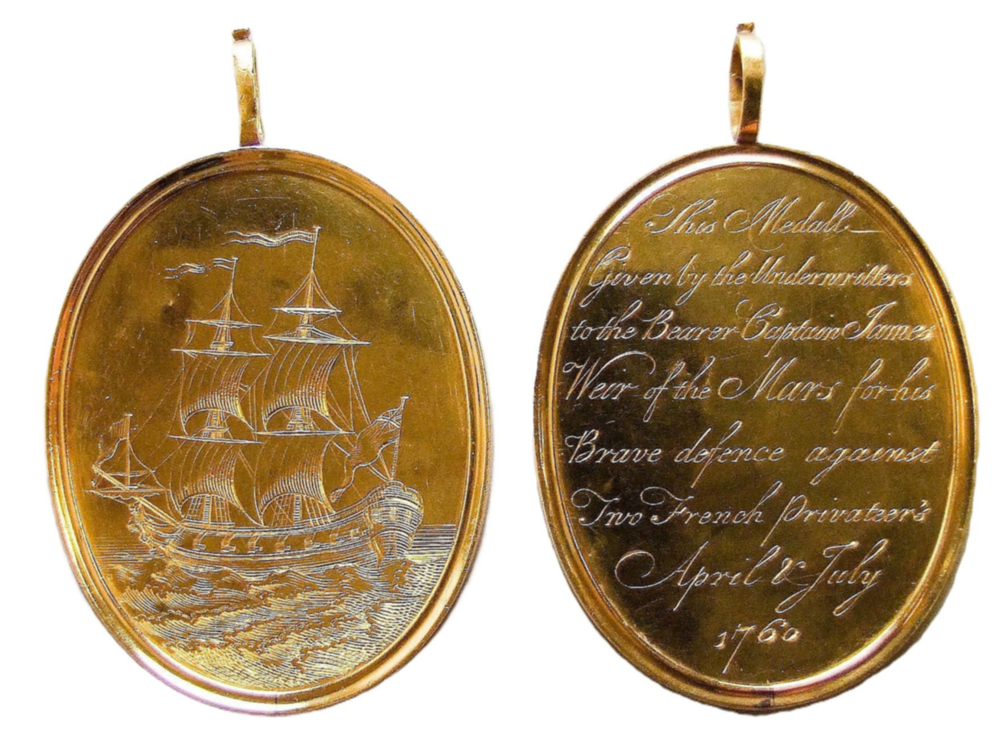
(Image courtesy of the Numismatics Collection, Yale University Art Gallery, 2001.87.88401)
The Passengers of the Annapolis
Reportedly, seven families had been on board the Annapolis when it first set sail on August 31, 1775, bound for London. When the Two Brothers came upon the dismasted Annapolis at sea, these passengers were taken back to Philadelphia. The names of five of these passengers were specifically mentioned by the Maryland Gazette on September 28, 1775. This group included two Loyalists, an inscrutable moderate, and two young men who would later ascend to prominence as Patriots. This disparate group of passengers might be considered representative of the population of the American colonies, who, in 1775, were similarly divided.
These individuals and their families, going back generations, were societally intertwined as members of Maryland’s upper crust. Lloyd Dulany and his wife Elizabeth, Dr. George Steuart and his son William, George Digges, and Edmund Brice took the Harriot mail packet from New York City to Falmouth, England, one month later.[17] In a bit of irony, the Harriot arrived in England in mid-November 1775, on nearly the same day that Captain Hanrick finally anchored the Annapolis.[18]
The Passengers
Lloyd Dulany (1742–1782) was an Annapolis native and London-trained lawyer who had built a handsome brick house in Annapolis on Conduit Street that reportedly cost him £10,000.[19] Dulany was carrying Gov. Robert Eden’s confidential letter to Lord Dartmouth, which he probably delivered belatedly. Dulany travelled with his wife, Elizabeth, who was the sister of fellow passenger Edmund Brice. Dulany was killed in a duel in London’s Hyde Park by the “notorious” Rev. Bennet Allen, another expatriate from Annapolis.
Dr. George Hume Steuart (1700–1784) was an Edinburgh-trained physician and former mayor of Annapolis. He had emigrated to Maryland in about 1721, but still had an estate in Scotland, to which he returned in 1775. He left his wife, Ann Digges Steuart, the aunt of fellow passenger George Digges, in Maryland to manage his estate, Dodon. Steuart was travelling with his son William, who returned to Maryland after the war and inherited the Dodon estate.
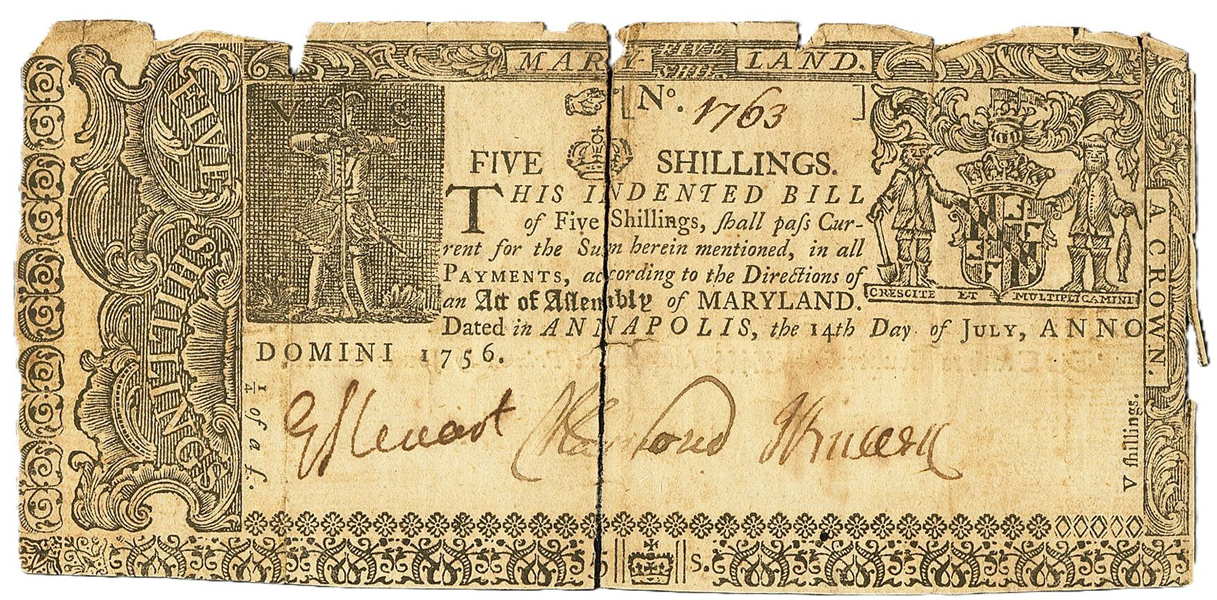
Steuart was an authorized signer of Maryland paper money in the 1740s and 1750s.
George Digges (1747–1792) lived on his family’s Warburton estate, directly across the Potomac River from Mount Vernon, and frequently socialized with George Washington. He was the younger brother of Thomas Attwood Digges (1742–1821), a controversial figure with an important numismatic connection. George Digges was in England with his brother and in France until 1778, when he travelled back to Boston with Sir James Jay. Jay was the brother of Founding Father John Jay. However, his politics, like those of George Digges and Thomas Digges, were more ambiguous.
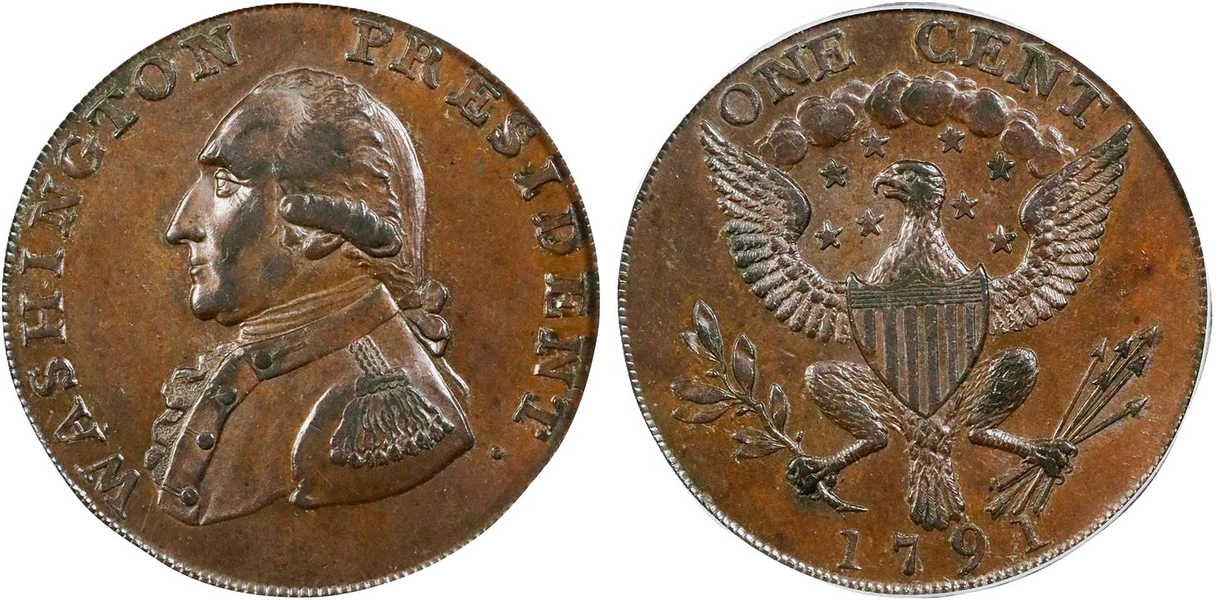
Thomas Digges “was trusted least by those who knew him best” and was described as “a liar, a speculator, a trader with the enemy, and a secret agent of the British government.”[20] He has remained an intriguing personality. His correspondence with Thomas Jefferson in 1793 revealed that private mints in Britain were endeavoring to strike the first copper coins for the United States. Digges named John Greogry Hancock as the engraver of his Washington/Eagle cents.
Edmund Brice (1751–1784) was a talented artist who studied under Charles Wilson Peale in Annapolis. Peale arranged for Brice to apprentice under Benjamin West in London. After his interrupted voyage on the Annapolis, Brice completed his journey to London in 1775 on the Harriot.
While studying in Europe, Brice met the Marquis de Lafayette and accompanied him to America as an aide-de-camp in June 1777. Through his association with Lafayette, Brice was commissioned as a major and participated in the defense at Brandywine and the encampment at Valley Forge. By September 1778, Brice was dispatching reports on naval developments from Lafayette to George Washington. In October 1778, Congress made him a brevet lieutenant colonel.
After the war, Brice returned to Annapolis, married, and had a son before dying at the age of only thirty-three.
Alexander Contee Hanson (1749–1806) was a Maryland native and lawyer. He was aboard the Annapolis to be ordained for the ministry of the Church of England. Hanson’s plans changed when he was returned by the Two Brothers to Philadelphia, where he met with his cousin, Col. Robert Hanson Harrison, George Washington’s chief secretary. Instead of attempting to find another vessel to take him to England, Hanson became the assistant private secretary to General Washington in 1776.
Hanson soon became very ill and had to give up the post within a few months. A delightful episode is recounted in a nineteenth-century biography of Hanson, when he visited Washington’s headquarters just after the Battle of Brandywine. They spent the night at a farmhouse, where Hanson was so unwell that General Washington took pity on him and gave him his bed. Hanson later told of how “Alexander Hamilton lay down on the floor in the corner, and he never saw a man look so like a cat.”[21]
Hanson excelled as a scholar of law and civics and served as the 2nd Chancellor of Maryland from 1789 until his death in 1806.
Conclusion
As we celebrate the semiquincentennial, the pomp and spectacle of our patriotic commemoration are highly anticipated. Still, we should not forget that many things so admired as glorious were arduously and painfully created. Such was the scene in 1775, when America was not yet united, and her families, like the masts and sails of the Annapolis, were broken and torn apart by the magnificent storm of enlightened ideals.
[1] Edinburgh Advertiser, November 21, 1775.
[2] Leicester Journal, October 28, 1775.
[3] “Correspondence of Governor Eden,” Maryland Historical Magazine, March 1907, 12.
[4] Ibid.
[5] Ibid.
[6] Maryland Gazette, September 28, 1775.
[7] Ibid.
[8] This is the middle of the Atlantic Ocean, about 600 miles east of New York City.
[9] Edinburgh Advertiser, October 24, 1775.
[10] Public Advertiser (London) November 17, 1775. The coordinates are in the eastern Atlantic Ocean south of the coast of Ireland.
[11] Mount’s Bay is off the southern coast of Cornwall, England.
[12] Pennsylvania Journal, January 31, 1776.
[13] Hampshire Chronicle, November 27, 1775.
[14] Northampton Mercury, November 9, 1778.
[15] Ibid.
[16] The London Reprisal Association financed and operated privateer ships of war. James Hanrick, “master mariner,” died in London about 1801; see The London Gazette, March 3, 1801, for a notice to the creditors and legatees of his estate.
[17] The Pennsylvania Ledger, October 28, 1775.
[18] Belfast News-Letter, November 28, 1775.
[19] Diary entry, September 23, 1771, Founders Online, National Archives, founders.archives.gov/documents/Washington/01-03-02-0001-0022.
[20] Thomas Digges to Thomas Jefferson, April 28, 1791, Founders Online, National Archives, founders.archives.gov/documents/Jefferson/01-20-02-0078.
[21] William L. Marbury, The High Court of Chancery and the Chancellors of Maryland, (Presented to the Maryland State Bar Association at the 1905 Annual Meeting). Original source: “Winter of 1851–3,” a manuscript by Charles W. Hanson.

Recent Articles
Last Call for a Dram Seller on the Mohawk River
Payback: Attack on the DeLancey House
A Dear-Bought Victory: The Battle of Bunker Hill and the Siege of Boston, 1775-1776
Recent Comments
"Payback: Attack on the..."
Fascinating account and detailed illustration of how much the AWI also was...
"Shenandoah Martyr: Richard Campbell..."
My ancestry points to this being my grandfather on my mother’s paternal...
"Payback: Attack on the..."
Yes, indeed, a great read as previously commented. And a great fascination...