


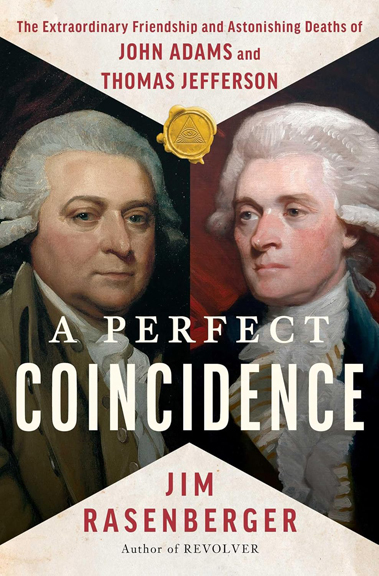
BOOK REVIEW: A Perfect Coincidence: The Extraordinary Friendship and Astonishing Deaths of John Adams and Thomas Jefferson by Jim Rasenberger (Scribner, 2026)
It is an astounding bout of timing that John Adams and Thomas Jefferson, the two men who collaborated so closely in declaring independence, died on the same Fourth of July day on the 50th anniversary of Independence. Although this fact is noted countless times in many works about these two founders, author Jim Rasenberger contends that it is more than just an interesting factoid that closes out the founding era of the nation – this event marks one of the greatest coincidences in the nation’s history. In A Perfect Coincidence: The Extraordinary Friendship and Astonishing Deaths of John Adams and Thomas Jefferson, Rasenberger reframes their relationship as one bookended by coincidence: first their coordination in bringing about the first Fourth of July and then in the remarkable concurrence of their nearly simultaneous deaths. Furthermore, Rasenberger views their deaths through the lens of contemporaries, who considered it as a monumental event that cemented the notion that America enjoyed divine favor.
 The book chronologically follows the relationship between Jefferson and Adams through their early work together in the Continental Congress, their time together in France, the contentious early presidential elections, and their respective retirement and years leading up to their deaths. Rasenberger relies largely on correspondence to tell the story of the closeness of their relationship as well as the cause of its rupture, taking a balanced and nuanced look at the character strengths and flaws and providing a well-rounded look at their respective careers as well as collaboration with one another. Although Jefferson and Adams had a remarkable relationship rendered all the more unusual by their oftentimes opposing viewpoints, their relationship fractured when the two men truly became political rivals during the early national period.
While students of the Revolution will find much of the information about Adams and Jefferson familiar, Rasenberger emphasizes how the coincidental nature of their reconciliation and deaths would have been viewed in the time period. In a turn of events that sounds almost too good to be true, Benjamin Rush dreamt that Adams and Jefferson reconciled and died at the same time. Spurred on by this prophetic dream, Rush worked for two years to reunite the two men before Adams brought himself to send the first letter that would kick off a remarkable correspondence in their twilight years. While the timing of their deaths would have been quite a coincidence regardless of these factors, the dream and the resumption of their friendship makes it a nearly perfect founding story.
Not only were the odds extremely small for such a thing to have happened, but the ramifications of the coincidence reverberated throughout the country. The title of the book is a play upon Jefferson’s phrasing to Benjamin Rush that he and Adams had “the perfect coincidence” of opinions and actions in 1776, but Rasenberger’s title gets at a different definition of “coincidence.” While Jefferson’s usage indicated an agreement or alignment, Rasenberger points to the concurrence of events – one deemed significant enough at the time that the deaths of Jefferson and Adams was actually added to the definition in the dictionary (pages 366-367). The change in language usage effected by this event underscores the weight that contemporary Americans gave it. While other countries had centuries of history and founding tales to draw upon, this event became a great story for the young United States to employ in the formation of national identity.
Within the wider context of the tendency of Americans to believe in Providential favor and their yearning to create a national origin story, Rasenberger emphasizes the deaths of Adams and Jefferson as an important event in solidifying the idea that the United States indeed enjoyed special favor. While this remained a theme throughout the Revolutionary period, the timing of their deaths reinforced the idea and reinvigorated the populace at a time when sectional tensions approached a fevered pitch. From the hypocrisy of the existence of the institution of slavery in a nation founded upon ideals stated in the Declaration of Independence to the question of the legality of slavery in new territories in the West, Americans grappled for decades with the question of slavery and how to deal with the regional tensions. Coming just years after the Missouri Compromise, the remarkably timed deaths of Adams and Jefferson reaffirmed the idea of Providential favor for America, serving to drown out tensions for a time with self-congratulatory awe. Their deaths also fanned the flames of the Second Great Awakening by providing an event that Americans interpreted directly as a religious message addressed directly to their nation (p. 370).
Written for a popular audience, Rasenberger’s style is accessible while maintaining a reliance on Adams’s and Jefferson’s own words as his main source material. Cross-referencing the letters the two men wrote to each other along with what they said and wrote to others and publicly provides a fuller picture of the way the two men related to each other. The book is readable and engaging, although serious students of Adams and Jefferson will be very familiar with most of the contents already. Nonetheless, the author maintains a sense of humor throughout that may be appreciated by readers who enjoy taking a wry look at the Founders. For both the seasoned student of the era as well as the person looking to get their feet wet, Rasenberger provides an entertaining read that frames Adams and Jefferson as a valuable example of two men who successfully reconciled and maintained a close relationship despite harboring differing views — perhaps a particularly poignant lesson as America celebrates its 250th year.
PLEASE CONSIDER PURCHASING THIS BOOK FROM AMAZON IN HARDCOVER OR KINDLE.
(As an Amazon Associate, JAR earns from qualifying purchases. This helps toward providing our content free of charge.)


Recent Articles
David Steele’s Macabre Medal
The Loyalist Experience and Aftermath in Revolutionary Philadelphia
America’s Original Stimulus Package: A Catalytic, Consequential Fishing Policy
Recent Comments
"La Petite Guerre and..."
This is a fascinating examination of the distinction between European *petite guerre*...
"James Wilson and Popular..."
Kelly – thanks for this contribution to the growing body of work...
"The Battle of Cowpens:..."
Kudos to you for a thoroughly researched article that corrects some of...