


On a Friday morning in 1764, a nineteen-year-old Abigail Smith sent some tobacco to her betrothed: one John Adams esquire, a country lawyer from Braintree.[1] Abigail was a parson’s daughter from nearby Weymouth, a young lady already brimming with the spiritedness and pragmatic optimism for which she would eventually become famous. But she didn’t send tobacco with a light heart; she sent it with fervent prayers that immortal powers would protect the man she loved, for he was about to undergo inoculation for smallpox, and she hoped he would use the tobacco to smoke his letters—a practice then thought to contain contagion.
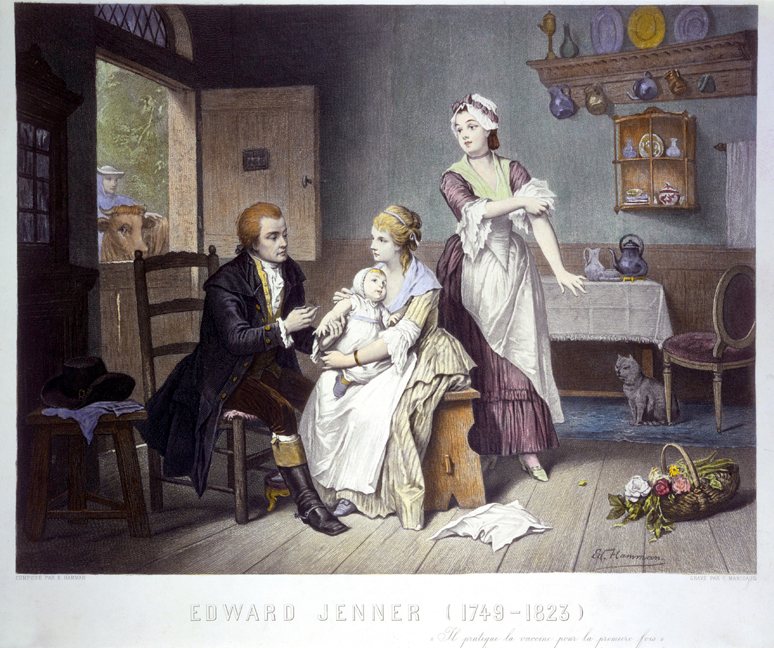
While fumigation as a method to prevent the spread of disease was largely abandoned in the twentieth century as science explored more effective means by which to protect against contagion, inoculations would go on to be not only the salvation of the American Revolution, but, as the precursors to modern vaccines, would become the gold standard for public health policy’s role in promoting life, liberty, and the pursuit of happiness for generations to come.[2]
Of course, in the spring of 1764, Abigail Smith could know nothing of this. She only knew that the man she planned to marry might not survive his ordeal.
At the time, the process of inoculation against smallpox, more properly referred to as variolation, was a far more dangerous method than the eventual smallpox vaccine would prove to be.[3] Smallpox contracted naturally killed up to thirty percent of its victims, but even two to three percent of those inoculated would still perish, because the process involved inserting a live infection into rent flesh by way of pus-soaked thread.[4]

And for those who survived it, the process was still painful and potentially disfiguring.
Abigail’s fears for John are evident in her letters. She was so fearful, in fact, that she could not bear to see him off a second time after he had already bid her adieu, writing, “The reflexion of what I that forenoon endured, has been ever since sufficient to deter me from wishing to see you again, till you can come and go, as you formerly used to.”[5]
For his part, John claimed the courage not to have “the Least Apprehension att all of what is called Danger” except insofar as he feared his letters might carry contagion and infect others.[6] And this, in turn, seems to have inspired some introspection on Abigail’s part about her own courage, for she wrote to the man to whom she would pledge her troth, “I wonder I write to you with so little restraint, for as a critick I fear you more than any other person on Earth, and tis the only character, in which I ever did, or ever will fear you. What say you? Do you approve of that Speach? Dont you think me a Courageous Being? Courage is a laudable, a Glorious Virtue in your Sex, why not in mine? (For my part, I think you ought to applaud me for mine.).”[7]
It’s a remarkable passage, for it both confirms her absolute respect for her future bridegroom’s intellect, while also asserting her own boundaries and autonomy. She did not simply state that she did not fear anything but his judgement. She also declared that she would never fear anything but his judgement–a statement that anticipated the extraordinary independence she would display as a wife and mother during the revolution.

Of his own ordeal, John wrote, “I believe, None of the Race of Adam, ever passed the small Pox, with fewer Pains, Achs, Qualms, or with less smart than I have done.”[8] Not all were so lucky. He described “a poor Man . . . now labouring with it, in the natural Way. He is in a good Way of Recovery, but is the most shocking sight, that can be seen. They say he is no more like a Man than he is like an Hog or an Horse—swelled to three times his size, black as bacon, blind as a stone.”[9]
It seems that he wanted to press upon his future wife the consequences and foolishness of those who refused the treatment, explaining,
This Contrast is forever before the Eyes of the whole Town, Yet it is said there are 500 Persons, who continue to stand it out, in spight of Experience, the Expostulations of the Clergy, both in private and from the Desk, the unwearied Persuasions of the select Men, and the perpetual Clamour and astonishment of the People, and to expose themselves to this Distemper in the natural Way!—Is Man a rational Creature think You?—Conscience, forsooth and scruples are the Cause.—I should think my self, a deliberate self Murderer, I mean that I incurred all the Guilt of deliberate self Murther, if I should only stay in this Town and run the Chance of having it in the natural Way.[10]
And he lamented that Abigail had not been immunized alongside him.[11] A circumstance which she hinted may have been prevented by her own fearful mother.[12]

By the time a married Abigail Adams faced the same choice for her own children, her mother had already been carried off by a different contagion—dysentery.[13] In fact, while John was away at the Second Continental Congress in Philadelphia, Abigail’s entire household fell ill with it. Abigail herself was dangerously sick while trying to care for her ailing little children and her servant girl, Patty, who lay putrefying of the disease.[14]
It was a grim time for a now thirty-year-old Abigail Adams.
While a war raged in the colonies, she lost friends, family, and neighbors to a foe she could not even see with the naked eye. And so it was that in the summer of 1776, at the very time her husband was helping to guide the Declaration of Independence through committee, Abigail Adams made the unilateral decision to be inoculated alongside their children.
She surely knew her husband’s increasing anxiety regarding the matter of smallpox and inoculations in general; he had written forcefully to Samuel Cooper,
The Small Pox is an Enemy more terrible in my Imagination, than all others. This Distemper will be the ruin, of every Army from New England if great Care is not taken. I am really Sorry that the Town of Boston attempted to clear itself of the Infection. I cannot but wish, that an innoculating Hospital, was set up in every Town in New England. But if this is not done, I am Sure that Some Hospitals, ought to be erected in Some convenient Places.[15]
On June 17, 1776, Abigail wrote to her husband that she appreciated his “approbation” of the way she was managing their private affairs in the midst of a war, without her husband at home, without the legal protection or authority to carry out her many increased responsibilities.[16] And after commenting upon the death of yet another notable person to smallpox, she also wrote that if an inoculation hospital was opened, “I shall with all the children be one of the first class you may depend upon it.”[17]
With this, she gave fair warning, but she did not wait upon her husband’s reply. If she had, he may well have told her to wait; that the burden it would put upon him to worry about his family undergoing the procedure while he carried American independence upon his shoulders several states away might be too great. Perhaps this is why she did not even send him word of her decision until it would be too late to stop her.
Abigail had never been one to dither. When she was but a young lady betrothed, waiting for John to come through his variolation-induced smallpox illness, Abigail had claimed that she would rather “have the small pox by inoculation half a dozen times, than be sprighted about” with such worries and anxieties.[18] And so now, upon hearing that the city of Boston was to perform an experiment in inoculation of all its citizens, she took fate in her own hands and went with her children to Boston from whence they could not leave until after they had been cleared by a doctor.
Importantly, she did not write to her husband again until July 13, after she and the children had all been inoculated.[19]
By then, John had already heard about it from others, and the distressed husband who knew her best guessed at her motives. “I suspect, that you intended to have run slyly, through the small Pox with the family, without letting me know it, and then have sent me an Account that you were all well. This might be a kind Intention, and if the design had succeeded, would have made me very joyous. But the secret is out, and I am left to conjecture.”[20]
His other letters reveal the extent of his distress:
It is not possible for me to describe, nor for you to conceive my Feelings upon this Occasion. Nothing, but the critical State of our Affairs should prevent me from flying to Boston, to your Assistance . . . I am very anxious about supplying you with Money. Spare for nothing, if you can get Friends to lend it you. I will repay with Gratitude as well as Interest, any sum that you may borrow[21]
And when he still had not heard from her, or about her, he raged,
Do my Friends think that I have been a Politician so long as to have lost all feeling? Do they suppose I have forgotten my Wife and Children? . . . Or have they forgotten that you have an Husband and your Children a Father? What have I done, or omitted to do, that I should be thus forgotten and neglected in the most tender and affecting scaene of my Life! Dont mistake me, I dont blame you. Your Time and Thoughts must have been wholly taken up, with your own and your Families situation and Necessities.—But twenty other Persons might have informed me.[22]
In the end, however, he did not mount a horse and come riding to his wife’s side. He wrote:
Never—Never in my whole Life, had I so many Cares upon my Mind at once. I shall feel like a Savage to be here, while my whole Family is sick at Boston. But it cannot be avoided. I cannot leave this Place, without more Injury to the public now, than I ever could at any other Time, being in the Midst of scaenes of Business, which must not stop for any Thing.[23]
This is likely something Abigail already understood perfectly well. As a woman of both sensitivity and practicality, she likely did not wish to burden her husband with the same anxieties she had herself felt on his behalf a decade earlier. And perhaps, just as importantly, the war had confirmed the spirit of independence and autonomy that she cherished as her own.
To explain her decision, she wrote, “I knew your mind so perfectly upon the subject that I thought nothing, but our recovery would give you eaquel pleasure, and as to safety there was none.”[24]
Well aware that she inhabited a world of decisions where safety was not possible, she was filled with private apprehensions for her own “little flock of children” who she had to expose to the dread disease not once, but multiple times.[25]
While Abigail endured “A most Excruciating pain in my head and every Limb and joint,” her children did not show signs of the illness.[26] Eventually, she wrote, “3 out of our 4 children have been twice inoculated,” because it was feared the treatment had not taken.[27] “The poor Doctor is as anxious as we are, but begs us to make it certain if repeated innoculations will do it.”[28]
Six-year-old Charles would require three inoculations in total, and suffered tremendously for it. Meanwhile, Abigail’s friend, Mercy Otis Warren, “lay the whole day in a State little better than nonexistance. I greatly feard she would not survive.”[29] Family members were terribly sick, too.[30] And Abigail wrote, “where I entertaind one terror before, I do ten now.”[31]
For each time the doctors cut into her children with a lancet, Abigail knew she was deliberately putting her little ones in danger. Each time she showed fortitude and uncommon good sense. As she would later prove with her entrepreneurial enterprises, she had a good head for numbers. Though her children were miserable and their lives in danger, she did not need John to explain the odds.
Fortunately, nine-year-old Johnny took the disease exactly as she hoped – the illness apparent, but mild. Charles had the worst of it, delirious and sick for weeks while his ten-year-old sister Nabby “has enough of the small Pox for all the family beside. She is pretty well coverd, not a spot but what is so soar that she can neither walk sit stand or lay with any comfort.”[32]
From afar John tried to offer some advice to his severely afflicted little girl. “Give my Love to my little Speckeled Beauty, Nabby. Tell her I am glad she is like to have a few Pitts. She will not look the worse for them. If she does, she will learn to prize looks less, and Ingenuity more.”[33]
In the end, John, Abigail and all their children were immunized against smallpox, and never had to fear it again the rest of their lives. And through the process, Abigail was able to prove the courage she boasted of back in 1764, volunteering herself and her family in adopting reason and science to the betterment of the republic. A lesson the patriots themselves took to heart.
[1] Abigail Smith to John Adams, April 12, 1764, L. H. Butterfield, ed., Adams Family Correspondence, vol. 1 (Harvard University Press, 1963).
[2] Charles T. Ambrose, “Osler and the Infected Letter,” Emerging Infectious Diseases 11, no. 5 (May 2005): 689–693. “Smallpox Vaccination: An Early Start of Modern Medicine in America,” PMC, pmc.ncbi.nlm.nih.gov/articles/PMC5463674/; Bobby Alan Wintermute, review of Smallpox in Washington’s Army: Disease, War, and Society during the Revolutionary War, by Ann M. Becker, Journal of American History 111, no. 2 (September 2024): 347–348. Stefan Riedel, “Edward Jenner and the History of Smallpox and Vaccination,” Baylor University Medical Center Proceedings 18, no. 1 (January 2005): 21–25. Fangjun Zhou et al., “Health and Economic Benefits of Routine Childhood Immunizations in the Era of the Vaccines for Children Program — United States, 1994–2023,” Morbidity and Mortality Weekly Report 73, no. 31 (August 8, 2024): 682–685.
[3] Talya Housman, “Variolation vs. Vaccination: 18th Century Developments in Smallpox Inoculation,” Beehive: The Official Blog of the Massachusetts Historical Society, May 2020, www.masshist.org/beehiveblog/2020/05/variolation-vs-vaccination-18th-century-developments-in-smallpox-inoculation/. Riedel, “Smallpox in the Post-Eradication Era,” Infectious Diseases in Clinical Practice 13, no. 1 (January 2005): 3–8.
[4] “Smallpox: The Scientific History from Variolation to Vaccination,” Science Museum of Virginia, smv.org/learn/blog/smallpox-scientific-history-variolation-vaccination/. John Adams to Abigail Smith, April 13, 1764, Adams Family Correspondence, vol. 1, founders.archives.gov/documents/Adams/04-01-02-0023.
[5] Abigail Smith to John Adams, April 12, 1764, Adams Family Correspondence, vol. 1.
[6] Ibid.
[7] Abigail Smith to John Adams, April 16, 1764, Adams Family Correspondence, vol. 1, founders.archives.gov/documents/Adams/04-01-02-0026.
[8] John Adams to Abigail Smith, April 26, 1764, Adams Family Correspondence, vol. 1, founders.archives.gov/documents/Adams/04-01-02-0031.
[9] John Adams to Abigail Smith, April 17, 1764, Adams Family Correspondence, vol. 1, founders.archives.gov/documents/Adams/04-01-02-0027.
[10] Ibid.
[11] Adams to Smith, April 26, 1764, Adams Family Correspondence, vol. 1.
[12] Abigail Smith to John Adams, April 19, 1764, Adams Family Correspondence, vol. 1, founders.archives.gov/documents/Adams/04-01-02-0029.
[13] Abigail Adams to John Adams, October 9, 1775, Adams Family Correspondence, vol. 1, http://www.masshist.org/digitaladams/archive/doc?id=L17751009aa.
[14] Abigail Adams to John Adams, September 8, 1775, Adams Family Correspondence, vol. 1, www.masshist.org/publications/adams-papers/index.php/view/ADMS-04-01-02-0179.
[15] John Adams to Samuel Cooper, July 2, 1776, Robert J. Taylor, ed., Papers of John Adams, vol. 4 (Harvard University Press, 1979), founders.archives.gov/documents/Adams/06-04-02-0145.
[16] Abigail Adams to John Adams, June 17, 1776, L. H. Butterfield, ed., Adams Family Correspondence, vol. 2 (Harvard University Press, 1963), founders.archives.gov/documents/Adams/04-02-02-0009.
[17] Ibid.
[18] Smith to Adams, April 19, 1764, Adams Family Correspondence, vol. 1.
[19] Abigail Adams to John Adams, July 13, 1776, Adams Family Correspondence, vol. 2, founders.archives.gov/documents/Adams/04-02-02-0026.
[20] John Adams to Abigail Adams, July 20, 1776, Adams Family Correspondence, vol. 2, founders.archives.gov/documents/Adams/04-02-02-0031.
[21] John Adams to Abigail Adams, July 16, 1776, Adams Family Correspondence, vol. 2, founders.archives.gov/documents/Adams/04-02-02-0028-0001.
[22] John Adams to Abigail Adams, July 20, 1776, Adams Family Correspondence, vol. 2.
[23] John Adams to Abigail Adams, July 16, 1776, Adams Family Correspondence, vol. 2.
[24] Abigail Adams to John Adams, July 13, 1776, Adams Family Correspondence, vol. 2.
[25] Abigail Adams to John Adams, July 21, 1776, Adams Family Correspondence, vol. 2, founders.archives.gov/documents/Adams/04-02-02-0033.
[26] Ibid.
[27] Abigail Adams to John Adams, July 29, 1776, Adams Family Correspondence, vol. 2, founders.archives.gov/documents/Adams/04-02-02-0040.
[28] Abigail Adams to John Adams, July 30, 1776, Adams Family Correspondence, vol. 2, founders.archives.gov/documents/Adams/04-02-02-0042.
[29] Ibid.
[30] Abigail Adams to John Adams, August 5, 1776, Adams Family Correspondence, vol. 2. Available online at Founders Online, National Archives, founders.archives.gov/documents/Adams/04-02-02-0048.
[31] Abigail Adams to John Adams, July 30, 1776, Adams Family Correspondence, vol. 2.
[32] Abigail Adams to John Adams, August 14, 1776, Adams Family Correspondence, vol. 2, founders.archives.gov/documents/Adams/04-02-02-0058.
[33] John Adams to Abigail Adams, August 30, 1776, Adams Family Correspondence, vol. 2, founders.archives.gov/documents/Adams/04-02-02-0073.



2 Comments
Life was difficult in the 18th century. Obviously this has relevance to today’s world but perhaps not in the sense that most would think (vac v antivac); for me it reinforces their understanding and acceptance of uncertainty. They knew the vaccine had risks but made the decision given what they had experienced. There are no easy, black/white answers
These primary sourced articles are exceptionally powerful. This article also reinforces Abigail as a force of nature. Thank you!
Question: obviously they did not burn these letters despite the concern/fear that they carried contagion. Any insights there?
They appear to have “smoked” the letters rather than burn them. Thank you for your interest!