


Worcester, Massachusetts, claims to be the site of the first public reading of the Declaration of Independence in New England. A bronze star and plaque on the sidewalk in front of Worcester’s City Hall commemorates the event. The plaque reads:

Here July 14, 1776 the Declaration of Independence was first publicly read in New England by Isaiah Thomas from the western porch of the meeting-house later known as the Old South Church.
Many writers have repeated one or more aspects of this claim. More surely will. None provide a primary source which indicates the Declaration was read to the public outside Worcester’s meeting-house on July 14, 1776, or that it was read by Isaiah Thomas.
The American Antiquarian Society, which Thomas founded in Worcester in 1812, is more circumspect. The Society’s website indicates that it “is believed” the first public reading of the Declaration of Independence in New England took place in Worcester. Thomas, they write, “is said to have intercepted a post rider bound for Boston carrying a copy of the Declaration and subsequently read it to a large crowd from the roof of the portico of the Worcester Meeting House.” The Society goes on to share that: “on July 22, a bigger and more formal celebration took place, coverage of which appeared in the July 24, 1776, issue of Thomas’s newspaper, the Massachusetts Spy.”[1]
Period Accounts of Public Readings in Massachusetts
The July 24, 1776 edition of the Massachusetts Spy contains what may be the only first-hand account of a public reading of the Declaration of Independence in Worcester. Under the heading “Worcester, July 24”, the Spy updated its readers on local news since its last edition. In the fourth of five short paragraphs in small type, its editors shared, “Last Thursday [July 18] the declaration of Congress for Independency was proclaimed from the Statehouse in Boston, amid the acclamations of thousands who assembled on the occasion.” Two paragraphs later, in larger type, it was reported that in Worcester:
On Monday last [July 22] a number of patriotic gentlemen of this town, animated with a love of their country . . . assembled on the green near the liberty pole, where after having displayed the colours of the Thirteen Confederate Colonies of America . . . the Declaration of Independency of the United States was read to a large and respectable body (among them were the Select-men and Committee of Correspondence) assembled on the occasion[2]
The Spy’s account indicates this reading was planned by “a number of public gentlemen,” rather than a spontaneous reading initiated by one man with access to a copy of the Declaration. As July 22 was a Monday, there must have been advance notice in order to assemble the community and its leaders. The crowd gathered on Worcester’s common, but near its liberty pole, rather than on the steps of the meeting-house. There was a program of sorts, as the reading began after the flag of the United States was raised. Each of these details is at odds with the story of a July 14 reading, on a Sunday, when most of the town should have already been at the meeting-house. Not mentioned is who read the Declaration.
The documented July 22 public reading in Worcester in the Spy’s account occurred four days after a public reading of the Declaration in Boston. John Rowe, a Boston merchant, wrote in his diary on July 13 that he heard “Independency was declard the 4th Instant at Philadelphia.” Four days later he noted, “18 July Thursday very Pleasant W[ind] W[est] This day Independency was Declard in Boston from the Balcony of the Council Chamber . . . a Great Confusion in Town.” Others noted the occasion as well. Abigail Adams wrote to her husband John that she had been there, and “Great attention was given to every word.” When the reading was finished, she wrote, “ the cry from the balcony was ‘God save our American States’ and then three cheers which rent the air.” Henry Alline described the scene similarly, in a letter to his brother dated July 19, writing, “Yesterday the Declaration for Independency was Published out of the Balcony of the Town House.”[3]

It’s likely there was more than one public reading of the Declaration in Worcester in 1776. On July 17 the Massachusetts Council ordered copies of the Declaration to be printed,
and a Copy sent to the Ministers of each Parish, of every Denomination, within this State; and that they severally be required to read the same to their respective Congregations, as soon as divine Service is ended, in the Afternoon, on the first Lord’s Day after they shall have received it:—And after such Publication thereof, to deliver the said Declaration to the Clerks of their several Towns, or Districts; who are hereby required to record the same in their respective Town, or District Books, there to remain a perpetual Memorial thereof.[4]
Worcester’s written town records from 1776 include a transcription of the Declaration, but don’t specify when it was officially read. The published records place this entry between the minutes of town meetings held on September 30 and October 21.[5] An October reading would be well after the Council’s July order for public readings in all churches, but printing and distributing copies would take time. In Westborough, two towns to the east, the Rev. Ebenezer Parkman first mentioned the Declaration in his diary on August 25 when he noted, “. . . Mr. Sumner at Westborough a.m. on 2 Sam [torn] p.m. on Josh. 5.13.14 and read the Declar [torn] Independency.”[6]
Later Recollections of Worcester’s Public Reading
Fifty years later two Worcester newspapers published recollections of the “first” public reading of the Declaration of Independence in Worcester. These accounts identified the reader as Isaiah Thomas. Neither paper attributed its account to any source. On July 4, 1826, under the heading “Reminiscence,” the National Aegis described the reading as the first in Worcester, writing:

The declaration of Independence was first read in this town by our fellow townsman, Isaiah Thomas, Esq. That document was received soon after it was adopted in Congress, by Mr. Thomas, then publisher of the Massachusetts Spy. At the request of those who thronged around, he ascended the porch of the South Meeting House, and from thence read the document to the multitude assembled.[7]
The following day the Spy, established by Thomas but in 1826 “printed for the proprietors by Samuel B. Manning,” extended the first reading claim from Worcester to the entire state, writing:
The first time the Declaration of Independence was publicly read in Massachusetts was in this town. The Express, on his way to Boston, furnished Isaiah Thomas, Esq. with a copy for publication in this paper, of which he was at that time the publisher. The news of its receipt soon spread throughout the town, and a large concourse of people collected, all anxious to see or hear so extraordinary a document. To satisfy their curiosity, Thomas ascended the portico of the South Meeting-House, (then the only one in town,) and read it to those who were assembled.[8]
A decade later historian William Lincoln wrote that there were three July readings. The first, he claimed, was by Isaiah Thomas on July 14, which he incorrectly stated was a Saturday, rather than a Sunday. The second, he wrote, occurred the next day, at Sunday services, which actually was July 14, but would have been too soon to have been the official public reading ordered by the Council on July 17. The third reading on July 22 was, he wrote, “the earliest festive commemoration of the occasion.[9]
On the centennial anniversary of American independence, Albert A. Lovell wrote that there were two public readings in Worcester. The first, he too claimed, was “On Sunday, the 14th of July, [when] a copy of this document on its way to Boston, was intercepted, and read from the porch of the Old South meetinghouse by Mr. Isaiah Thomas, and thus, for the first time on Massachusetts soil.” He then went on to reference the July 22 reading, quoting the July 24 Spy.[10]
Speculation on the Source of Worcester’s Copy
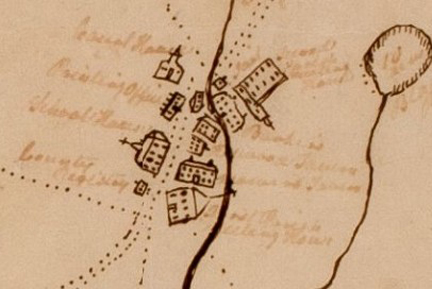
Later accounts of Worcester’s reading of the Declaration offered various explanations as to why it happened there first. Like other key aspects of this claim, they are not backed up by primary sources, and several are clearly mistaken. None take into consideration that the two locations central to most accounts, Worcester’s meeting-house as the site of the reading, and the printing office as the site where Thomas allegedly obtained a copy of the Declaration, are about a half a mile apart.
Shortly after the star and plaque were placed in front of Worcester City Hall, Charles Lemuel Nichols offered his explanation as to why the first public reading in New England occurred in Worcester. Writing if Isaiah Thomas, he claimed,
Thomas saw a horseman enter town on the morning of July 14, 1776. Upon inquiry he found that the messenger was bearing to the commander-in-chief at Cambridge an official copy of the Declaration of Independence. Convincing him of his own sincerity and hastily copying this precious document, Thomas gathered his townsmen before the church, read the precious words while standing on the porch, and caused them to be printed in the subsequent issue of the Massachusetts Spy. [11]
Nichols did not provide a citation to support this account or explain why a rider was heading to Cambridge with a copy of the document for George Washington in July of 1776, since the general and most of his army had left four months earlier, and were in New York City.
An online walking tour of Worcester’s Revolutionary War sites doesn’t say how Thomas obtained the copy of the Declaration to read. It does include a flawed explanation for why though, claiming: “The plan was to read it at Boston but, fearing interception by British patrols occupying the city, it was decided it would be read in Worcester by the distinguished patriot.”[12] It’s unlikely there was any fear of this sort, as British forces left Boston on March 17, 1776, and the Declaration was read from the balcony of the State House there to an enthusiastic crowd on July 18.
In another account, Worcester’s minister, the Rev. Thaddeus Maccarty, initiated the first reading, not Thomas himself. A biography of Macarty claimed, “When a post rider rode into Worcester on a hot day in July 1776, bearing the news that the Declaration of Independence had been signed, he was summarily halted by a tall, slender man with dark, piercing eyes. The man was Rev. Thaddeus Maccarty.” Having done so, Mccarthy then turned to “Isaiah Thomas, at the time the post master, was in the little throng that had collected in anticipation of the news and it was Mr. Thomas, at the command of the clergyman, who mounted the porch of Old South Church and read the message that thrilled the city.”[13]
What’s not mentioned in the majority of the accounts of the reading of the Declaration in Worcester is that on Wednesday, July 17, the Spy printed the document in its entirety on its front page. It was one of many, and not the first newspaper in New England to do so.
The Declaration was first printed as a broadside in Philadelphia, on July 4, by John Dunlap. The first newspaper to print the Declaration in its entirety was the Pennsylvania Evening Post, on July 6, 1776. The news spread fast. On July 10, 1776, the Spy informed its readers, “It is reported that the Honorable Continental Congress have declared the American Colonies independent of the Monster of Imperious domination and cruelty—Great Britain! Which we hope is true.”[14] The full text of the Declaration was first printed in New England on July 12, in New London, Connecticut in the Connecticut Gazette; and the Universal Intelligencer.[15] The following day it was published in Rhode Island in the Providence Gazette and Country Journal under the heading “The following Declaration of the General Congress was Yesterday received from Philadelphia.”[16] While the Spy doesn’t say when the copy it printed arrived in Worcester, it would have been before July 17, based on when copies reached these other New England towns, and the time needed to set the type and print the paper for its readers.
Isaiah Thomas as the Reader
Most accounts credit Thomas’s standing as a prominent Patriot and his role as Worcester’s printer and postmaster as the reason he was able to access a copy of the Declaration when it was on its way to Boston, and either on his own initiative or at the urging of others, read it to the crowd. In order for this to have happened, he would have had to have been in Worcester on July 14. It’s not entirely clear that he was. Understanding why sheds light on who Thomas was, and what he achieved over the course of his lifetime.
Much of what we know about Isaiah Thomas comes from his own accounts of his life. Thomas wrote that in 1774 he made arrangements to send a printing press and person to manage it to Worcester, as “a number of gentlemen in the county of Worcester, zealously engaged in the cause of the country, were, from the then appearance of public affairs, desirous to have a press established in Worcester.”[17] Instead, when he learned that British troops had left Boston on the night of April 18, 1775, and were headed to Concord to destroy Provincial stores there, “At day break, the next morning, he crossed from Boston over to Charlestown in a boat with Dr. Joseph Warren, went to Lexington, and joined the provincial militia in opposing the king’s troops. On the 20th, he went to Worcester, opened a printing house, and soon after recommenced the publication of his newspaper.”[18]
Once in Worcester, about forty miles west of Boston, Thomas recalled: “it was finally determined that his press should remain at Worcester, and that postriders should be established to facilitate an intercourse between that place, Watertown and Cambridge; and at Worcester he continued to print for congress until a press was established at Cambridge and at Watertown.”[19] While his new home seemed well beyond the reach of the British army, Thomas faced new challenges. Leaving Boston meant leaving behind most of his customers and subscribers, some of whom owed him money. In addition,
[a] letter addressed to the Provincial Congress at Watertown in October of this year (1775) shows that this body had refused to pay for his post-rider service and the two hundred copies of his ‘Spy’ sent to them from Worcester . . . It is not surprising, therefore, to read a statement by Benjamin Russell, one of his apprentices at this period, that these were not times of affluence; that the apprentices slept on rags in the garret, and they and their master often ate together in the office their meals of bread and milk bought by the pennyworth.[20]
Thomas wrote that he remained in Worcester until some point in 1776 when “he let a part of his printing apparatus, and his newspaper, to two gentlemen of the bar, William Stearns and Daniel Bigelow.” Thomas left Worcester for Salem, Massachusetts, where he intended to establish a printing office. There, after encountering a number of challenges which he described as “obstructions to the plan arising in consequence of the war,” he sold the press and type he had brought with him. Two years later he returned to Worcester, to resume his printing business there in 1778.[21]
Thomas’s account of this period of his life leaves out several details. On February 20, Rev. Ebenezer Parkman of Westborough noted in his diary: “[I] am informed that Isaiah Thomas Printer of the Spy at Worcester, is disenabled; his Printing Office etc. seized.”[22] In the weeks that followed, only two editions of the Spy were printed from February 16 through April 22, 1776, and no paper was printed from May 31 until June 21.[23] In the March 1 edition Thomas explained to his readers, “The Printer is sorry to say, especially at this Crisis of affairs, that the cruel hand of Oppression, in conjunction with unmerited malice, prevented him from publishing a paper last week.”[24]
When the Spy resumed publication on June 21, Thomas’s name was no longer on the masthead at the top of front page, as it had been for years. Instead, at the bottom of the back page, William Stearns and Daniel Bigelow were listed as its publishers.[25] A short notice informed readers, “The Publishers of this Paper hereby inform the Public that Mr. Isaiah Thomas having relinquished the Printing Business in Worcester, they shall continue the same at the Printing-office lately improved by said Thomas.”[26]
Thomas’s grandson, Benjamin Franklin Thomas, provided a bit more detail on the what happened between 1776 and 1778, after Thomas left Worcester, writing that in Salem “The nature of the obstructions will be understood when we learn that three writs of attachment were served upon his press and types in a single evening.” As a result, Thomas and his family moved to a small farm in Londonderry, New Hampshire.[27]
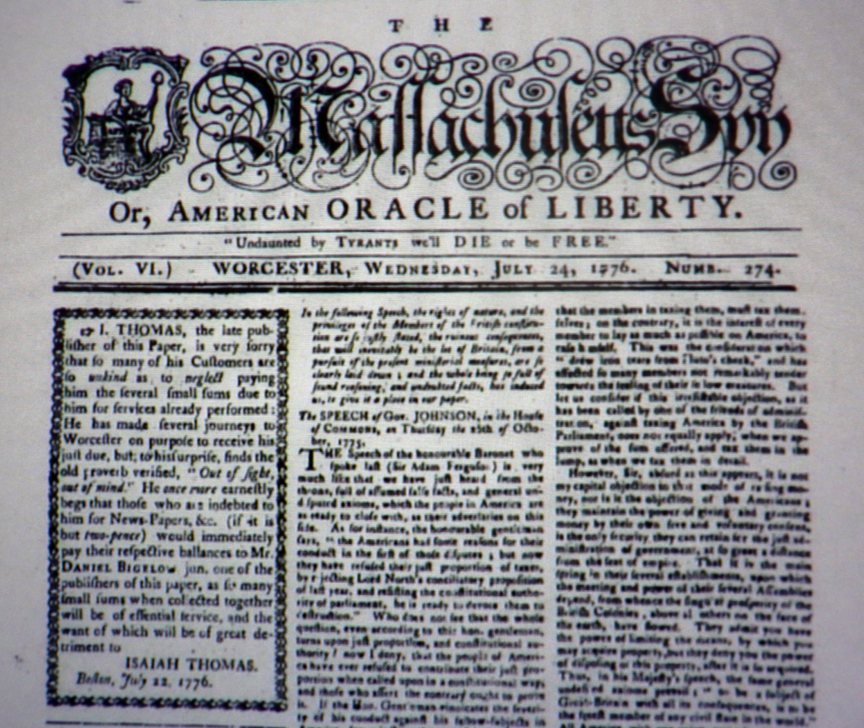
Benjamin Franklin Thomas also claimed that his grandfather “While on a visit to Worcester, July 24th, 1776, he read from the porch of the South Church, to an assembly consisting of almost the entire population of that and adjoining towns, the declaration of independence.”[28] He had good reason not to credit the July 22 reading to Thomas. On July 17, in the same issue of the Spy in which the Declaration was printed, there was a notice from Thomas indicating that he had been in Worcester on June 14 to collect money he was owed. The following week, in the July 24 edition of the Spy, there was another dunning notice from Thomas dated July 22 from Boston, putting him forty miles away from Worcester on the date of the documented public reading.[29]
Thomas returned to Worcester in 1778, two years after the adoption of the Declaration, and the public readings which followed. In the July 2, 1778, edition of the Spy, he informed its readers: “Isaiah Thomas, Printer, the original proprietor and publisher of this paper, resumes the printing business.”[30] This time Thomas and his printing business would flourish. Three years later he received what appears to be his first appointment as a town official when he was selected to serve on the Committee of Correspondence on March 12, 1781.[31] Three decades later he would note in his diary at the beginning of the year in 1810, “Last year I held more offices in Society than I could attend to.”[32]
Isaiah Thomas On The 4th Of July
Thomas’s autobiographical writings and diary offer insight as to how things changed for him after he returned to Worcester in 1778. In his History of Printing in America, he wrote a lengthy account of his life, including being questioned by colonial authorities in Nova Scotia for inserting language opposing the stamp act into the paper he was working for from 1765 to 1767, and his refusal to appear before the governor’s council in Massachusetts in 1771 for questioning about an essay he published in the Spy. He made no mention of reading the Declaration of Independence in Worcester in 1776.[33]
Thomas usually noted the anniversary of the Declaration in his diary, which as published spans twenty-eight years, from 1805 to 1828.[34] How and where he celebrated varied, but there was no reminiscence of what he did in 1776. His entry for 1805 suggests that remained in Worcester, noting, “Independence—highly celebrated excellent Fire Works in the Evening.” The following year he remained close to home, noting for that year, “Went to Leicester. Academy dedicated.” One year later, in 1807, he wrote, “Dined at Faneuil Hall. The Hon. John Adams late President of the United States, and the Hon. Robert Treat Paine, two who signed the Declaration of Independence were present—about 450 dined in the Hall, which was handsomely decorated.”[35]
In the years that followed he traveled to Boston three more times on the Fourth, the last time in 1818. The years preceding and following reflected a country that was divided in its politics; Thomas noted in 1817,
The Federalists and Republicans associated, in Worcester and its neighborhood, and celebrated the day together. Every thing was done to the satisfaction of both parties; neither the oration or the Toasts gave the least offense. I officiated as President on this occasion being unanimously chosen by a meeting of both parties previously. About 300 dined together in public, in a booth on the hill, west.[36]
In 1819, however, in an entry dated July 3, as July 4 was a Sunday, he wrote: “Independence kept in Worcester by the democratic party, who gave out that they wanted no federal Company—many federalists went to Charlton to celebrate the day—I kept it at home.”[37]
His diary entry for July 4, 1826, the fiftieth anniversary of American independence, reflects the status he had achieved in his adopted home town in the decades which followed his return to Worcester. That day, he wrote that he “Presided at the publick Dinner this day in the Town Hall, and walked in the procession.”[38] The following year he wrote the meaning the day held for him and, at seventy-eight years old, the effects of age on his health, writing:
As it was the 4th of July, a day which I wish to regard whilst I have life, notwithstanding I was unfit to go abroad, I to Church to join the Society of ‘Odd Fellows’ in the Exercises of the day, and afterwards to the Hall where they dined . . . but could not partake in either eating or drinking.”[39]
Was there a public reading of the Declaration of Independence in Worcester on July 14, 1776? It’s possible, as three days later it appeared in full in print on the front page of the Spy. If it was read on July 14, would it have been the first public reading in New England? That is impossible to say, as it is just as likely there were similar and earlier readings in New London, Connecticut where it was printed on July 12, or Providence, Rhode Island when it arrived in town that same day.
If there was a July 14 reading, did it occur on the steps of Worcester’s meeting-house? Perhaps, but that seems uncertain as well, as the meeting-house was located about half a mile south of the printing office, where it was set in print by July 17. If there was a July 14 reading, it seems more likely it would have been near the printing office
Did Isaiah Thomas do the reading? This seems least likely of all. His life was in turmoil that summer. Thomas’s diary ends two years before his death, with an entry dated December 28, 1828: “Went to Church once.” He made no entry on July 4 that year.[40] Nowhere in his autobiography or his diary did he mention that he read the Declaration of Independence to the public in Worcester on July 14, 1776. Regardless, Worcester’s citizens, like those in towns throughout the newly created United States, were eager to read and hear the words declaring them independent.
[1] “The New Media and the Making of America, 1730-1865”, American Antiquarian Society, collections.americanantiquarian.org/earlyamericannewsmedia/exhibits/show/age-of-revolution/item/40.
[2] Massachusetts Spy, July 24, 1776.
[3] “From Our Cabinet: Declaration of Independence,” Massachusetts Historical Society, www.masshist.org/objects/cabinet/july2002/july2002.htm.
[4] Franklin P. Rice, ed., Worcester Town Records From 1753 to 1783 (The Worcester Society of Antiquity, 1882), 4:280.
[5] “Worcester History”, The City of Worcester, www.worcesterma.gov/city-clerk/worcester-history. Rice, Worcester Town Records From 1753 to 1783, 4:280.
[6] “Diary of Rev. Ebenezer Parkman”, The Ebenezer Parkman Project, diary.ebenezerparkman.org/wp-content/uploads/2018/03/1776-PDF-5-footnotes.pdf. A broadside copy of the full text of the Declaration in the special collections of the Boston Public Library, printed in Salem by E. Russell includes the Council’s order at its bottom: www.digitalcommonwealth.org/search/commonwealth:47429c74x. Additional copies are in the collections of the Massachusetts State Archives (archives.lib.state.ma.us/entities/archivalmaterial/1bb678f7-cdac-49b3-981d-a772680e617a) and the Massachusetts Historical Society (www.masshist.org/database/966).
[7] National Aegis, July 4, 1826.
[8] The Massachusetts Spy and Worcester County Advertiser, July 5, 1826.
[9] William Lincoln, History of Worcester, Massachusetts (Moses D. Phillips and Company, 1837), 114-115.
[10] Albert A Lovell, Worcester in the War of the Revolution (Tyler and Seagrave, 1876), 81-83.
[11] Charles Lemuel Nichols, Isaiah Thomas, Printer, Writer & Collector (The Club of Odd Volumes, 1912), 12-13. On July 14, 1776, George Washington was in New York City. That day he wrote to John Hancock that he had rejected an offer of peace from British Gen. William Howe: “George Washington to John Hancock, 14 July 1776”, Founders Online, founders.archives.gov/documents/Washington/03-05-02-0218.
[12] “Worcester Revolutionary Walking Tour,” Discover Central Massachusetts, www.discovercentralma.org/articles/post/revolutionary-walking-tour-worcester-massachusetts/.
[13] “Reverend Thaddeus McCarty,” American Antiquarian Society, collections.americanantiquarian.org/portraits/bios/75.pdf (quoting from “Old Bible Given to South Church,” Worcester Sunday Telegram, April 18, 1926, American Antiquarian Society Newsclipping File).
[14] Massachusetts Spy, July 10, 1776.
[15] “Declaration Database”, Harvard University, declaration.fas.harvard.edu/sites/g/files/omnuum10521/files/declaration/files/declaration_databaseaugust_2018_2023_update.pdf. The Declaration was also printed in the Connecticut Courant and Hartford Weekly Intelligencer and the Norwich Packet on July 15; in Salem, Massachusetts, in The American Gazette; or, the Constructional Journal, and Exeter, New Hampshire, in the New Hampshire Gazette, or, Exeter Morning Chronicle on July 16; and in New Haven in the Connecticut Journal on July 17, the same day it appeared in the Spy. The first printings in Boston were on July 18, in the Continental Journal, and Weekly Advertiser, and The New-England Chronicle, the same day it was read to the public from the balcony of the State House.
[16] Providence Gazette and Country Journal, July 13, 1776.
[17] Isaiah Thomas, The History of Printing in America (Printed for the American Antiquarian Society, 1874), 180-181.
[18] Ibid., 169.
[19] Ibid., 170.
[20] Charles Lemuel Nichols, Isaiah Thomas, Printer, Writer & Collector (The Club of Odd Volumes, 1912), 11. In 1780, when Thomas was drafted to serve for six months with the Continental army, Benjamin Russell went in place of his master. Benjamin Franklin Thomas, Memoir of Isaiah Thomas by His Grandson (Munsell, Printer, 1874), 58.
[21] Thomas, The History of Printing in America, 179-180. Thomas may have decided to relocate to Salem, a wealthy port town, as its printer Samuel Hall had relocated to Cambridge in 1775 to print for the Provincial government and army. Thomas, The History of Printing in America, 177.
[22] “Diary of Rev. Ebenezer Parkman”, The Ebenezer Parkman Project, 2026, diary.ebenezerparkman.org/wp-content/uploads/2018/03/1776-PDF-5-footnotes.pdf.
[23] Nichols, Isaiah Thomas, Printer, Writer & Collector, 58. Thomas was not the only printer who struggled to put out a newspaper in 1776. Carl Robert Keyes writes in his blog, “The Adverts”: “Instead of the usual four pages, the January 12, 1776, edition of the Connecticut Gazette consisted of only two pages . . . Timothy Green, the printer of the Connecticut Gazette, had only enough paper that he was forced to condense the contents to a half sheet, one page printed on each side.” adverts250project.org/2026/01/12/january-12-11/. Keyes also notes that in the fall of 1775, the Essex [Massachusetts] Journal explained to its readers that it was being printed on smaller sheets of newsprint saying, “THE only apology we can make at this time for printing on no better paper,” as, “we can borrow from other printers who have lately been obliged to make use of the same sort, which was as they say, because they could procure no better.” adverts250project.org/2025/10/20/october-20-10/.
[24] Charles L. Nichols, “Some Notes On Isaiah Thomas and His Worcester Imprints,” Proceedings of the American Antiquarian Society, Vol. 13, Part 3, (1900): 438-439.
[25] Nichols, Isaiah Thomas, Printer, Writer & Collector, 58.
[26] Nichols, “Some Notes On Isaiah Thomas and His Worcester Imprints”, 433.
[27] Benjamin Franklin Thomas, Memoir of Isaiah Thomas by His Grandson (Munsell, Printer, 1874), 55. His personal life was in turmoil as well. After marrying Mary Dill in 1769 at age twenty, while in South Carolina, “to his Astonishment he found that his Wife had had a bastard some Years before & that she had been prostituted to the purposes of more than One.” By 1775 their marriage was marked by a “petulance of Temper & unhappiness of Disposition which she daily exercised to the disturbance of domestic Peace.” In February of that year Mary traveled to Portsmouth, New Hampshire, and stayed in several inns overnight with her lover, leading Thomas to first separate from her, and then file for divorce in 1777. J.L. Bell, “Avowed Themselves to Be Man & Wife”, boston1775.blogspot.com/2011/02/avowed-themselves-to-be-man-wife.html.
[28] Benjamin Franklin Thomas, Memoir of Isaiah Thomas by His Grandson, 55. In his speech marking the centennial of independence, B.F. Thomas would claim that his grandfather read the Declaration publicly on Sunday, July 14, adding that the reading occurred on “a quiet summer’s morning,” when “the people of the village had been suddenly gathered.” (Celebration By The Inhabitants Of Worcester, Mass., of the Centennial Anniversary of the Declaration of Independence (Printed by Order of the City Council, 1876), 29.
[29] Massachusetts Spy, July 17, 1776 and July 24, 1776.
[30] Charles L. Nichols, “Isaiah Thomas and His Worcester Imprints,” 431.
[31] Rice, Worcester Town Records From 1753 to 1783, 4:384.
[32] Isaiah Thomas, The Diary of Isaiah Thomas, Benjamin Thomas Hill, ed., (American Antiquarian Society, 1900), 1:79-80. Thomas’s list included serving as Grand Master of Freemasons in Massachusetts, a director of the Worcester Bank, and the Worcester Turnpike Corporation; a member and proprietor of the Boston Athenaeum Society; a member, librarian and director of the Worcester Library Company, and a magistrate of Worcester County. In addition, he was a member of the Massachusetts Charitable Fire Society, the Massachusetts Charitable Mechanic Association, the Massachusetts Humane Society, the Massachusetts Agricultural Society, the Christian Monitor Society, the Foresters Association, and the Evangelical Missionary Society of Massachusetts. He humbly concluded with the statement, “I cannot boast of being a useful member of many of the abovementioned Institutions.”
[33] Thomas, The History of Printing in America, 158-159, and 166-169.
[34] Thomas, The Diary of Isaiah Thomas, Volume 1 and Volume 2.
[35] Thomas, The Diary of Isaiah Thomas, 1:9, 20 and 48.
[36] Ibid., 1:354 and 2:23.
[37] Ibid., 1:354 and 2:23.
[38] Ibid., 2:239. A footnote indicates, “The procession . . . marched to the Old South Church, where the exercises consisted of prayer by Rev. Aaron Bancroft; the reading of the Declaration of Independence by William Lincoln; and an oration by Charles Allen.” Ibid., 2:239-240.
[39] Ibid., 2:239 and 272.
[40] Ibid., 2:319, 301-302.

One thought on “Isaiah Thomas and the Declaration of Independence”
Superb original research and creative analysis to debunk historical myth. Well done.