

If one were to create a soundtrack for the day the Declaration of Independence was read in Philadelphia, what music would accompany the event? While “Yankee Doodle” might immediately come to mind, only two tunes, the “Liberty Song” sung to the British tune “Heart of Oak” printed in 1768, and the 1770 hymn “Chester” by William Billings were popular patriotic songs confirmed to have been published in America by July 4, 1776. Wouldn’t it be extraordinary if we could tie a published version of not only “Yankee Doodle” but sixty-one other selections performed in America to the birth of our nation?
The eminent musicologist and head of the music division of the Library of Congress, Oscar G. Sonneck (1873-1928), led with such a hypothesis in his landmark 1905 book A bibliography of early secular American music, speculating that a fife instruction and music book or “tutor” available for sale circa 1805 was originally published during the second half of the eighteenth century. He considered it “most likely identical” to a lost music collection book published in Philadelphia that was advertised in the Pennsylvania Gazette on July 3, 1776. The relationship between these texts is a critical question to explore. If these two were one and the same book, then there would be dozens of marches and airs to add to our newly published American playlist.
Enter the musicians—fifes and drums lead military maneuvers, Philadelphia: November 14, 1775
A brigade composed of three battalions began to march through the streets of Philadelphia in preparation for defense of the united colonies. The march was planned to move from the “head” of Arch Street to Fourth Street, north to Vine Street, east to Second Street, and then south to Spruce Street to separate at the end of the historic city border.[1]

The officer called the command, and the musicians relayed the command to the soldiers. No soldier would be out of earshot of the fife and drums. The manual exercises were well-defined. Each drum beating signaled a motion: Double Roll . . . Present Arms! Flam (sounding on the drum like saying the word “Flut”) . . . Prime and Load! Ruff (sounding on the drum like saying the word “Ruff” and rolling the “R”) . . . Caution! Drums coupled with the fifers playing tunes signaled other movements. To Arms . . . Form Battalion! Retreat, and March . . . Retreat by Files from the Center of Grand Divisions! First part of The General . . . Firing Ceases!
Setting the Scene—the sights and sounds of martial preparation fill the streets, Philadelphia: Sunday, December 3, 1775
Resident Cecilia Parke Shee reported to her brother, John Parke:
alas—what I can tell you—nothing but distressful things of the trouble of the times—the extreme scarcity of money . . . many people who formerly held their heads very high—now put to their shifts to maintain themselves . . . you cannot imagine how altered our city is . . . the Streets dull and silent—no busy hum of men—nothing disturbs our serenity—only now and then the drum and the parading of the troops[2]

Later in December a few fifers and drummers were seen marching down the streets of colonial Philadelphia recruiting for the Continental marines, the sighting attributed to the perceptive Benjamin Franklin under the pseudonym “An American Guesser”: “I observed on one of the drums belonging to the marines now raising, there was painted a Rattle-Snake, with this modest motto under it, ‘Don’t tread on me.’”[3] This motto of the Revolutionary Gadsten flag was first reported seen one week prior on the main mast of the USS Alfred, when she was at anchor at the Northmost part of Chesapeake Bay, December 20, 1775.[4]
Setting the Stage—Fife and Drum Majors play an important role in new battalions, Philadelphia: Saturday November 25, 1775
The House of Representatives put forth rules and regulations for better government of the military association in Pennsylvania. They deemed that all battalions be completed as soon as possible. The eighteenth regulation stated that battalions “will consist of at least six companies of not less than forty and not more than seventy-six privates each” and amongst its officers to have a drum and fife-major, with each company having a drummer and a fifer.[5] The thirty-second regulation specified the pay of three shillings for drummers and fifers and the drum-major and fife-major of every battalion “shall receive each a sum not exceeding fifteen shillings per week; and it is required that the Drum-majors and Fife-Majors, when not in service on days of exercise, shall be diligently employed in instructing a proper number of persons for Drummers and Fifers of the several battalions.”[6] The pay for a drum of fife major was twice that of an adjutant, owing to the importance placed on their work and perhaps the difficulty of filling the position with a skilled player and an instructor.
The drum major and fife major were charged to pass along to other drummers and fifers the knowledge of what beats and what music to play, and how to play their instruments. Drummers needed to learn the rudiments, calls, and signals necessary to pass orders from the commander to the troops. While drummers primarily were instructed by in-person training or rote, fifers learned through a combination of in-person instruction and playing by ear as well as by referring to printed music and instructions. Personal handwritten books kept on purchased manuscript paper were either copied from published music or dictated. It is from the study of extant manuscripts that modern-day musicians have forged their concept of what music was played in the colonies during the American Revolution.

Enter the “conductor” Michael Hillegas
Michael Hillegas was appointed treasurer of the Committee of Safety in Philadelphia in 1774, serving under Benjamin Franklin, and then appointed Continental treasurer July 29, 1775 by the Continental Congress. He was named treasurer of the United States in September 1776.[7] A wealthy and successful businessman, he owned what is considered the first shop in Philadelphia to sell music books and musical instruments, beginning in 1759.[8] He was personally appraised by John Adams after a joint excursion up the Delaware River along with prominent Philadelphians Owen Biddle and David Rittenhouse: “Hillegas is one of our Continental Treasurers, is a great Musician—talks perpetually of the Forte and Piano, of Handell &c. and Songs and Tunes. He plays upon the Fiddle.”[9] Michael Hillegas was also a musical supplier for Thomas Jefferson’s violin and guitar accessories and music[10].
In a May 10, 1760 letter to an English publisher, Hillegas ordered many instruction books called “tutors” to sell: “14 Tutors for Harpsichord, 24 Tutors for Violins, 18 Tutors for German Flutes and 4 Tutors for Common Do [recorders]” amongst other music collections and instruments.[11] On January 5 and February 2, 1764 he placed advertisements in the Pennsylvania Gazette so extensive that they ran for forty lines of listed sheet music titles, music instruction books and instruments, spanning a third of a column of a three-column page.[12]
On May 28, 1772, Hillegas placed yet another extensive advertisement for imported tutors for sale, plus collections of songs and musical instruments and accessories:
JUST IMPORTED and to be SOLD, by MICHAEL HILLEGAS, At his house, in Second-street, A GREAT Variety of Music, . . . TUTORS, or BOOKS OF INSTRUCTION, for the VIOLIN, GERMAN FLUTE, COMMON FLUTE, FIFE, and HAUTBOY; . . . &c. &c.[13]
The tutor for the fife was most likely The Compleat Tutor for Fife, printed and sold by Thomas Bennett, No. 61, near St. Andrew’s Church, Holborn, London. The music book was available for sale sometime after January of 1767, the date printed on its title page.[14]
A score is placed on the podium (Michael Hillegas, A Complete Tutor for the Fife, Philadelphia, 1776)
Hillegas was the Treasurer that oversaw the fines incurred by the Associators for non-attendance and other matters.[15] His political position placed him at the forefront of the requirements of the brigades and as a musician, he must have been particularly attuned to the musical preparation of the fifers to lead battle commands.
With a practical intent of accessibility by the fifers and drummers parading on the streets, practicing at camp and rallying the troops, Michael Hillegas entered the music publishing business. He prepared a fife tutor for sale to coincide with the fight for independence. In response to the comprehensive boycott instituted by the First Continental Congress on December 1, 1774 prohibiting the importation of all British goods, advertisement of material goods for sale was a rarity. Yet in a remarkable seven separate issues in the summer of 1776 Hillegas placed advertisements in the Pennsylvania Gazette for his new book.[16]
JUST PUBLISHED, and to be SOLD by MICHAEL HILLEGAS, A COMPLETE TUTOR FOR THE FIFE, comprehending the first Rudiments of Music, and of that Instrument, in an easy familiar Method. To which is annexed, besides the Fife Duty, and the usual Collection of Lessons, Airs, and Marches, in the English Edition, a Variety of new favourite ones never before printed.[17]
A second score is placed on the podium
Thirty years later another fife tutor advertised the same content. As Oscar Sonneck speculated, is the second score a copy of the first with a newly designed cover?
The Compleat Tutor for the fife, Containing ye Best & Easiest Instructions for Learners to Obtain a Proficiency, To which is added, A choice Collection of ye most Celebrated Marches, Airs, &c. Properly adapted to that Instrument; with several choice Pieces for two Fifes.
Philadelphia. Price 62 ½ cents. Printed for and sold by George Willig. Number 12 South Fourth Street, Philadelphia. Where also may be had a great variety of other music, musical instruments, strings, &c. &c.[18]
The artist Norman and composer Billings weigh in on the score
The frontispiece to the George Willig tutor features an engraving signed by John Norman, Jr. Historian Oscar Sonneck observed:
That it was Americanized appears from the engraved plate. It shows a Hessian soldier playing a fife in front of a fort from the flag pole of which the American stars and stripes are flowing. The helmet of the Hessian shoes the word “Liberty” instead of the Hessian coat of arms . . . is equally evident that the “Stars and Stripes” have been added. The plate is by Norman, an early American engraver, and can be traced back to Revolutionary times as Mr. Jordan of the Pennsylvania Historical Society informed Sonneck. [19]
Freelance architect and landscape-engraver John Norman (1748–1817) moved to Philadelphia from London in April 1774.[20] The following December he advertised for subscribers to his American edition of Swan’s British Architect which was boasted to be “cheaper than the London edition by ten shillings at least.” Interestingly he offered for view a specimen of what would later amount to sixty “copper-plates and type” at his premises on Second Street near Spruce Street.[21] Historian Carolyn Yerkes wrote,
In the process of reprinting the British Architect and the Collection of Designs, it was reported that John Norman made almost no alterations to the originals. Norman’s plates reversed the illustrations of the older editions, but other changes were minimal, and the texts remained nearly identical.[22]
Norman’s first map, “The theater of war in North America” engraved and sold in Philadelphia in 1777, was similarly retooled from a British map.[23] John Norman advertised for his reworked map in the Pennsylvania Evening Post on July 10, 1777:
This map is engraved from a very late copy done in England on a new and accurate plan, calculated for the use of the officers in the British army. —The American publisher therefore apprehends that the utility of the map will be equally self evident to all the officers of the Continental army, and to all the inhabitants of the Thirteen United States in America.[24]
Could he have aided the Continentals by engraving a copy of a British fife tutor in the interim year? His signature on the frontispiece lends to credibility that the music was also engraved by him. Further consideration that he was also the music engraver comes in an advertisement in the Pennsylvania Ledger, April 4, 1778 for the Compleat Instructor for the Violin with music by H.B. Victor, “just published, and now selling by J. Norman, Engraver, opposite the old Workhouse, in Third-street.”
Additionally, Norman began engraving plates for music scores almost immediately after arriving in Boston in 1781. One of his first engraving projects was for the composer of “Chester,” William Billings. The frontspiece of Billings’ The Psalm-Singer’s Amusement was signed by Norman and the copperplates of the music are attributed to him.[25] Historian Richard J. Wolfe wrote that “he probably engraved all the Boston sacred music imprints between 1781 and 1793.”[26] Wolfe thought The Psalm-Singer’s Amusement most likely to be the first published music cut on metal in America, a consideration now up for debate.
In the late eighteenth century, frontispieces for books were typically engraved in copperplate and the rest of the text was typeset. Notated music was mostly engraved. Amy Carson from the Library Company of Philadelphia showed this author the second known published John Aitkens songbook of 1787, a printing by an engraved plate, whose appearance on sight is identical to the extant edition of fife tutor which has been attributed to Willig, with its signature raised edges around all pages.[27] If the Willig tutor is decidedly a reprint of the Hillegas 1776 tutor, it would be the first published music cut on metal in America.
Returning to the original imported score, the Bennett Fife Tutor
Like the reinvented Norman engraving projects of 1775 and 1777, the body of the tutor is for all practical purposes is a direct copy of The Compleat Tutor for Fife, printed and sold by Thomas Bennett in London around 1767, which is most certainly the fife tutor that Michael Hillegas imported for sale at his music store in 1772. The title page of the Bennett tutor is almost identical to the wording in the Willig reprint of Hillegas with the exception of the publisher’s name and address and one telling omission—“A choice Collection of ye most Celebrated Marches,” is not followed by the British qualifier “As Performed in the Guards.”
After the title page is the frontispiece signed by Norman, which is a copy of the artwork in Bennett which other earlier fife tutors from England also employed.[28] Then there are the first “Rudiments of Music and of that Instrument, in an easy familiar Method.” The instructions for the fife are detailed—what fingers to put down for what notes, how to read music and rhythms. In comparing the Hillegas tutor to the earlier Bennett tutor, the text is copied exactly, but the font and pagination vary as edits for clarity were made. For instance, in the Bennett tutor, the scale was written in the same octave notated in the music, while in the Hillegas tutor the scale or gamut was notated in the octave higher. Presumably this was done to omit these extremely confusing instructions in the text: “All the Notes above C, are call’d in Alt to distinguish them from those below, of which they are only a Repetition; and those above C, in Alt, are call’d double D, double E, double F, and double G, in Alt.”
Following the instructions for beating in common and triple time is the music for the English fife duty. This section features the “foot march with eight divisions” and the “troop” with its “doublings,” which encompass marching music, roll calls, and flag presentation commands.
Additionally, the duty includes the “Taptoo,” used for retiring to bed, and the “Reveilly,” the signal for waking. In total, there are four pages of fife duty, with a few additional pieces placed later in the book. These duties were essential for preparing soldiers for war. As available in fifers’ manuscripts as well as later editions of fife and drum manuals, they were played by both the Continental forces and the British regulars. Notably, “The General,” “To Arms,” “Assembling,” and “The Drums Call” continue to be performed by Revolutionary War reenactors on both sides today.
Apart from minor adjustments—such as error corrections, changes in articulation, and improved spacing to prevent measures from splitting between lines, the first twenty pages of instruction and music as well as four subsequent pages are identical. They maintain the same order, pagination, nomenclature, note placement, rhythms, keys, articulations, ornaments, and repeats. The designation of tunes for single fife versus two-part harmony also remains consistent. In total, there are forty-eight pieces of music (seventeen duty pieces and thirty-one marches) spanning seventeen separate pages.
p. 8 Foot March with 8 Divisions
Troop
p. 9 Doublings of the Troop
Doublings
Taptoo
p. 10 The Reveilly
The General
To Arms
Troop or Assembling
Troop
p. 11 The Scotch Reveilly
The General
The Drums Call
The Dead March
The Singling of a Troop by Mr. Weideman
p. 12 Lord Loudon’s Grenadiers March
The Turks March
The Train of Artillery, Grenadiers March
p. 13 The Coronation March
The Second Grenadiers March
The Wiltshire March
The Bedfordshire March
p. 14 March for the thirty-fifth Regiment [contrapuntal]
p. 15 Bellisle March [contrapuntal]
The Retreat
Captain Money’s March
p. 16 The New Coldstream March
The Marquis of Granby’s or 1st Troop of Horse Grenadiers March
The Gloucestershire March
The Militia March
p. 17 The Warwickshire March
The Lincolnshire March
The Lighthorse March
p. 18 The Coldstream or Second Regiment of Guards March [contrapuntal]
p.19 Captain Reed’s or the Third Regiment of Guards March [contrapuntal]
The Dukes March
p. 20 The Duke of Glousters March As Perform’d before his Majesty at the Review in Hyde Park [contrapuntal]
The Essex March
The contents of the Bennett Tutor from page 21 to 24 resumes later, adding:
p. 23 Prince of Wales’s March
Prince Ferdinand’s March
Pioneer’s March
p. 24 Dorsetshire March, The [contrapuntal]
March in Scipio [Handel opera]
p. 25 Grenadiers March
Count Brown’s March
Lord Carmarthen’s March
p. 26 Grano’s March [contrapuntal]
Cumberland March
Comparing to the most recent score—the Willig Fife Tutor
George Willig owned the music publishing and instrument sales company “Musical magazine”. His 12 South Fourth Street, Philadelphia address was first advertised in printed sheet music in 1804.[29] The operations of the Hilligas and Willig musical sales establishments flanked the period of John Aitken’s pioneer music publishing establishment in Philadelphia (1787 to 1811). In presumably similar fashion to Hillegas’ publication, “some of Aitken’s earlier publications were reissued by Willig under his altered imprint.”[30]
Willig added two pages to the middle of what became a thirty-page instruction and music book. These added pages use a different typeface, and the subsequent page numbers from page twenty-two onward were altered. As noted in Sonneck’s pioneering research, on the final eight pages, the new numbering is superimposed over the original, and as personally viewed, in most cases, both numbers remain legible. Likewise, one of the two pages added by Willig includes the song “Jefferson’s March,” which would not have been composed prior to the drafting of the Declaration of Independence.
Willig’s engraving added these tunes:
President’s March [Hail Columbia]
Washington’s (Grand) March
Stoney Point
Jefferson’s March
Life Let Us Cherish
Roslin Castle
The fiddler Captain George Bush, checks against Hillegas’ score to clarify what he is to play
Next to weigh in was Capt. George Bush (1753-1797), who by his own account was a fiddler.[31] His autobiography comes in the form of a letter to George Washington. On the Presidents’ fifth day in office, Bush was responding to Washington’s request to learn more about Bush, collector of customs at the port of Wilmington Delaware.[32]
New York May 5th 1789
Sir
In answer to the questions you were pleased to put to me this day, I take the liberty to trouble you with the following detail … in 1776 I was appointed a Liut. in the Troops of Delaware. In 1777 I was promoted to the Command of a Company in one of the 16. Regts Commanded by Coll Hartley, this as you well know was blended with Coll Pattons & formed the 11th Penna. Regt under the command of Coll Hubley.[33]
As a captain and the paymaster of the 11th Pennsylvania Regiment from 1779, he collected purchase and payment logs in his notebook along with hand-copied marches and dance tunes, which he signed and dated at the start.
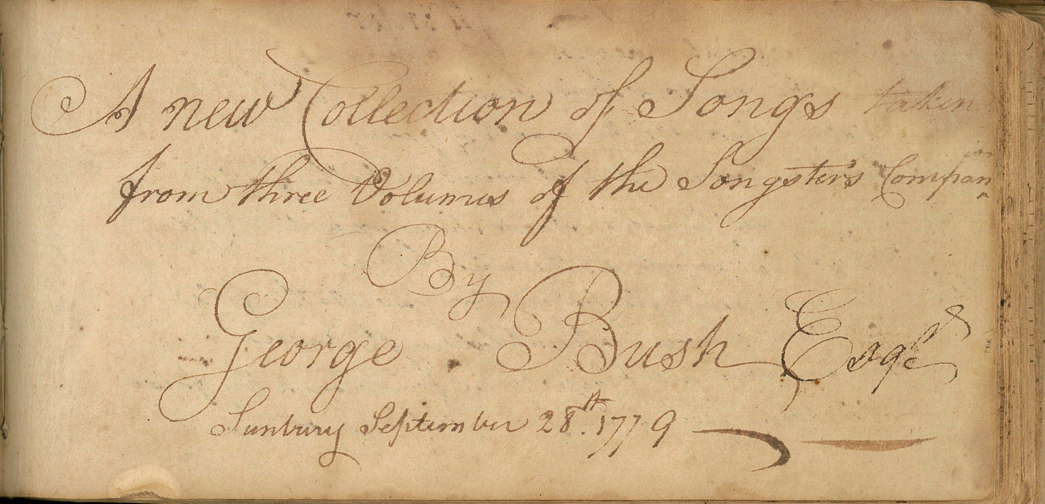
Executive Director of The Society for American Music (previously the Sonneck Society), Kate Van Winkler Keller paid a visit to the repository for the Bush Notebook, the Historical Society of Wilmington, Delaware, and published her many discoveries in three separate volumes. Her research emphasized the music that included dance steps, as she was a musicologist and historian with an emphasis on folk dance.[34]
In her research, Keller disclosed, “there are several aspects to its contents, which will reward more detailed study. The first and most significant is that a cluster of tunes near the beginning appears to have been copied from the now-lost fife tutor printed in Philadelphia in 1776” [35]
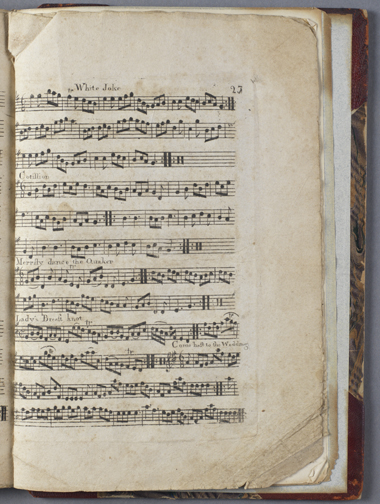
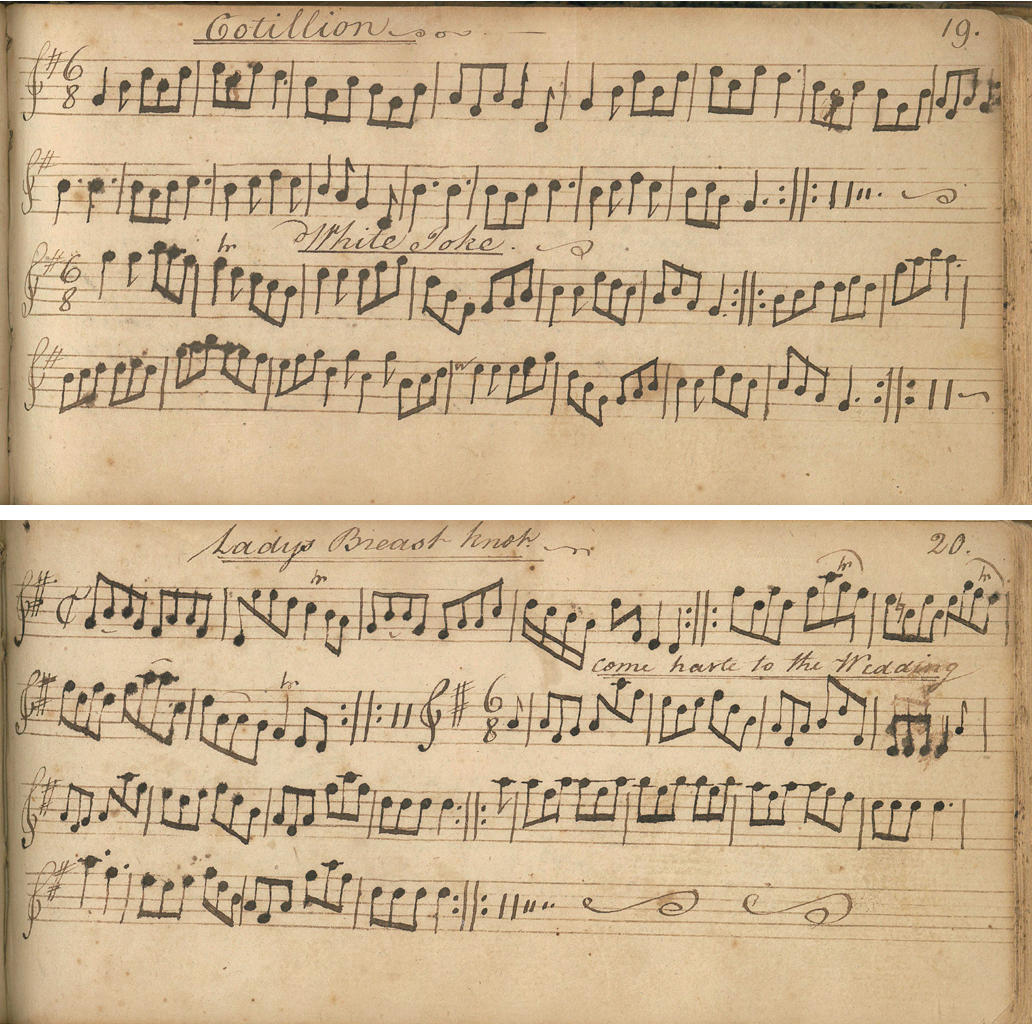
In this example even the untrained eye can clearly see that the scores are quite similar. Placing the start of the tune, “Come Haste to the Wedding” in the middle of the staff rather than at the start in both manuscripts, draws attention to this unusual placement.
Evidence that the one is a direct copy of the other:
- Both Bush and Hillegas presented a few songs not found in other American sources.
- George Bush’s manuscript employs not only identical formatting, notes and rhythms, but the copy is identical to the Hillegas fife tutor down to the stem directions and individual heights in the musical notation.
- Ornamentation and articulation in music of this era are superfluous, making identical slurs, trills and appoggiaturas an impossibility without duplication.
- Both the Hillegas and Bush songs have identical musical notation mistakes, misplacing the key signature on four separate occasions. In “Lady’s Breast Knot” and “Come Haste to the Wedding” Hillegas and Bush incorrectly marked the music as if it were written in bass clef.
How do we know for certain that George Bush copied his manuscript book from the Hillegas tutor and not the other way around?
- Bush named and dated his copy book only three pages before he wrote music identical to the Hillegas tutor. He was demonstrating that his transcription originated from another and obviously older source.
- While the opening tunes in Bush’s manuscript were copied with an elegant and accurate hand, later in his manuscript he wrote with the skill of an amateur not understanding how to dictate rhythms correctly. If his “El! Belle Catherine” was correctly notated it would amount to sixteen measures worth of music in 2/4 time. It is instead incorrectly marked in 6/8 time, and all eight of his measures have more than six eighth notes in them (8-10-8-12-8-7-9-15 respectively) which are grouped in 1, 2, 3, and 4 eighth-note beamed patterns, creating dozens of notation errors.
The final and definitive proof that Bush copied the music from Hillegas’ fife tutor is the copying of the end measure sign, the custos.
The discovery complete; the curtain rises. George Bush takes center stage in the 1776 production of Custos: the revolutionary defender of music
In music notation, a custos is a symbol that is seldom used but solely appears at the end of a line of music to indicate the pitch of the first note on the following line, which helps guide the performer. The word custos comes from the Latin word for guardian. Also called a “direct,” it is an uncommonly used notation which fell out of favor after the sixteenth century, entering the Baroque. Most seasoned performers move their eyes ahead of the notes that they are playing or singing, making the custos unnecessary. Even in the Bennett English fife tutor it was infrequently used.
An inexperienced player might not understand the zig zag lines’ meaning or value, which clearly was the case of George Bush as he dutifully copied the mark into his manuscript in the middle of a line, which not only demonstrated his lack of understanding of what the mark meant in the music but also just as significantly, demonstrated without a doubt that he was copying from Michael Hillegas, A Complete Tutor for the Fife, Philadelphia, 1776.
The textual analysis of these final pages is very clear and convincing. We can now attribute not only forty-eight pieces from the English fife tutor as the first music book published on the new American soil, but the following “Variety of new favourite ones never before printed” (as touted by the 1776 advertisements) can now be added to this venerable list:
| p. 27 White Joke |
| p. 27 Cottilion [a French contredanse] |
| p. 27 Merrily Danced the Quaker |
| p. 27 Lady’s Breast Knot |
| p. 27 Come Haste to the Wedding |
| p. 28 Philadelphia Associators Quick March, The |
| p. 28 Yankee Doodle |
| p. 28 Sette in Queen Mab, The |
| p. 28 Lovely Nancy (A Retreat) |
| p. 29 Georgia Grenadier’s March by Mr. Alexander, The |
| p. 29 Haymaker’s Dance |
| p. 29 Guardian Angels |
| p. 29 Corelli’s Gavot [an English country dance]
p.30 Congress, The [contrapuntal] |
Custos has the last stand. The musical finishes and the reviews come in.
There are two personal flute manuscript books; one kept by Henry Beck “copied in the year 1786” housed at Lancaster History Museum and Research Center, and the other by John Hoff (1776-1818) dated January 13, 1797 housed at the Library of Congress. Together they corroborate the tunes “The Congress,” the “Cottilion,” “Georgia Grenadier’s March by Mr. Alexander,” “Guardian Angels,” “Haymaker’s Dance,” “Lady’s Breast Knot,” “Lovely Nancy,” “Merrily Danced the Quaker,” “the Philadelphia Associator’s (or Pennsylvania) Quick March,” the “Sette in Queen Maab,” the “White Joke” and “Yankee Doodle” were indeed available to copy and include prior to the reissuing of the fife tutor by George Willig, circa. 1804.
Important in the distribution of the works from the day is that much of the music printed in a tutor can be interchangeable—music for the German transverse flute can be played on the violin or hautboy (oboe) and visa-versa. The fife music appears no different in its range even though the playable range of the instrument is different. It is understandable that the printed music found favor with flutists Beck and Hoff, and a violinist, in the case of Bush. It also makes sense that the pieces that had staying power past revolutionary times.
Where the Thomas Bennett fife tutor and the Michael Hillegas fife tutor differ is critical for the understanding of what new military music and airs were being learned and performed in Continental Philadelphia and the surrounding colonies. While most of the fourteen newest tunes were originally English (the “Philadelphia Associator’s Quick March,” for instance, is the older English tune “Pantheon Cotilion”), the “Georgia Grenadier’s March by Mr. Alexander” is perhaps an original American work. The tune “The Congress” was later reconfigured both in range and key, taking out an impossible key change to D minor for the fife and adjusting all altissimo notes. Its revamped version is the popular fife and drum tune “The York Fusiliers,” whose origins up until now have been elusive. This is most likely an original American work.
The United States owes its musical history to the Patriot Capt. George Bush and his family who preserved his copy book. I am thankful to Kate Keller for leaving the scholarship to aid this further discovery that America has had the published music to dozens of Revolutionary War tunes in our country’s collection for the last 250 years, which Americans can now claim with authority. An unbelievable total of sixty-two musical selections can now be attributed to the published American “playlist” which will be tied indelibly to the birth of the nation. The fact that these tunes were available for Americans to play for pleasure, to share, teach, and to go to battle with is enough knowledge for this new historian and fife and drum director to disseminate in the headlong march into the next chapter of America.
[1] Library Company of Philadelphia Broadsides, “Directions for manouvres, to be performed by the brigade composed of the three city battalions, on Tuesday, the fourteenth of November, 1775,” Am 1775, therevolutionarycity.org/islandora/directions-manouvres-be-performed-brigade-composed-three-city-battalions-tuesday.
[2] Cecilia Shee, “Letter to John Parke,” December 3, 1775, therevolutionarycity.org/node/17223/manifest-single.
[3] “An American Guesser,” Pennsylvania Journal, December 27, 1775.
[4] E. Stanly Gobold, Jr. and Robert H. Woody, Christopher Gadsden and the American Revolution (Knoxville: University of Tennessee Press, 1982), 142.
[5] Dunlap’s Pennsylvania packet, The general advertiser (Philadelphia, PA), December 4, 1775, www.loc.gov/item/sn83021126/1775-12-04/ed-1/.
[6] ibid.
[7] Michael Hillegas to George Washington, September 5, 1789, Founders Online, National Archives, founders.archives.gov/documents/Washington/05-03-02-0349.
[8] William A. Fisher, One Hundred and Fifty Years of Music Publishing in the United States, 1783–1933 (Boston, 1933), 23.
[9] John Adams, diary entry, September 28, 1775, Founders Online, National Archives, founders.archives.gov/documents/Adams/01-02-02-0005-0003. The “Forte and Piano” that Michael Hillegas was talking perpetually about to John Adams was most likely the musical instrument newly built in Philadelphia by John Behrent and advertised in the Pennsylvania Packet postscript on March 4, 1775 and again on March 13. The design allowed the “extraordinary fine” instrument to be played loudly (forte) or softly (piano), as the strings were struck by hammers rather than plucked by quills like its predecessor, the harpsichord. This particular instrument, rediscovered in 2021, is considered America’s first piano.
[10] Thomas Jefferson, personal account books, entries for June 22, July 28, and October 16, 1775; May 24 and August 3, 1776; and May 26, 1779. Coolidge Collection of Thomas Jefferson Manuscripts, 1705-1827, Massachusetts Historical Society. http://www.masshist.org/collection-guides/digitized/fa0031/memo_1776-1778#25
[11] Michael Hillegas to John Johnson, May 10, 1760, Michael Hillegas Papers, Historical Society of Pennsylvania, Am.0802.
[12] The Pennsylvania Gazette, January 5 and February 2, 1764.
[13] The Pennsylvania Gazette, May 28, 1772.
[14] Thomas Bennett, The Compleat Tutor for the Fife (Holborn, ca. 1767), drive.google.com/file/d/12vWWVCadPhccngiJ5eYh9Mx40nmGykbN/view.
[15] Dunlap’s Pennsylvania Packet, December 4, 1775.
[16] The Pennsylvania Gazette, June 19, 26, July 3, 31, August 14, 21 and September 4, 1776. Seemingly intentionally there is a separate advertisement on June 26, 1776 directly beneath Hillegas’s for a miliary procedural book printed, published and sold by R. Aitken, bookseller on A New System of Military Discipline, with focus on the training of the Militia on how to best prepare for war.
[17] This book will be referred to as Michael Hillegas, A Complete Tutor for the Fife, Philadelphia, 1776. There has been much speculation on the publisher of the original title. Oscar Sonneck, A bibliography of early secular American music, p. 579 www.loc.gov/resource/music.musihas-200033451/?c=160&sp=4&st=pdf&pdfPage=596 lists Hillegas as the publisher. H. Glenn Brown and Maude O. Brown, A Directory of the Book-Arts and Book Trade in Philadelphia to 1820, p. 61 also lists Hillegas as a music publisher and bookseller. Other researchers have attributed the publishing of this title to Hall and Sellers, the publisher for the Pennsylvania Gazette and cite Charles Evans, American Bibliography, 14 vols. (Chicago: privately printed; and Worcester: American Antiquarian Society, 1903-59) Listing #14686 However, in the Evans listing, Hall and Sellers is printed within square brackets indicating the information is inferred.
[18] George Willig, The Compleat Tutor for the Fife ([ca. 1804]), Historical Society of Pennsylvania, Am 1805 Com.
[19] Oscar George Theodore Sonneck, A Bibliography of Early Secular American Music, ed. William Treat Upton (Washington, DC: Library of Congress Music Division, 1945), 85. www.loc.gov/resource/music.musihas-200033451/.
[20] “Nicholas Brooks hires John Norman,” Pennsylvania Journal (Philadelphia), no. 1638, April 27, 1774; and “John Norman, Architect and Landscape-Engraver, from London,” Pennsylvania Journal (Philadelphia), no. 1640, May 11, 1774.
[21] “JUST PUBLISHED, and now selling by ROBERT BELL.” Pennsylvania Journal (Philadelphia), no. 1699, June 28, 1775. Dunlap’s Pennsylvania Packet, The general advertiser. (Philadelphia, PA), December 5, 1774, accessed February 26, 2026. www.loc.gov/item/sn83021126/1774-12-05/ed-1/.
[22] Carolyn Yerkes, Print and Politics in the First American Architectural Books, Journal18, accessed February 26, 2026. www.journal18.org/issue11/print-and-politics-in-the-first-american-architectural-books/. On the changes between the Norman’s British Architect and the Collection of Designs and the original Swan’s British Architect, see Morrison H. Heckscher and Leslie Greene Bowman, American Rococo, 1750–1775: Elegance in Ornament (New York: Metropolitan Museum of Art, 1992), 6.
[23] Robert Sayer and John Bennett. The Theatre of War in North America, with the Roads, and Tables, of the Superficial Contents, Distances, &ca. Map. London: Printed for Robt. Sayer and Jno. Bennett, 1776. Library of Congress. www.loc.gov/item/74693101/.
[24] “JUST published, and now selling by JOHN NORMAN, engraver.” Pennsylvania Evening Post (Philadelphia), July 10, 1777.
[25] William Billings, The Psalm-Singer’s Amusement: Containing a Number of Fuging Pieces and Anthems. Boston: Printed and sold by the author, 1781. Library of Congress. www.loc.gov/item/2008581402/.
[26] Richard J. Wolfe, Early American Music Engraving and Printing book (xxx) 23
[27]John Aitken, A Compilation of the Litanies and Vespers, Hymns and Anthems as They Were Sung in the Catholic Church (Philadelphia: John Aitken, 1787), Library Company of Philadelphia.
[28] Thomas Bennett, The Compleat Tutor for Fife.
[29] Stamitz, Johann. Air. Philadelphia: printed for G. Willig & sold at his musical magazine, No. 12 South 4th Street, 1804, accessed February 25, 2026. colenda.library.upenn.edu/catalog/81431-p30000f6q.
[30] Richard J. Wolfe’s, Early American Music Engraving and Printing book, page 110 as quoted “After Aitken’s break with music publishing in 1811, or , more likely, after his death in 1831, George Willig apparently acquired his plate stock, and probably his engraving tools and publishing equipment also, for we know that some of Aitken’s earlier publications were reissued by Willig under his altered imprint.”
[31] George Bush, personal notebook, September 28, 1779, The Delaware Historical Society. His expense book was started upside down in the back of his manuscript book. He lists expenses “pd. for bow to my fiddle and for 2 strings”.
[32] George Bush to George Washington, May 5, 1789, Founders Online, National Archives, founders.archives.gov/documents/Washington/05-02-02-0152. Original source: The Papers of George Washington, Presidential Series, vol. 2, 1 April 1789–15 June 1789, ed. Dorothy Twohig (Charlottesville: University Press of Virginia, 1987), 209–10.
[33] Bush to Washington, May 5, 1789.
[34] “Kate Keller,” obituary, Hartford Courant, 2018, www.courant.com/obituaries/kate-keller-hartford-ma/.
[35] Kate Van Winkle Keller, “Fiddle, Dance and Sing with George Bush: A New Source of Eighteenth-century Popular Music,” The Sonneck Society for American Music Bulletin 18, no. 2 (Summer 1992): 47–49.

Recent Articles
Last Call for a Dram Seller on the Mohawk River
Payback: Attack on the DeLancey House
A Dear-Bought Victory: The Battle of Bunker Hill and the Siege of Boston, 1775-1776
Recent Comments
"Payback: Attack on the..."
Fascinating account and detailed illustration of how much the AWI also was...
"Shenandoah Martyr: Richard Campbell..."
My ancestry points to this being my grandfather on my mother’s paternal...
"Payback: Attack on the..."
Yes, indeed, a great read as previously commented. And a great fascination...