

Revolutionary patriotic songs did not always remain fixed after entering circulation. Soldiers, civilians, and families copied and performed them in manuscripts and other informal settings, allowing their wording and content to change over time.[1]
A small manuscript ledger kept in rural Exeter, Rhode Island, between approximately 1793 and 1798 preserves evidence of this process. Amid ordinary labor accounts and household records appears a patriotic ballad whose opening verses closely parallel the manuscript commonly known as the Roxbury Camp Song (1775). As the ballad continues, the Rhode Island version departs from the Roxbury text, adding verses that celebrate American victory, toast the Continental Congress, and honor Gen. George Washington.[2]
The Gardner manuscript therefore raises a question about how Revolutionary songs were transmitted: does it represent a simple copy of an earlier wartime song, or a later version that had evolved through circulation? Comparing the two manuscripts suggests the latter, providing evidence that patriotic music continued to be adapted and transmitted in New England communities after the Revolution.
The Discovery
The manuscript examined here survives as a small hand-sewn booklet consisting of four folded leaves of laid paper bound together with linen thread.[3] Used primarily as a working ledger, it records labor performed by neighboring farmers, payments in cash and produce, blacksmithing services, and other routine transactions typical of rural Rhode Island during the early republic.[4] The volume is associated with Zebulon Gardner (1753–1829), whose name appears repeatedly throughout its accounts and whose life is documented in contemporary land and probate records.[5]

Although the ledger functioned principally as an account book, its compiler also used available space to preserve material unrelated to bookkeeping.[6] Alongside the financial entries are two literary texts: the patriotic Revolutionary ballad and an elegy commemorating William Turner Green of Newport, Rhode Island.[7] Their inclusion reflects a common eighteenth-century practice in which account books also served as informal commonplace books, preserving poems, songs, and memorial verse considered worthy of remembrance.[8]
The patriotic ballad is the manuscript’s most historically significant feature. Rather than surviving as a printed broadside or published song, it was copied into a privately-maintained ledger that remained outside the published record.[9] As a result, the manuscript offers a rare opportunity to examine how Revolutionary songs were preserved within everyday household manuscripts rather than through commercial printing. It is this manuscript context that makes comparison with the Roxbury Camp Song especially valuable, for it provides evidence not only of textual similarity but also of the continued circulation of patriotic music beyond its original wartime setting.
The Ballad
The patriotic ballad preserved in the Gardner manuscript belongs to the tradition of Revolutionary songs that celebrated the American cause through verse.[10] Although copied into a farm ledger rather than a dedicated songbook, its language reflects the patriotic ideals that characterized much of the period’s manuscript and printed music.[11] References to defending charter rights, celebrating military success, honoring Gen. George Washington, and praising the Continental Congress place the composition firmly within the political culture of the American Revolution.[12]
The ballad is organized as a series of rhyming stanzas that move from exhortation to celebration. Its opening verses call upon Americans to unite in defense of their liberties and confront a common enemy, employing language typical of Revolutionary patriotic verse. Later stanzas shift in tone, celebrating military victory and offering patriotic toasts to the Continental Congress and to Washington. Rather than dwelling on the uncertainties of conflict, these verses present the Revolution as a successful achievement worthy of remembrance.[13]

Although the manuscript preserves only one version of the song, several features distinguish it from a purely wartime composition. The emphasis on victory, national leadership, and public commemoration suggests that the text reflects not only the experience of Revolution but also the ways Americans remembered that conflict in the years that followed.
Comparing the Roxbury Camp Song
The Roxbury Camp Song was composed during the American encampment at Roxbury, Massachusetts outside of Boston in 1775.[14] Although the Gardner manuscript was copied many years later, the opening verses preserve numerous verbal similarities that point to a shared textual tradition rather than independent composition.[15]
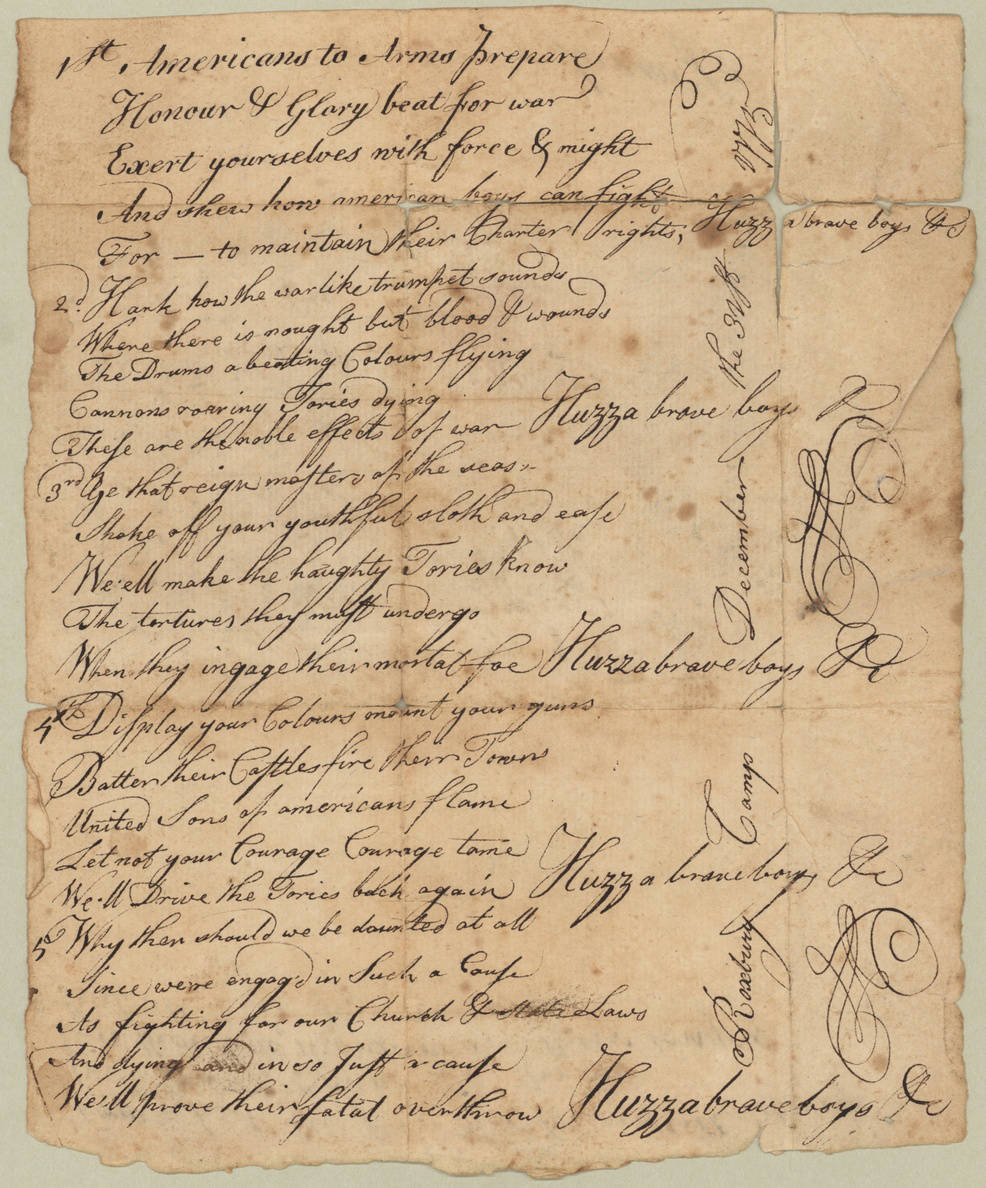
Several parallels are particularly striking. The Gardner manuscript begins with the exhortation “Exolt yourselves with force and might,” closely corresponding to the Roxbury text’s “Exert yourselves with force & might.”[16] Likewise, the Gardner line “See how the American boys will fight” clearly echoes the earlier “And shew how the American boys can fight.” Both versions also retain the appeal to defend Americans’ “charter rights.”[17] While differences in spelling and wording are consistent with eighteenth-century manuscript copying, the preservation of these distinctive phrases strongly suggests that the two texts belong to the same tradition rather than representing separate patriotic compositions.
The similarities, however, extend only through the opening portion of the ballad. The Gardner version also preserves variations within lines that otherwise parallel the Roxbury text. For example, Roxbury reads “When they ingage their mortal foe,” while Gardner has “know that we can meet a daring foe.” This variation shows that even lines shared between the two versions were not necessarily transmitted word for word.[18]

As the Gardner version continues, it departs more substantially from the known Roxbury manuscript by introducing additional verses absent from the earlier text. These later stanzas proclaim that “the battle” has been won, invite listeners to “drink success to the great Congress,” and offer a patriotic toast to Gen. George Washington.[19] Together, these additions shift the emphasis from encouraging resistance during wartime to celebrating the successful outcome of the Revolution and the political institutions that emerged from it.
The relationship between the two manuscripts therefore appears to be one of continuity rather than simple duplication. Gardner preserved recognizable elements of the earlier song while transmitting a version that had acquired both textual variations and additional patriotic material. Whether these changes were introduced by a single copyist or accumulated gradually through repeated transcription cannot now be determined. Nevertheless, the manuscript demonstrates that the song did not necessarily survive as a fixed text, but could develop as it passed through different hands.
How Revolutionary Songs Traveled
Unlike printed broadsides, many Revolutionary songs circulated through handwritten copies and oral performance. Soldiers learned them in camp, civilians repeated them at taverns and public gatherings, and families preserved favorite verses in account books, commonplace books, and personal notebooks. Because these songs were copied by individuals rather than standardized by printers, variations in wording, spelling, and even entire stanzas could emerge as they passed from one person to another.[20]
The Gardner manuscript provides a particularly useful example of this process. Its relationship to the Roxbury Camp Song is visible in the preservation of distinctive phrases, but the differences between the texts show that transmission did not require exact reproduction. The variation between “mortal foe” in the Roxbury manuscript and “daring foe” in Gardner illustrates how a recognizable line could survive while its wording changed.
The manuscript’s later verses demonstrate an additional form of adaptation. By celebrating victory, praising the Continental Congress, and honoring Washington, the Gardner version reflects a political context different from that of a song composed during the opening months of the war. Its preservation in a rural Rhode Island ledger also shows how patriotic material could move beyond military camps and printed publications into the everyday records of local communities. Everyday manuscripts therefore provide evidence of Revolutionary cultural memory that complements the printed record.[21]
Conclusion
The Gardner manuscript demonstrates that the history of Revolutionary patriotic music cannot be reconstructed from printed sources alone. By preserving a distinctive variant of the Roxbury Camp Song, the ledger provides evidence that patriotic songs continued to circulate and change through handwritten transmission after the Revolution.[22]
Although the precise history of the ballad’s development cannot be fully reconstructed, comparison with the Roxbury manuscript suggests that familiar songs were adapted as they passed through local communities, acquiring new verses that reflected the political memory of the early republic. The Gardner ballad therefore offers insight not only into the survival of a single Revolutionary song but also into the broader processes by which Americans preserved and reshaped their Revolutionary heritage.
As a manuscript witness to this tradition, the Gardner ledger illustrates the value of everyday documents as sources for the cultural history of the American Revolution. Its preservation of both familiar and distinctive verses demonstrates that handwritten manuscripts remain an important resource for understanding how Revolutionary ideas and patriotic expression continued to evolve beyond the printed page.
Roxbury Camp Song
Transcription from the supplied manuscript image; original spelling and capitalization retained.
1st
Americans to arms prepare
Honour & Glory beat for war
Exert yourselves with force & might
And shew how american boys can fight
For to maintain their Charter rights Huzza brave boys
2nd
Hark how the warlike trumpet sounds
Where there is nought but blood & wounds
The Drums a beating Colours flying
Cannons roaring Tories dying
These are the noble effects of war Huzza brave boys
3rd
Ye that reign matters of the seas
Shake off your youthful sloth and ease
We’ll make the haughty Tories know
The tortures they must undergo
When they ingage their mortal foe Huzza brave boys
4th
Display your colours mount your guns
Batter their Castles fire their Towns
United Sons of americans flame
Let not your Courage Courage tame
We’ll Drive the Tories back again Huzza brave boys
5th
Why then should we be daunted at all
Since we’re engag’d in such a Cause
Its fighting for our Church & State Laws
And dying in so just a cause
We’ll prove their plot to overthrow Huzza brave boys
Gardner Ballad
Transcription from the supplied Gardner ledger image. Each line is joined across the gutter from the left page to the right page; a slash (/) indicates the division between the two pages. Original spelling and capitalization retained.
Heres to the bold am americans / That boldly runs To Storm the Lins
For To mantain Their Carter right/ all the field of batte
Exolt your Selvs with force and might/ Se how the americans boys will fight
For To maintain their Charter right/ were Cannon Loud do rattle
So will push briskly on and let them/ know that we can meet a daring foe
and bravely vindicate our Cause Threw/ fire and blood and water
oh Some will Kill and Some will/ wound well leav them bleeding on the ground
a Coward we hope there wont be found/ well make a bloody slaughter
and When we do The batte win o we/ will drink with joy to think
that we have fought the batte out/ as bold as alexander
besure to Think before you drink/ to Drink Success to the great Congress
Likewise to Those of law full right/ for it comes to them by Charter
So now we have the Batte won oh we will/ Drink with joy to think
that we have fought the Battle out as bold as/ alexander
So home Boys home we will Return to our/ sweet hearts we have left alone
Hears a health to General Washington his Brave/ & a bold commander
[1] Oscar George Theodore Sonneck, Report on “The Star-Spangled Banner,” “Hail Columbia,” “America,” “Yankee Doodle” (Government Printing Office, 1909), 10–18; Center for Popular Music and American Antiquarian Society, American Vernacular Music Manuscripts, ca. 1730–1910, popmusic.mtsu.edu/americanvernacularmusicmanuscripts/.
[2] Zebulon Gardner Ledger, four-leaf manuscript ledger and commonplace book, ca. 1793–1798, private collection.
[3] Zebulon Gardner Ledger.
[4] Zebulon Gardner Ledger.
[5] J. H. Beers & Co., Representative Men and Old Families of Rhode Island: Genealogical Records and Historical Sketches of Prominent and Representative Citizens and of Many of the Old Families, vol. 3 (J. H. Beers & Co., 1908), 2060; FamilySearch, “Rhode Island, Town Clerk, Land Records” and “Rhode Island, Town Clerk, Probate Records,” accessed June 25, 2026.
[6] Zebulon Gardner Ledger.
[7] Zebulon Gardner Ledger.
[8] Center for Popular Music and American Antiquarian Society, American Vernacular Music Manuscripts, ca. 1730–1910, accessed June 28, 2026; Chris Goertzen, “American Vernacular Music Manuscripts, ca. 1730–1910: Digital Collections from the American Antiquarian Society and the Center for Popular Music,” Nineteenth-Century Music Review 17, no. 1 (2020): 173–178.
[9] Zebulon Gardner Ledger.
[10] Sonneck, Report on “The Star-Spangled Banner,” 10–18
[11] Center for Popular Music and American Antiquarian Society, American Vernacular Music Manuscripts.
[12] Zebulon Gardner Ledger.
[13] Zebulon Gardner Ledger.
[14] Roxbury Camp manuscript ballad. 1775. Manuscript collection. American Ancestors, Boston, Massachusetts.
[15] Zebulon Gardner Ledger.
[16] Zebulon Gardner Ledger, Private collection, Roxbury Camp manuscript ballad.
[17] Zebulon Gardner Ledger, Private collection, Roxbury Camp manuscript ballad.
[18] Zebulon Gardner Ledger, Private collection, Roxbury Camp manuscript ballad.
[19] Zebulon Gardner Ledger.
[20] Sonneck, Report on “The Star-Spangled Banner,” 10–18; Center for Popular Music and American Antiquarian Society, American Vernacular Music Manuscripts.
[21] Center for Popular Music and American Antiquarian Society, American Vernacular Music Manuscripts; Goertzen, “American Vernacular Music Manuscripts,” 173–178.
[22] Zebulon Gardner Ledger, Private collection, Roxbury Camp manuscript ballad.

2 Comments
Greetings Marc Lee,
Thank you for posting this interesting article about The Revolutionary Song. This was of particular interest to me as I am currently doing research on the hymns and anthems composed by my ancestor Daniel Read (1785-1836) of Rehoboth, MA. I am developing a website with collaborators and would be delighted to consult with you. Thank you
Hello Otis,
Thank you for your kind note. I was interested to learn from Metcalf’s article in the Hymnology Archive that Daniel Read published songbooks and a musical magazine. I imagine it’s especially meaningful to explore his legacy as his descendant.
My article follows a different path of musical circulation: a Revolutionary song copied by hand and adapted as it passed through local communities. It’s fascinating to consider handwritten and printed music as parallel ways songs reached people.
I appreciate you reaching out, and wish you and your collaborators well with the website.