



At the start of the American Revolution, Captain John Manley was a hero. George Washington praised him. Newspapers trumpeted his naval victories, and even his British enemies acknowledged his abilities. When Congress created the Continental Navy, it commissioned him as the second-ranking officer.
Today John Manley is largely forgotten, and even his burial place is unmarked. How did a career that began in such triumph end in poverty and obscurity?
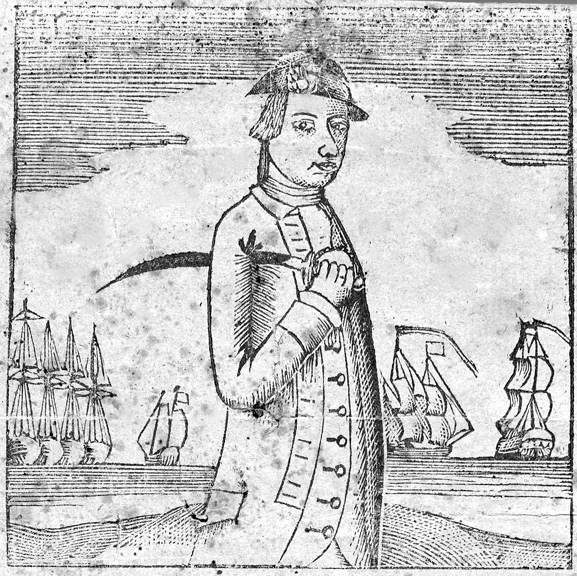
While Manley’s naval exploits are well documented, historians have been less clear about his origins: where he was born, his activities before the Revolution, and how he rose to prominence in such a short time. He seems to have come from nowhere, shot to fame, and then faded away. But if Americans have been unclear as to Manley’s origins, the British were not. The master of a British fishing brig that Manley captured testified, “He told me he was born at Merrychurch near Dartmouth, I then recollected that I knew many of his Family.”[1] Later, when Manley himself was captured, another British officer noted that he “was born at Torquay near Torbay and that he has a brother and sister living at St. Marychurch now.”[2]
At the time, St. Marychurch was a fishing village, and John Manley’s earliest seafaring experiences were most likely on fishing vessels, where boys as young as twelve or thirteen could find work. When Manley came to America around 1747, he first settled in Marblehead, Massachusetts, another prosperous fishing community. As a young man, he rose through the ranks on fishing or merchant vessels, and according to another British officer, Manley “had been master of a merchant-man before he took arms against his sovereign.”[3]

With the outbreak of the French and Indian War, Manley served as a privateer on the Boston-based Hertford, an experience that would mark him for life. During the first cruise, he fell afoul of the ship’s owner, who “shackled both his legs with heavy irons, fastened down with staples to the deck of said ship,” according to a suit that Manley later filed.[4] For one week, he was fed only bread and water, “whereby he suffered great pain, shame and disgrace, hunger and thirst.”
Despite this abuse, it appears that Manley received his share of the prizes the Hertford had taken. Lured by the promise of more, he likely continued as a privateer on other vessels until the end of the French and Indian War—a theory buttressed by the fact that two weeks after the war ended, he took a wife, as returning servicemen have done for ages. With the war over, Manley returned to merchant shipping and was quite successful, until the events of 1775 set him on a new course.
To Arms
In the aftermath of the Battles of Lexington and Concord in April 1775, John Manley enlisted in the Marblehead regiment of John Glover, the famous “amphibious regiment” that later came to Washington’s aid in New York and Trenton. Before this, Glover’s regiment marched to Boston just as Washington took command of the Continental Army. Not long after, Washington decided to arm private vessels as a small fleet to harass British shipping and protect America’s coast, something he had been hesitant to do before. According to John Adams, the suggestion to do so came from John Manley, though others have been credited as well.[5]
As part of Washington’s little squadron, John Manley was given command of the schooner Lee, with a crew made up of fellow Marbleheaders from Glover’s regiment. While technically soldiers, these were men who knew the sea and had worked together before, making them the ideal crew for the makeshift naval force.

For the most part, the captains in the squadron were a disappointment to Washington. “Our rascally privateersmen go on at the old rate, mutinying if they cannot do as they please,” he wrote to Joseph Reed.[6] John Manley was the exception, making several captures and then pulling off a feat that would make his name.
The Nancy, a British munitions ship loaded to its beams with supplies for British troops, was lost at sea for weeks before finally making Boston Harbor. In an audacious ruse, Manley pretended to be a pilot vessel, sent to help the Nancy navigate the tricky entrance to Boston. Without firing a shot—and to the astonishment of the Nancy’s captain and crew—he took the ship, an “instance of divine favor,” according to Washington, providing his army with a wish list of supplies it could otherwise only have dreamt of. [7]
Vigilance and Industry
Washington rewarded Manley’s efforts in January 1776, writing to Congress, “I have for his great vigilance and industry appointed him Commodore of our little squadron”[8]—a squadron that was still only semi-official and not under the authority of Congress. As commodore, Manley was given the schooner Hancock, a faster vessel than the Lee, though only nominally better equipped.
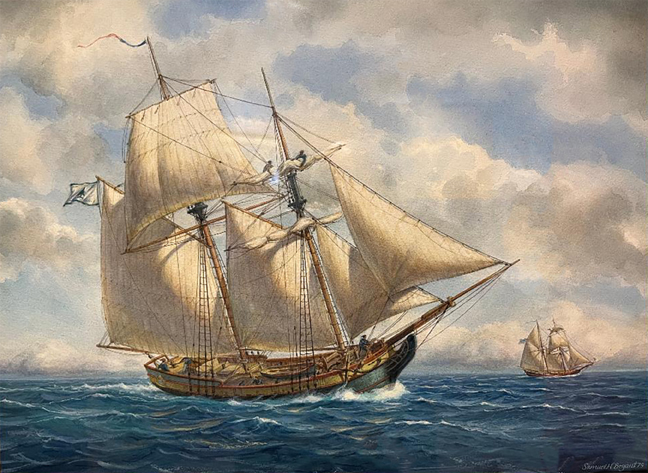
Manley made a few captures with the Hancock before being attacked by an eight-gun British brig, the Hope. Chased by the Hope, the Hancock ran aground south of Boston and endured withering gunfire for a day and a night. With the help of the local militia, Manley and his crew repelled the attackers, whose captain withdrew, assuming that the battered Hancock had been “effectually disabled from ever cruising again.”[9]

He was wrong. Within a few days, the determined Manley had refloated his ship, refitted it, and made it ready for action again. By this time, however, he was lobbying for a bigger ship, one that would allow him to do battle with the Royal Navy’s larger ships rather than simply targeting smaller commercial vessels.
In April 1776, Manley captured the Elizabeth—among the last of the British vessels to sail from Boston as they evacuated the city—which carried a number of loyalists. Among them was one Crean Brush, a notorious scoundrel who had packed the ship with goods stolen from Boston residents. Bostonians rejoiced at the capture of Brush, but the Elizabeth—which had originally been an American vessel before being captured by the British, and which carried the belongings of non-combatants—was judged not to be a legitimate prize. Manley and his crew received nothing for the capture, as happened more than once over the course of his career.
That same month Manley got his wish for a bigger ship. The previous October, Congress had established the Continental Navy and ordered the building of thirteen frigates as its core. On April 17, 1776, the Marine Committee of Congress nominated officers for those frigates, and Manley was first on the list, though his name was listed as “William Manly,” which no doubt irked him.[10] At any rate, the actual ranking of officers would not be settled until later that year.
With his nomination, Manley was assigned one of the new frigates—also named the Hancock—and spent the better part of 1776 fitting it out. His task was complicated by a lack of guns—the nation had few foundries to cast cannons—and the want of a crew capable of manning the ship. When Manley was not in Newburyport overseeing the ship’s construction, he was in Philadelphia arguing about his rank in the newly formed navy. Nor was he the only one.
On October 10, 1776, after much jockeying for position and regional pressure, the Marine Committee finally settled on the ranking of captains in the Continental Navy. Initially, Manley was ranked third—probably after Hector McNeill, a relatively inexperienced captain who had been commissioned after Manley—a placement that angered Manley so much that he threatened to leave the service. “Captain Manley is uneasy about his being the third, and has desired leave to resign,” committee member Josiah Bartlett wrote to John Langdon. “Whether his resignation will be accepted, or his rank altered, I am uncertain.”[11]
By the time the ranking was made public, Manley was moved to second rank, and McNeill was third. This may have planted a seed of acrimony between the two captains, which would bear disastrous fruit for both of them in the days to come. Manley was also ranked far above John Paul Jones, who was 18th, which infuriated Jones and made Manley the object of his lifelong disdain.
Setting Sail
Manley’s frigate, the Hancock, did not set sail until the spring of 1777, a delay that frustrated all concerned. His fleet consisted of nine privateers and another brand-new frigate, the Boston, commanded by none other than Hector McNeill. Manley and McNeill were at odds from the beginning, arguing over the signals to be used between their ships and even whether they were to sail together or separately, as McNeill requested. The discord between them was public knowledge according to James Warren, a member of the Navy Board of the Eastern Department, who wrote to John Adams, “McNeil and Manly it is said, like the Jews and Samaritans, will have no connections or intercourse.”[12]
After many delays, the Hancock finally set sail on May 21, among the finest ships of its time. Manley intended the fleet to sail as a pack, a plan that met disaster in the first week. On May 27, while sailing off St. George’s Bank, the fleet was struck by a fierce gale, scattering the ships. When the storm subsided, only the Hancock, the Boston, and one privateer remained. The others, perhaps preferring to take prizes privately rather than serving the new navy, scarpered.
Despite his diminished fleet, Manley was at first successful. He captured the Littleton, loaded with supplies for the British army, and narrowly escaped capture himself from a powerful sixty-four-gun warship Somerset. A month later Manley’s luck ran out.
June 8 began well enough. Off the Grand Banks of Nova Scotia, Manley captured the Fox, a twenty-eight-gun frigate that, ironically, had been assigned to protect the Grand Banks fishery. The loss was a grave embarrassment to the British, who decided to put an end to Manley’s depredations.
At this point, relations between Manley and McNeill had become increasingly strained. While headed home with the prize Fox, they were set upon by three British ships. The battle began, and McNeill took off, ignoring Manley’s instructions to stay together and leaving Manley to fend for himself. Manley tried to run but was outpaced by a ship that he thought was the sixty-four -gun Raisonable. After hours of being battered, he surrendered—and only then discovered that his adversary was the forty-gun Rainbow, a ship he should have been able to defeat if McNeill had not abandoned him.
The British were overjoyed, having captured the man they called “the chief executive officer of their navy, in whom the Congress place all their confidence, and who is the only man of real courage they have at sea.”[13] They had recaptured the Fox. And John Manley was headed to prison.
A Hellhole and a Court-Martial
No details have been found about Manley’s confinement, except that at the time of his exchange he was being held on the Preston, the flagship of Commodore William Hotham at New York. Manley’s friends and associates petitioned for his release, but that was not arranged until months had passed. Finally, in March 1778, Manley was exchanged for a British captain, Tobias Furneaux—ironically, the captain who had brought Manley to New York after his capture aboard the Hancock.
When Manley returned to Boston, he found himself facing charges over the loss of the Hancock. While he had been imprisoned, Hector McNeill had tried to cast blame for the debacle on him, calling Manley “ignorant, obstinate, overbearing and tyrannical beyond description, a man under whose command none can live with pleasure but such creatures as himself.”[14] McNeill requested that a court of inquiry be held, and it was—with the result that both Manley and McNeill were to face court-martials.
The courts took only three days to acquit Manley of all charges and to remove McNeill from the service. McNeill complained that he had been treated unfairly, which was nonsense, according to James Warren. “He may tell you fine stories,” Warren wrote to Samuel Adams, “but be assured he has had as fair and impartial a trial as a man ever had and as much tenderness and delicacy both in the prosecution and sentence as he ought to wish for.”[15]
Having been acquitted, Manley wanted to return to battle. But now, ships were hard to come by. At first, Manley was promised a new ship being built in Salisbury, Massachusetts. But that ship was instead given to a French captain in honor of the recently-signed alliance with France. James Warren argued for giving Manley another ship, praising him as a “blunt, honest, and I believe brave officer,” one who was “extremely popular with officers and seamen.”[16]
But it was not to be. Frustrated, Manley returned to privateering, as captain of the fourteen-gun Marlborough. After a single cruise on that ship that netted three captures, Manley took command of the Cumberland, a 290-ton ship with twenty guns. Among his crew was seventeen-year-old John Greenwood, whose diary provides details of Manley’s cruise on the Cumberland.
“Our intention was to cruise off the island of Barbados and intercept the outward-bound West Indian fleet of merchantmen,” according to Greenwood.[17] On the way to the Caribbean, Manley captured a British transport, then continued to Barbados where he was set upon by the Pomona, a thirty-six-gun British frigate. “As we had only eighteen guns and 130 men, we were obliged to make an attempt to escape,” Greenwood recalled.
Chased and outgunned, Manley hit on a bold and risky plan. Running just ahead of the Pomona, he aimed to turn into its path, causing it to slam into the Cumberland and likely sink it. At that point, Manley’s men would board the Pomona, taking advantage of the element of surprise to overpower it, essentially trading his old ship for a new one. “I am confident we should have overpowered them, taking them so unexpectedly,” Greenwood recalled.[18]
There was one problem. When Manley sent his men to the arms chest to outfit themselves for combat, they found only “thirty cutlasses and a few miserable pikes,” wrote Greenwood. Forced to surrender, John Manley was headed to prison again.
Escape and Mutiny
The Cumberland’s crew was tossed into the dungeon of the Bridgetown, Barbados jail, while Manley and his officers were given the usual courtesy of being allowed to move freely about the prison yard. He used that freedom to plot an escape. One night, he and his officers climbed the wall of the yard, using a ladder that he had fashioned from some rope he’d obtained. They made their way to town, commandeered a sloop, and sailed past unsuspecting British frigates, eventually making their way to the French colony of Martinique.
Upon returning to Boston, Manley began looking for another ship to serve with the navy, but once again was frustrated. He set his sights on a new frigate being built at Newburyport, but it was given to someone else. So once again, he returned to privateering, this time aboard the Jason, a 200-ton ship with eighteen guns. His men included his clerk, William Russell, and nineteen-year-old Joshua Davis, both of whom kept diaries that record Manley’s exploits.
At first, the Jason was threatened by bad luck. Chased by the British into a squall, the ship lost its bowsprit, three of its masts, and a crew member who was swept overboard. Miraculously—and thanks in part to the squall—Manley escaped capture. “The vessels that were in chase of us saw our trouble—hove about—and went off with the squall; and we saw no more of them,” Davis wrote. [19]
The squall having passed, Manley ordered his crew to begin repairs, but they insisted on heading to harbor to do so. “I’ll harbor them,” Manley shouted, perhaps suspecting that the men wanted to jump from what they now considered an unlucky ship.[20] He drew his cutlass, struck his boatswain “with such force that his teeth were to be seen from the upper part of his jaw to the lower part of his chin,” according to Davis.[21] Manley took on two other crew members, subdued them, and the threatened mutiny was over. Within thirty-six hours, the Jason was completely refitted and ready to sail again.
Clearly, John Manley wasn’t one to put up with being crossed, whether by man or beast. One night not long after, the Jason’s crew hung their salted pork over the sides of the ship to soak away the preserving brine in the less-salty seawater. In the morning, they found their lines picked clean. The culprit was a shark, which had been following the ship.
Undaunted, Manley baited a shark hook with pork, and the shark took the bait. The crew wrestled the enormous, thrashing beast aboard—at the cost of some spokes in the ship’s wheel—and cut off its head. “Our captain then ordered the steward to give the ship’s company two casks of butter, and the cook to prepare the shark for the people’s dinner,” Joshua Davis recalled.[22]
Instructed to join an armada headed north for the ill-fated Penobscot Expedition, Manley instead headed south to New York. There, he captured two British privateers, brought them to Boston, and set sail again. Off Nantucket, the Jason was set upon by a fleet of forty British ships. One of them chased Manley, whose luck held once more; a thick fog rolled in, allowing the Jason to change course and escape undetected. Manley continued taking prizes on the Jason until the last day of September, when his luck finally ran out.
The Jason sailed for the Grand Banks, where it was chased for an entire day by a British frigate, the Surprise. When the frigate caught up with the Jason, its captain demanded, “Heave to, or we will fire into you.”[23]
“Fire away, and be damned, we have got as many guns as you,” Manley replied.
The two ships fired broadsides at each other, continuing into the night, at which point it was so dark the Jason’s gun crew couldn’t see to load the guns. The Jason’s rigging and sails were ruinously damaged, and Manley’s crew fled below decks to escape the fighting. “It was therefore thought needless to stand it any longer, and the captain took the trumpet and called out for quarters,” according to Joshua Davis.[24]
In the course of the battle, half of Manley’s hat had been shot away. When he was brought aboard the Surprise, its captain said, “You have had a very narrow escape, Manley.”
“I wish to God it had been my head,” Manley replied.
Plymouth Prison
Manley was carried aboard the Surprise to St. John, Newfoundland, where his capture was greeted with joy by the British. Having escaped prison in Barbados, he was deemed too important a prisoner to confine in Halifax, the usual place of incarceration for American prisoners. The governor of Newfoundland ordered Manley, “Go on board of the ship that took you, and there you shall be confined until you arrive in England, where you shall be kept during the war.”[25]
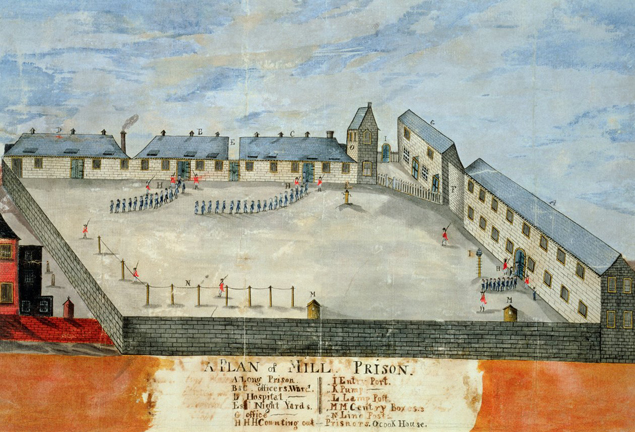
In December 1779 Manley arrived at Mill Prison in Plymouth, England, where he spent almost exactly two years. Mill Prison had one ward for ordinary seamen and soldiers, another for officers. These bordered a yard where prisoners were allowed to spend time during the day. They could also earn money by making small objects like spoons and boxes and could receive donations from visitors and friends.
Despite such amenities, John Manley was determined not to enjoy the King’s hospitality. He made many attempts to escape—sometimes alone, sometimes with others—all of which failed and resulted in him being sent to solitary confinement in the black hole, where he was fed half the usual rations.
When not attempting to escape, Manley wrote letters—or had his clerk William Russell write letters—to influential people like Benjamin Franklin and John Adams, pleading to be exchanged or to assist him financially. Franklin wrote to his aide in London, “I am concerned for Capt. Manley, who is a brave and useful officer, and desire you to supply him with necessaries to the amount of 25 guineas.”[26]
Over the course of Manley’s imprisonment, possible exchanges came and went with no success. He was finally released in December 1781, thanks only to the actions of an English earl; a group of American prisoners was set to be exchanged from Forton Prison in Portsmouth, but one of them became too sick, and a replacement was sought. The earl suggested John Manley, and he was set free.
By the time Manley returned to America, a British army had surrendered at Yorktown. The war was winding down, but it wasn’t over yet.
The Final Cruise
Once more, John Manley was in search of a ship. This time he had better luck—at least at first.
The captain of the Deane, a thirty-two-gun Continental frigate, had been removed from command over charges that had been filed against him by one of his lieutenants. The ship—renamed the Hague because its previous namesake had fallen out of favor—was given to Manley with instructions to “annoy the enemies of the United States and facilitate the exchange of our seamen prisoners with them.”[27] Robert Morris, the Agent of the Marine, also instructed Manley to run a tight ship with rigid discipline. “This is so essential both in officers and men that I am determined never to overlook any instances of the want of it which may fall within my observation,” Morris wrote.[28] They were words that would later come back to haunt Manley.
The Hague sailed with 256 officers and men, many of whom had served on the Deane. Among these was 1st Lt. Benjamin Page, whom Manley would soon come to regret having aboard.
Sailing to the West Indies, the Hague took several prizes including the 300-ton Baillie carrying sixteen hundred barrels of rum, sugar, coffee, and other provisions. This was the last major capture of the Revolution, and it was made by the same captain who had made the first significant capture of the war. As James Fenimore Cooper wrote in his history of the American navy, “This officer who had virtually begun the maritime war on the part of the United States in a manner closed it.”[29]
Days after capturing the Baillie, the Hague was sailing off Antiqua when it was set upon by the Dolphin, a forty-four-gun British frigate. The Dolphin chased Manley through the night, and in the morning it was joined by four more British ships, including the seventy-four-gun Hercules.
At this point, the Hague was vastly outgunned, and Manley hit on a desperate scheme. He headed for the reefs off of Guadeloupe, where his attackers could not follow because of their size and deeper drafts. The plan worked, until the Hague ran aground. The British let down boats with sailors and marines, intending to board the Hague and take her. But John Manley had one more trick up his sleeve.
To increase his speed while running from the Dolphin, Manley had dumped most of his guns overboard, except for two small cannons, which he kept hidden until now. He opened fire on the enemy’s boats with deadly effect, killing almost all the men in the boats.
Despite this, the British kept up their attack, firing on the Hague through the night as Manley’s crew tried to pull their ship off the reef. Finally, after withstanding three days of heavy gunfire, Manley managed to refloat the Hague and sail it up the Salée River, a narrow passageway that separates the two halves of Guadeloupe, where the British could not follow. In parting, he raised his Continental colors and fired off a thirteen-gun farewell salute to his foes in honor of America’s thirteen colonies.
It was a daring escape and a fitting end to the naval career of Capt. John Manley. Or should have been.
Return and Ruin
Manley undertook repairs to the battle-damaged Hague at Martinique, which took three months. By then, England had recognized America’s independence and the war was winding down. The Hague returned to Boston, where a nasty surprise awaited Manley.
The Hague was made to sit in quarantine—to make sure no infectious disease was aboard—during which 1st Lieutenant Page wrote to Robert Morris to bring charges against Manley. The charges remain mysterious to this day, as Page’s letter and any transcript of the ensuing court-martial are missing. Whatever the charges were, Manley was found guilty and stripped of his commission. A possible influence on the finding was that, with the end of the war, Robert Morris had many captains on the rolls that were no longer needed, nor was there cash on hand to pay them the customary half-pay pension. It may be that a court-martial was simply a convenient way to trim the rolls.
Cashiered from the navy, Manley returned to merchant shipping, where he did reasonably well, for a time. But by 1790, his health and his financial affairs had taken a turn for the worse. Some of the prizes he had taken as a privateer were judged to be illegitimate, depriving him of any prize money for them. Nor did he ever receive the prize money due him for captures he made on behalf of the Continental Navy.
Finally, in March 1793, Congress passed an act to provide soldiers and seamen injured during the war with a pension and lump sum for payments dating back to the time of their injury. Manley received a pension of $30 per month and $500 for injuries received on the Hancock in 1777. He died less than a year later, on February 12, 1793, a day marked by a severe snowstorm. Manley’s funeral on February 18 was conducted with military and Masonic honors. His pallbearers included notable figures, fellow Masons, and even former enemies. Among the attendees, according to the Massachusetts Mercury, was the supreme executive—or governor—of Massachusetts, John Hancock.[30]
The funeral procession ended at the King’s Chapel Burying Ground, the first and oldest cemetery in Boston. But this is no official record of Manley’s burial there, nor is there any marker or gravestone in his name. The final resting place of America’s first naval hero, a man to whom his country owes a great debt, remains unmarked.
[1] Deposition of Captain Thomas Hardy, June 11, 1777, Naval Documents of the American Revolution (Government Printing Office, 1964 – ), 9:88 (Naval Documents).
[2] Letter from a lieutenant aboard St. Albans at New York to his brother in Exeter, quoted in the Exeter Flying Post (Exeter, England), October 17, 1777, quoted in Phillip C. F. Smith, Fired by Manley Zeal: A Naval Fiasco of the American Revolution (Peabody Museum of Salem, 1977), 5.
[3] Ithiel Town, A Detail of Some Particular Services Performed in America, During the Years 1776, 1777, 1778 and 1779 (New York, 1835), 15.
[4] Suffolk County (Mass.) court files, 1629-1797.
[5] The Works of John Adams, Second President of the United States (Little, Brown and Co. 1856), 10:24.
[6] George Washington to Joseph Reed, November 20, 1775, Naval Documents, 2:1082.
[7] Washington to Reed, November 30, 1775. Naval Documents, 2:1199.
[8] Washington to John Hancock, January 30, 1776, Naval Documents, 3:1046.
[9] Samuel Graves to Philip Stevens, February 1, 1776, Naval Documents, 3:1078.
[10] Journal of the Continental Congress, April 17, 1776.
[11] Josiah Bartlett to John Langdon, October 15, 1776, American Archives, 2:1063.
[12] James Warren to John Adams, March 23, 1777, Naval Documents, 8:184.
[13] Halifax Gazette (Halifax, Nova Scotia), extraordinary issue, July 12, 1777, quoted in Isaac J. Greenwood, Captain John Manley, Second in Rank in the United States Navy: 1776–1783 (C. E. Goodspeed, 1915), 73.
[14] Hector McNeill to the Continental Marine Committee, August 25, 1777, Naval Documents, 9:804.
[15] Warren to Samuel Adams, July 5, 1778, Naval Documents, 13:263.
[16] Warren to Samuel Adams, July 5, 1778, Naval Documents, 13:262.
[17] John R. Greenwood, The Revolutionary Services of John Greenwood of Boston and New York 1775-1783 (De Vinne Press, 1922), 48.
[18] Greenwood, Revolutionary Services, 50.
[19] Joshua Davis, A Narrative of Joshua Davis, an American Citizen (Boston: 1811), 4.
[20] A Narrative of Joshua Davis, 5.
[21] Ibid.
[22] A Narrative of Joshua Davis, 9.
[23] A Narrative of Joshua Davis, 11.
[24] A Narrative of Joshua Davis, 11.
[25] Narrative of Joshua Davis, 13.
[26] Benjamin Franklin to Thomas Digges, Feb. 9, 1780, Franklin Papers.
[27] Robert Morris, The Papers of Robert Morris, 1781-1784 (University of Pittsburgh Press, 1984), 6:154.
[28] Morris, The Papers of Robert Morris, 6:154.
[29] James Fenimore Cooper, History of the Navy of the United States of America, Vol. 1 (H & E Phinney, 1847), 1:129.
[30] Massachusetts Mercury, February 19, 1793.

Recent Articles
The Rise and Fall of Captain John Manley
Remembering the Revolution: Little Compton, Rhode Island
Last Call for a Dram Seller on the Mohawk River
Recent Comments
"Payback: Attack on the..."
Thank you all for your kind words. I was very lucky in...
"Payback: Attack on the..."
Joseph Orchard, how fun! Oliver DeLancey avoided having the property confiscated, and...
"Second Coming of a..."
Hi Ann. Thank u for this! Jeremiah Jack is my eighth grade...