



The night was dark. Clouds blotted out the stars; the waning quarter moon would not rise until nearly dawn. Whaleboats under Capt. John Buchanan slipped silently down the Hudson River from Tarrytown on the ebbing tide. As they approached Manhattan, they glided with muffled oars past His Majesty’s twenty-gun post ship Mercury, lying at anchor off Spuyten Duyvil Creek. Neither the ship’s tender, the armed sloop Hotham, nor the nearby galley Spitfire spotted them or raised an alarm.[1]
The boats rowed on down the coast of Manhattan. They were bent on revenge.
The British campaign of burning and destruction up the Hudson the previous month had been shocking. Now the recent burning of two tenant farmhouses in Westchester County, with the Van Tassel families driven out into the cold in their nightclothes, was the last straw. Brig. Gen. Samuel H. Parsons had written to British Maj. Gen. William Tryon, decrying the destruction of civilian property and asking him to disavow his captains’ burning of the houses. Tryon’s reply was arrogant, very nearly a taunt: he refused, declaring that he would gladly burn any committeeman’s house within his reach.
Maj. Gen. Israel Putnam and Parsons were stung. The easiest response would have been to do exactly what Parsons had warned: burn the nearby estate of James DeLancey. DeLancey was colonel of the Loyalist Westchester Militia. Although his mother and younger siblings still lived in the home, under Tryon’s rules it might be considered a legitimate target. But someone had a more audacious idea. They had evidently learned that the Loyalist Brig. Gen. Oliver DeLancey had traveled from his military post on Long Island to visit his family in rural Bloomingdale, on northern Manhattan Island.[2]

Putnam decided they would strike not the home of James DeLancey, but that of his uncle Oliver.[3] It would be a surprise. It might capture the highest-ranking officer in the Loyalist forces. It would alarm the British and their sympathizers, who felt themselves safe on Manhattan. Above all, it would be a stunning rebuke to Tryon for his approval of the burning in Westchester—for Putnam’s order was that DeLancey’s house should burn, no matter what.
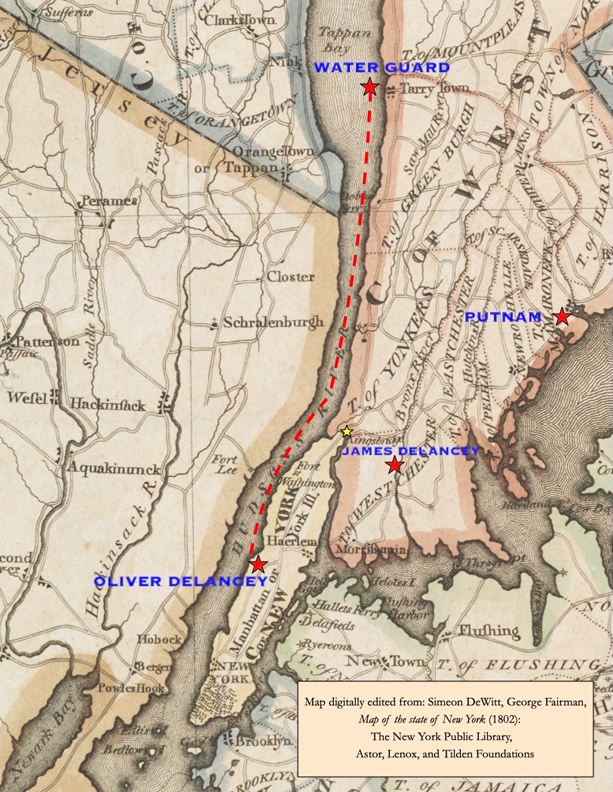
Putnam turned to John Buchanan, captain of the Continental water guard on the Hudson, now withdrawn north to winter cantonments at Tarrytown. Buchanan was a Scot who had first come to attention during the Stamp Act protests. Elected captain in New York City’s militia in 1775, he had served as Washington’s coxswain in 1776 and, during the New York campaign, had been entrusted by various generals with, as he recalled, “many confidential and difficult services” — “many dangerous enterprizes,” a friend clarified, — “which [I] had the happiness to execute to their satisfaction.” For the past year Buchanan had served as commandant of all Continental small watercraft on the river. “As a soldier,” his friend remembered, “he was mild, intrepid, careful, and undaunted.”[4]
It was said that Buchanan’s crew that night were Connecticut men, and this seems likely. Aside from a core of local mariners, the water guard was typically drafted from Continental units stationed nearby. We know the name of only one member of the expedition, a New York volunteer—and a boy. Abraham Martling of Tappan was sixteen. His father, from Tarrytown, was a riverboat captain on the Hudson, and Abraham frequently sailed as a hand on his father’s sloop. He seems to have been something of a daredevil. Enlisting at fifteen, in 1776 he was wounded as one of the enthusiastic local volunteers who swarmed to serve on the galleys attacking the enemy warships Phoenix and Rose off Tarrytown. He appears to have leapt just as readily to join this venture on Manhattan. An acquaintance remembered Abraham as “a very warm Whig.”[5]
* * *


Their target, Oliver DeLancey, was a member of one of New York’s most powerful families, long prominent in the colony’s political life, and a Loyalist officer who had raised a brigade of provincial troops for the king. Wealthy by inheritance, he was also a successful land speculator and talented administrator who took a keen interest in improving his extensive holdings.[6]
After his father’s death, DeLancey had acquired the family’s country seat in rural Bloomingdale, where his older children grew up. In 1761 he removed to the unoccupied estate of his sister, Lady Peter Warren, in what is now Greenwich Village, while managing her vast American properties. He found he loved Greenwich and, after decades of unpaid service, expected to inherit the house. Instead, upon his sister’s sudden death, he received only a token bequest, and the heirs in England declined his offer to buy it. As political unrest in New York mounted, DeLancey began securing his account books in separate locations as a precaution. He was unable to collect many of his rents. Though he remained active politically, he privately confessed to “a depression of Spirits.” “Age, Poverty, & Sickness are all in my View with Little hope of Bettering,” he wrote in 1774. He resolved to withdraw to Bloomingdale, where he still owned farmland. There he would build “a small House of my own” for his declining years. The family reluctantly returned to Bloomingdale in August 1775.[7]
* * *
The new house was not in fact small; rather, the property was merely undeveloped in comparison to the princely estates—with greenhouse, coach house, stables, and manicured pleasure grounds—they had known before. For the moment, however, the family no longer needed an imposing country seat. The two DeLancey sons had long since left home, one married and the other serving in the British army. The three older daughters had all been married from Greenwich. Now there remained only Oliver, his wife Phila, and their youngest daughter, Charlotte, nineteen.[8]

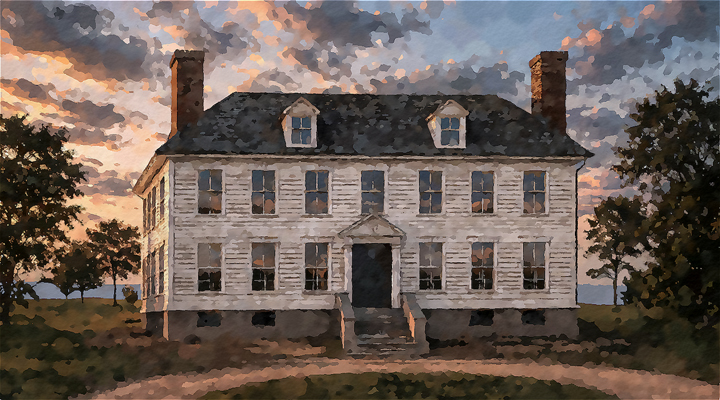
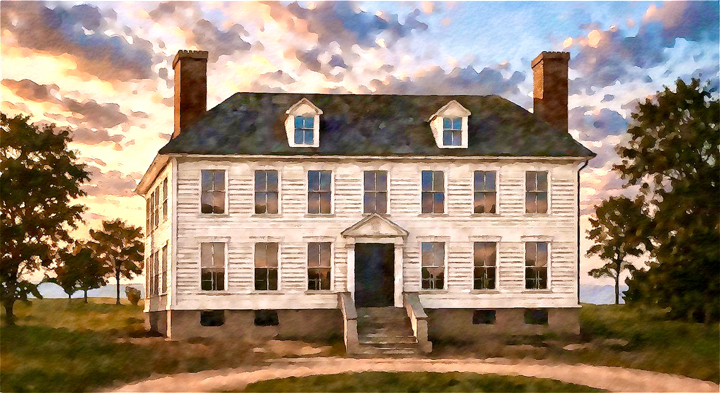
No drawings or plans of the new house survive. DeLancey left an inventory listing its contents room by room in such meticulous detail—from the number of window curtains to the dimensions of the Turkey carpets—that we can, in effect, walk through the home. It was a double-pile Georgian box, eighty by forty feet: a two-story rectangular structure with a hip roof and a central hallway. Owing to his gout, DeLancey’s bedchamber and study were on the rear of the first floor, flanking the hall. At the front were the large formal drawing room and, opposite, the dining parlor with its butler’s pantry. Upstairs were additional bedchambers; in the cellar were the kitchen, wine cellar, main pantry, dairy, and servants’ quarters.[9]
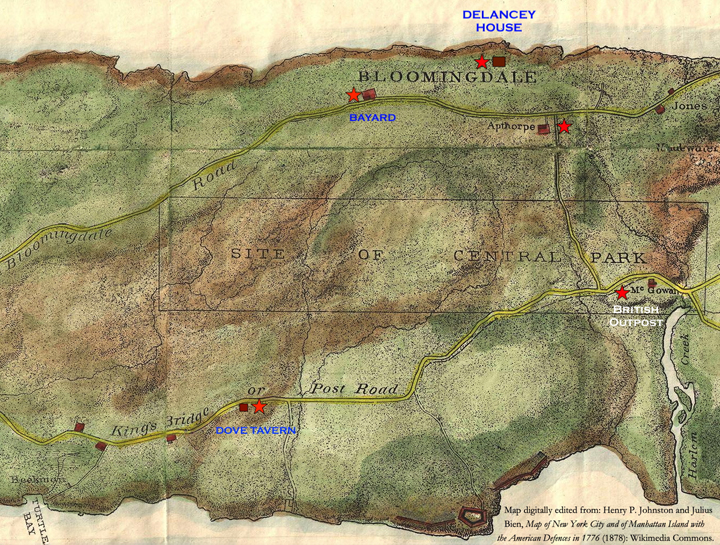
The large clapboard house stood far back from the Bloomingdale Road, on a knoll about three hundred feet from the rocky shore of the Hudson River sixty feet below. In her second-floor rooms, his wife kept a selection of spyglasses with which she could watch ships on the river and the tranquil sunsets over the Palisades. DeLancey had been mobbed at Greenwich.[10] For all its inconvenience—over an hour by coach from the city—the farm must have felt safe.
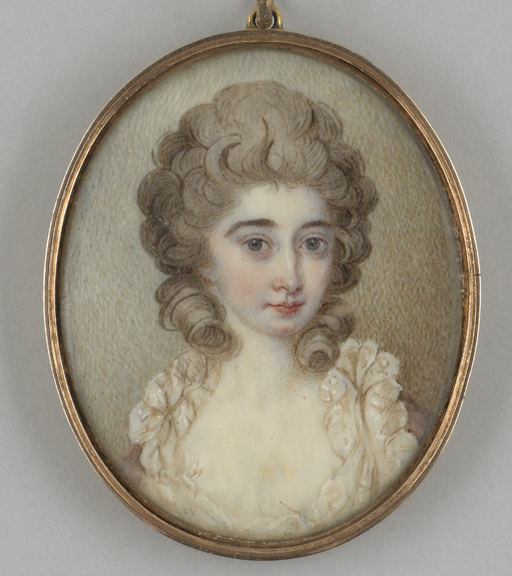
At least at first. “I am very Frequently threatned with Connecticut Imprisonment but as I Express no fear I am in hopes to be Lett alone until I Can be Supported,” DeLancey had written at the turn of the new year. Everything depended on the arrival of British troops. Instead, in February 1776, Maj. Gen. Charles Lee arrived in New York at the head of five hundred rebel militia, with more pouring in. By March, the rebels had cut down the woods at Greenwich. His tenants were driven off. Two of his houses in the city were razed to construct an artillery battery. “I am in a very Distressed Condition,” he wrote, “Subject to Many Insults and no Protection.”[11]
Finally the hammer fell. On June 19, he and the two wealthy Loyalists whose Bloomingdale estates bracketed his—Robert Bayard to the south and Charles Apthorp to the north—received summonses from the New York Provincial Congress, demanding that they appear at City Hall to be examined as potential enemies to their country. Instead, the three men escaped by night, paddling down the Hudson to the sixty-four-gun British warship Asia. DeLancey recalled, “The Canoe that carried us down [was] Small and Leaky and Ready to Sink.”[12]
He would be gone three months, not returning until September, when he came as a brigadier general of provincial forces with the conquering British army. During his absence, DeLancey later testified, his farm and lands had been left “in the Hands and Management of [my] wife and Servants.”[13]
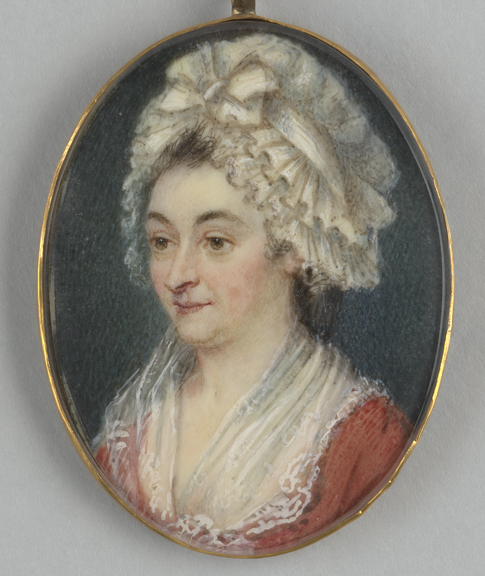
His wife was accustomed to such responsibilities. Her husband traveled often, and Phila Franks DeLancey was a notably competent woman. She had been raised in New York City in a prominent Jewish family that prized education. When she was eleven, her mother noted proudly, “Phila Learns French, Spanish, Hebrew, and writing in the morning”; in the afternoon she was taught needlework and dancing. “She makes a Quick advance in what[]ever She Learns.” Yet when, at twenty, the bright, romantic Jewish girl secretly married Oliver DeLancey, an Anglican, and moved to his Bloomingdale home, her mother never spoke to her again.[14]
After thirty-five years of her husband’s thoughtlessness, the romance had dimmed, but Phila DeLancey could be counted on to be a well-bred and capable hostess, smoothly executing whatever orders he sent in his laconic notes. In her bedchamber stood an escritoire with glazed bookshelves, and one imagines her writing by candlelight as she dates a letter, “We[dnes]day Night 11 clock,” faithfully forwarding provisions or political and social news. Phila was devout and cultured (she read Virgil and attempted pastorals in the style of her favorite poet, Alexander Pope), and a loving mother. She had also become quite deaf. Though she enjoyed intimate social calls, she now avoided large gatherings. “My hearing being so imperfect,” she confessed, “I dread the confusion.”[15]
* * *
Shortly after midnight on November 26, 1777, the whaleboats reached the Bloomingdale landing. The guard posted there was taken by surprise. Four men were seized; one escaped into the night. Pressing inland, Buchanan’s party reached the DeLancey house at about one o’clock.[16]
In a second-floor bedchamber, Charlotte DeLancey and her friend Elizabeth Floyd woke to the sound of men’s voices on the lawn below. Puzzled, thinking it must be some of the servants, they pushed up their window and called down, “Who is there?”
A rough voice shouted, “Put in your heads, you bitches!”[17]
Instantly, the raiders crashed through the front and rear doors, entering a broad, carpeted center hall running forty feet from front to back. By the light of their flickering torches they would have seen matching seven-foot sofas set against opposite walls, large gilt sconces with their branches of unlit candles, a black walnut tall clock, and a wide marble-topped table beneath a full-length, gilt-framed portrait of the late lieutenant governor, James DeLancey. Between the side doors large gilt-framed maps of the surrounding colonies hung above ranks of carved mahogany chairs and Italian marble wine coolers. A sweep of carpeted stair rose to the second floor.[18] Despite its new construction, it was a house that breathed old money.
The raiders would have known they did not have much time. There were the ships in the river. The man at the landing had escaped. The troops at McGowan’s Pass were less than three miles away. Where to begin?
A quick search revealed they had missed the jackpot: Brig. Gen. Oliver DeLancey had returned to his command on Long Island.[19]
Who, then, was in the house? Phila DeLancey, his wife, fifty-five. Their eldest daughter, Ann DeLancey Cruger—called Nancy—thirty-three and childless, who had likely come to stay when her husband John Harris Cruger, now a lieutenant colonel in British service, fled New York mobs in the summer of 1776. Their youngest daughter Charlotte, and her friend Elizabeth (“Betsy”) Floyd, visiting from her family’s estate on Long Island—both nineteen, both from wealthy landed families, and both noted for their beauty. Maria DeLancey, aged three, the child of their eldest son Stephen. And servants, white and black, free and enslaved—seventeen by DeLancey’s count, though this may have included laborers living in the outlying farmhouse. Of the men, only one “gentleman” servant was in the house at the time of the attack.[20]
Had the three young women on the second floor run from their bedchambers at the crash of the doors, or were they cowering within their bed curtains? What of the enslaved men and women below stairs, the housekeeper, the manservant? Between the raiders and the terrified occupants of the house, there must have been a cacophony of shouting and screams.
Phila DeLancey, however, was severely hard of hearing. Five years later she wrote a poem recalling the attack. That night she had not long been asleep. “By sickness worn — by various ills opprest / In downy sleep I sought to calm my breast / Its balmy influence scarce my eyelids close / When Lo! I woke to new and keener woes”[21]
She woke in confusion to find a strange man with a blazing torch in her bedchamber. “His savage looks too sure announc’d my doom / For the fell Monster with remorseless ire / With vengeful hands had set my Room on fire.”[22] Her crimson damask curtains, the matching bed hangings and upholstered easy chair, her escritoire with its shelves of books, her dressing table, her large looking glass—all soon disappeared in choking smoke.
The surviving accounts of the attack are fragmentary and from different perspectives; we see it only in flashes, with no sure way of ordering events in time. It appears that the raiders began firing the house on the second floor, both to drive out its occupants and to ease the plundering of the bedchambers of money, jewelry, watches, and other portable goods.[23]
In their haste—and in their fear of being caught so far behind enemy lines—the men were rough as they forced the women from the rooms. “By flames surrounded and beset by foes / Who dealt with fury their repeated blows,” Phila wrote. Coughing and crying, bare-legged in their shifts before a motley group of strangers, the women must have feared not only the fire but worse. “Thus to the ruffian I address’d my pray’r / Oh! Spare in mercy my dear Children spare.”[24]
The manservant was quickly made a prisoner. The housekeeper and the enslaved housemaids and other servants who slept below stairs must also have poured into the upper and lower halls in screaming confusion. A raider shouted for all to “get out quick.”[25] With broken windows and open doors front and back, the high-ceilinged central hall and its wide stairwell would have acted as a wind tunnel, feeding the flames.
It appears Nancy was the first of the family down the carpeted stairs, Phila stumbling behind her. “And as I wept, by torturing woes oppress’d,” Phila wrote, “They rais’d the dagger to my daughter’s breast.”[26] Was there a knife? Or was Phila writing metaphorically?
Nancy broke free and fled down the massive stone steps in front of the house. Unlike her younger sister, she had grown up in Bloomingdale and knew the neighboring fields, swamps, and woods. She also knew there was a British outpost at McGowan’s Pass two and a half miles to the northeast, and may have been aware that the 57th Regiment of Foot was posted a few miles to the southwest between herself and the city.[27]
Dodging the armed men outside, Nancy struck out into the night to find help. The utter darkness that had concealed the raiders’ boats soon left her disoriented. The usual way to McGowan’s Pass was to follow the long, rail-fenced driveway to the Bloomingdale Road, turn north along her father’s fence to the neighboring Apthorp estate, and then take the lane east across what would later become Central Park toward Harlem. But a wing of the British army had encamped on the DeLancey estate the year before, cutting down the orchards and burning the fences for fuel.[28] In her panic, in the dark, Nancy missed the turns and became hopelessly lost.
Meanwhile Phila, too, after having been “abused and insulted … in a most infamous manner,” escaped and ran out the front of the house. She was too late to see her daughter set out. Judging by her actions, what she did see were men—for despite the fire overhead, her instinct was to hide. The house stood on a knoll, with a circular carriage sweep before it and no nearby cover. Battered and terrified, Phila hurried down the stone steps and crawled into the dog kennel mortared beneath the stoop.[29]
Upstairs the two girls were struggling in the hall. In the bedchambers the long drapes and bed curtains were burning. The terrified girls in their skimpy nightclothes were surrounded by men with torches and guns. “One of the wretches,” Charlotte later confided, could not resist pretty Miss Floyd and seized Betsy for a kiss. When she fought him off, he yanked down a burning curtain and tried to wrap her in it. “As she ran down the stairs to avoid the fire,” her uncle wrote, “the brute threw it after her.”[30]
Charlotte rushed to rescue three-year-old Maria, asleep in the south wing.[31] The thick pall of smoke trapped at the ceilings of the bedchambers would soon ignite and the rooms flash into flame. Carrying the child, Charlotte ran down the stairs after Betsy.
In the central hall they were stopped. Some of the men restrained them, determined to find DeLancey’s money.
Luxurious Turkey carpets hushed the raiders’ steps as they ransacked the dining parlor, with its built-in cherry bookcase and cabinets, its mahogany dining tables and chairs, its gilt tea tables and ticking longcase clock. On the sideboard, DeLancey’s massive silver service and his two pairs of silver-mounted pistols made fine booty. Across the hall, the drawing room’s silk-upholstered settees, harpsichord, guitars, family portraits, and card tables were of no interest, and in DeLancey’s bedchamber his clothing, uniforms, and array of military portraits offered little to men in a hurry. But in the booklined study they must have gleefully seized his gold watches and silver stopwatch, his silver-mounted sporting guns, his gold- and silver-hilted swords, and his broadswords, scattering the papers from his desk and breaking open his strongboxes.[32]
Still they could not find his cash. The women had surrendered their pin money, but the DeLanceys were famously rich.[33] Some of the raiders were sure the family knew where DeLancey hid his purse. Phila, who likely did know, had fled.
By now the fire on the second floor had spread upward into the garret, while the draft through the breached hall pulled flames down the stairwell and through the plastered walls. In the dark, lit by flickering torches, the high ceilings of the main floor roiled with smoke. Dumbwaiter shafts in the drawing room and dining parlor drew fire and smoke down to the cellars.[34] Time in the house was running out.
It was later reported that the child Maria was “in a most barbarous manner thrown on the ground.” Perhaps, as the men seized at Charlotte—their last hope of finding DeLancey’s cash—the toddler was flung from her arms. Raiders struck Charlotte with the butts of their muskets, her father later wrote, leaving her “Beat and Cruelly Bruised to force [her] to discover where my money was.”[35]
At this point Captain Buchanan intervened, ordering the men to stop. Turning to the girls, he said, “Be off as fast as you can.”[36]
Charlotte gathered up Maria, and she and Betsy ran out of the burning house.
* * *
Hurry, hurry. The building might have gone up faster than the raiders anticipated, but from the outset they had known their time was short. Now the house itself had become a blazing beacon to the enemy. Charlotte later explained that, aside from the attempted kiss, none of the women had been sexually “insulted”—“as the rebels were too eager to plunder, burn the house, and get off safe.” William Bayard, whose brother Robert lived next door in the old DeLancey mansion, had worried for his safety from the raiders, “but there hurry was so Great” that he was untouched.[37]
Not long after the girls fled, Buchanan and his men also left the house. “Hearing the alarm guns in New York,” a rebel newspaper reported, they “thought it was time to decamp.” Prodding their prisoners down the path to the river landing, they carried their “considerable” loot. With few hands free, they had to be creative. Sixteen-year-old Abraham Martling is said to have had the large brass andirons from the drawing room slung across his shoulders.[38]
With prisoners and plunder safely stowed, the task became to get away. There was no possibility of sneaking back the way they had come. “The fire of the house caused a great alarm among the British shipping,” a Tarrytown native recalled.[39] Were enemy boats sent to investigate? Were the raiders chased on the water?
They fled across the river to New Jersey. Rowing the mile would have taken twenty to thirty minutes, depending on wind, current, and their exhaustion. On the far side they pulled their boats from the water and burned them. According to one newspaper, they broke into a small house in Secaucus and stole food, clothing, and blankets before heading north with their prisoners and plunder back to Tarrytown.[40]
* * *
Meanwhile Nancy walked and ran alone, panicked, clad only in her shift, barefoot on the frosty ground. She kept moving, in her confusion changing direction, staggering uphill and down, through woods and around swamps, for hours. Her feet must have gone numb, her mind dulled with exhaustion and cold. In the predawn light she found herself near a farmhouse, having crossed Manhattan to the Kingsbridge Road. At the door she was greeted by a German butcher, whose home doubled as the Dove Tavern. Nancy was taken in and “treated with the utmost hospitality”—likely warmed, clothed, fed, and put to bed.[41]
Back beneath the stone stoop, Phila cowered, weeping. She was terrified for her small granddaughter. “Maria! Infant blossom, and my joy / By fire in cruelty they would destroy.” It is not clear at what point she learned Maria had been rescued by Charlotte. She did know her daughters were wandering somewhere in the cold and dark. “Torn from my side they trod the frozen plain / How Keen my bosom felt the afflictive pain / Heart chill’d with grief, oh whither could they fly / Naked and shiv’ring in a wintry sky.” She probably did not hear the raiders leave the blazing house above her. Betsy’s future son-in-law recalled, “Poor old Mrs. DeLancey, who was as deaf as an adder, hid herself in a dog-kennel, and came near being burned there.”[42]
When she did crawl out, Phila joined stunned, sobbing servants at the edge of the inferno. “The house was burnt to the Ground & not a Shilling of furniture Cloathing or anything Else saved,” William Bayard observed; the “Loss must be Very Considerable Indeed.” Two children of servants died in the fire, one white and one black.[43]
Phila was numb. She could not stop worrying about her daughters. “By grief impell’d, a horrible despair,” she wrote, “I slowly mov’d thro’ the inclement air; With slightest covering and my feet quite bare / My aching limbs with cold could scarcely move / To seek the object of my tenderest love.”[44]
Carrying Maria, Charlotte and Betsy had fled not down the driveway but across the fields, the sharp stubble cutting their bare feet. They limped on in the dark, through woods and thorny thickets that tore their feet and legs. They reached a swamp and waded up to their knees in freezing water. At last they found a small rise and pushed into the shelter of thick bushes. There they stopped. Huddled together, holding the child, they sat on their muddy feet “to keep a little warmth in them” until the first light of dawn. The person who encountered them upon their emergence must have been shocked by the sight of the scratched and bleeding girls in bedraggled underclothes. All three were carried to the home of Charles Apthorp.[45]
* * *
Reactions to the raid were mixed. Parsons, uneasy with the destruction, wrote to the president of Congress to ask whether such actions were to be sanctioned; the reply, apparently misunderstanding the question, expressed approval. In New York, the Provincial Congress shared Parsons’ concern, alarmed by the precedent. A Loyalist account branded the attack as an act of “savage barbarity . . . scarcely to be met with in History or Romance.” Yet a Patriot newspaper asked pointedly, “You who are fond of burning work, how do you like it when it comes so near home?”[46]
The money the raiders sought had in fact been in the house. Four purses, containing nearly £1,600 in guineas, half Joes, Spanish dollars, and New York and New Jersey paper currency, had been hidden in the cherry wall case in the dining parlor. Sifting the ashes, some of the guineas and half Joes were recovered, along with “eight pieces of broken and melted gold,” leaving the cash loss at roughly £1,200. DeLancey later estimated his total losses that night at £13,868, including the house and its contents, the greater part in furnishings, personal effects, and stores destroyed in the fire.[47]
He at once moved to take charge of his family, their guest, and the servants, now left without shelter or clothing. The women and his young granddaughter were brought into the city, where, after a sleepless night in the November cold, they were for several days “confined to their Beds in a Most Dangerous Situation” under a physician’s care. Charlotte and Betsy could not walk on their lacerated feet for over a week. On December 16, Phila and Charlotte DeLancey sailed for England, never to return. Nancy Cruger’s trials did not end that night; she would follow her husband in his military service through the war, enduring further dangers before the family’s eventual exile in England. Betsy Floyd returned to Long Island, only to be plundered again in 1779 when her uncle Thomas Jones was seized by raiders. Maria DeLancey died at the age of six.[48]
The object of the expedition had been retaliation (as contemporaries immediately recognized). Putnam ordered that DeLancey’s house should burn, and Buchanan carried out the order. The attack was later credited with checking, for a time, the burning of civilian property in the area; as one observer wrote, it “put a period, for the present, to that … species of destruction.” [49] Yet the result was the same devastation it was meant to avenge: a house destroyed, a family driven out. And with it were lost the papers and portraits of one of New York’s most prominent families, gone in a single night.
[1] Clouds, Mercury, Hotham, Spitfire: Log of HMS Mercury (Capt. James Montagu), ADM 51/600, The National Archives (TNA), UK; moon: https://tinyurl.com/4s7sb7w2 ; tide: https://tinyurl.com/38dzrchm ; muffled: John Romer interview, “McDonald Papers, 1844–1850,” manuscript, Westchester County (NY) Historical Society, (“McDonald Papers”), 175.
[2] Oliver DeLancey to Henry Clinton, November 13, 1777, Sir Henry Clinton Papers (HCP), vol. 26, item 34, William L. Clements Library, University of Michigan (WLCL); courtesy of Todd W. Braisted.
[3] David Humphreys, The Life and Heroic Exploits of Israel Putnam (Silas Andrus & Son: 1850), 156, and Hugh Hughes to Horatio Gates, November 27, 1777, Revolutionary Papers, Vol. 3, 235-237, George Bancroft collection, The New York Public Library (NYPL).
[4] Scot: John Buchanan will, October 7, 1795, vol. 41, New York Wills and Probate Records, 1659–1999; coxswain: John Adam to Elias Boudinot, November 30, 1777, Elias Boudinot Papers, vol. 1, Historical Society of Pennsylvania (HSP); “confidential and difficult,” “had the happiness”: John Buchanan petition, August 19, 1785, in W. T. R. Saffell, Records of the Revolutionary War (Pudney & Russell: 1858), 102; “dangerous enterprizes,” “mild, intrepid”: New-York Journal, October 24, 1795.
[5] Connecticut: Rivington’s New York Loyal Gazette, November 29, 1777. Martling: Six Abraham Martlings were associated with Tarrytown. Abraham B. Martling (1761–1841) of Tammany Hall was identified by John Romer as the cousin in this raid. Hand: Abraham B. Martling affidavit in Isaac Seaman, New York, No. W16,399, Collection M-804, Pension and Bounty Land Application Files, National Archives and Records Administration (Pension Files); enlisted: Abraham B. Martling, New York, No. S [no number], Pension Files; wounded/“very warm”: Romer interview, McDonald Papers, 849-50.
[6] Raised brigade: Oliver Delancey memorial, AO 13/85/323, TNA; administrator: Julian Gwyn, The Enterprising Admiral: The Personal Fortune of Admiral Sir Peter Warren (McGill-Queen’s University Press, 1974), 68.
[7] Acquired: I. N. Phelps Stokes, The Iconography of Manhattan Island, 6:95; to Greenwich: Gwyn, Enterprising Admiral, 45; expected: DeLancey to William Skinner, October 27, 1774, G/Am/168, Gage Family of Firle: American Papers, East Sussex Record Office (The Keep, Brighton) (Gage Papers, ESRO); declined: DeLancey to Warren heirs, February 27, 1773, G/Am/143, ibid.; securing: DeLancey to Skinner, January 5, 1776, G/Am/180, ibid.; unable: DeLancey to Skinner, March 22, 1776, G/Am/181, ibid.; “depression” and “small House”: DeLancey to Warren heirs, February 27, 1773, G/Am/143, ibid.; “Age, Poverty”: DeLancey to Charles FitzRoy, April 6, 1774, G/Am/160, ibid.; returned: DeLancey to Skinner, January 5, 1776, G/Am/180, ibid.
[8] She was born August 1758: Phila DeLancey to DeLancey, September 28, 1758, DeLancey Papers, New-York Historical Society (N-YHS).
[9] DeLancey memorial, AO 13/3/315–17 (inventory made two days after raid).
[10] Stood: Stokes, Iconography, 6:96; 300 ft: Randel Farm Map 44 (1820) Museum of the City of New York (MCNY); spyglasses: DeLancey memorial, AO 13/3/317; mobbed: DeLancey interview, May 3, 1784, in Hugh E. Egerton, ed., The Royal Commission on the Losses and Services of American Loyalists (Oxford, 1915), 116.
[11] “Threatned”: DeLancey to William Skinner, January 5, 1776, G/Am/180, Gage Papers, ESRO; “Distressed”: DeLancey to Skinner, March 22, 1776, G/Am/181, ibid.
[12] Bayard resided in the original DeLancey mansion, his wife’s inheritance: Robert Bayard memorial, AO 13/113/107; “The Canoe”: DeLancey memorial, AO 13/85/339.
[13] DeLancey memorial, AO 13/3/288.
[14] Edith B. Gelles, The Letters of Abigaill Levy Franks (Yale University Press, 2004), 12, 124.
[15] “We[dnes]day”: Phila DeLancey to DeLancey [undated, 1758], DeLancey Papers, N-YHS; Virgil/Pope: “Transcription of correspondence between Mrs. Phila DeLancey and William Smith, 1752,” Box 3, Folder 75, William Smith Papers, University Archives, University of Pennsylvania; “My hearing”: Phila DeLancey to DeLancey, November 23, 1778, DeLancey Papers, N-YHS.
[16] Four men: Hughes to Gates, November 27, 1777, Revolutionary Papers (NYPL), and Adam to Boudinot, November 30, 1777, Elias Boudinot Papers (HSP); one o’clock: DeLancey memorial, AO 13/3/315.
[17] Thomas Jones, History of New During the Revolutionary War, ed. Edward F. De Lancey (New-York Historical Society, 1879), 1:670.
[18] Instantly: ibid.; furnishings: DeLancey memorial, AO 13/3/316. The portrait was among those family portraits and papers entrusted to DeLancey when his nephew left for England.
[19] DeLancey memorial, AO 13/3/315.
[20] “Nancy”: Ann is Nancy in family correspondence, e.g. John Harris Cruger to Henry Cruger, November 8, 1779, Van Schaack Family Papers, Rare Book and Manuscript Library, Columbia University; “Betsy,” Thomas Jones to Arabella Jones Floyd, November 4, 1783, Edward Floyd De Lancey Papers (MCNY: De Lancey Papers), Accession no. 42.315.359B, UID MN1118392; their beauty: James Fenimore Cooper, letter to editor, The Home Journal, March 25, 1848; Maria: Maria DeLancey, born a twin April 2, 1774 (New-York Gazette and Weekly Mercury, April 4, 1774), her brother died April 5 (DeLancey to Maj. Gen. FitzRoy, April 6, 1774, G/Am/160, Gage Papers, ESRO); seventeen: DeLancey memorial, AO 13/3/315; “gentleman”: Hughes to Gates, November 27, 1777, Revolutionary Papers.
[21] Phila Franks De Lancey, “Lines written by the late Mrs. De Lancey” (“Lines”), November 26, 1782 (fifth anniversary of the attack), De Lancey Papers, Accession no. 42.315.502, UID MNY205991.
[22] “Savage looks”: ibid.; crimson: DeLancey memorial, AO 13/3/317.
[23] John Harris Cruger memorial, AO 12/20/149.
[24] “Lines,” De Lancey Papers, MCNY.
[25] The manservant: “a gentleman … found in the house,” Hughes to Gates, November 27, 1777, Revolutionary Papers, and William Tryon to Clinton, November 30, 1777, HCP vol. 27, item 45, WLCL, courtesy of Todd W. Braisted; Get out quick: Jones, History, 1:669.
[26] “Lines,” De Lancey Papers, MCNY.
[27] Grown: the family moved to Greenwich when Nancy was seventeen; 57th Regiment: Clinton to Gen. Vaughan and Tryon, November 27, 1777, HCP vol. 263, Letter Book, WLCL; courtesy of Todd W. Braisted.
[28] Wing of army: DeLancey memorial, AO 13/3/288–89. With customary precision, DeLancey recorded that British troops destroyed 2,820 posts and 8,960 eleven-foot rails.
[29] “Abused”: Jones, History, 185 (noting Phila left before girls); carriage sweep: inferred from loss of coach, DeLancey memorial, AO 13/3/296; dog kennel: Jones, History, 1:670, and Cooper, Home Journal, March 25, 1848.
[30] “Wretches”: “Unknown De Lancey family history, 1685–1844,” De Lancey Papers, MCNY, Accession no. 42.315.447, UID MNY1117858. Notes of EFDL, including recollections of Charlotte; he omitted the kiss of “Miss Floyd,” his grandmother, when publishing Jones’s History; “the brute”: Jones, History, 1:185.
[31] Maria’s bedchamber inferred from presence of perambulator, DeLancey memorial, AO 13/3/317.
[32] DeLancey memorial, AO 13/3/315-316.
[33] Pin money: Rivington’s New York Loyal Gazette, November 29, 1777; rumor placed the amount at £500: Hugh Gaine, The Journals of Hugh Gaine, Printer, ed. Paul Leicester Ford (Dodd, Mead & Co., 1902), 2:57. DeLancey did not record such a sum.
[34] Fire behavior consistent with house’s construction and layout in DeLancey’s memorial.
[35] “Barbarous”: Rivington’s New York Loyal Gazette, November 29, 1777; “Beat and cruelly Bruised”: DeLancey memorial, AO 13/3/315.
[36] Jones, History, 1:670; as he is described “ordering,” this is taken to be Buchanan.
[37] “Insulted”: ibid; “there hurry”: William Bayard to Earl Percy, December 14, 1777, Alnwick Castle, Manuscripts of the Duke of Northumberland, Letters and Papers of Hugh, Earl Percy, 1777-1782, Volume 52, Reel 27, courtesy of Todd W. Braisted.
[38] “Hearing”: New York Packet, December 4, 1777; “considerable”: Romer interview, McDonald Papers, 175. Martling: Romer, ibid, states “one man” stole them; as Martling was the sole crewman identified, the episode is often ascribed to him; drawing room: DeLancey memorial, AO 13/3/316.
[39] Romer interview, McDonald Papers, 849.
[40] Burned: ibid., and New York Packet, December 4, 1777; broke into: Rivington’s New York Loyal Gazette, November 29, 1777.
[41] Kept moving: Jones, History, 1:670; “hospitality”: ibid., 186.
[42] “Maria!”: “Lines,” De Lancey Papers, MCNY; “Poor old”: Cooper, Home Journal, March 25, 1848.
[43] “Burnt to the ground”: Bayard to Percy, December 14, 1777; children: Phila calls them “babes” in “Lines,” Rivington’s New York Loyal Gazette “infant children,” while DeLancey writes, “One white Child, one Black Child of six Years Perished in the Flames,” DeLancey memorial, AO 13/3/315.
[44] “Lines,” De Lancey Papers, MCNY.
[45] Descriptions from Thomas Jones (Betsy’s uncle) and Charlotte, in Jones, History, 1:186, 670.
[46] Uneasy: Samuel H. Parsons to Henry Laurens, December 2, 1777, Henry Laurens Papers (HSP); reply: Laurens to Parsons, December 23, 1777, ibid.; alarmed: Journals of the Provincial Congress of the State of New-York, 1775–1777 (Albany: Thurlow Weed, 1842), 1101 (“we fear that so conspicuous an example…”); “barbarity”: Rivington’s New York Loyal Gazette, November 29, 1777, an account likely informed by DeLancey as it mentions a second guest—either in error or otherwise unrecorded—from DeLancey memorial, AO 13/3/315; “burning work”: New York Packet, December 4, 1777.
[47] Purses: DeLancey memorial, AO 13/3/315; estimated: ibid., 317.
[48] “Confined”: DeLancey memorial, AO 13/3/315; could not walk: Jones, History, 1:187, and Bayard to Percy, December 14, 1777; sailed: Royal Gazette, December 20, 1777; dangers: Ann Cruger to DeLancey, February 4, 1780, DeLancey Papers, N-YHS; plundered: Jones, History, 1:186; Maria: “Maria DeLancey, April 20, 1780, 6 yrs,” Burial Register, Trinity Church, New York.
[49] Retaliation: Hughes to Gates, November 27, 1777, Revolutionary Papers (NYPL); “put a period”: Humphreys, Life and Heroic Exploits, 156; recognized: Stephen Kemble, Journals of Lieut. Col. Stephen Kemble, 1773–1789 (Gregg Press, 1972), 144: (November 25, 1777) “The cause of this to be Ascribed to General Tryon, who had given Capt. Emmerick Instructions, on a late Excursion, to burn some Houses at Tarrytown. General (Rebel) Parsons expostulated in a Letter to Mr. Tryon on the subject, and wished him to deny his knowledge of what was done by Emmerick, but he would not do it.”



3 Comments
Great read and super storytelling.
Great recount of the horrors of this war! Solid scholarship. This is important in understanding civilian life during this long war–especially what noncombatants faced like women and children. There is no doubt that the American Revolution, although it seems like such a majestic undertaking was so brutal for so many people.
Lapped up every word! Great article, Selden, so rich in detail. Finding them all deserves an article in itself.