



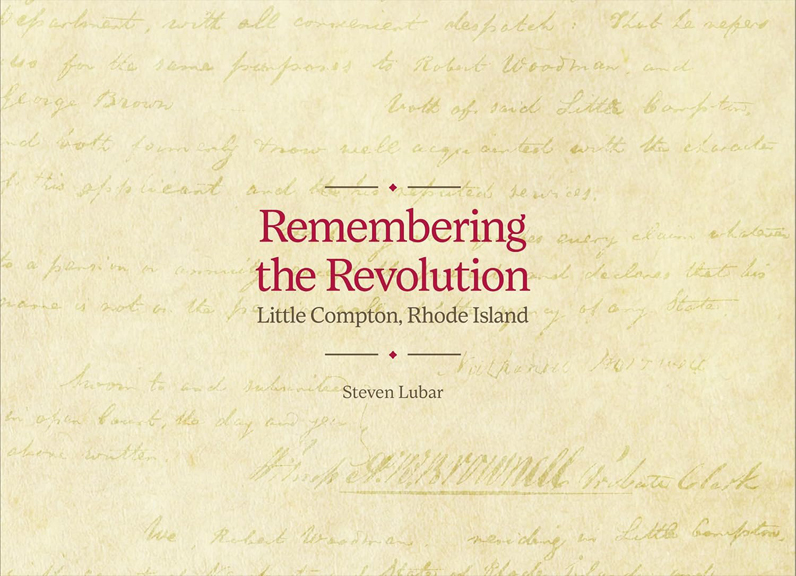
BOOK REVIEW: Remembering the Revolution: Little Compton, Rhode Island by Steven Lubar. (Little Compton, RI: Little Compton Historical Society, 2026). $25.00 hardcover.
Marjory O’Toole, the Executive Director of the Little Compton Historical Society, explains the value of the Society’s recent publication Remembering the Revolution: Little Compton, Rhode Island in the book’s Foreword:
 Imagine the thrill of finding an enormous bundle of documents written by your Revolutionary-era ancestors or community members. The papers painstakingly describe their experiences leading up to, during, and after the war. Each man or woman tells their own story in their own words. Even better, two hundred years ago those stories were scrutinized by local and federal officials for their truthfulness and accuracy. We can (with very few exceptions) believe what these witnesses to the Revolution have to say [page vii].
The President of the Little Compton Historical Society, Brown professor Steven Lubar, wrote the Society’s excellent study of testimonies from pension applications, and from 1853 interviews by Horace Gaylord with Revolutionary War survivors and their family members. The resulting work, as described by Director O’Toole, is indeed thrilling because the testimonies reveal little-known details about the Revolution that historians often gloss over. Of the 83,000 pension applicants, eighty were from Little Compton, a community that did not see battle but became a destination for refugees from British-occupied Newport. Some testimonies show that people living during the Revolution were both excited and traumatized by events. Widows, in many cases, became the main holders of memories, usually outliving their veteran husbands.

The book is divided into six sections. The first, “’We will stand ready with our lives and fortunes’: Before the War,” covers events that led up to the American Revolution. Unfair tax legislation from Parliament, the tea boycott, the burning of the Gaspee, the Coercive Acts, and the formation of the Continental Army were all described by Little Compton participants. The second section, “’In almost a continual alarm’: The War in Little Compton,” the plight of Quakers, spies, traitors and anti-war community leaders are included. The occupation of Newport had a major effect on Little Compton, which was in a state of constant concern over invasion. The fascinating testimony of fourteen women is the subject of “’We never were safe’: Life in a Time of Terror.” Black and Wampanoag soldiers are featured in the fourth section, “’To stand guard on the shores’: Defending Little Compton,” along with the stories of twenty-two defenders of the town. The final section, “’To Go a Soldiering’: Little Compton and the Wider War,” examines how soldiers from Little Compton fared in other battles in the Revolution, often at sea.
Remembering the Revolution: Little Compton, Rhode Island is a gripping narrative that celebrates the role of one small town in the smallest state (small in size, but large in Revolutionary fervor). The book contains beautiful pictures of many artifacts that are associated with Little Compton and the Revolution: powder horns, furniture, paintings, muskets, cannon balls, detailed maps of the time, etc. The book is an obvious “must-have” for residents of the town, but Revolutionary War historians will find it worth having for themselves.
PLEASE CONSIDER PURCHASING THIS BOOK FROM AMAZON IN HARDCOVER.
(As an Amazon Associate, JAR earns from qualifying purchases. This helps toward providing our content free of charge.)


Recent Articles
Remembering the Revolution: Little Compton, Rhode Island
Last Call for a Dram Seller on the Mohawk River
Payback: Attack on the DeLancey House
Recent Comments
"Payback: Attack on the..."
Thank you all for your kind words. I was very lucky in...
"Payback: Attack on the..."
Joseph Orchard, how fun! Oliver DeLancey avoided having the property confiscated, and...
"Second Coming of a..."
Hi Ann. Thank u for this! Jeremiah Jack is my eighth grade...