

George Washington’s two most-remembered wartime mounts, Nelson and Blueskin, have been the subject of considerable popular retelling, much of it post-dating the events by decades. The manuscript record is thinner than the later accounts but clear on the essentials. Both horses came to Washington as gifts from friends. Both carried him through much of the Revolution. Both survived the war and were retired from active service. Beyond those shared outlines their stories diverge—in origin, in the uses to which Washington put them, and in the manner of their departures.
The Horse Washington Lost in the Summer of 1778
On August 11, 1778, Brig. Gen. Thomas Nelson Jr. wrote to Washington from Virginia, offering the gift of a horse. The opening sentence of the letter establishes the occasion:
Will you pardon a liberty I am about to take with you. I have been inform’d that you have had the misfortune to lose your favorite Horse & that you are not mounted at present as you ought to be.
That was followed, in the same letter, by the offer itself.[1]
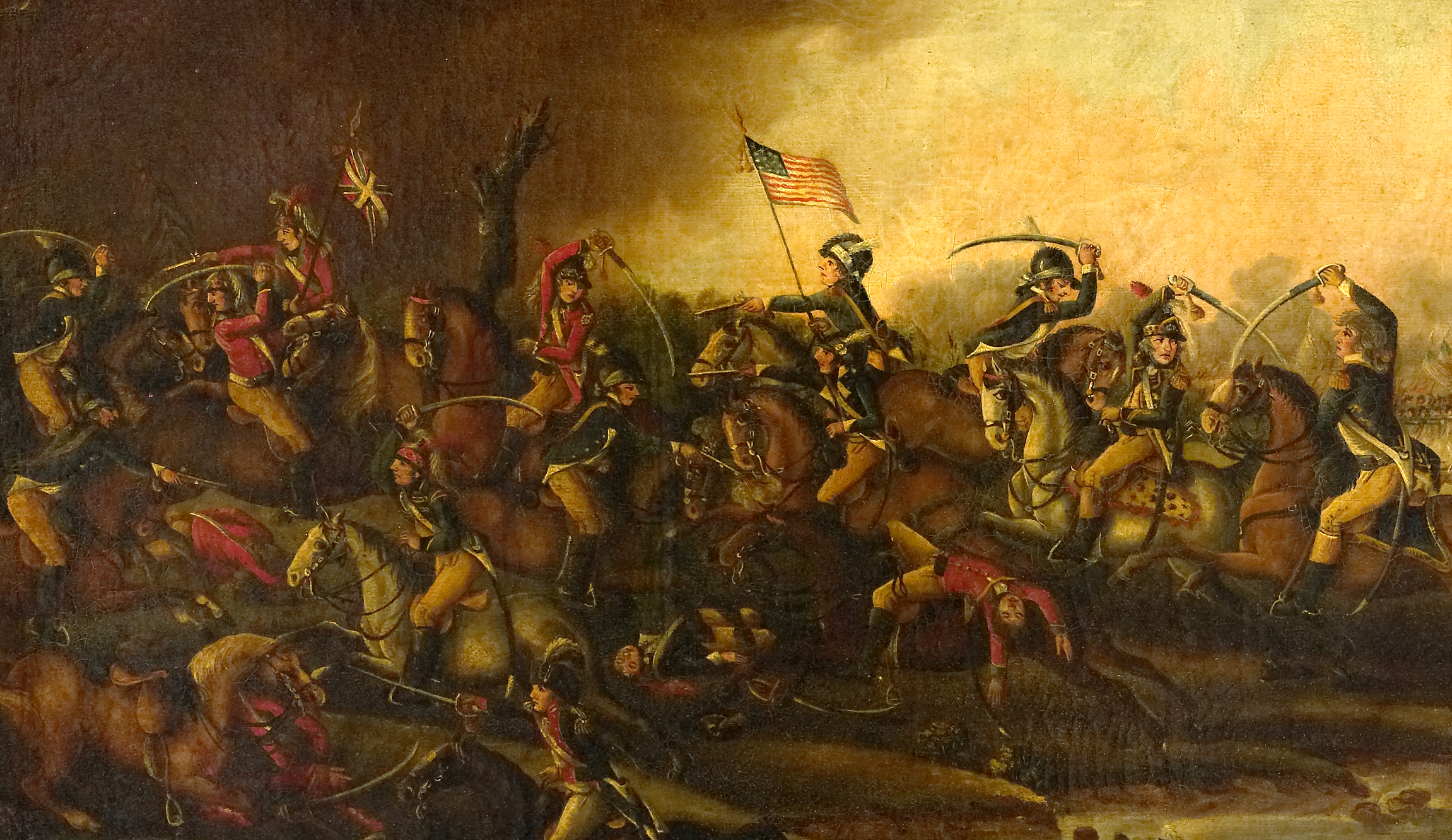
Which horse Washington had lost, and under what circumstances, is not stated in the correspondence. The timing points plausibly toward the Battle of Monmouth, fought on June 28, 1778—the longest single day of combat in the war and, by a wide margin, the hottest. Temperatures climbed past 100 degrees, and many soldiers on both sides collapsed from heatstroke.[2] It was recorded that Washington’s own horse died in the heat during the fighting.[3] Washington, writing to Henry Laurens three days later, described the battlefield conditions—a “deep sandy Country almost entirely destitute of Water”—but made no reference to his mount[4].
Alexander Hamilton also lost a mount at Monmouth. Writing to Elias Boudinot on July 5, 1778, Hamilton reported that John Laurens “had a slight contusion also—and his horse killed,” while he himself “had his horse wounded in the first part of the action with a musket ball.”[5]
The color and name of Washington’s lost horse were not recorded. Nineteenth-century paintings of Monmouth commonly depict Washington on a gray or white charger, and Washington’s association with “the man on the white horse” imagery dates from this period. Mark Edward Lender and Garry Wheeler Stone argue from the primary sources that Washington rode a dark mount at Monmouth.[6] The editors of the Papers of George Washington, annotating Nelson’s letter, do not identify the lost horse directly as a Monmouth casualty, and no surviving document makes the link between the battle and Washington’s lost horse explicit.
By late summer 1778 Washington was short a favored horse, the circumstance was known in Virginia, and a friend was prepared to press a gift on him by private courier.

The Nelson Letter
Thomas Nelson Jr.’s letter of August 11, 1778 is preserved at the Library of Congress and published in the Revolutionary War Series of the Papers of George Washington. The body of the offer, after the opening quoted above, reads:
The Liberty I am about to take with you, is that of sending you a Horse that will suit you better than anyone in Am[e]rica. But then I must insist that he be accepted as a present, for his value cannot be ascertain’d. He is now nine years old and of most excellent qualities. He is not quite reconcild to the beat of Drums, but that he will soon be familiariz’d.
The letter was sent, per the cover note, “By favor of Mr Randolph.”[7] Washington replied from his camp at White Plains on August 20, 1778, accepting. His response records that Nelson had pressed the gift “once, nay twice,” and that Washington had been in a “distressed situation … for want of one.”[8] He named the animal after its donor.
Nelson’s description of the horse is limited to age, temperament, and general quality. No sire, no dam, and no foaling location are named. The phrase “favourite Horse”—which Washington echoes in reply—is consistent with a personal saddle horse Nelson had been riding himself.

One chronological conflict persists between the primary and the secondary record. The tradition preserved by George Washington Parke Custis has Nelson foaled around 1763, which would make him approximately twenty-seven at his death in 1790.[9] Nelson’s 1778 letter identifies the horse as “nine years old,” which would place the foaling in 1769. The 1763 date is the one used on the Mount Vernon encyclopedia entry; the 1769 date comes from the primary source. The two have not been reconciled in the literature.
Thomas Nelson Jr.
The donor, Thomas Nelson Jr. (1738–1789), was a Yorktown-born planter-merchant, Cambridge-educated, who signed the Declaration of Independence and succeeded Thomas Jefferson as governor of Virginia in June 1781. He died at the Hanover County estate of Offley Hoo in January 1789.[10] The standard biography documents no specialized horse-breeding operation on any Nelson property.[11] Nelson had extensive holdings, but no evidence has emerged from his papers or biographers identifying a formal breeding program on any of his estates. The claim in some later retellings that the horse was bred at a “Nelson estate near Yorktown” has no contemporary source.
Nelson’s Service, 1778–1781
Washington rode Nelson for the remaining three years of the war. Contemporary and near-contemporary descriptions have the horse standing sixteen hands, a light sorrel or chestnut with a white blaze and white feet.[12] Custis’s Recollections and Private Memoirs of Washington identifies Nelson as the horse Washington rode to receive Lord Cornwallis’s surrender at Yorktown on October 19, 1781.[13] Custis’s account is a nineteenth-century reminiscence rather than a contemporary report; no earlier source confirms it.
Blueskin’s Origins
Washington’s other primary wartime mount, Blueskin, came to him earlier and through a different channel. The horse was a gift from Col. Benjamin Tasker Dulany of Maryland, a close friend of Washington’s stepson John Parke Custis and a frequent guest at Mount Vernon. Dulany married Elizabeth French—then a ward of Washington’s—on February 10, 1773, with Washington giving the bride away; the gift of Blueskin followed shortly after the wedding.[14]
Blueskin was a gray—dark at birth, whitening as he aged, with dark skin showing through the white hair as a faint blue in sunlight. The sex of the horse is variously reported in the secondary literature (stallion in some accounts, gelding in others), and contemporary sources do not resolve it.
The accepted pedigree traces Blueskin to the stallion “Ranger,” later known in Virginia as “Lindsay’s Arabian.” The origins of Ranger are preserved in a body of nineteenth-century Arabian-horse tradition rather than in contemporary documents. That tradition has Ranger arriving in colonial America as a gift from the Sultan of Morocco to a British frigate captain, suffering an injury en route, and being brought to Connecticut by a New England ship captain who nursed him through the voyage. Whatever the accuracy of those details, Ranger stood at stud in Connecticut by the late 1760s and sired a line of quality horses there. Washington is said to have taken notice of these horses among the Connecticut cavalry in 1775–76, and a man identified only as Captain Lindsay subsequently purchased Ranger and brought him to Virginia.[15] Blueskin, by the same tradition, was Ranger’s son; no Revolutionary-era pedigree document corroborates the claim, but it is consistent with the horse’s general coloring and type, and it has been accepted by subsequent writers.
Rotation and Reputation
Contemporary accounts describe Washington rotating between the two horses to preserve each. Nelson, whom one account called a “splendid charger,” was the steadier animal under gunfire and cannon blast; Blueskin was more easily unsettled by battle noise.[16] Washington preferred Nelson for engagements, reserving Blueskin for marches, inspections, and staff work. Robert Hunter, an English visitor to Mount Vernon in 1785, recorded a conversation with Washington’s household in which the same division was stated plainly—Nelson had “carried the General almost always during the war,” while Blueskin “next to him . . . had that honor.”[17]
The iconographic record diverges from the operational one. Blueskin, with his bright coat, was the horse most often painted. He appears in John Trumbull’s studies, in John Faed’s Washington Taking the Salute at Trenton, and in many of the large nineteenth-century canvases that established Washington’s “man on the white horse” imagery. None of the major portraitists is known to have worked from Blueskin in person; Faed never traveled to America, and while Trumbull sat with Washington repeatedly, whether Blueskin was ever present is unrecorded.[18]
The Horseman
Contemporaries who saw Washington ride described his horsemanship as exceptional. Jefferson in 1814 wrote that Washington had been “the best horseman of his age.”[19] The Marquis de Chastellux, who met Washington during the Revolution, was more specific:
I mention these minute particulars, because it is the General himself who breaks all his own horses; and he is a very excellent and bold horseman, leaping the highest fences, and going extremely quick, without standing upon his stirrups, bearing on the bridle, or letting his horse run wild.[20]
Chastellux’s observation deserves weight on two counts. He noted Washington’s balance—riding fast without standing in his stirrups or pulling on the reins—and that Washington broke his own horses, a practice unusual for a Virginia gentleman of his station and still more unusual for a commander-in-chief in the middle of a war.
Washington was also tall. George Mercer’s 1760 description places him at six feet two inches in his stockings and about 175 pounds, well above the average of his era, when adult men in British North America typically stood between five feet seven and five feet eight.[21] A sixteen-hand horse, the size ascribed to both Nelson and Blueskin, measures approximately sixty-four inches at the withers. On an animal of that size, a rider of Washington’s length would sit with his legs extending well below the horse’s barrel, his boots closer to the ground than a shorter rider’s would be. Sixteen hands was a substantial animal by any period standard, but it did not dwarf a man of Washington’s height; the imposing figure in the visual composition was the rider. Nineteenth-century equestrian portraits typically show the chargers larger than they were in life and the rider more compact in proportion, inflating both toward the heroic register. In practice the proportions ran the other way.
These elements bear on the horses’ operational record. Horses read their riders closely – a balanced, confident rider can steady a nervous mount, and an unsettled rider can unsettle a steady one. Nelson’s reputation for composure under fire was very likely a function of Washington as much as of the horse itself. Blueskin’s reported nervousness under cannon blast was a trait Washington appears to have worked with rather than against, reserving the animal for the duties in which his temperament was a better fit. In an army short of serviceable cavalry, assigning each horse to the work it could do well was an act of practical horsemanship.
The conditions at Monmouth overrode all of this. The heat killed horses across both armies on June 28, 1778, and several of Washington’s aides lost or had wounded their own mounts that day. No level of horsemanship could preserve an animal worked hard in 100-degree heat and sandy terrain without water. But across the broader arc of the war—the long marches, the night movements, the rides under fire—the composure of the rider and the fact that Washington had trained his own animals appear consistently in the accounts of those who watched him ride.
Retirement
Both horses were retired to Mount Vernon after the war. Washington’s diary entry of November 18, 1785 records a full inventory of his horses, listing “Nelson. Riding Horse,” and “Blewskin. Ditto,” along with sixteen others described by height, color, and function.[22] The pasture into which Nelson and Blueskin were turned lay close to the Mansion House. Visitors walked out to see them; Hunter’s 1785 account describes the two horses feeding “at their ease for their past services” and being recognized by visitors who pressed treats on them.[23]
Custis, who was born in 1781 and grew up at Mount Vernon, recalled Washington walking the grounds and stopping at Nelson’s paddock, where the “old war-horse would run, neighing, to the fence, proud to be caressed by the great master’s hands.”[24] The passage is sentimentalized but not contradicted by earlier accounts.
Washington’s broader equine activity at Mount Vernon after 1783 shifted toward breeding; the contrast with Nelson’s undocumented background is most visible in his Arabian stallion Magnolia, for whom Washington’s March 1785 Virginia Journal advertisement traced a four-generation pedigree from the Ranger Arabian back to the Godolphin Arabian.[25]
The Return of Blueskin
In November 1785 Washington returned Blueskin to Elizabeth Dulany. The immediate occasion was a gift of “Roots of Scarcity” (mangel-wurzel) she had sent Martha Washington, and the horse was offered in return. Washington’s accompanying note, dated November 23, 1785, is preserved in the Confederation Series of the Papers of George Washington (original at the Maryland Historical Society):
General Washington presents his best respects to Mrs Dulany with the horse blueskin; which he wishes was better worth her acceptance. Marks of antiquity have supplied the place of those beauties with which this horse abounded—in his better days. Nothing but the recollection of which, & of his having been the favourite of Mr Dulany in the days of his Court ship, can reconcile her to the meagre appearance he now makes.
The note acknowledges, without dwelling on it, that the animal being returned was visibly older.[26] The reference to Dulany’s courtship of Elizabeth ties the horse back to the prewar social circle of Mount Vernon—the Dulanys and Custises had been students together under the Reverend Jonathan Boucher in Annapolis, and Elizabeth’s mother, Penelope French, was at that moment in negotiation with Washington over neighboring land on the neck below Mount Vernon.[27]
The Dulanys were living in the Alexandria-Fairfax area in 1785; they acquired the Shuter’s Hill property outside Alexandria from Ludwell Lee in 1799, fourteen years after Blueskin’s return.[28] Where specifically Blueskin was kept during his remaining years is not recorded, and the date of his death does not appear in any surviving document found to date. By the time the Dulanys took possession of Shuter’s Hill, the horse was very likely dead of old age.
Benjamin Tasker Dulany (c. 1752–1816) and Elizabeth were both buried in the small private cemetery atop Shuter’s Hill. That cemetery was disturbed during Union occupation of Alexandria in the Civil War, when the hilltop was fortified as Fort Ellsworth and the Dulany mansion pressed into service as headquarters and hospital, and the site was substantially regraded in 1922–23 during construction of the George Washington Masonic National Memorial, which now stands on the hilltop.[29]
Nelson’s Death
Nelson remained at Mount Vernon after Blueskin’s departure. Washington was in New York during most of 1789–90, serving his first presidential term; Nelson was left under the supervision of the Mount Vernon farm manager. The weekly report of December 25, 1790 records his death.[30] If the foaling date of 1763 is accepted, the horse was twenty-seven—old for a horse of that era, though not impossibly so. If the 1769 date implied by the 1778 letter is correct, he was twenty-one.
Custis recorded in his memoir that Nelson died “many years after the Revolution, at a very advanced age.”[31] No burial location was recorded. Eighteenth-century plantation practice typically saw horses, even beloved ones, buried in unmarked pits on the estate grounds; the ceremonial burial of famous horses, with plaques and markers, belongs largely to the nineteenth century and later.
A claim that circulates online—that Washington had Nelson preserved by taxidermy, and that the mounted horse is on display at Mount Vernon—is not supported by the documentary record. The preserved horse in the Donald W. Reynolds Museum and Education Center diorama is a twentieth-century stand-in for Blueskin: a former Amish workhorse from Pennsylvania selected for size and color, mounted to give visitors a physical sense of scale alongside a wax figure of Washington. Eliza McGraw documented the provenance in her Atlas Obscura article on historical horse taxidermy.[32] None of Washington’s actual horses is known to have been preserved.
Virginia Thoroughbred Context
Because Nelson lacks a surviving pedigree, later retellings have sometimes supplied descriptive language—“Virginia Thoroughbred–influenced saddle stock” is a common formulation—intended to locate the horse in the broader equine genetics of the colony. The formulation is reasonable in general terms. The first Thoroughbred known to have reached America was Bulle Rock, a twenty-one-year-old son of the Darley Arabian brought to Virginia in 1730 by the mariner James Patton and owned at stud in Hanover County by Samuel Gist. Over the forty-five years before the Revolution, roughly sixty-three identifiable Thoroughbreds crossed the Atlantic to the colonies, chiefly through Chesapeake ports. The most consequential pre-Revolution imports were Monkey (imported 1747), Janus (imported 1756, later a foundation sire of the American Quarter Horse), and Fearnought (imported 1764 by John Baylor, with stud fees reportedly five times those of his competitors).[33] By the time Nelson the horse was foaled, this genetic material had been circulating through Tidewater mares for a generation.
Whether Nelson carried any of it, and in what proportion, is unknown. Thomas Nelson Jr.’s correspondence documents his own estate’s horses as predominantly working animals—in an April 1781 letter to Jefferson complaining about wartime impressment, Nelson described horses taken from Tidewater planters as “chiefly plough Horses.”[34] This is a glimpse of the general stock on Tidewater estates, not of specialized breeding animals, and it suggests that a quality saddle horse in Nelson’s possession would have been a personal acquisition rather than a product of home breeding.
[1] Thomas Nelson, Jr., to George Washington, August 11, 1778, Founders Online, National Archives, founders.archives.gov/documents/Washington/03-16-02-0309.
[2] On the heat, the duration of the fighting, and the heat casualties on both sides, see Mark Edward Lender and Garry Wheeler Stone, Fatal Sunday: George Washington, the Monmouth Campaign, and the Politics of Battle (University of Oklahoma Press, 2016), 316–35. For a Continental soldier’s first-person account (“the mouth of a heated oven seemed to me to be but a trifle hotter than this ploughed field”), see Joseph Plumb Martin, A Narrative of Some of the Adventures, Dangers and Sufferings of a Revolutionary Soldier (Hallowell, ME: Glazier, Masters, 1830), 93–98.
[3] Mary V. Thompson, “Battle of Monmouth,” George Washington’s Mount Vernon, www.mountvernon.org/library/digitalhistory/digital-encyclopedia/article/battle-of-monmouth. The claim that Washington’s mount died at Monmouth appears as well in numerous nineteenth- and twentieth-century accounts, but no primary source has been located that ties the Monmouth casualty to a named horse or that confirms the cause of death.
[4] Washington to Henry Laurens, July 1, 1778, Founders Online, National Archives, founders.archives.gov/documents/Washington/03-16-02-0001.
[5] Alexander Hamilton to Elias Boudinot, July 5, 1778, Founders Online, National Archives, founders.archives.gov/documents/Hamilton/01-01-02-0499.
[6] Lender and Stone, Fatal Sunday, 341.
[7] Nelson to Washington, August 11, 1778.
[8] Washington to Nelson, August 20, 1778,” Founders Online, National Archives, founders.archives.gov/documents/Washington/03-16-02-0373.
[9] George Washington Parke Custis, Recollections and Private Memoirs of Washington, ed. Benson J. Lossing (New York: Derby and Jackson, 1860), 166, 249; Mary V. Thompson, “Nelson (Horse),” George Washington’s Mount Vernon, www.mountvernon.org/library/digitalhistory/digital-encyclopedia/article/nelson-horse.
[10] Emory G. Evans, Thomas Nelson of Yorktown: Revolutionary Virginian (University Press of Virginia for the Virginia Historical Society, 1975), 128–32.
[11] Ibid., 42–57; see also Nell Moore Lee, Patriot Above Profit: A Portrait of Thomas Nelson, Jr. (Nashville: Rutledge Hill Press, 1988), 18–40.
[12] Custis, Recollections, 249.
[13] Ibid., 166.
[14] Editorial note in Washington to Elizabeth French Dulany, November 23, 1785, Founders Online, National Archives, founders.archives.gov/documents/Washington/04-03-02-0340. See also “[February 1773]” in The Diaries of George Washington, ed. Donald Jackson and Dorothy Twohig (University Press of Virginia, 1976–79), 3:156–57.
[15] The Ranger / Lindsay’s Arabian origin story is preserved in nineteenth-century Arabian-horse tradition rather than in contemporary Revolutionary-era documents and should be treated as tradition. For one published version of the narrative, see “Ben Hur” [pseud.], “Washington’s Best Saddle Horse,” CMK Record, reproduced at cmkarabians.com/2006/07/05/washingtons-best-saddle-horse/.
[16] Custis, Recollections, 249 (“splendid charger”); Robert Hunter, Quebec to Carolina in 1785–1786: Being the Travel Diary and Observations of Robert Hunter, Jr., a Young Merchant of London, ed. Louis B. Wright and Marion Tinling (San Marino, CA: Huntington Library, 1943), 192–94. Hunter’s Mount Vernon account was first printed as “An Account of a Visit Made to Washington at Mount Vernon, by an English Gentleman, in 1785: From the Diary of John Hunter,” Pennsylvania Magazine of History and Biography 17, no. 1 (1893): 76–82, under the misidentification “John Hunter”; Wright and Tinling established the diarist’s identity as Robert Hunter, Jr.
[17] Hunter, Quebec to Carolina, 193.
[18] William Spohn Baker, The Engraved Portraits of Washington (Philadelphia: R. M. Lindsay, 1880), 121–24.
[19] Thomas Jefferson to Walter Jones, January 2, 1814, quoted in William Alfred Bryan, George Washington in American Literature, 1775–1865 (Columbia University Press, 1952), 49.
[20] Marquis de Chastellux, Travels in North America in the Years 1780, 1781 and 1782, trans. and ed. Howard C. Rice Jr., 2 vols. (University of North Carolina Press for the Institute of Early American History and Culture, 1963), 1:111.
[21] Mercer’s description is quoted in full in Douglas Southall Freeman, George Washington: A Biography, 7 vols. (New York: Charles Scribner’s Sons, 1948–57), 3:6–7; see also Ron Chernow, Washington: A Life (New York: Penguin Press, 2010), 186, who reviews the sometimes conflicting height evidence. For eighteenth-century adult male stature in British North America, see Richard H. Steckel, “A Peculiar Population: The Nutrition, Health, and Mortality of American Slaves from Childhood to Maturity,” Journal of Economic History 46, no. 3 (September 1986): 721–41.
[22] Diary entry, November 18, 1785,” Founders Online, National Archives, founders.archives.gov/documents/Washington/01-04-02-0002-0011-0018; The Diaries of George Washington, vol. 4, 1 September 1784–30 June 1786, ed. Donald Jackson and Dorothy Twohig (University Press of Virginia, 1978), 230–32.
[23] Hunter, Quebec to Carolina, 193.
[24] Custis, Recollections, 166.
[25] Advertisement for Magnolia standing at Mount Vernon, Virginia Journal, March 24, 1785; quoted in the editorial note to Diary entry: November 18, 1785, Founders Online, founders.archives.gov/documents/Washington/01-04-02-0002-0011-0018. See also “Magnolia,” George Washington’s Mount Vernon, www.mountvernon.org/library/digitalhistory/digital-encyclopedia/article/magnolia.
[26] Washington to Dulany, November 23, 1785, Founders Online, National Archives, founders.archives.gov/documents/Washington/04-03-02-0340.
[27] Editorial note, Papers of George Washington, Confederation Series, 3:395–96.
[28] “Archaeology at Shuter’s Hill Plantation,” City of Alexandria, Virginia, www.alexandriava.gov/archaeology/basic-page/archaeology-shuters-hill-plantation; “Wayfinding: Shuter’s Hill,” City of Alexandria, Virginia, www.alexandriava.gov/historic-sites/basic-page/wayfinding-shuters-hill.
[29] “Wayfinding: Shuter’s Hill”; “A Firm Foundation for Freemasonry’s Memorial to Washington,” George Washington Masonic National Memorial Association, gwmemorial.org/blogs/news/a-firm-foundation. The Memorial’s cornerstone was laid November 1, 1923; the hilltop was graded from 138 feet to 107 feet during the 1922–23 construction campaign. The precise disposition of the Dulany graves during that work has not been documented in the public record.
[30] Thompson, “Nelson (Horse),” citing the Mount Vernon Weekly Report of December 25, 1790 (photostat, PS-11, Mount Vernon Ladies’ Association).
[31] Custis, Recollections, 249.
[32] Eliza McGraw, “The Strange, Centuries-Old Tradition of Stuffing Dead Horses,” Atlas Obscura, September 1, 2017, www.atlasobscura.com/articles/the-strange-centuries-old-tradition-of-stuffing-horses.
[33] Julie A. Campbell, The Horse in Virginia: An Illustrated History (University of Virginia Press, 2010), 17–36; John Eisenberg, “Off to the Races,” Smithsonian Magazine, November 2013, www.smithsonianmag.com/history/off-to-the-races-2266179/; “Legacy of the Horse: Significant Pre-War Imports,” International Museum of the Horse, imh.org/exhibits/past/legacy-of-the-horse/significant-pre-war-imports/.
[34] Thomas Nelson, Jr., to Thomas Jefferson, April 10, 1781, Founders Online, National Archives, founders.archives.gov/documents/Jefferson/01-15-02-0582.

3 Comments
Why no mention of Prescott? That was George’s white saddle horse during his Southern Tour 1791 and most likely the horse in the Trumbull painting In Charleston, SC.
Thank you. Terrific to get this detailed information about the horses that helped win the war. I think few people understand just how integal Washington’s abilities as a horseman were to our success.
Very interesting. Thank you. Surprised to learn that Blueskin was an Arabian,