



During the first four years of the War for Independence, the British-held province of East Florida was a large and painful thorn in the side of the southern states. Under the leadership of royal governor Patrick Tonyn, a former army officer, East Florida became a haven for Loyalists fleeing from Georgia and the Carolinas. Tonyn organized some of these refugees into a regiment known as the East Florida or King’s Rangers, under Lt. Col. Thomas Brown, and their frequent raids into southern Georgia did much to destabilize that state. British regulars under Gen. Augustine Prevost also constituted a threat, making a serious incursion into Georgia in the fall of 1778. Political and military leaders in the southern states were well aware of the danger posed by their hostile neighbor and launched three unsuccessful attempts to seize East Florida in 1776, 1777, and 1778. In October 1778, the Marquis de Bretigney, a French officer, devised a detailed plan for a fourth invasion of the province and the capture of its capital, St. Augustine. Bretigney’s proposal, along with two others from anonymous writers, won the endorsement of Maj. Gen. Robert Howe, Continental commander of the Southern Department, to make another attack on East Florida, and the idea was embraced by the Continental Congress. If undertaken as intended, a powerful invasion force would have had an excellent chance of achieving its objective, but the British attack on Georgia in December 1778 put an end to the plans and put the Americans on the defensive in the South.

Charles Francois Sevelinges, born in Soissons, France, in 1754, was not a member of the French nobility, though he called himself the Marquis de Bretigney. He began serving in the French army in 1775 and claimed to have held the rank of lieutenant colonel, another dubious assertion given that his French military service ended in 1777 when he was no more than twenty-three-years old.[1] Despite his youth, Bretigney apparently possessed considerable wealth—when he approached the American commissioners in Paris in late May or early June 1777 with his offer to serve in America, he stated that he wished to bring ten other officers with him at his own expense, along with arms and equipment for 130 men. On June 12, the American representatives accepted Bretigney’s offer. Bretigney and his party planned to sail in late June from Nantes aboard the Anonyme; the vessel also carried supplies procured by Pierre-Augustin Caron de Beaumarchais, the French government’s intermediary in providing aid to the United States.[2]
Either the ship’s departure was delayed or the voyage was unusually long, since the first report of Bretigney’s arrival in America came from John Lewis Gervais in Charlestown, South Carolina, who on November 3 informed his friend Henry Laurens, then serving as president of the Continental Congress, that “we have had another importation of French Men with Credentials from Mr Francklin.” Gervais noted that Bretigney “is the head & has ten or eleven Officiers with him” and had brought uniforms and arms for 130 men, “having Freighted a Vessel for that purpose,” an indication that Bretigney may have chartered his own ship rather than sailing on the Anonyme. The marquis expected that Congress “will accept his Services to raise a Corps of Light Troops,” Gervais wrote, adding that “I believe he wants nothing but to be Colonel of this intended Regt.” and hoped that Congress would pay the enlistment bounties for the recruits, who would be “none but Frenchmen.” Bretigney impressed Gervais, who remarked that he “had the honner of Monsr De Britigny’s acquaintance. I find him a Sensible Man & I believe, as far as I can judge a good Officier, and Zealous in Our Cause.”[3]
South Carolina president John Rutledge was less impressed with the newcomers. Bretigney arrived “with his Suite . . . some days ago,” Rutledge told Laurens on November 7. “As usual, they had no Money and application was made to our inexhaustible Treasury, for a supply,” Rutledge sarcastically wrote. State officials decided to send the French officers to Virginia by ship and gave them “what money may be necessary, for forwarding ’em to Congress.” Rutledge asked Bretigney to send him an account of expenses so the state could seek reimbursement from Congress. “We are so plagued with Sturdy Beggars, of Chevaliers, and french adventurers, commended or recommended by the Congress’s Commissioners at Paris, that I am out of all Patience with ’em,” Rutledge complained.[4]

Apparently Bretigney’s travel plans changed, as on November 26 Gervais wrote that the French officers had sailed from Charlestown bound for Edenton, North Carolina. The voyage ended in disaster. On February 16, 1778, Gervais informed Laurens that the ship, with all on board and the military supplies, had been captured by a British vessel and taken to St. Augustine in East Florida.[5]
Bretigney was not heard from again until June 1, 1778, when he penned a letter to Franklin from Cap Francois in Haiti. After congratulating Franklin for his work in bringing about the alliance between the United States and France, the marquis remarked on the good treatment he had received in Charlestown, since which time “I have languished six months in the fetters of the English.” With “a little courage and audacity” he had “escaped from the hands of my executioners,” who fed him a feeble daily diet of “eight ounces of biscuit, three ounces of bacon, brackish water, and insults.” However, Bretigney believed “that during my imprisonment I have not been absolutely useless to your compatriots. I have had the good fortune to convey to the general who commands in Carolina and Georgia,” Robert Howe,” all possible information about St. Augustine, its fortifications, its garrison[,] the means of establishing an intelligence there, and perhaps also the means of surprising this city, the possession of which would be the greatest resource for your compatriots.” Bretigney stated his intention to go to Georgia and serve under “my Friend” Howe, and advised Franklin that if the war continued, it would be necessary to take “from the English that part of Florida which hinders trade, by the privateers which it arms at St. Augustine, the refreshments and water which it supplies to the frigates which grow before Charleston, and finally by the Indians and the Royalist Rengers who plunder and desolate Georgia.”[6]
By August Bretigney was back in the United States where he submitted his invasion plans to Congress. The delegates heard his proposal on August 26 and referred it to a committee.[7] Although no further record of official action appears in its journals until November, in early October Congress sent a complete copy of Bretigney’s plan to Maj. Gen. Benjamin Lincoln, who had succeeded Howe as commander of the Continental Army in the Southern Department. The document, fifteen pages in length, opened with a justification for invading East Florida. “The tranquility of Georgia and the interest of Carolina require the reduction of St. Augustine,” Bretigney wrote. “The necessity of this undertaking, the most certain and less expensive means to Succeed,” had been the focus of his attention and had led him “to propose a plan of attack by which much of the troops blood will be Spared and the Success of this undertaking secured.” Bretigney noted that his ideas were based on personal observation of the strength of the town’s garrison, the location “of the advanced posts and of all the country in general which separates Savannah from st. Augustine,” and the defensive works in the town, from which he had calculated “the number of troops to be employed in the affair.”[8]
The key to St. Augustine’s defense, Bretigney observed, was the Spanish-built fort Castillo de San Marcos, which the British called Castle St. Mark. Bretigney stated that the fort contained sixty cannon, 24- and 36-pounders, and protected the northern and western approaches to the town as well as the harbor entrance to the east, so that a naval attack could not succeed. The fort boasted “very good Casemates. Bombproofs. but not sufficient lodgment” for more than four hundred men, and its weaknesses were “Extreme bad water. and little room for Magazines to furnish the Garrison during a blockade of any continuance.” There was, Bretigney added, only one outwork: “an intrenchment with six cannon the neglected remains of a more considerable fortification the Spaniards had made” for defense against Indian attack. The barracks were also outside the fort at the edge of town where they could “be insulted and burned with out being defended by the cannon of the fort.”[9]

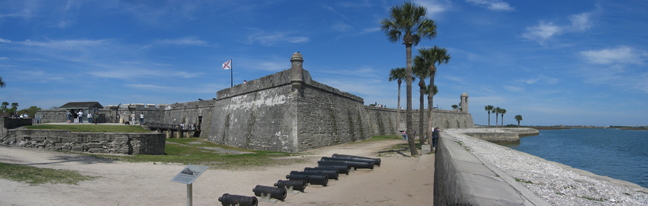
According to the marquis, St. Augustine’s garrison numbered 1,100 regulars, 300 provincial rangers in Brown’s regiment, “a parcel of indians which can not exceed 250,” and some militia. The latter could be discounted, as “they are so few and despicable” that they could not resist for a half hour “if attacked by thirty American recruits.” Among the regulars, Bretigney asserted, were “100 Frenchmen almost all inlisted by force who desire only a favourable instant to defect and 400 Germans: the two thirds of which are dissatisfied” so that General Prevost could count only on those troops of British ancestry. Although well equipped, the garrison was chronically short of provisions and subsisted largely on supplies from enemy vessels captured by British privateers or seized in Georgia by Brown’s rangers. While Bretigney admitted that he “greatly respects the military talent of Genl Prevost,” he believed that if St. Augustine were “blocked up by land. and could receive no provisions from Europe. the garrison would be obligd in a few months to lay down their arms without firing a musquett.”[10]
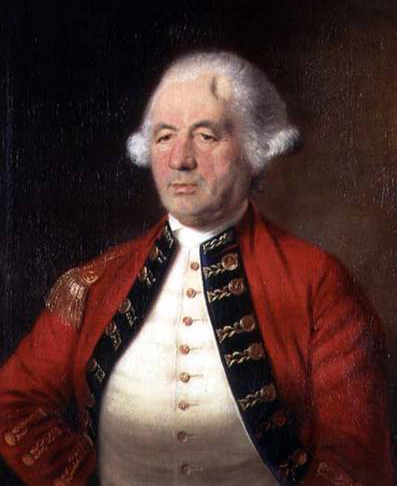
Bretigney recommended that the invasion force concentrate at Savannah, which would also function as its supply base. From there the American troops would march southward, cross the St. Mary’s River unopposed, and proceed to the St. John’s River, where they were likely to meet opposition. The crossing there was “defended by two small redoubts thrown up as by chance and unable to resist the attack of 400 men,” the marquis declared. It consisted of “four wooden houses forming four Bends of Bastions in which are six bad cannon almost without carriages.” A second, smaller redoubt with two cannon “whose effect is not dangerous” constituted an even less formidable obstacle. Between eighty and one hundred soldiers garrisoned the redoubts. The Americans could cross the river with the support of “two or three Small vessels of eight or Ten Guns,” defeat the defenders, and leave the ships to protect their supply line; the redoubts could be converted to “magazines and hospitals.” It was possible that Prevost would order the redoubts evacuated, because his plan was to form defensive lines, screened by Brown’s Rangers, to delay the enemy’s advance, fall back from one position to another when forced to do so, and as a last option, “shut himself up in St. Augustine.” Should the American expedition encounter no resistance after crossing the St. John’s River, they would have only a thirty-six-mile march to St. Augustine along “the only road practicable for an army,” but one that was too sandy for heavy artillery to traverse.[11]
Three thousand troops, preferably Continentals, would be required for the invasion, Bretigney estimated, so that twenty-five hundred would be available for combat at any time. A small number should be cavalry, while eight “Small field pieces and two Mortars is all the artilery required,” as these could be transported by road. If the British chose to oppose the invaders north of St. Augustine, this would be to the Americans’ advantage, the marquis maintained, because by keeping their force concentrated, the American commanders could attack these British detachments with a decisive numerical advantage, thus defeating Prevost’s army in detail. “It is certain that the British in Florida have neither Strength nor means Sufficient to raise fortifications and form lines capable to Support a Serious resistance, this is only a despicable bugbear which will not Stop the army a fortnight in its march,” Bretigney remarked. He believed that if Prevost adopted such a plan, it would be because of “his extravagant confidance in the valour of his troops and the Superiority of their discipline.—The Same prejudice ruined Genl Burgoyne” at Saratoga and would be equally disastrous for Prevost.[12]
Upon reaching St. Augustine, the Americans would take position outside the range of the fort’s guns, fortify themselves, and initiate siege operations. From there they could “block up the enemy in order to cut off his Supply of provisions . . . harass the enemy without engaging in any decisive affair to fatigue & weaken them, and lastly to oblige the garrison & inhabitants to retreat into the fort” where crowding, disease, food shortages, and bad water would force their surrender. Bretigney predicted that Prevost could employ no more than eight hundred troops to defend the city, since some would have to be diverted to defend the southern approach to the Matanzas River at a small fort there and others would be needed to defend a “tower” across the river from the Castillo. The number defending the main fort would be reduced by desertion, Bretigney predicted, because there were only three or four months’ provisions in the town and fort, and the defenders would grow demoralized as supplies dwindled. Bretigney recommended welcoming deserters into the American lines but barring the admission of “women, children, & Negros” who would “consume their provisions and create trouble.”[13]

Bretigney suggested other subsidiary operations that might hasten Prevost’s surrender. One was to burn the town if that was considered beneficial to the besiegers. Another was to send a party of four hundred troops to capture the tower and its “weak guard” and two cannon. Small American parties in armed vessels might also approach British ships at night and set them on fire. Such actions might convince Prevost to abandon the fort, providing an opportunity to attack the withdrawing British; at the very least, they would demoralize the Castillo’s defenders. In any case, the campaign would be over in three to four months. “I think this method of Mastring St. Augustine would be the quickest, the least expensive, & consequently the best,” Bretigney confidently concluded, having noted that the victorious Americans, after capturing St. Augustine, could march to British West Florida and take its capital, Pensacola.[14]
Gen. Robert Howe, meanwhile, had written to Congress on September 22 pressing for an attack on East Florida, most likely in response to Bretigney’s proposal. The general’s letter was read to the delegates on November 2. Congress, having considered the fact that “a considerable force hath been directed to assemble at Charleston” and would no longer be needed to defend South Carolina and Georgia if the British did not invade those states, then passed a resolution stating that Lincoln “be directed to endeavour to reduce the province of East Florida.” Congress referred Howe’s letter to the committee studying Bretigney’s plan.[15]
The committee made its report on November 10. The delegates then approved a lengthy, detailed resolution regarding an attack on East Florida. First, South Carolina’s governor would be officially notified that Congress had ordered Lincoln to attack East Florida, provided the British remained on the defensive in the South. Second, Congress authorized Lincoln to enlist men in the Continental regiments of South Carolina and Georgia “to serve during the continuance of the expedition.” If Lincoln believed that the number of Continentals from those states, along with others to be sent from North Carolina and Virginia, was too small to ensure success, he could “engage a number of volunteers, not exceeding fifteen hundred,” to serve in the expedition, organize them as he saw fit, and appoint officers to lead them. All those participating in the offensive, whether Continentals, volunteers, or militia, who served until “the castle of St. Augustine is reduced,” were to receive as bounties the same quantities of land that Congress had previously approved for those enlisting in the Continental Army; if they were killed or died during the East Florida operations, their heirs would receive the land, which would be in East Florida.[16]
Congress was to send recommendations to the governments of North and South Carolina, and Georgia, to give Lincoln “every assistance in their power.” The governors of Maryland and Virginia would be informed of the expedition’s “high importance to the welfare of the United States” and urged to make “every exertion . . . during the course of the winter” to facilitate the conquest of East Florida. Both states were advised to send their galleys to Charlestown to assist with the naval operations. To encourage the enlistment of crews and reward them, Congress approved a bounty of up to forty dollars for every recruit who would serve six months aboard a galley, and also provided that “the continental share of all property taken by the said galleys” during the expedition was to be “divided amongst the officers and men.” Because “differences relative to commands may arise amongst the officers of the respective states, whose galleys are employed, which . . . might defeat the end of the enterprise,” Congress ordered Capt. John Barry to take command “of all the armed vessels employed on the intended expedition,” making him subject to Lincoln’s orders, and directed Barry to go to Maryland “with the utmost dispatch . . . to expedite the equipment of the galleys to be furnished by that state; and proceed with them to Charleston.”[17]
Finally, “to facilitate his procuring intelligence of the enemy’s strength and designs in . . . East Florida,” Congress sent Lincoln 201 pounds 5 shillings in specie to cover relevant expenses. Then, in a remarkable display of optimism, Congress provided the text of a proclamation Lincoln was to issue upon his arrival in East Florida. He was to inform the inhabitants, in the name of the United States, that he had “not come to destroy, but to protect” them “in the enjoyment of their rights and property” provided they “repair to his standard” and take an oath abjuring their allegiance to King George III. Anyone “attainted of high treason in any” of the thirteen states was not eligible for forgiveness. East Floridians who volunteered to serve alongside the Americans were to receive “the same pay and emoluments” as Lincoln’s troops.[18] The delegates had clearly given the proposed invasion much thought and it had their full support.
Lincoln had written to South Carolina governor Rawlins Lowndes in late December regarding the projected invasion, and Lowndes replied on December 24. By that time, the Americans had learned that a British fleet had left New York several weeks earlier and was expected to arrive at any time, so that Lowndes informed Lincoln that he could not give “a Direct . . . Written Answer . . . relative to the subject respecting East Florida.”[19]
Sometime in December, another individual submitted a different proposal to Lincoln regarding an invasion of East Florida. The unnamed writer informed Lincoln that he had left Congress in October and that the delegates had given him two plans for an expedition against St. Augustine, one of them Bretigney’s and the other that of an anonymous correspondent who proposed making a quick thrust by sea to capture the Castillo. “I think it would be embarrassing and unsafe, to attempt an expidition on either of the plans,” the writer stated. The approach march would require a large number of wagons and sufficient quantities of forage for the horses; the writer noted that “an attempt without [adequate forage] was made the last year; the consequences were, that, by the time the army reached St. Mary’s [River], their horses were rendered useless, knocked on the head [killed], & then waggons burnt & the troops obliged to return without them.” Four rivers needed to be crossed for a force marching overland from Savannah to reach St. Augustine, dictating a slow approach that would give the enemy time to prepare to meet them, while a seaborne attack was too dangerous because the troops would be unable to retreat if their assault failed.[20]
In an enclosure, the writer outlined his own plan for the capture of St. Augustine. “An army cannot be marched across land to St. Augustine without the aid of a naval force,” the writer stated, while moving “solely by sea is unsafe, and to expect the reduction of it in any other way than by a regular siege too precarious to be attempted.” If the Americans made another effort to invade East Florida, the person suggested, the troops should “be marched as light as possible” by land while galleys along the coast both protected them and escorted a flotilla of transports that carried baggage, provisions, ammunition, and artillery. The infantry needed a substantial numerical advantage over their British opponents. Heavy cannon were unnecessary to reduce the Castillo; this could be accomplished using saps (approach trenches to bring attackers closer to fortified positions), the work to be done by “a number of negroes,” and mortars for bombardment. The writer warned that the expedition could only be attempted from December to March, as the remaining months were too hot and the heat, water, and swamps were “mortal and would kill more soldiers than the fire of the enemy.” Finally, the writer asserted that the French and Germans serving in British units were more dissatisfied than Bretigney had claimed, and “only desire[d] an opportunity to enter in the American service.”[21]
On December 21, Lincoln sent Howe information concerning a possible move against St. Augustine, perhaps the proposal he had received from the unidentified correspondent. Lincoln added that he had heard reports that Congress wanted him to undertake such an invasion but that he had received no official notice. The next day Lincoln, who had finally received Congress’s instructions concerning an expedition to seize East Florida, informed Governor Lowndes of the delegates’ intention, adding that such an invasion depended on the necessary supplies being available. Lincoln had already complained about supply shortages, and told Lowndes that if Congress was “mistaken” about the availability of supplies, “and the expedition should fail” as a result, “or I should not have it in my power to afford succour to any other State in the department . . . I wish to give Congress satisfactory reasons for my conduct.” Thus Lincoln placed the burden for the success of the proposed invasion squarely on the shoulders of South Carolina’s civil authorities. Two hours later, Lincoln sent Lowndes another letter, enclosing Congress’s resolutions on the expedition and asking what land and naval forces the state could provide. Lincoln also sent information on Congress’s plan to North Carolina governor Richard Caswell, stating that he planned to leave that state’s troops in South Carolina while he marched with the Continentals to St. Augustine.[22]
Lincoln’s preparations were almost immediately rendered moot, and he wrote the expedition’s epitaph in a letter to Henry Laurens on December 26. Since receiving Congress’s resolves, he had been investigating the possibility of undertaking the invasion, Lincoln noted. His commissary officers, however, said they could not get the necessary supplies in the South. The essential items would have to be “brought from the North, or elsewhere, particularly arms, powder, field-pieces, lead, entrenching tools &c.” But planning had been interrupted by the arrival of the British fleet off the Georgia coast, a danger that was now Lincoln’s priority, he reported.[23] The British movement had simultaneously secured East Florida and threatened Georgia with invasion.
More than a year after the proposed American expedition was thwarted by the British attack on Georgia, Lincoln shared his plans for such an enterprise with Washington in response to a letter the former had received from Samuel Huntington, president of the Continental Congress. Huntington had authorized Lincoln “to correspond with the Governor of Havanna, and with him, to plan, adjust, and carry into execution, measures for the reduction of Georgia, and then to extend our operations to the conquest of East Florida.” Lincoln stated that he would “make a few observations on an expedition to East Florida, and point out some of the difficulties which may attend it, and give my ideas of a mode to obviate them.” He remarked that Congress had received “plans on which an expedn to St Augustine ought to be conducted—these have made impressions on their minds, which lay me under an obligation of pointing out . . . the few errors therein.”[24]
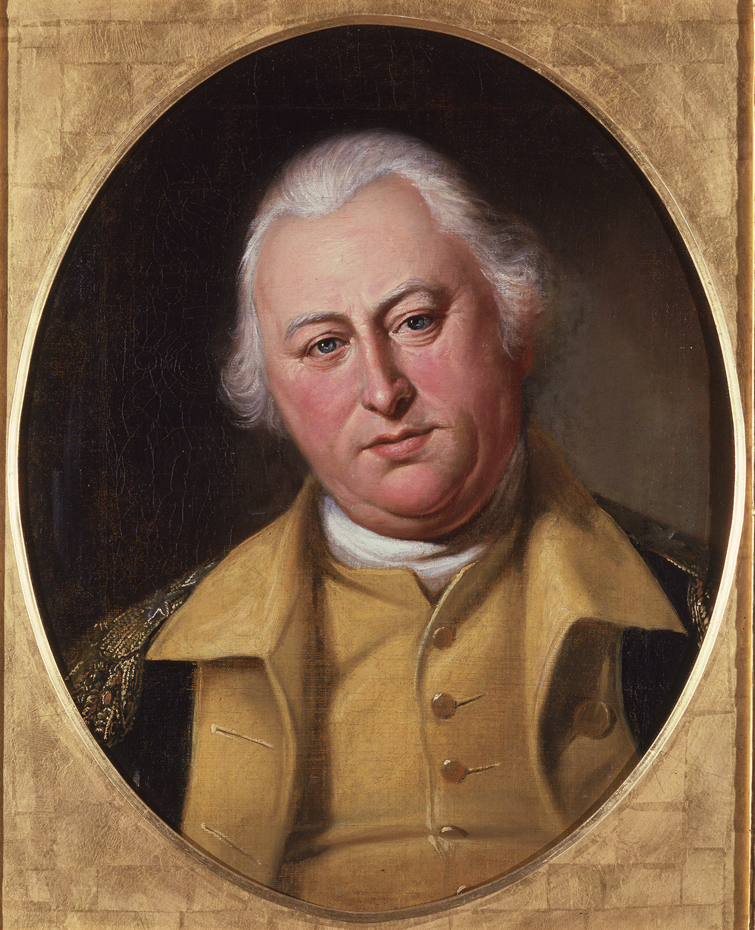
Lincoln noted that when he left Philadelphia in October 1778, congressional delegates had “put in my hands the observations, of two Gentlemen, of known abilities, on the situation and strength of St. Augustine” and the force required for its capture. He then briefly reviewed the first such plan, Bretigney’s, that required a siege, before summarizing the plan of “an anonymous observe[r]” who wanted to send troops by water, “and the Fort attempt[ed] by storm.” Based on his own knowledge of the area, “the difficulties which would attend the marching an Army through it,” and the strength of the British position at St. Augustine, Lincoln declared that “it would be embarrassing, and unsafe to attempt an expedition against that Province on either of these plans, though there are many useful observations in them.” He believed the operation would take 150 days and then went on to repeat, often verbatim, most of the information he had received in December 1778 from the unnamed writer. Lincoln emphasized the need for large numbers of wagons, great quantities of forage, and other supplies, and asserted that the “barren desert” the army would have to traverse would render its approach to St. Augustine “so gradual that time will be given to the Garrison to make every necessary preparation.” He also noted the “unhealthiness of the Climate” before expressing doubt “whether to attempt an expedition from no other hope of success than from a blockade in which many lives will be lost, much money expended and on the success of which the honor of the States so much depends, can be justified.”[25]
Having thus dispensed with Bretigney’s plan, Lincoln next dismissed the second proposal, for a waterborne assault, before again reverting to the unnamed writer’s plan. Lincoln made only a few alterations to it, the most notable his belief that if Spain participated, “that Power must supply a naval force sufficient to cover our Gallies and small craft, all of wh. could keep to the inland navigation.” The Spanish would also have to supply heavy artillery, mortars, ammunition, and troops. Lincoln also altered a few details regarding river crossings and asserted that “saps, mines, bombardments” from heavy mortars should be employed against the Castillo. He added that these plans were nothing more than “general hints, similar to some I put into the hands of the Delegates from the Massachuset’s Bay.”[26] Although the plan submitted to him by the unnamed writer contained no hint of its author’s identity, Lincoln very likely knew and trusted that individual or he would not have so completely embraced the proposal. His doing so suggests that he would almost certainly have conducted the offensive along those lines had he been given the opportunity, either during the winter of 1778-1779 or in 1780.
Just as the earlier expedition never got beyond the planning stages, so too did this one fall victim to British movements. In a postscript of January 29, Lincoln announced that a British fleet had arrived at Savannah—Sir Henry Clinton’s armada of warships and transports that had sailed from New York with the intention of seizing Charlestown. The result, Lincoln wrote, was that “we have no reason to expect that the [invasion of East Florida] can be attended to soon, if ever.”[27] For a second time, British actions had prevented the Americans from undertaking an operation to secure their southern flank, though in this case, there was almost no chance of such an enterprise getting underway. As Lincoln had made clear, he would depend on considerable Spanish support, but Spain had entered the war as an ally of France, not the United States, and it was hardly credible that the Spanish would undertake joint military action with the Americans despite the hopes of Congress and American military leaders.
Had the Americans been able to mount the expedition proposed in 1778, and the states provided the support that Congress requested, the course of the war might have been changed. An American occupation of East Florida before the departure of the British fleet sent to capture Georgia might have prevented the British from launching a campaign against the southern states. It is also possible that, with the American forces spread thinly along the Atlantic seaboard, the British could have decided to strike at any one of the vulnerable coastal towns; the seizure of Charlestown, for example, would have left all the American troops to the southward isolated and vulnerable to captured. Such scenarios, though, are probably not realistic. Lincoln may not have been able to assemble the troops and supplies necessary for the proposed expedition, and even if he had done so, he was not the most energetic or capable of generals. His invasion may have been no more successful than its three predecessors. Whatever might be conjectured, Bretigney’s proposal and that of the anonymous advocate of a seaborne attack, both made in October 1778, and the third plan put forth in December, simply came too late to allow for such an operation to be prepared and launched before British forces arrived in Georgia and undertook an offensive of their own.
[1] H Marquis de Brétigney to George Washington, January 1, 1779, https://founders.archives.gov/documents/Washington/03-18-02-0611.
[2] Marquis de Bretigney, Memorandum for the Commissioners, (after May 28, 1777), in William B. Willcox, ed., The Papers of Benjamin Franklin, Vol. 24 (New Haven, CT: Yale University Press, 1984), 96-98, 96n-98n.
[3] John Lewis Gervais to Henry Laurens, Nov. 3, 1777, in George C. Rogers, Jr., and David R. Chesnutt, eds., The Papers of Henry Laurens, Vol. 12 (Columbia: University of South Carolina, 1990), 16-17.
[4] John Rutledge to Laurens, November 7, 1777, Papers of Laurens, 12:35.
[5] Gervais to Laurens, November 26, 1777, and February 16, 1778, Papers of Laurens, 12:88, 451.
[6] Bretigney to Benjamin Franklin, June 1, 1778, Papers of Franklin, Vol. 26 (1987), 560-561.
[7] Records of August 26 and September 21, 1778, in Worthington Chauncey Ford, ed., Journals of the Continental Congress, Vol. 11 (Washington, DC: Government Printing Office, 1908), 837, 940.
[8] Marquis de Bretigney, “Memorial and Particulars relative to Fort St. Augustine with a plan of attack & Military Operations necessary for the reduction of that Place,” sent to Lincoln c. October 3-8, 1778, Benjamin Lincoln Papers, microfilm, South Carolina Department of Archives and History, Columbia.
[9] Ibid.
[10] Ibid.
[11] Ibid.
[12] Ibid.
[13] Ibid.
[14] Ibid.
[15] Record of November 2, 1778, Journals of the Continental Congress, 11:1091.
[16] Record of November 10, 1778, Journals of the Continental Congress, 11:1116-1117.
[17] Ibid, 1118-1120.
[18] Ibid, 1120-1121.
[19] Rawlins Lowndes to Lincoln, December 24, 1778, Lincoln Papers.
[20] Unnamed to Lincoln, December 1778, Lincoln Papers.
[21] Enclosure labeled “No. 2” in unnamed to Lincoln, December 1778, Lincoln Papers.
[22] Lincoln to Howe, December 21, 1778; Lincoln to Lowndes, December 22, 1778 (two letters of this date); Lincoln to Gov. Richard Caswell, December 22, 1778, Lincoln Papers.
[23] Lincoln to Henry Laurens, December 26, 1778, Lincoln Papers.
[24] Lincoln to Washington, January 28-29, 1780, in Benjamin L. Huggins, ed., Papers of Washington, Vol. 24 (2016), 301-302.
[25] Ibid, 302-304.
[26] Ibid, 304-305.
[27] Ibid, 305.



One thought on “American Plans for a Fourth Invasion of East Florida”
A great article on an oft neglected “theater” of the War. It seems like any plan to capture St. Augustine would have required so many moving parts to succeed, especially with such long supply lines, that any attempt would have been likely to fail. Credit to Congress for considering the plans, though. I wonder if bringing Florida in to the fold would have increased American ambitions toward, or influenced the destinies of, the Caribbean colonies.