



Located along the western coast of the Hudson River just north of New York City, Orange County New York[1] was an active theater of war in the northern department. Large mountain ranges abutting both sides of the river gave the region the name of the Highlands, and provided a strategic barrier between New York City and the interior of the state. Along this stretch of river forts were constructed, massive iron chains were drawn across the river, and Benedict Arnold betrayed his country. The men of Orange County were active throughout the war in the region between the Hudson and Delaware Rivers manning forts, defending frontiers, fighting Tories and Iroquois, and providing men to the Continental army.
The arrival of the British off the shores of Staten Island in late June 1776 sparked a flurry of activity in the county, including raising a regiment to be levied to the Continental army under thirty-five year old Col. Isaac Nicoll. Nicoll had been active since hostilities began the prior year, having commanded forces at the defenses along the Hudson in 1775 through June 1776. Nicoll’s new regiment was drafted from the militia to serve six-month enlistments in a brigade under the command of Gen. George Clinton. The soldiers’ ideals of liberty would be tested by life-altering experiences of war fighting against the professional military might of His Majesty’s world power. From July to December 1776, the regiment faced trials and tribulations as they first protected the Orange County countryside from naval raids, then served at the northern fringe of Washington’s army. The regiment confronted shortages of critical supplies, met the enemy in combat on land and water, and conducted surveillance and espionage operations. The performance of the men varied between the extremes of great heroism and fear-inspired cowardice in the face of battle.
Defending the Highlands Countryside
On July 12, just a couple weeks after the British fleet first appeared in New York Harbor, British Capt. James Wallace sailed up the Hudson River with the twenty-gun Rose, forty-four-gun Phoenix and three support vessels. Wallace had been active in 1775 in the Long Island Sound and Narragansett Bay regions, bombarding the town of Stonington, raiding the islands of the sound and bay, and blockading the Thames River. Wallace soon found the countryside around the Hudson was not the easy, fertile target that the islands of the Long Island Sound had been the prior year.
Wallace was ordered up the Hudson to test American river defenses and reconnoiter the river north of York Island (today’s Manhattan). Passing American batteries, including those at Fort Washington (York Island) and Fort Constitution (soon to be renamed Fort Lee on New Jersey side), Wallace’s fleet absorbed hull shots and damage to sail and rigging, while suffering a few casualties. But the river defenses failed to stop the ships and Wallace continued north before anchoring in the Tappan Zee, a wide area of the Hudson beginning about eight miles north of King’s Bridge at the northern tip of York Island.[2] From there Wallace’s fleet threatened the countryside and Rebel fortifications along the river as far north as Fort Montgomery.

New York had just called out one-fourth of the militia from Orange, Ulster, and Westchester Counties to be formed into three regiments of ten companies each, to serve in a brigade under Gen. George Clinton. Clinton’s Brigade, including Nicoll’s Regiment, was quickly put into action to respond to Wallace’s threat from the river. They marched south down the west side of the Hudson about eight miles to Haverstraw Bay on July 16, where Wallace’s fleet had already been engaged by some enthusiastic local Orange County militia under the command of Col. Ann Hawkes Hay. Clinton reported that Wallace had “discharged a few shot at the Houses on the West shore doing little or no Damage. This they were provoked to by the Rable assembling in large Bodies on Shore & firing at the Shipping tho more than a Mile distant; The Shipping just returning Shot equal to the Number of Vollies from our People.”[3] Clinton took command of the “Rable” and ordered Nicoll’s men to gather the cattle and sheep in the area and move them inland and away from the fleet.
The next day, Wallace raided and burned the farm of a poor, semi-blind farmer by the name of Jacob Halstead. By the time Nicoll’s Regiment arrived, Wallace and the fleet were gone. Clinton’s disgust with Wallace’s behavior was evident; “Capt. Wallace headed the Party who committed this little Robery; his Share of the Plunder was . . . a Pigg so very Poor that a Crow woud scarcely deign to eat it.” Clinton, frustrated by his inability to move quickly enough to protect Halstead, redeployed his troops along the riverside “to prevent effectually any Mischief in future.”[4] Clinton’s Brigade and the militia under his command continued to protect the Orange County shoreline from Wallace. Over the next few weeks, the British fleet spent its time sounding the river—measuring its depth—while threatening the country on both sides of the river. Wallace made an attempt to land on the west side of the river, but was repulsed by the Orange County militia.[5] While Wallace faced strong resistance on the western side of the Hudson, across the river in Westchester County the king’s fleet found a loyal farmer eager to help, and Wallace “took off a Yoke of Oxen a Steer a Cow & 10 Sheep from the Farm” along with the Tory.[6]
On August 2, Nicoll highlighted for the first time a shortage of supplies in a letter to the Convention of the State of New York: “We are without a Commissary to provide for the troops, and have no store of provisions, powder, and ball. I must, therefore, request that the Congress will give orders that we may be speedily supplied.”[7]
Heroes Among the Ranks
While the Americans had no large vessels to counter Wallace, they were not defenseless on the river. On August 16, Wallace’s fleet was attacked by six American row-galleys—small, maneuverable boats with one cannon each. One of the British support vessels, the Charlotta, was crippled and burned. Under constant fire from the remaining ships of Wallace’s fleet, Lt. Richard Langdon and two others from Nicoll’s Regiment successfully towed the crippled ship back to shore, with one cannon ball whizzing by Langdon’s head. With the wreck secured, the regiment was able to salvage its guns, including a six-pounder, three smaller cannon, and ten swivel guns, in addition to its sails and rigging. Gen. William Heath was so impressed with this feat that he wrote Gen. George Washington “I therefore beg leave to recommend this Service in Particular to your Excellency notice and if you Should think Some Reward Proper to be Given, it will be gratefully received by the Adventurers and Perhaps Prompt Others to daring Actions.”[8] But just as Washington was receiving this report from Heath, he received another report—British troops were on the move from Staten Island.

Defending New York
Two days after the row-gallery attack Wallace’s fleet left the Tappan Zee and moved south to rejoin the British navy in New York Harbor, again sustaining damage while running the Rebel defenses. Wallace had spent more than five weeks in the Hudson above York Island and had kept Nicoll’s Regiment and Orange County militia engaged as it threatened the countryside. With the immediate British naval threat gone the militia units returned home, but Nicoll’s Regiment had nearly five months of service remaining. They would be redeployed for the defense of New York that was about to begin.
General Clinton moved his regiment across the Hudson at Dobb’s Ferry into Westchester County, then continued south, where it was attached to General Heath’s division. Heath’s was the northern most division of Washington’s army, stationed at the north end of York Island. Heath had troops spread out over the hilly Harlem Heights area, the hills along the Hudson where Fort Washington had been erected, and at King’s Bridge, the connection between the island and the Westchester County to the north and east.
As Clinton’s Brigade arrived at King’s Bridge, it was immediately confronted with more supply shortages that would become the focus of the brigade’s officers and quartermasters in the coming weeks. The struggles began with the basics of shelter and food. The brigade had no tents, and while requests for tents were sent to General Washington in New York City, there were none to spare, leaving Nicoll’s men to fend for themselves for shelter. Clinton was authorized by the New York Convention to purchase lumber and by August 22 shipments were arriving and the construction of barracks began in earnest.[9] The entire brigade also lacked equipment and material necessary to construct bake houses to prepare the hard biscuits that were a key part of their daily rations, forcing them to rely on inconsistent supply from ovens operating in New York City.[10] The shortages also extended to basic war needs. Heath’s Division lacked horses for sending express messages between commanders and a severe lack of ammunition wagons plagued the division.[11] Some of Clinton’s Brigade was put to work on fortifications, but entrenching tools were not sufficient for the extensive work required. Heath sent for more tools, and once received the men of Nicoll’s Regiment were put to work enhancing defenses.
After Wallace’s success running the Hudson batteries, both Washington and Heath remained concerned that the British would choose to land troops north of Heath and trap the American troops on York and Long Island. When the first British landings on Long Island were detected, they still remained wary that it was just a feint to draw the Americans’ attention. In a letter to Washington, Heath revealed this concern, while also showing disdain for both the British and the French: “I have never been afraid of the force of the Enemy, I am more So of their Arts, They must be well watched, They like the Frenchman look one way and Row the other.”[12] The same day, Nicoll’s Regiment was sent to a post near Fort Washington, replacing another regiment sent by Heath to augment the fort’s defenses in anticipation of the British navy moving north. But the Long Island landings were not a feint and the largest battle in the history of North America was about to begin.

More than 30,000 combined troops took part in the Battle of Long Island. The Americans suffered more than 1,000 casualties—killed, wounded and missing. After being flanked by the British, they were overwhelmed and driven back to Brooklyn. There they were trapped between Britsh land forces and the bay, where the British navy, as soon as weather, wind, and tide allowed, would sail up and surround them. But it was the weather that provided the fortuitous break that General Washington used to save the American army. Through the night of August 29 and the foggy morning of the 30th, using all the row boats that could be procured up the East River, Washington successfully withdrew all 9,000 American troops across to York Island. When the fog finally lifted, the British were shocked to find that the American troops had vanished.
Defending York Island
For the twenty-first century mind, it is difficult to conceive of the New York City area as open fields, rolling hills, and forested lands. In 1776, the population of the city at the south end of York Island was only about 25,000 citizens. Moving away from the city, today’s densely populated Manhattan, Queens, and Bronx, a land of skyscrapers, subways, airports and famous bridges, was lightly populated, mostly natural lands broken up by country roads, plowed fields, large estates, and small villages. York Island was about thirteen miles long and two miles wide and shaped somewhat like a bottle, narrowing in the north to a width of less than a mile. King’s Bridge, the connection to Westchester County, was at the northern tip of the island crossing the Harlem River, which cut southeast to the East River. The rugged terrain in this narrow neck, known as Harlem Heights, was hilly and rocky, difficult ground for an attacking force but highly defendable for troops in possession of the land. It was in this area that the Americans had constructed Fort Washington, on steep, elevated terrain along the Hudson River.
The coastlines and the islands of the East River were much different than today, as the development of the last 200 years has consolidated and enlarged islands, drained and reclaimed swamplands and artificially filled in inlets and shoreline. The river is a tidal estuary, flowing in and out with the tide, which made navigation by sail tricky. The lower end of the river runs north between York and Long Islands up to a sharp turn east at its confluence with the Harlem River. Here there were two islands—Montresor’s and Buchanan—and the converging currents driven by changing tides and the narrow, rocky straits made navigation extremely difficult at this part of the river called Hell Gate. Once the river turned east, it flowed through more narrow straits and islands as it made its way to the Long Island Sound.
When General Heath received news of the Long Island evacuation, his first operation was directed at American troops. Chaos reigned as the dispirited troops were brought onto York Island, and many shell-shocked militia tried to desert. The only way off the island by foot was King’s Bridge, and Washington issued an order to Heath to stop them: “As Numbers of the Militia are going off without Licence, I desire you will stop all such at Kingsbridge, as are not furnished with regular Discharges.”[13]
Having lost control of Long Island, the difficulty of defending New York was quickly made clear. In the next days, Nicoll’s Regiment was stationed at Fort Washington as attention was turned to the Hudson River. Concerned about a naval run up the river, Heath ordered the sinking of cheveaux-de-frise to obstruct the river, but the current proved too swift and the obstruction floated down the river.
The East River shorelines from Hell Gate to the Long Island Sound would also need to be monitored and defended. Just after the American evacuation of Brooklyn, three British warships moved up the river through Hell Gate before anchoring near Hunts Point on the Westchester County shore. Heath deployed troops along the northern shoreline to keep an eye on the enemy’s movements. This upper stretch of the East River became the base of Nicoll’s Regiment’s activities.
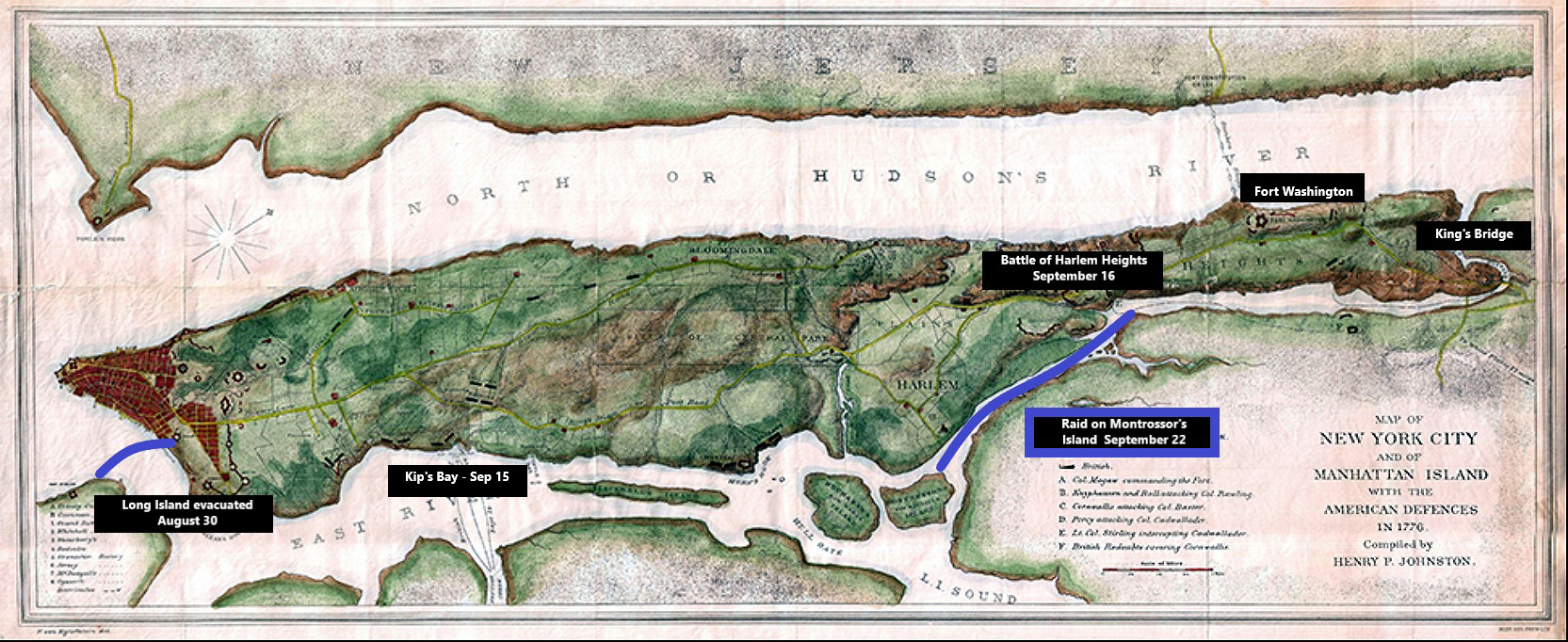
Once deployed, Clinton’s Brigade launched clandestine operations to obtain intelligence from Long Island. Nicoll quickly made contact with a Patriot on Long Island by the name of Aspinwall Cornwell. Having rowed across the East River from Long Island, Cornwell related that the main body of the enemy was in Bedford, east of Brooklyn. British Gen. William Howe was readying resources for further actions, having impressed more than 1,000 wagons and carts for transporting boats, baggage, and supplies. Cornwell reported that these actions were in preparation for a crossing of the East River between Hell Gate and Frogs Point. Nicoll’s spy slipped back onto Long Island that evening, hoping to procure more information.[14] Over the next days, more information was received from other Long Island Patriots on the location and status of Howe’s troops. Spies reported that Howe was sanctioning drafts of Tories into service, and Robert Rogers—of French and Indian War fame—was raising of a regiment of Loyalist rangers.[15] Other sources indicated Tory officials on Long Island were offering Royal Pardons for those willing to turn against the Rebel cause. Long Island had become a dangerous place to be a Patriot.
Retreat to Harlem Heights
While Howe carefully developed plans and redeployed troops on Long Island, the American force on York Island remained vulnerable. Washington called a council of war with his generals to discuss whether New York City should be evacuated. General Clinton, the future governor of New York, strongly argued that the city must be held. The city would be of great value to the British, “yet its Importance is much enhanced when we consider if possessed by the Enemy it furnishes them with a safe Harbour through the Winter for their Fleet Barracks & good Quarters for their Troops add to this A Safe & Happy Assylum for the disaffected.”[16] American troops had spent tens of thousands of man hours constructing defensive fortifications; to abandon those works as they had done on Long Island would demoralize the troops, handing over the advantage of the strong works that had been constructed in the city and throughout the island. Others felt the city was impossible to defend, were concerned that troops would be cut off and trapped, and strongly urged withdrawal north to Harlem Heights. Some pushing for withdrawal wanted to torch the city to deprive the British from the benefits Clinton had outlined, but Washington had received orders from Congress to prevent destruction of the town if evacuated.
After hearing out his generals, Washington decided to withdraw and began a staged evacuation of the city. The next few days were chaotic as the wagon and horse shortages became more acute. The retreating American forces experienced great difficulty moving the sick, all the stores of military, camp, food supplies, and other baggage for the more than 9,000 troops moving north from New York City toward King’s Bridge, where they were redeployed in the Harlem Heights and into Westchester County. Each day, the inevitability of British attack hung over the troops, and on September 10, Nicoll’s Regiment and the rest of Clinton’s Brigade were ordered to “lie on their arms.”[17] Clinton had canceled an expedition to Long Island the previous night because a small British fleet “lay in a Line directly opposite to the Place we must have Landed.”[18]
Once the 9,000 troops left New York City, the remaining troops in the city and along the river shorelines didn’t have to wait long before the British launched the long-awaited attack. On September 15, a naval barrage from the East River cleared the beaches for landing British infantry on York Island at Kip’s Bay, and the shell-shocked American forces quickly retreated north in chaos, chased by lines of Redcoats. During the chaos, the American troops in New York City miraculously avoided being trapped by escaping along the Hudson side of the island to Harlem Heights. The next morning, the opposing armies skirmished near Harlem Heights, precipitating a two-hour long battle where the determined American troops eventually forced the British from the field. This victory, the first for the American troops in the 1776 New York campaign, only briefly masked the steep cost of both land and men lost. From the British landing at Kip’s Bay on the 15th through the withdrawal of enemy troops from Harlem Heights the next day, the Americans had lost New York City and most of York Island while suffering casualties of 142 killed and wounded.[19] General Heath provided a heartrending description of the pathetic scene of the dead and wounded in a letter to General Washington on the eighteenth:
The Condition of the Sick & wounded scattered all along the Road, makes it my Duty to acquaint your Excellency therewith—Some of the wounded were with their wounds undressed Yesterday Afternoon as I was well informed—The Sick are without Physicians actually many of them dying—And where there are Physicians, they are destitute of Medicine, and no Director to be found—Such Scenes are enough to shock every feeling of Humanity.[20]
Chaos on the East River
As the calendar turned from summer to fall it had been one week since the British landed at Kip’s Bay. The traumatized army had been devastated by the loss of Long Island and with the British now in control of most of York Island, fear and anxiety was rampant through the ranks. The fatigued and defeated men had survived the full terror of battle under fire; continuous thundering cannon blasts that shook the ground, screams of unimaginable pain from both friend and foe, and gruesome bloody images of the dead and wounded strewn about the landscape. The powerful, professional enemy was coldly planning its next strike, seeking to annihilate the civilian army and quickly end the revolution here and now. The deep trauma of war infected the minds of many a citizen soldier as they awaited the next onslaught from the enemy. The tenuous situation of the battered Rebel force would evoke varied reactions along the behavioral extremes of calmness and fear, courage and timidity, strength and weakness, heroism and cowardice. The attack against Wallace’ fleet led by Richard Langdon and others from Nicoll’s Regiment had demonstrated calmness, courage, strength, and heroism. But at this anxiety-filled time of the 1776 campaign a poignant example of the opposite response to war trauma would play out in Nicoll’s Regiment.
In the week after the Battle of Harlem Heights, General Heath’s Division was being pressured by British activity in the northern section of the East River. He reported that the Brune, a British thirty-six-gun frigate that was anchored near Hell Gate, “is continually annoying our guard at that post,” and a pair of enemy cannon set up in a crossfire led to a request for artillery reinforcements to “return their compliments.” Meanwhile, British guns from Montresor’s Island had destroyed a couple of outbuildings, and Heath was “desirous to make them equally uneasy.”[21] The request for more artillery could not be accommodated, so Heath authorized a raid to quiet the British on Montresor’s Island and called upon Nicoll’s Regiment to provide some of the men. Two captured deserters from the Brune had provided intelligence that only a small contingent of enemy troops remained on the island. Determined to take out this force, Heath sent 240 men down in three boats with the ebb tide of the Harlem River. One of the boats was commanded by Capt. John Wisner of Nicoll’s Regiment, the nephew of Orange County’s Continental Congress representative Henry Wisner.
As the boats traveled down the river, Wisner crouched low in fear while crying out that there were five times the number of enemy as thought and that a ship lay in wait to fire grape shot at the unsuspecting Americans. As the boats approached the island and the enemy opened fire, Wisner screamed out “for God’s sake retreat, or we shall all be cut off,” sparking confusion and terror on the boat.[22] His display of fear and paranoia induced others to panic and soon control of the boat was lost. Instead of landing with the force attacking the island, Wisner’s boat retreated to the northern shoreline of the East River. Due largely to the chaos created by Wisner, only one of the three boats landed, and fourteen men lost their lives in this failed mission. Wisner was quickly court-martialed for cowardice and misbehavior before the enemy, and was cashiered—dishonorably discharged—from the army.[23]
Retreat to White Plains
Clinton’s Brigade continued surveillance along the East River shoreline from Hell Gate to the Long Island Sound and up the coast to New Rochelle. There were many islands in the river and in the Sound, with numerous inlets and peninsulas along this shoreline, including Frogs Neck, Pell’s Point, and Myers Point, there was a significant amount of shoreline to monitor and defend along this stretch of waterway. From the perspective of Nicoll’s men looking south over the river toward Long Island, the river islands and inlets provided cover for the king’s forces to remain mostly hidden by these natural obstructions.
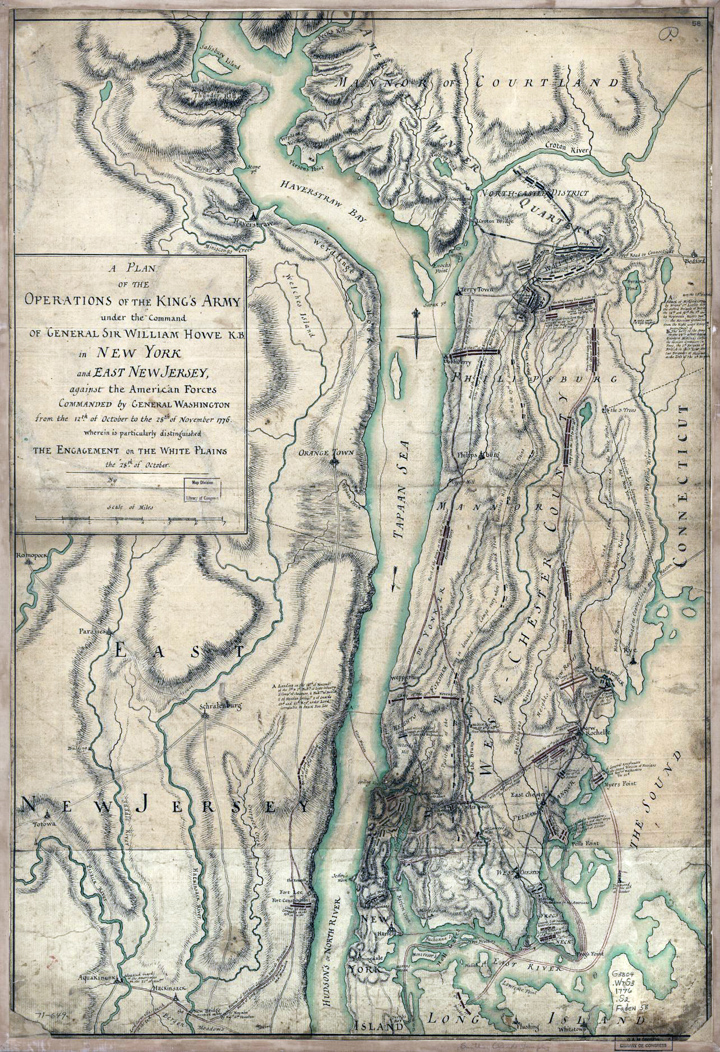
The British began their next offensive on October 9 when the warships Phoenix, Roebuck, and Tartar ran the batteries of the Hudson.[24] Damaged but not deterred by the cannonading from Forts Washington and Lee, the three British vessels attacked a handful of smaller American vessels defending the river. Like the forts, the smaller American ships proved to be nothing more than a minor annoyance, and the British ships proceeded up river to the Tappen Zee. Still uncertain as to British plans, Washington reminded Heath to “take proper precautions against a Feint & watch the Enemy’s Motions—they perhaps may make a feint to land at Frogs point to draw your attention that way & slip down when it is high water towards Morrissania with a view of getting in your Rear—Guard agt that.”[25] On the same day Heath received this letter from Washington, he observed “a Large number of vessells, Ships, Brigs, Schooners, Sloops Lighters &c. Saild through Hell gate yesterday afternoon, and Came to anchor last night off Frogs Point, where they still remain, during the night.”[26] An advance force of 4,000 enemy troops landed at Frogs Neck and tried to cross over the marshy connection to the Westchester County mainland during low tide. The Redcoats were resisted by American troops at this narrow point, forcing them to retreat back to the point. Heath reported to Washington that “whether this Manoeuvre is a Fient or not is yet Uncertain, I Beleive our Readiness to meet them yesterday at the Bridge & Pass over the Marsh has Disopointed them.”[27]
But this was in fact no feint. A few days later, Howe landed more British and Hessian troops further east and up the Long Island Sound coast at Pell’s Point. This force was quickly opposed by Massachusetts Col. John Glover’s 750 men, who sniped at the enemy from behind well-protected stone walls, inflicting significant casualties on the enemy before retreating. This strong, persistent resistance led the cautious British general to slow the advance of his troops.
With the British now on land north of East River and less than ten miles to the east of King’s Bridge, the American army was at immediate risk of being flanked, compelling Washington to once again retreat. The American army, spread out through Harlem Heights, King’s Bridge, and the East River shoreline began redeploying toward the town of White Plains eighteen miles to the north. Heath began the withdrawal of the rest of his division before sunrise on October 21 with Clinton’s Brigade and Gen. Samuel Parson’s Connecticut troops the last to leave; “Each regiment will throw out a flank-guard; and General Parsons will order a rear-guard of fifty men.”[28] With the shortage of wagons and horses still acute some of the transporting tasks would be done by the individual soldiers. The few wagons available were reserved first for the sick, and many camp supplies were prohibited to be loaded, with the men carrying all they could on the march north.
Clinton’s Brigade followed a different path, as the general sought to protect a large store of flour recently stored at Dobb’s Ferry.[29] The stores and provisions of Nicoll’s regiment were loaded onto vessels on the Hudson with the baggage of the rest of the brigade. The baggage was shipped up the river about ten miles to Dobb’s Ferry as the entire brigade marched along the Albany Road, picked up the baggage and continued on to White Plains “without delay.”[30] Wary of the British troops just a few miles to their east, Heath’s Order to March included instructions if Clinton’s division encountered the British on their way to White Plains: “Should the division be attacked on the march, the line will instantly form, the reserve at one hundred paces in the rear; the light artillery as it is posted on the march; the heavy artillery on the nearest commanding height.”[31]
The division arrived near White Plains before sunrise on the twenty-second after a forced march through the night. Heath’s Division took a post on high ground just behind the town, while the rest of the American troops filled in the hills to their right, west of Heath. In total, the American army totaled more than 14,500 men, spread out for more than a mile on high ground. As Nicoll’s Regiment dug in on this advantageous ground, they did so with a force that was reduced by nearly 20 percent due to illness. As recently as the beginning of October, one of every five of the officers were sick, and the rank and file showed similar sickness rates near the time of the battle.[32]
On the morning of October 28 the Continental Army was entrenched on the hills just behind town, with lines extending for more than a mile southwest toward Chatterton’s Hill on the far right. Only at the last moment did the Americans send troops to this hill. Once Howe started moving his troops, more than 13,000 red- and blue-coated enemy troops marched forward, drawing closer to the entrenched Americans for an apparent frontal assault, initially concealing Howe’s actual intentions. As the enemy moved forward, Hessians under Gen. Johann Rall and British troops veered toward the American right on Chatterton’s Hill and British artillery began raking the American militia on the hill. The enemy forded the Bronx River in front of the hill, and began moving up the heights under fire. The American troops inflicted severe casualties on the enemy as they fought their way up the hill but were overrun and retreated in disarray. Howe did not immediately press the engagement any further, but from Chatterton’s Hill the British now threatened the American army in the hills behind town. The next day, all but the left of Heath’s Division drew back to higher ground and once again began fortifying.[33] The British still did not advance, and it poured rain all the following day, keeping both armies behind their fortifications.
When the skies cleared on November 1, the British began moving against Heath on the left of the American lines where Nicoll’s Orange County men were posted. The British unleased a furious cannonading but the American artillery effectively responded, sending the enemy into confusion before they eventually retreated back to their lines. “The British made no other attempt on the Americans, while they remained at White Plains. The two armies lay looking at each other, and within long cannon shot.”[34] Nicoll’s Regiment spent a few more tense days on the hills behind White Plains before the British began moving back south toward New York City.
Barely Surviving 1776
After the British left White Plains, Heath’s Division, including Nicoll’s Regiment, was ordered up river another nineteen miles to Peekskill to protect the Hudson Highlands.[35] Approaching the end of its tour of duty, the regiment had some administrative tasks to take care of. Two more court-martials of officers took place, though the charges faced were not combat related as they had been with Captain Wisner. Capt. Abraham Dolson was charged with stealing and selling the blanket of a fellow soldier, while Lt. William Horton was charged with “getting drunk and stripping to fight in a publick tavern, and behaving in an infamous manner, unbecoming an officer and a gentleman.”[36] Both were found guilty and cashiered. Meanwhile, numerous officers who had been promoted during the campaign were still awaiting their commissions and “the officers think that they have been treated with neglect, that they have not received their commissions before.”[37]
The morale of the citizen soldier was affected by more than a summer and fall of sacrifice and defeat on the field of battle. In Orange County, militia had been called away from home many times throughout the summer and fall, laboring on the fortifications of Forts Montgomery and Clinton and defending the shoreline while waiting on a British move up into the Highlands. The Levies who signed up for six month service were now close to the expiration of their enlistments, a situation common over the entire American army. The thrill of service for the cause of Liberty had been tempered not only by their life-altering experiences of the horror of war, but also the distressing situation of their families back home. Henry Wisner, Jr., cousin of the cashiered Capt. John Wisner, penned a letter on December 24 that highlights the anguish of the Orange County soldiers and concern for their families left behind:
I have been visiting the different battalions of militia, and finding them so uneasy that I am afraid that, notwithstanding everything that can be said and done, many of them still go home. The situation of their families is so very distressing that no argument can prevail with them. Many of them left their families without wood, without meal, and without fodder at home for their cattle, many of their families without shoes, and some of them little better here.[38]
After serving their six-month term through the chaotic summer and fall of 1776, Nicoll’s Regiment was disbanded in January 1777. Many of these citizen/soldiers were hardened by their experiences and remained active through the rest of the war. Isaac Nicoll became sheriff of Orange County, and spent his next years pursuing raiding Tory cowboys led by the notorious Claudius Smith. Many returned to service in the Orange County militia at the Hudson River forts, including Forts Montgomery and Clinton which were destroyed by the British in 1777. Others served along the Delaware River frontier in the west, including some who lost their lives as part of the militia force routed by Joseph Brant at Minisink Ford in 1779.[39] Militia was also active in the ongoing civil war between Patriots and Loyalists in the no-man’s land of Orange County. The men of Orange County would be a persistent presence through the rest of the war along the banks of the Hudson River.
[1] Colonial Orange County included present-day Rockland County, and parts of today’s territory in the north was part of Ulster County. Its present boundaries were established in 1798.
[2] William Heath, and Memoirs of Major-General William Heath. William Abbatt, ed. (New York, W. Abbatt, 1901), 41-42.
[3] George Clinton to George Washington, July 23, 1776, Founders Online, National Archives. founders.archives.gov/documents/Washington/03-05-02-0320.
[4] Ibid.
[5] Clinton to Washington, August 2, 1776, Founders Online, National Archives, founders.archives.gov/documents/Washington/03-05-02-0407.
[6] Ibid.
[7] Peter Force, American Archives, Series 5 Vol. 1 (Washington, DC: Peter Force, 1848), 730.
[8] William Heath to Washington, August 20, 1776, Founders Online, National Archives, founders.archives.gov/documents/Washington/03-06-02-0084.
[9] Heath to Washington, August 18, 1776, Founders Online, National Archives, founders.archives.gov/documents/Washington/03-06-02-0060.
[10] Heath to Washington, August 22, 1776, Founders Online, National Archives, founders.archives.gov/documents/Washington/03-06-02-0096.
[11] Heath to Washington, August 27, 1776, Founders Online, National Archives, founders.archives.gov/documents/Washington/03-06-02-0126.
[12] Heath to Washington, August 23, 1776, Founders Online, National Archives. founders.archives.gov/documents/Washington/03-06-02-0103.
[13] Washington to Heath, August 30, 1776, Founders Online, National Archives, founders.archives.gov/documents/Washington/03-06-02-0138.
[14] Heath to Washington, September 6, 1776, Founders Online, National Archives, founders.archives.gov/documents/Washington/03-06-02-0191.
[15] Isaac Nicoll to Heath, September 8, 1776, Peter Force, American Archives, Series 5 Vol. 2 (Washington, DC: Peter Force, 1851), 244-245.
[16] Clinton to Washington, September 12, 1776, Founders Online, National Archives, founders.archives.gov/documents/Washington/03-06-02-0231.
[17] Heath to Washington, September 10, 1776, Founders Online, National Archives, founders.archives.gov/documents/Washington/03-06-02-0219.
[18] Public Papers of George Clinton, First Governor of New York, 1777-1795, 1801-1804. Vol. I (Wynkoop Hallenbeck Crawford Co., 1899), 343.
[19] Henry P. Johnston, The Battle of Harlem Heights, September 16, 1776 (London: The Macmillan Company, 1897) places American casualties at 30 killed, 100 wounded. Victor Brooks and Robert Hohwald, How America Fought Its Wars (Conshohocken, PA: Combined Publishing, 1999) places Kip’s Bay casualties for Americans at 12 killed and wounded.
[20] Heath to Washington, September 18, 1776, Founders Online, National Archives, founders.archives.gov/documents/Washington/03-06-02-0265.
[21] Ibid.
[22] Court-martial testimony of Captain Eldridge, in Force, American Archives, Series 5 Vol. 2, 611.
[23] The details of the action are based upon Force, American Archives, Series 5 Vol. 2, 610-613. See Joshua Shepherd, “Fiasco: The Disastrous Raid on Montresor’s Island,” Journal of the American Revolution, April 2, 2019, allthingsliberty.com/2019/04/fiasco-the-disastrous-raid-on-montresors-island/.
[24] David McCollough, 1776 (Simon & Schuster, 2006), 228.
[25] From a letter from Robert Hanson Harrison to General Heath relaying orders from General Washington, in notes to Heath to Washington, October 11, 1776, Founders Online, National Archives, founders.archives.gov/documents/Washington/03-06-02-0408. In 1776, Morrisania was an estate of the Morris family located in Westchester County north of the East River.
[26] Heath to Washington, October 13, 1776, Founders Online, National Archives, founders.archives.gov/documents/Washington/03-06-02-0420.
[27] Ibid.
[28] Force, American Archives, Series 5 Vol. 2, 1165. Order of March to be observed by the Division of the Army under the command of Major-General Heath, in their route from this place to White Plains. King’s Bridge, October 21, 1776, Peter Force, American Archives, Series 5 Vol. 3 (Washington, DC: Peter Force, 1853), 503.
[29] Public Papers of George Clinton, 1:390.
[30] Force, American Archives, Series 5 Vol. 2, 1165.
[31] Ibid.
[32] On October 4, 1776 Nicoll’s Regiment reported four of twenty officers present as sick. Force, American Archives, Series 5 Vol. 2, 871. On November 2, 1776 Nicoll’s Regiment reported Rank and File present of 179 of which 39 were sick.
[33] Heath, Memoirs of Major-General William Heath, 71.
[34] Ibid., 73.
[35] Ibid., 75.
[36] Force, American Archives, Series 5 Vol. 3, 1084.
[37] Ibid., 1450.
[38] E.M. Ruttenber and L.H. Clark, History of Orange County, New York (Everts & Peck, 1881), 55-56.
[39] In the officer corps, Lt. Jacob Dunning served at Minisink in 1779 and was killed in battle.

One thought on “Nicoll’s Regiment of Orange County New York”
It should be noted that Orange County of this time period included what is currently Rockland County, NY as well as much of the southern part of the current Orange county.