

BOOK REVIEW: Atlas of Independence: John Adams and the American Revolution by Chris Mackowski, (El Dorado Hills, CA: Savas Beatie, LLC, 2026) $16.95 Paperback
Chris Mackowski’s Atlas of Independence positions John Adams as just that, a self-sacrificing man who attempts to direct his “reluctant colleagues” towards America’s independence. Mackowski is pretty plain in his argument that without John Adams, there would be no America.[1]
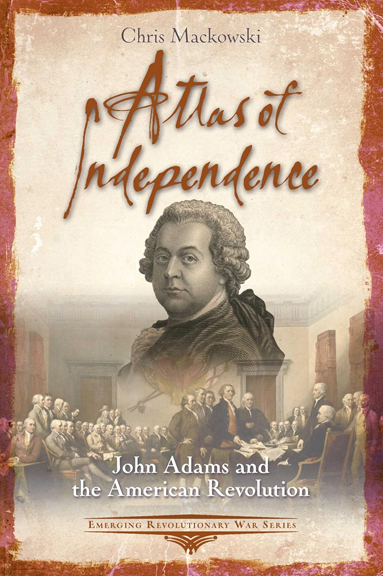 Set against the backdrop of America’s 250th birthday, the book is the eighth in the Emerging Revolutionary War Series, a collection of reader-friendly overviews of the period. It is the first in the series to focus on a particular person. However, Mackowski is also quick to remember Adams’ own distaste of romancing historical periods. Therefore, attempts are made to not fall into hero worship. Using his creative writing skills, Mackowski uses Adams’ own letters and the letters of others to construct a conversational story.
The main themes of Adams involve his intelligence, humility, and commitment to justice. Adams entered Harvard at sixteen, with a love of reading and ambition for a legal career. He had awareness of his own ambitions and the need to stay humble. In his own words, he entered the legal career to “redress wrongs … maintain liberty and virtue, [and] discourage and abolish tyranny.”[2] All of these themes are throughout the book, arranged chronologically from Adams’ childhood to his presidency. He defended the British soldiers on trial for the Boston Massacre, he did not care to be overshadowed by Samuel Adams, and he penned the Novanglus letters laying the framework for independence. Justice, humility, and intelligence pervade much of Adams’ story. The only other competitor for feats in this book to rival his own is his wife, Abigail.
The correspondence between John and Abigail Adams is well-known to historians. Mackowski is able to take their correspondence and build empathy with readers. He paints a picture of longing and sacrifice between the two when Adams left Boston. Abigail herself still served her community, even assisting during a typhoid epidemic which claimed her mother’s life. The year 1777 was difficult in their relationship due to further separation compounded by Abigail miscarrying a baby girl. It is in these moments that the humanity of the Adamses shines. Historians may have issues with Mackowski’s take on John’s response to her “remember the ladies” letter. His view is that John respected his wife to have these intellectual debates.
Other chapters of the book include Adams’ relation to important figures of the Cause. These include John Dickinson, Thomas Paine, Thomas Jefferson, George Washington, and Benjamin Franklin. Mackowski focuses on the similarities and differences of the people Adams encountered. Both he and Washington were unprepared for the task of taking on the British Empire. Of course, Adams’ friendly rivalry with Thomas Jefferson is well documented. The book also chronicles Adams’ personal concern of being overshadowed by such men. At the same time, he complements both men as exceptional leaders and writers, respectively. This corroborates the running theme of Adams’ humility vs. his own ambition. Humorous anecdotes that readers may find of interest include James Lovell competing for Abigail’s affections and Adams’ time as Franklin’s roommate, where they argued over whether to keep a window open or closed.
Other additions to the book include appendices consisting of a driving tour of Quincy historical sites, Adams’ work on the Massachusetts Constitution, a short work by Dr. Richard G. Frederick on the historical analysis of the musical 1776, and Adams and slavery. It is that last appendix that contains the paradox of liberty that all historians of this time period must confront. Overall, anecdotes and the words of Adams himself support Mackowski’s idea of Adams guiding the country to independence. At the same time, the work falls short at times in analyzing Adams’ contributions. But at its heart, it definitely humanizes the man, an “atlas of independence.”
PLEASE CONSIDER PURCHASING THIS BOOK FROM AMAZON IN PAPERBACK OR KINDLE.
(As an Amazon Associate, JAR earns from qualifying purchases. This helps toward providing our content free of charge.)

[1] St. Bonaventure University, “Mackowski’s latest book recasts John Adams for America’s 250th,” February 11, 2026, www.sbu.edu/news/news-items/2026/02/11/mackowski-s-latest-book-recasts-john-adams-for-america-s-250th.
[2] Chris Mackowski, Atlas of Independence: John Adams and the American Revolution (Savas Beatie, LLC, 2026), 4, 19-23.


Recent Articles
Trade, Land, Speculation: William Kerin Constable in the Age of Revolution
David Steele’s Macabre Medal
The Loyalist Experience and Aftermath in Revolutionary Philadelphia
Recent Comments
"David Steele’s Macabre Medal"
Excellent article. Most interesting. Well done.
"La Petite Guerre and..."
This is a fascinating examination of the distinction between European *petite guerre*...
"James Wilson and Popular..."
Kelly – thanks for this contribution to the growing body of work...