


“My Famely a Raived at this Place”—Lt. Henry Simmons, The Cascades, June 23, 1783
For the Loyalists who joined British General John Burgoyne’s army in the weeks and months leading up to the decisive battles at Saratoga in the fall of 1777, the British defeat meant far more than the loss of a battle. Men who had left their homes and families to fight for the Crown found that the road home had suddenly closed. Ahead lay a years-long journey in which military defeat led to retreat, years of displacement, and permanent resettlement under the protection of the British Crown.
The Revolutionary War Journal of Loyalist Lt. Henry Simmons[1] presents a rare, firsthand account of this journey from the perspective of a junior officer in the service of the King’s Loyal Americans, and later, Jessup’s Loyal Rangers.[2]
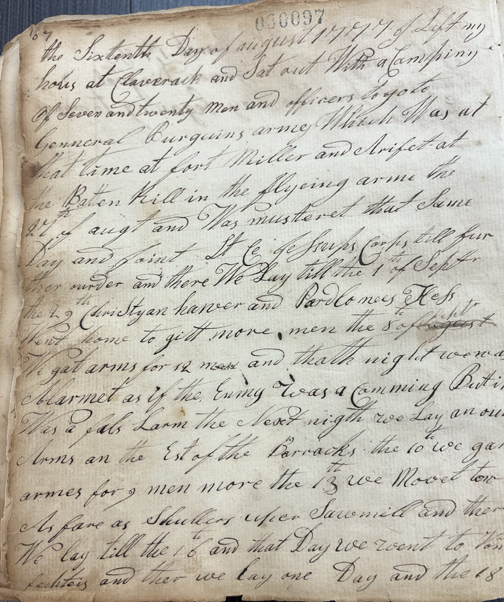
On August 16, 1777, Simmons, a tenant farmer from New York’s Hudson River valley, left his home and family and set out with twenty-seven men and officers to join Burgoyne’s army near Saratoga. In strikingly plain language, Simmons related his experiences during the campaign’s final engagements and the long retreat that followed.

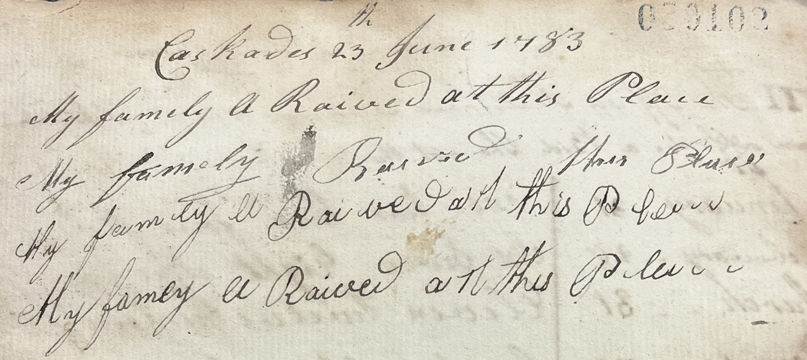
Nearly six years after his departure, Simmons’s journal recorded the arrival of his family at the Cascades, a series of rapids along the St. Lawrence River west of Montreal: “My famely a Raived at this Place.” Repeated four times in succession, the entry becomes a metaphor for both the Simmons family’s experience and the broader Loyalist passage through conflict, displacement, and eventual resettlement.
Henry Simmons and the Loyalist Choice
Henry Simmons was born Johann Henrich Simon in Teerbosch, New York. His grandparents were among the thousands of German-speaking Palatine refugees who had reached New York only thirty years before. Settled by British authorities in work camps near present-day Saugerties and Germantown, they were expected to produce naval stores for the Royal Navy. The project soon failed, but its purpose survived in the name of Simmons’s birthplace: Teerbosch, meaning “Tar Bush” or “Tar Forest” in English, where he was born in 1740.[3]
In 1763, Simmons married Anna Margaretha Bonestiel, who was also a descendant of Palatine refugees.[4] Henry and Anna Margaretha established a household in nearby Claverack, where they raised some seven children.[5]
The Simmons family lived and farmed in a region where land, tenancy, and local authority were deeply contested. Established through grants made under Dutch and British rule, large manorial estates such as Rensselaerwyck and Livingston Manor shaped social and economic life across much of the Hudson Valley.[6] Their leasehold system had become a persistent source of grievance, expressed in rent resistance, confrontations with sheriffs, crop burnings, and periodic armed clashes.[7]

By the 1770s these disputes over land and authority had become entangled with the wider imperial crisis. Yet political allegiance was not neatly determined. Many supported the Patriot cause, while others remained loyal to the Crown. In some families, brothers, cousins, and in-laws chose opposing sides. [8]
It was in that unsettled world that Henry Simmons made his choice:
On the sixteenth day of August, 1777, I left my house at Claverack and set out with a company of twenty-seven men and officers to join General Burgoyne’s army, which at that time was at Fort Miller.[9]
Following the British capitulation at Saratoga, Simmons and his men retreated north to Canada, where Simmons was assigned to an engineering unit supporting the British garrisons near wartime Montreal. In June 1784, the Simmons family joined the first organized wave of Loyalist settlers in what became Upper Canada and later the province of Ontario.

Seven Weeks at Saratoga
Simmons and his men reached Burgoyne’s army eleven days later at the Batten Kill, which joined the Hudson about seventy miles north of Simmons’s home in Claverack.[10]
We arrived at the Batten Kill in the flying army on the 27th of August and were mustered that same day. We joined Lieutenant Colonel Jessup’s corps until further orders.[11]
The passage marked Simmons’s formal entry into Loyalist military service. Simmons and his men were mustered and attached to the corps of Lt. Col. Ebenezer Jessup, which was then known as the King’s Loyal Americans. Simmons was commissioned as a lieutenant in a company commanded by Capt. Christian Wehr.[12] Less than two weeks after Henry Simmons left his home in Claverack, the thirty-seven-year-old husband, father, and tenant farmer had become an officer in a Loyalist corps serving with the British army.
Yet they were not entering a settled military routine. Loyalist auxiliaries were still being recruited and armed as the Saratoga campaign moved toward its decisive battles. Only days after their arrival, two men returned home to gather additional recruits, while those remaining in camp received arms as the battle approached.
On the 29th, Christian Haver and Bartholomew Hess went home to gather more men.[13] On the 8th of September, we received arms for twelve men, and that night we were alarmed as if the enemy were approaching, but it proved to be a false alarm. The next night we lay on our arms east of the barracks. On the 10th, we received arms for nine more men.
To “lay on our arms” meant resting or sleeping while remaining armed and ready for an expected attack.[14]
Simmons recorded the two battles that decided the Saratoga campaign. The first, fought at Freeman’s Farm on September 19, 1777, left the British in possession of the field, but with heavy losses that were difficult to replace.[15]
That day our flying army and the rebels had a battle at Freeman’s Farm. Our men forced the rebels to retreat and killed between three and four hundred of the enemy, while we had about two hundred killed and wounded.
Simmons’s casualty figures reflect the information available to a junior Loyalist officer serving with Burgoyne’s army. Modern estimates reverse them: British and allied losses were nearly 600 killed, wounded, or captured, while American losses exceeded 300.[16] The tactical result came at a price Burgoyne could ill afford.
Christian Haver and Bartholomew Hess had left on August 29 as the Loyalist forces worked to build their ranks. When they returned in the days after Freeman’s Farm, they brought eighteen much-needed recruits and a “committee man,” likely a member of a local revolutionary authority, prisoner. What Simmons would refer to as the “battle west of Freeman’s Farm” was the second of the two engagements that decided the campaign.
On the 22nd of September, Christian Haver and Hess returned, bringing eighteen men with them and a committee man prisoner. We remained there until the 7th of October, when there was another battle west of Freeman’s Farm. Our army retreated the next day back to John Taylor’s on the hill.[17] That day they engaged with cannon, but I cannot say how many were killed on either side.
The Battle of Bemis Heights, fought on October 7, 1777, ended in a decisive and costly British defeat. The following day, Simmons and the rest of Burgoyne’s army began the retreat that would end in capitulation nine days later.[18] As the situation deteriorated, Simmons described the practical work of consolidation and retreat.
On the 10th, we moved back about a mile. Some of the volunteers guarded the bateaux to the Fish Kill at Schuyler’s.[19] That same day we went as far as Archibald McNeil’s to cover the artificers while they built bridges, and we stayed there two days.[20] On the 12th, we returned to the flying army, which lay on the hill north of the Fish Kill, and remained there until the 17th.
Some of the men guarded bateaux—flat-bottomed boats essential to transportation and supply—near the Fish Kill, which entered the Hudson near the estate of the prominent Patriot and American General Philip Schuyler.[21] Simmons’s unit also protected skilled military tradesmen known as artificers as they worked at an important Hudson River crossing about two miles upriver.[22]
The perils of the battle and the close proximity of the encounters are reflected in British military records, which report that seven of the forty-odd men in Christian Wehr’s company were taken prisoner by Patriot forces during the battle and the days that followed.[23] Simmons and his men soon rejoined the flying army at the higher ground nearby as General Burgoyne and his staff decided the fate of the campaign.
Capitulation
Simmons’s next entry records the British surrender on October 17, 1777. The spare, matter-of-fact entry belies the magnitude of the moment. Coming only two months after Simmons had left his home and family, the British capitulation marked not only a turning point in the Revolutionary War, but an immediate and profound reversal of fortune in the lives of Simmons and his men.
Most of Burgoyne’s regular troops became part of what would be known as the Convention Army, initially expected to march to Boston for embarkation to Great Britain but later held in American hands. Under the terms of the Convention, Loyalists like Simmons and his men would follow a different path. Their road led not home, but north to Canada, away from familiar ground and, for men like Simmons, to a prolonged separation from their families.[24]
The retreat to Canada began that day.
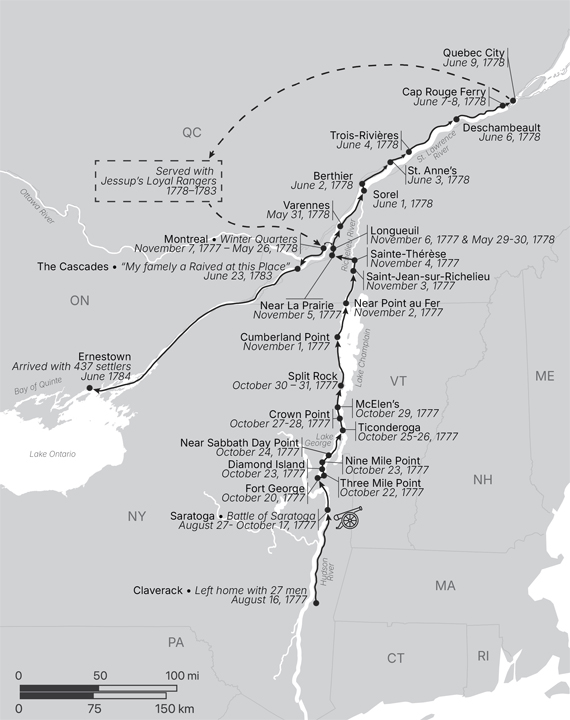
That day we laid down our arms by capitulation. By the terms of the convention, the volunteers, sailors, artificers, and bateau men were to go to Canada. We crossed the river that day and went as far as Batten Kill. On the 18th, we went to a place belonging to one Johnson and on the 20th to Fort George, where we remained until the 22nd, about one o’clock, when we marched as far as Three Mile Point and stayed the night.
Retreat to Canada
What had begun as a military campaign had become retreat.[25] Over the next eight months, the journal recorded a sustained period of movement, hardship, and the gradual passage from retreat to displacement.
Traveling by bateau in unfamiliar territory, Simmons and his party moved north along Lake George. They reached Ticonderoga, the fort guarding the passage to Lake Champlain, on October 25. As the month drew to a close, wind and weather began to govern the pace of their retreat. On the exposed waters of Lake Champlain, a late October storm brought cold rain and early snow, forcing the group to shelter along the shoreline. Even after the storm subsided, unfavorable winds continued to delay their progress.
There we obtained a bateau and traveled about eight miles that day.[26] The wind was from the north, and we remained there through the 27th and 28th in the woods, with a storm from the north of snow and a little rain.
On the 29th, we went as far as McElen’s.[27] Around noon the wind was still from the north, and it rained that afternoon and the following night. The next day the wind shifted to the south, and we traveled as far as Split Rock,[28] where we were windbound from the 30th through the 1st of November.[29]
When the wind finally permitted them to continue, Simmons and his party resumed their journey north. Eleven weeks after Simmons left his home and family in Claverack, and seventeen days after the capitulation that had changed the course of their lives, they reached the British province of Quebec. Their arrival brought only partial relief: at St. Johns, they again spent the night in the woods.
On the 1st of November, the wind came about to the south, and we sailed as far as the east point of Cumberland Bay. On the 2nd, we went five miles north of Point au Fer.[30] On the 3rd, about noon, we arrived at St. Johns, where we remained that night in the woods.
St. Johns, the modern Saint-Jean-sur-Richelieu, stood at the head of the Richelieu River, where its fort guarded the route between Lake Champlain and the St. Lawrence valley. Simmons and the other Loyalists moving north from Saratoga now entered a predominantly French-speaking and Roman Catholic province, culturally distinct from the communities they had left behind in New York.[31]
Traveling north from St. Johns, the transition became immediate: the party lodged with French inhabitants as they continued toward Montreal. Upon reaching the south shore of the St. Lawrence River opposite the city, the group was unable to cross and was forced to spend the night in nearby Longueuil.
On the 4th, we traveled about nine miles and lodged with some French inhabitants. On the 5th, we came within about one mile of La Prairie. On the 6th, we went to Longueuil but could not cross the river and were obliged to stay the night.
They crossed the river to Montreal the next day. As fall drew to a close, movement north gave way to winter quarters in the area surrounding the city. There, the men received “half mounting,” an issue of clothing that assumed greater importance as the Canadian winter closed in.[32] In the days after Christmas, they witnessed the death of one of their number, an event that Simmons noted in the brief, matter-of-fact voice that characterizes the journal.
On the 23rd of November, we drew half mounting for the men at St. Louis.[33] On December 29th, 1777, John Stopilbin died.
John Stopilbin joined the King’s Loyal Americans near Saratoga in the days after the Battle of Freeman’s farm, likely among the men recruited by Haver and Hess.[34] Having survived the Battle of Bemis Heights, Stopilbin did not survive the retreat.
With the end of winter quarters in late May, the group’s movement resumed, now toward Quebec City, about 160 miles downstream along the St. Lawrence. The journal traces their progress through a succession of river crossings and settlements along its banks. After traveling by water to the area near Trois-Rivières, Simmons and his companions continued the remaining eighty miles toward Quebec City on foot.
By June 7, they reached Cap Rouge Ferry, only nine miles west of Quebec City. The narrative breaks off abruptly in the middle of the entry for June 9, 1778.
On the 6th, we marched to Deschambeault.[35] On the 7th, we marched to Cap Rouge Ferry[36] and stayed there that night and the following day and night. On the 9th,
Simmons and his party had likely reached their destination at or near Quebec City. The purpose of their travel to Quebec, and the circumstances of their departure, remain uncertain.
Loyalist Displacement and Military Service in British Quebec
Although the narrative falls silent, surviving military records and Simmons’s account book illuminate his activities during what would become years of displacement. A volunteer who had first joined the British army in New York, Simmons was soon assigned to the army’s engineering department, where he operated within the garrisons and logistical networks of wartime Quebec.[37]
Simmons appears to have moved back upriver toward Montreal by the spring of 1779, his new duties and area of operations reflected in the many transactions in his account book. One series of entries from 1780 records expenses for transportation from Montreal to the British garrison at Chambly and back to Coteau-du-Lac, upriver from Montreal, illustrating both Simmons’s involvement and the routes that connected British posts along the St. Lawrence–Richelieu River corridor.
Other entries from June 1780, which identify Simmons as an assistant engineer, document the supply of blankets to regimental personnel, miners, and masons working at Coteau-du-Lac. These entries coincide with the construction of the Coteau-du-Lac canal, whose stone walls formed a passage that allowed boats and supplies to bypass the nearby rapids and continue upriver.[38] Numerous other entries show that Simmons’s duties regularly placed him within the transportation networks operating along the St. Lawrence near Montreal and Coteau-du-Lac.
While Simmons’s account book provides considerable insight into the nature and locations of his military duties, it reveals little about his family. British military records fill part of this gap. One muster roll from May 1781 records Simmons alongside the other members of his corps. In a column listing families, Simmons was among a handful of men whose entries stated that their families were not there.[39] While the return reports the family’s absence, it is silent as to their departure from New York and their ultimate arrival in Quebec.[40]
An otherwise-routine entry in Simmons’s account book places Henry at the Cascades on June 22, 1783. The next day, the narrative portion of his journal resumes with a single entry, repeated four times.
Caskades 23th June 1783
My famely a Raived at this Place
My famely a Raived at this Place
My famely a Raived at this Place
My famely a Raived at this Place
Although the circumstances of the Simmons family’s arrival, and of the journal entry itself, remain uncertain, the entry’s timing coincides with the cessation of the war’s hostilities and the Crown’s efforts to find permanent homes for the thousands of displaced Loyalists stranded in Quebec. That problem would soon be solved as the British government formulated a plan to relocate the Loyalists and their families along the north shore of Lake Ontario.[41]
Loyalist Resettlement in Ernestown
The following year, the Simmons family was one of the many families who traveled to the newly surveyed Loyalist settlements west of Cataraqui, near present-day Kingston, Ontario. Simmons helped lead a party of Jessup’s Loyal Rangers and their families—including more than 400 men, women, and children—to the still-unnamed Township No. 2, which would later be known as Ernestown. There, they formed part of the first organized wave of Loyalist settlement in what would become Upper Canada.[42]
Displacement had become resettlement—the Simmons family had finally arrived at the place that would become their new home.
[1] Diary and Account Book of Lieutenant Henry Simmons, A2019.060.39, Museum of Lennox and Addington, Napanee, Ontario. The journal includes forty-nine written pages: forty-three pages of accounts and six pages of narrative.
Digital images of all forty-nine pages are presented in Lieutenant Henry Simmons: Revolutionary War Journal and Account Book, archive.org/details/lieutenant-henry-simmons-revolutionary-war-journal-and-account-book-complete-all-bates-stamped-pages.
Digital images of the narrative pages, together with diplomatic and modernized transcriptions prepared by the author, are presented in Lieutenant Henry Simmons: Revolutionary War Journal and Account Book Annotated and Diplomatic Transcriptions, archive.org/details/lieutenant-henry-simmons-revolutionary-war-journal-and-account-book-annotated-an_202608.
An annotated transcription of a portion of Simmons’s journal was previously prepared by H. C. Burleigh. See Henry Simmons, “Lieutenant Henry Simmons’s Journal, 1777–1778,” transcribed by Herbert Clarence Burleigh, [198-], folder 2324.3, box 2, file 47, Herbert Clarence Burleigh fonds, Queen’s University Archives, Kingston, Ontario. A transcribed version of Burleigh’s work is at usgennet.org/usa/ny/county/columbia/veterans/henry_simmons_diary.htm.
This article builds upon Burleigh’s work by incorporating a 1783 entry not included in his transcription, providing a new modernized transcription of the narrative, reconstructing and mapping Simmons’s route, expanding on the Simmons family’s experiences in and around Montreal, and interpreting the journal in the context of Loyalist military service, retreat, displacement, and resettlement.
[2] The King’s Loyal Americans were absorbed into Jessup’s Loyal Rangers, the corps with which Simmons would later be most closely associated, in 1781. Gavin K. Watt, A Service History and Master Roll of Major Edward Jessup’s Loyal Rangers, with the research assistance of Todd A. Braisted (Carleton Place, ON: Global Heritage Press, 2017), 3.
[3] Henry Z. Jones Jr., The Palatine Families of New York 1710, 2 vols. (Henry Z. Jones Jr., 1985), 968–75, 1199, 1258-9, 1276.
[4] Jones, The Palatine Families of New York 1710, 970.
[5] United Empire Loyalist Association of Canada, Loyalist Directory, detail for Lt. Henry Simmons, uelac.ca/loyalist-directory/detail/?wpda_search_column_id=7649.
[6] Claude Joseph Sauthier, Cartographer, Richard H Pease, David Vaughan, William Faden, and Millard Fillmore. A chorographical map of the province of New York in North America: divided into counties, manors, patents, and townships: exhibiting likewise all the private grants of land made and located in that province, 1779, www.loc.gov/item/2018588054.
[7] Irving Mark, “Agrarian Revolt in Colonial New York, 1766,” The American Journal of Economics and Sociology 1, no. 2 (1942), 111–42.
[8] Thomas J. Humphrey, “Conflicting Independence: Land Tenancy and the American Revolution,” Journal of the Early Republic 28, no. 2 (2008), 159–82.
[9] Entries from Simmons’s journal are presented in modernized English that has been edited for readability while preserving the structure, substance, and tone of the original. In places where the entries are uncertain or require significant interpretation, the modernized transcription includes an endnote that provides the original phonetic spelling and background on the interpretation.
[10] Sauthier et al., Chorographical Map of the Province of New York.
[11] The journal refers to Jessup’s Corps as “Lt Ce Je Saups Corps.” Simmons was mustered into the corps of Lt. Col. Ebenezer Jessup, then a part of the King’s Loyal Americans, in 1777. Watt, A Service History and Master Roll of Major Edward Jessup’s Loyal Rangers, 11.
[12] Gavin K. Watt, with the research assistance of Todd Braisted, The British Campaign of 1777, vol. 2, The Burgoyne Expedition (Global Heritage Press, 2013), 101.
[13] Christian Haver and Bartholomew Hess were mustered into the King’s Loyal Americans along with Henry Simmons on August 27, 1777. Watt, The British Campaign of 1777, 102, 120.
[14] David Hackett Fischer, Washington’s Crossing (Oxford University Press, 2004), 204.
[15] John F. Luzader, Saratoga: A Military History of the Decisive Campaign of the American Revolution (Savas Beatie, 2008), 188-193.
[16] Luzader, Saratoga, 333.
[17] The entry refers to “John Daylor’s.” It is likely that the entry is a variant of John Taylor, whose home and farm were located nearby. Oudemool, L., Christopher Stevens, H. Eliot Foulds, Eric Schnitzer, Linda White, and Charles Martin, Cultural Landscape Report for Saratoga Battlefield, Saratoga National Historical Park, vol. 1, Site History, Existing Conditions, and Analysis (Boston: Olmsted Center for Landscape Preservation, National Park Service, 2002, 59.
[18] Luzader, Saratoga, 237-40.
[19] This entry refers to the estate of prominent Patriot and American General Philip Schuyler, which was located near the junction of the Fish Kill and the Hudson River. Luzader, Saratoga, 242–43.
[20] The entry refers to “arche mc neal,” likely a phonetic rendering of Archibald McNeil, who operated a strategically important ferry across the Hudson north of Schuylerville. Stephen G. Strach, A Preliminary Analysis of the Gerlach ‘Plan’ of Saratoga (Schuylerville), New York, 1777 (report, Saratoga National Historical Park, 1982), Block E-1.
[21] Strach, A Preliminary Analysis of the Gerlach ‘Plan’ of Saratoga, Block A-3.
[22] Erna Risch, Supplying Washington’s Army (Center of Military History, United States Army, 1981), 131.
[23] Roll of His Majesty’s the Kings Loyal Americans Commanded by Lieutenant Colonel Ebenezer Jessup With the Casualties Between 27th August and 24th October 1777. Captain Christian Wehr’s Company, as cited in Watt, The British Campaign of 1777, 278.
[24] Articles of Convention Between Lieutenant-General Burgoyne and Major General Gates, October 16, 1777, arts. II, IV, VIII–IX, Avalon Project, Lillian Goldman Law Library, Yale Law School.
[25] Five men deserted rather than join the retreat. Their fate is uncertain. Roll of His Majestys the Kings Loyal Americans, as cited in Watt, The British Campaign of 1777, 278.
[26] Eight miles north of Fort Ticonderoga, where the group spent two days in the woods during a late October snowstorm, was likely in the vicinity of Crown Point, New York.
[27] McElen’s was likely a lakeshore landing or homestead in the vicinity of Port Henry, New York. The location is inferred with reference to the preceding and subsequent days’ locations.
[28] Split Rock was a recognized landmark along the western shore of Lake Champlain.
[29] This and Simmons’s next entry present the date as October 1. Based on the timing and sequence of the events described in the journal, the correct date is almost certainly November 1.
[30] Cumberland Point and Point au Fer were located along the western and northern reaches of Lake Champlain. Cumberland Point was located near present-day Plattsburgh, New York. Point au Fer was the location of Fort au Fer, a British fort.
[31] John A. Dickinson and Brian Young, A Short History of Quebec, 4th ed. (McGill-Queen’s University Press, 2008), 53.
[32] Great Britain, War Office, Regulation Relative to the Clothing & Half-Mounting of the Infantry, and to the Inspection of the Clothing of the Army in General (March and Teape for His Majesty’s Stationery Office, 1800), 4.
[33] The entry refers to “St. Sous,” which is likely a phonetic rendering of St. Louis. The location is inferred as a reference to an area near Lake St. Louis, west of Montreal.
[34] Roll of His Majesty’s the Kings Loyal Americans Commanded by Lieutenant Colonel Ebenezer Jessup With the Casualties Between 27th August and 24th October 1777. Captain Christian Wehr’s Company. HP, as cited in Watt, The British Campaign of 1777, 278.
[35] The entry refers to “Pont Shambo,” likely the phonetic rendering of Deschambault, a settlement on the north shore of the St. Lawrence River between Trois-Rivières and Quebec City.
[36] This entry refers to “Carruse Ferry,” likely a phonetic rendering of Cap Rouge Ferry, which was located downriver from Deschambault and about nine miles west of Quebec City.
[37] Officers Names, Characters and Pretentions, in the Several Corps of Loyalists in the Province of Quebec, n.d. LAC, HP, B166, ff.141-42; Effective Roll of the Corps of Royalists Commanded by Ebenezer Jessup Esquire – 1st May 1781; Transcript, AC, HP, MG21, B167b [AddMss21827, Part 2, ff.275-76], both as cited in Watt, The British Campaign of 1777, 2:288, 285.
[38] John P. Heisler, The Canals of Canada, Canadian Historic Sites: Occasional Papers in Archaeology and History, no. 8 (Ottawa: National Historic Sites Service, National and Historic Parks Branch, Department of Indian Affairs and Northern Development, 1973), 12-19.
[39] List of the Officers of the different Corps of Royalists in Canada specifying the time they joined the Kings Troops, in what rank they commenced pay and to what corps they belong, Haldimand Papers, Add. MSS. 21827, fol. 280, Library and Archives Canada, Héritage, reel H-1655, image 7.
[40] A number of provision lists from the Montreal area during the period 1779-1783 refer to a Henry and Andrea Simmons and their family. It appears that these entries refer to a different Henry Simmons, who served with Butler’s Loyal Rangers. See William A. Smy, An Annotated Nominal Roll of Butler’s Rangers, 1777–1784, with Documentary Sources (Friends of the Loyalist Collection at Brock University, 2004), 168. Lieutenant Henry Simmons and the second Henry Simmons, and their respective families, would both settle in Ernestown in 1784.
[41] From General Haldimand to Lord North, November 6, 1783, in E. A. Cruikshank, ed., The Settlement of the United Empire Loyalists on the Upper St. Lawrence and Bay of Quinte in 1784: A Documentary Record (Ontario Historical Society, 1934), 23–34.
[42] From Sir John Johnson to Frederick Haldimand, July 10, 1784, quoted in Cruikshank, The Settlement of the United Empire Loyalists on the Upper St. Lawrence and Bay of Quinte in 1784, 134–35; Return of Disbanded Troops & Loyalists Settled in [Cataraqui] Township No. 2, 7th October 1784. Haldimand Papers, AddMss21828, Library and Archives Canada, Héritage, reel H-1655, image 191.

Recent Articles
My Family Arrived at this Place: A Loyalist Ranger’s Road from Saratoga
Freedom Round the Globe: A World History of the American Revolution
Trade, Land, Speculation: William Kerin Constable in the Age of Revolution
Recent Comments
"Hero to Zero? Remembering..."
Arnold was the hero of Saratoga "the best general on either side"...
"From Roxbury to Exeter:..."
Hello Otis, Thank you for your kind note. I was interested to...
"The Milford Connecticut Cartel"
Elizabeth, unfortunately none of the accounts of this incident identify any Milford...