


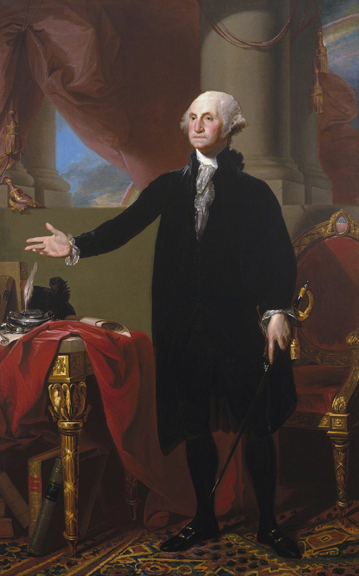
The Marquis de Lafayette arrived in New York City to great fanfare on August 16, 1824. Two days later the sixty-six year old Frenchman and his entourage made their way across the East River to inspect the Brooklyn Navy Yard. Before returning to Manhattan, they paid a social call to the Brooklyn Heights home of Hezekiah Beers Pierrepont and his wife Anna. Lafayette was there to pay his respects to Ann White Constable, Anna’s mother and the widow of William Kerin Constable, a New York merchant who had served as Lafayette’s aide-de-camp for a brief but consequential period during the Revolutionary War. Accompanying Lafayette to the Pierrepont residence was Col. Nicholas Fish, who forty-eight years previously had been a young officer in the Battle of Long Island. There in the Pierrepont’s palatial home, sometimes called the Four Chimneys House, Colonel Fish and Lafayette took note of the 8 x 5 foot portrait of George Washington hanging on the parlor wall. Executed in the Lansdowne-style, the Washington portrait had been commissioned by William Kerin Constable in 1796 from Gilbert Stuart. It was one of two Washington portraits that Constable had commissioned from the artist, the other a smaller rendering that Constable gifted to his good friend Alexander Hamilton. In addition Constable commissioned a likeness of himself, which Stuart dutifully produced along with the two portraits of Washington. Constable could certainly afford these luxuries; by the mid-1790s he was at the height of his powers and one of the wealthiest merchants in New York.
Inspired by the painting of Washington staring down from above, Lafayette, Fish, the Pierreponts, Mrs. Constable, and the others naturally got to talking about the events that had taken place in Brooklyn Heights nearly half a century earlier. Lafayette had not been at the Battle of Long Island, but Fish had been in the engagement as a staff officer for Brig. Gen. John Morin Scott. Colonel Fish averred that it was there at the Four Chimneys House that General Washington and his senior-most officers—which included General Scott—decided to undertake the risky evacuation across the East River to Manhattan on the night of August 29, 1776.[1] Lafayette and Colonel Fish reminisced with the Pierreponts and Widow Constable for a brief time before making their way back to Manhattan.
William Kerin Constable had been born in Dublin, Ireland on either New Years Day 1751 or 1752. Sources differ on the precise year. His parents were John Constable and Jane Kerin, who had married in Ireland in 1749. John Constable became a physician and moved to British North America during the Seven Years War to be a surgeon in the British Army. Dr. Constable served primarily in Montreal and eventually settled in Schenectady, New York. There he raised his family and became part of the community. One of his closest associates was Superintendent of Indian Affairs Sir William Johnson, a fellow Irishman who too had become a British military officer and settled in Upstate New York.
When William was a teenager, Dr. Constable sent him back to Ireland to attend Trinity College in Dublin. After graduation in the early 1770s young William returned to Schenectady and apprenticed in the mercantile firm of Phyn, Ellice, and Company, a business concern partially owned by his brother-in-law James Phyn. The firm thrived in the years prior to the Revolution trading rum, tobacco, molasses, iron, flints, kitchenware, and other goods with the Native Americans in exchange for furs; accoutering British military outposts; and engaging in the human slave trade. Barely twenty, William learned the merchant trade by traveling up and down the Province of New York and across the Great Lakes to Detroit negotiating on behalf of Phyn and Ellice. The Townsend Duties, Coercive Acts, and non-importation agreements that the colonists created in response to those unpopular measures sometimes made business difficult, but things proceeded well enough for the enterprising young man and the trading company. Just before the war broke out William Kerin Constable and James Phyn moved to London to establish an office there. It was a natural move given the firm’s extensive ties to Great Britain, and Alexander Ellice soon followed.

In the ensuing years the Phyn and Ellice Trading Company carried on with a rotating mix of business partners and consequent name changes. By 1776 Alexander Ellice had moved to British Canada, where from an office in Montreal he carried on the company’s business much as it had been conducted before the start of the war. Few specifics are known of Constable’s activities in the early years of the Revolution but by at least 1777 he had returned to North America and settled in Philadelphia, where on behalf of the company he seems to have traded with any redcoat, loyalist, or patriot with the funds to pay for the goods he had on offer. This hardly made him unique. Many colonists were more than happy to engage in trade with British troops and officials, who unlike most colonists could pay in pounds sterling as opposed to hyper-inflated Continental paper currency. With his brother-in-law still back in London, Constable traded overseas as well. By one account, he sent at least two full ships from Philadelphia to England loaded with goods for sale in the nation with which the colonists were waging war.[2]
William Constable seems to have adjusted well and settled comfortably into life in British-controlled Philadelphia. Adjusting well too was the White family, the Philadelphia clan into which he would soon marry. Nancy White—William’s future sister-in-law—was one of the few dozen young ladies escorted by young British officers to the May 18, 1778 Meschianza, a bacchanalia of excess and overindulgence at which British troops and their guests ate, drank, danced, jousted, and otherwise carried on in tribute to their outgoing commander Gen. William Howe. Nancy was one of the Ladies of the Blended Rose and cavorted happily with British officers.[3]
Because of these business and social ties, Constable’s loyalty came into question after the British evacuated the city. When the city was again under patriot control William Kerin Constable took the Oath of Allegiance. Gouverneur Morris, the Continental Congressman who among other things had co-authored the New York State Constitution, wrote to New York governor George Clinton on March 2, 1779 vouching for Constable and asking Governor Clinton’s permission for Constable to return to New York. The governor wrote back three weeks later with his assent.[4]
Details of Constable’s activities while in New York are few, but whatever happened Constable in 1780 was jailed for a time upon his return to Philadelphia for allegedly smuggling British supplies.[5] A desire to remove any lingering suspicions over his true sympathies may be what motivated William Kerin Constable to dedicate himself to the patriot cause. By early 1781 he was serving as an officer under the command of Brig. Gen. John Peter Gabriel Muhlenberg in Virginia, which by this time was a focal point in the war. Muhlenberg wrote to his superior, Gen. Friedrich Wilhelm von Steuben, on February 9, 1781:

An express from Mr. Constable informs me that the enemy have sent four hundred men from Portsmouth, who have taken post in the edge of the Dismal [Swamp], on the road leading from Suffolk to Portsmouth. I cannot conceive what their intentions are, unless the march of the troops from Cabin Point to this place has alarmed them, and caused them to think we meditated an attack on Portsmouth.[6]
That spring Constable corresponded regularly with Virginia governor Thomas Jefferson. Writing in his capacity as Muhlenberg’s aide-de-camp, Constable informed Governor Jefferson on April 7 that
A number of the Enemy’s transports sailed yesterday and the day before, ’tis said they are gone for N: Yk: to take on board a further reinforcement to be commanded by Sr. Henry Clinton in Person. They are indefatigable in strengthening and augmenting their Works at [Portsmouth], and from every information I can gain their intention is to make it a place of Arms and transferr the seat of War to this State.[7]
That spring Muhlenberg left Steuben’s command and joined General Lafayette’s Light Infantry. It was then that the bright and charismatic Constable came to the attention of the French commander. Constable wrote to Jefferson in his new capacity as Lafayette’s aide-de-camp from Richmond on May 26 informing the governor gravely that “The times of the Militia expire daily and they are discharged, but very few come in to supply their place.” He added in the same letter that “Lord Cornwallis arrived at [Petersburg on] the 20th. The 23d. Colo. Tarleton, with 300 Horse of his Legion.” Constable concluded the long missive by informing Jefferson that General Lafayette had gone out to reconnoiter the situation.[8] The growing British threat would not be Gov. Thomas Jefferson’s problem to deal with for much longer. On June 4, 1781, two days after his term expired, he hastily fled Monticello to escape Tarleton and his fast approaching cavalry.

The war continued in the Virginia theater throughout the summer and fall until Cornwallis’s surrender at Yorktown on October 19. When that event took place, William Constable was not there to see it. While the vice was tightening in Virginia, he had already returned home to Philadelphia. Still, Constable had not left military service entirely. In September 1781 he was elected to the First Troop Philadelphia Cavalry, and the following February he continued with the unit as an honorary member.[9]
The surrender at Yorktown was a turning point in the war in North America, and with it Constable settled back further into Philadelphia life. Dublin-born, he joined the Friendly Sons of St. Patrick of Philadelphia on December 18, 1781.[10] He and Ann White married at Christ Church on Second Street on February 28, 1782. The wedding was officiated by the Rev. William White, rector of Christ Church, chaplain of the Continental Congress, and brother-in-law of Robert Morris, the recently-appointed Superintendent of Finance under the Articles of Confederation. Constable also entered into a business partnership with James Seagrove, engaging in the mercantile trade throughout the West Indies, Europe, and North America. He also owned shares in several privateering missions.[11]
When Gen. George Washington rode triumphantly into New York City on November 25, 1783, William Constable purportedly was part of the entourage.[12] The story—recounted more than a century later on March 17, 1889 at the 105th annual dinner of The Society of the Friendly Sons of St. Patrick in the City of New York by Charles P. Daly—may be apocryphal. Still, it is not entirely far-fetched. Constable had his eyes on returning to New York, and it is therefore possible that he was there on Evacuation Day. Either way, William, Ann and their children moved to Manhattan sometime shortly after the war’s end. It was an opportune time for an enterprising merchant to settle in New York. Constable was not even yet thirty-five when the Revolution ended, and there would be many opportunities to engage in trade, land speculation, and economic development as Americans built their new nation. It was a logical move too given that Constable had grown up in New York and knew the state well.
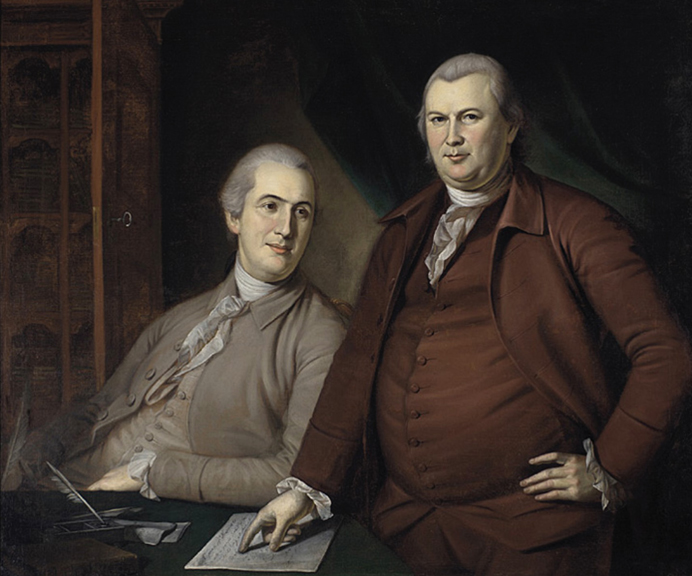
On February 22, 1784, less than three months after the British evacuation, New Yorkers watched with excitement as the Empress of China, a three-hundred-and-sixty-ton sailing vessel loaded with gingseng and Spanish silver dollars, sailed out of the East River for Asia. It would return fifteen months later. While it was gone, the Constables were settling in. William and Ann purchased a home on Great Dock Street in Lower Manhattan close to the bustling waterline. Eventually they moved into another house on the corner of Wall and Williams Streets to accommodate their growing family. Irish New Yorkers founded the Society of the Friendly Sons of St. Patrick in the City of New York on March 17, 1784. Constable was one of the earliest members and would be its president in 1789-90 and again in 1795. Constable also dissolved his relationship with James Seagrove and on May 10, 1784 entered into articles of partnership with Robert Morris and Gouverneur Morris. The two were well-placed business partners to have. Lauded by many as the Financier of the American Revolution, Robert Morris was now one of the Empress of China’s largest financial backers. Gouverneur Morris had served as Robert Morris’s assistant in the Department of Finance after leaving the Continental Congress. Constable and the two Morrises entered into a seven-year partnership.[13] The following month merchant John Rucker joined the arrangement. Emphasizing that the Morrises were silent partners in the venture, the organization was called Constable, Rucker, and Company.
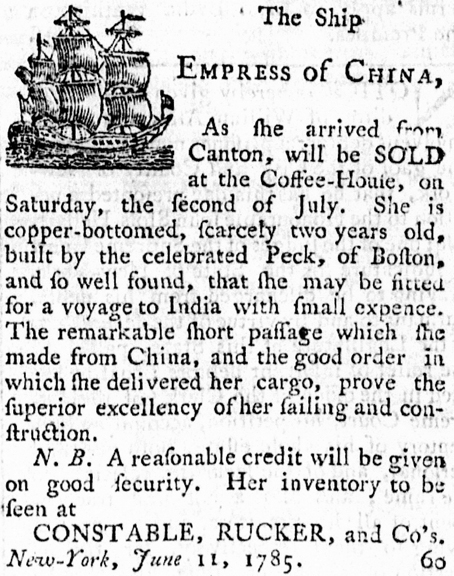
New York City became the capital of the United States when the Confederation Congress moved to Manhattan in January 1785. Dr. John Constable died in April and was laid to rest in St. Paul’s Chapel and Churchyard in Lower Manhattan. On May 11 the Empress of China returned to New York Harbor laden with Chinese silk, tea, porcelain, and other goods. Its return was a major moment in the history of the young nation. North American trade with Europe, West Africa, and the Caribbean were nothing unusual. An American vessel doubling the Cape of Good Hope all the way to Canton and then back again was something else entirely. The Empress of China’s voyage proved the efficacy of the American ability to engage in truly global trade. Now, Constable, Rucker, and Company was one of the merchant houses commissioned to sell the Empress of China’s bounty. It proved so lucrative for everyone involved that Constable, Rucker, and Company purchased the Empress of China on July 2, 1785 and sent it on another voyage.
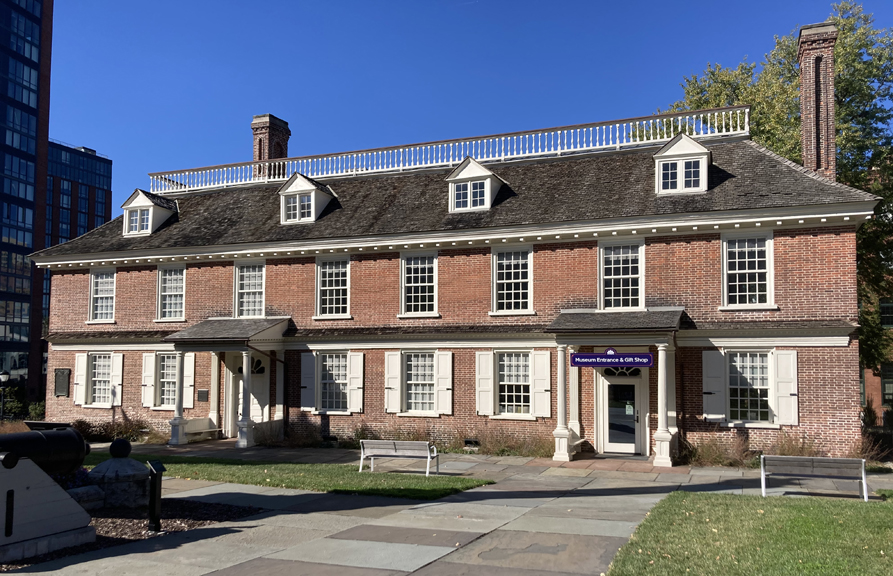
The following year William Constable purchased Philipse Manor Hall, about twenty miles north of New York City. The roots of the purchase dated back to legislation passed by the New York State Legislature on October 22, 1779 titled: “An Act for the Forfeiture and Sale of the Estates of Persons who have adhered to the Enemies of this State, and for declaring the Sovereignty of the People of this State, in respect to all Property within the same.” More widely called the Confiscation or Forfeiture Act, the legislation identified—by name—fifty-nine individuals whose property was eligible for confiscation. One of those singled out was Frederick Philipse III, whose properties were some of the greatest prizes on offer. Philipse came from one of the wealthiest—perhaps the wealthiest—families in colonial New York. In addition to owning several properties in Manhattan, his Manor of Philipsburg in Westchester County stretched from Spuyten Duyvil Creek to the Croton River, more than 90,000 acres spread across over twenty square miles. Within that, the Manor of Philipsburg had not one but two estates: Philipsburg Manor (Upper Mills) in Sleepy Hollow, and the aforementioned Philipse Manor Hall (Lower Mills) in Yonkers.
In a 1925 lecture, historian J. Franklin Jameson argued that the break-up of the large estates during and shortly after the Revolution, especially in the North, was nothing less than the “freeing of the soil.”[14] What Jameson meant was that the large estates whose provenance traced back to the Dutch patroonships and early British land grants were now being taken from the wealthy families who had owned them for generations, divided into parcels, and sold to middling and lower class yeomanry. There is some truth to that. More precisely however, the Forfeiture Act freed the soil of those who had remained loyal to the British Crown. Families like the Livingstons, who for the most part had joined the patriot cause, usually held on to their property; others, such as the loyalist Philipses, lost most of their holdings. Scores of Frederick Philipse III’s onetime tenants purchased lots that they had once toiled on as renters. And it was not merely the middling and lower sorts who were buying parcels once owned by loyalists. Already-wealthy New Yorkers such as Gerard G. Beekman, Jr. and William Constable became even more so through the purchase of confiscated land. William Constable purchased Philipse Manor Hall on May 12, 1786 from Cornelius P. Low, who himself had purchased the manor and surrounding property—more than three hundred acres—from the Commissioners of Forfeiture less than a year earlier before financial difficulties forced Low to sell. Other than summering there occasionally, the Constables never permanently lived in the manor. Instead, Constable generated revenue through Philipse Manor Hall’s powerful mills and bountiful orchards with their easy access to the Hudson River and markets.
Constable had been a director of the Bank of New York from 1787 to 1792. In addition to local land investment and financial services, Constable prioritized global trade and other opportunities. When John Rucker died in 1788, the Morrises and Constable changed the name of their organization to Constable & Company and continued on until their partnership contract expired in 1791. Constable also entered into a series of land speculation deals with Alexander Macomb. Macomb and Constable knew each other well. They were neighbors and both leaders in New York City’s St. Patrick Society. Macomb’s house on Lower Broadway served as the Executive Mansion for President George Washington from February 23 to August 30, 1790 before the federal government moved to Philadelphia. Macomb’s legacy would be mixed. His speculating on securities and the public debt with William Duer starting in December 1791 led to the Panic of 1792, for which both men spent time in debtors’ prison.
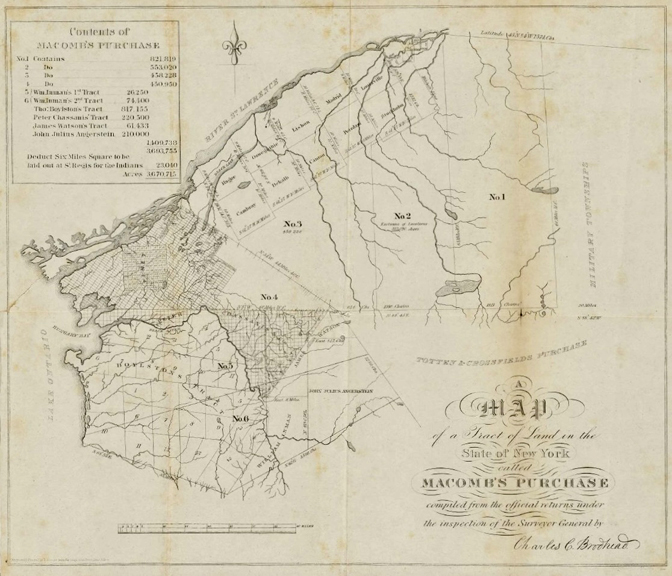
Land speculation, often via contractual agreements of dubious legality made with Native Americans, became something of a fever with Americans in the early years of the republic. A year before the 1792 crash, Macomb, Constable, and Daniel McCormick had acquired what came to be called Macomb’s Purchase, a series of tracts exceeding 3.6 million acres—some 5,600 square miles—in Upstate New York. A step ahead of his creditors, Macomb on June 6, 1792 ceded title to Constable of some 1,920,000 acres of his own portion.[15] Constable himself had moved to London in late 1791 to sell shares in Macomb’s Purchase in England and on the Continent. One of the most important purchasers would be La Compagnie de New York, a group comprised primarily of royalists seeking sanctuary from La Terreur during the French Revolution. Their project came to be called Castorland, “castor” being the French word for beaver. Despite high expectations the Castorland project proved unsuccessful, primarily because the new arrivals could not adjust themselves to the harsh weather and terrain they experienced in rural Upstate New York. The majority repatriated to France when the worst excesses of the French Revolution passed.
Constable returned to New York in June 1795. That year he became a warden in St. John’s Episcopal Church in Yonkers just a short walk from Philipse Manor Hall. The church was a stately house of worship financed by Frederick Philipse III in the early 1750s that still holds services today. Despite this, Constable eventually gave up any plans he may have had to use Philipse Manor Hall as a residence and sold the estate on April 29, 1796. It was a time of change. Constable also sold the house on the corners of Wall and Williams Streets to the Bank of New York. On July 4, 1796 Constable became and honorary member of the New York State Society of the Cincinnati.
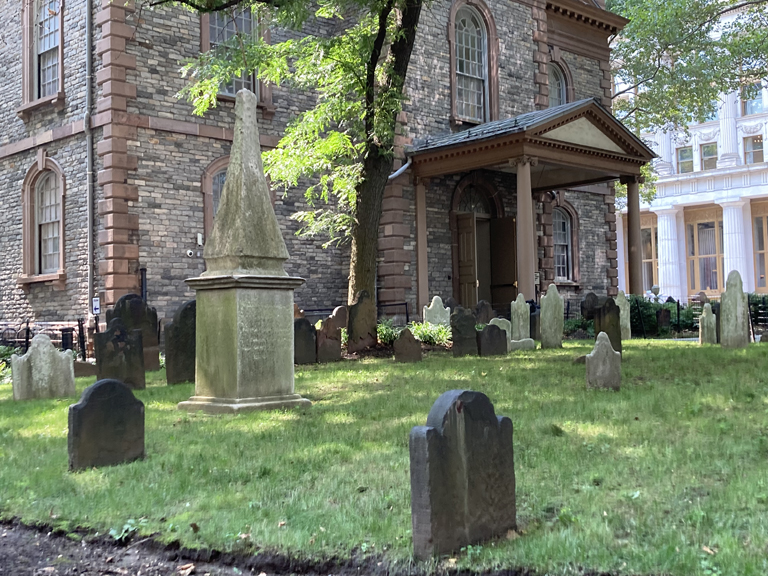
William Constable returned to Europe in the late 1790s for health and business reasons. Sometime while in Europe in the 1790s he met Hezekiah Beers Pierrepont. The rising young merchant had spent much of that decade traveling throughout India, China, and Europe on business.[16] Constable returned to New York in 1801 to find his finances in ruins due to the mismanagement of his brother James, to whom he had given power of attorney. William Constable never fully recovered from the financial blow and in 1801 even spent a short time in debtors’ prison.[17] His health further deteriorated. Hezekiah Beers Pierrepont married Constable’s daughter Anna on January 21, 1802. Gouverneur Morris wrote in his diary on Monday May 9, 1803 that he “Saw Mr. Constable in the Morning—He is very ill.” Morris returned the following day and noted that his old partner was “wasting fast.”[18] Only in his early fifties, William Kerin Constable died on May 22, 1803 and was laid to rest beside his father in Saint Paul’s Chapel and Churchyard.
As one of Constable’s co-executors, Hezekiah Pierrepont settled his late father-in-law’s estate, and through his financial prowess mitigated what could have been even further economic disaster. In many ways the biggest rewards came in the succeeding generations of Constable children and their families. The Pierreponts themselves inherited much of William’s Upstate New York landholdings and in 1804 purchased the Brooklyn Heights mansion where two decades later Lafayette would visit the Widow Constable. Meanwhile, William Constable Jr. in the 1810s built Constable Hall in Constableville, New York on land that he too had inherited. It would remain in the family until 1948 and is today a museum.
[1] John Morin Scott to the New York Convention, September 6, 1776, Founders Online, National Archives, founders.archives.gov/documents/Jay/01-01-02-0180. Historians still debate the exact location of the so-called council of war. Contradicting the Four Chimneys argument for the case is a letter that General Scott wrote to the New York Convention on September 6, less than ten days after the evacuation. In that missive Scott wrote that the council of war had taken place at the nearby Brooklyn home of Philip Livingston, the estate of Scott’s best friend, William Livingston. The dispute over the exact location of the council of war will likely never be resolved.
[2] Emily Williams, “The Luck of the Irish: A Biographical Sketch of William Constable,” Lewis County Historical Society Journal 5 (1975): 5.
[3] Sherman Day, Historical Collections of the State of Pennsylvania (George W. Gorton, 1843), 573.
[4] Edith Pilcher, The Constables: First Family of the Adirondacks (North Country Books, Inc., 1992), 9.
[5] Pilcher, The Constables, 9.
[6] Henry A. Muhlenberg, The Life of Major-General Peter Muhlenberg, of the Revolutionary Army (Carey and Hart, 1849), 382-383.
[7] William Constable to Thomas Jefferson, April 7, 1781, Founders Online, National Archives, founders.archives.gov/documents/Jefferson/01-05-02-0466.
[8] Marie-Joseph-Paul-Yves-Roch-Gilbert du Motier, marquis de Lafayette Jefferson, May 26, 1781, Founders Online, National Archives, founders.archives.gov/documents/Jefferson/01-06-02-0021.
[9] History of the First Troop Philadelphia City Cavalry, from Its Organization, November 17th, 1774 to Its Centennial Anniversary, November 17th, 1874 (Hallowell & Co., 1875), 179.
[10] John Hugh Campbell, History of the Friendly Sons of St. Patrick and of the Hibernian Society for the Relief of Emigrants from Ireland: March 17, 1771-March 17, 1892 (Hibernian Society, 1892), 105.
[11] Williams, “The Luck of the Irish,” 9.
[12] Constitution, By-Laws, Officers, Committees, Roll of Members, &c., of the Society of the Friendly Sons of St. Patrick in the City of New York (Dempsey and Carroll, 1894), 38.
[13] Robert Morris, The Papers of Robert Morris, 1781-1784, Volume 9: January 1-October 30, 1784, edited by Elizabeth M. Nuxoll and Mary A. Gallagher (University of Pittsburgh Press, 1999), 325-330.
[14] J. Franklin Jameson, The American Revolution Considered as a Social Movement (Princeton University Press, 1926), 77.
[15] Julius Goebel, Jr. and Joseph H. Smith, eds. The Law Practice of Alexander Hamilton: Documents and Commentary, Vol. 4 (Columbia University Press, 1980), 141.
[16] R. Burnham Moffat, Pierrepont Genealogies from Norman Times to 1913 (Privately printed, 1913), 159.
[17] Pilcher, The Constables, 15.
[18] Gouverneur Morris, The Diaries of Gouverneur Morris: New York, 1799-1816, edited by Melanie Randolph Miller and Hendrina Krol (University of Virginia Press, 2018), 282.

Recent Articles
The Rise and Fall of Captain John Manley
Remembering the Revolution: Little Compton, Rhode Island
Last Call for a Dram Seller on the Mohawk River
Recent Comments
"Payback: Attack on the..."
Thank you all for your kind words. I was very lucky in...
"Payback: Attack on the..."
Joseph Orchard, how fun! Oliver DeLancey avoided having the property confiscated, and...
"Second Coming of a..."
Hi Ann. Thank u for this! Jeremiah Jack is my eighth grade...