

BOOK REVIEW: Freedom Round the Globe: A World History of the American Revolution by Sarah M.S. Pearsall (New York, NY: Doubleday, 2026) $35.00 hardcover.
Johns Hopkins history professor Sarah M.S. Pearsall has given American Revolutionary War scholars a one-of-a-kind look at the Revolution and its role as a world event. Instead of describing how the Revolution affected world events (the French Revolution and Haitian Revolution, for example), she focuses on how various world events affected those of the War of American Independence. She grew up with the typical American view of the Revolution as a solely American event, ordained from high above and making the U.S. truly “exceptional.” Her new book, Freedom Round the Globe: A World History of the American Revolution, puts the Revolution in an international context. “Moving beyond simple hero worship, or propaganda, this capacious history aims to celebrate principles and to acknowledge complications while connecting the U.S. story with people and places all over the world” (page xi).
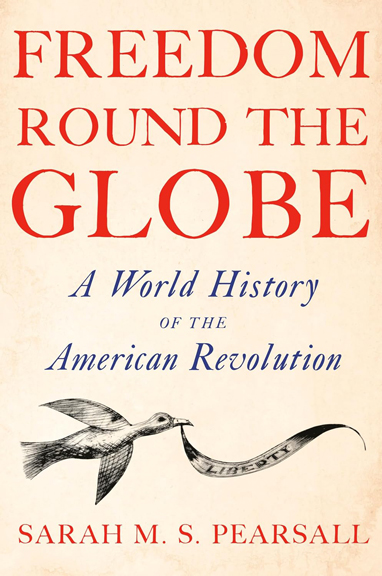 The Introduction is centered on the powder horn of a Black soldier from 1777, Prince Simbo. The horn is decorated, as many were at the time, and Pearsall offers one image: a bird in flight carrying a banner with the word “Liberty.” What did that term mean, especially to a man like Prince Simbo? What does freedom mean to people all over the world? Was it the same idea to both enslaved people and agitated members of the Continental Congress who demanded freedom from a tyrant? The American Revolution, Pearsall writes, is a Russian doll, containing many interpretations of liberty. All these trends influenced the events taking place in the thirteen eastern British colonies.
Each chapter’s “theme” in the book is based on a word from the Declaration of Independence and then elucidates how each value prompted behavior among all kinds of people. The chapters are arranged chronologically, beginning with the end of the French and Indian War and ending with the Early Republic. The geographic locations that are included are Detroit in the western frontier (Unity), St. Kitts in the Caribbean (Consent), Kolkata in India (Government), Edinburgh in Scotland (Happiness), Anomabu on the west coast of Africa (Liberty), Quebec City in Canada (Independence), the German states of Hessen-Kassel (Civility), the hall of Versailles (Respect), the land of the Haudenosaunee Confederacy (Security), the Mediterranean fortress of Gibraltar (Life), Havana in Cuba (Honor), the Chinese port city of Guangzhou (Fortunes), and finally the settlement of Sierra Leone on the west African coast.
As far as events go, the reader will discover how each one led directly or indirectly to what was happening in the rebelling British colonies in North America. Some seem minor, such as the hanging of a slave for the murder of her master in the town of Bkejwanong (Anishinabe name of what would later be known as Detroit). Debating the definition of happiness in Edinburgh is tied to the Boston Massacre, Boston Tea Party, and the Coercive Acts. The slave trade in Fort Anomabu helps to show how Americans were redefining the concept of liberty at the time of Lexington and Concord. The failure to conquer Quebec City pushed the Congress to prepare for declaring independence. Gibraltar was the setting for the largest military action of the American Revolution. The conflict between the Spanish and the British over the Floridas led to the British defeat at Yorktown. The efforts of establishing international trade in China was part of America’s pursuit of wealth, which would become a nightmare scenario for Indigenous nations.
Pearsall concludes Freedom Round the Globe by pointing out that although the British were dealing with a revolutionary spirit all over its empire, only thirteen of its colonies rebelled. What happened in the United States was very different, for a variety of reasons. Did these reasons make the U.S. truly “exceptional”? The plight of Prince Simbo and his powder horn ends the book. Prince Simbo survived the war and lived the rest of his life in Connecticut, but his horn survives still. The banner can still be seen clearly. Pearsall’s narrative, written with a light and, at times, humorous style, is very much worth the effort. Her work makes the story and the values of the American Revolution easier to appreciate.
PLEASE CONSIDER PURCHASING THIS BOOK FROM AMAZON IN HARDCOVER or KINDLE.
(As an Amazon Associate, JAR earns from qualifying purchases. This helps toward providing our content free of charge.)

Recent Articles
Freedom Round the Globe: A World History of the American Revolution
Trade, Land, Speculation: William Kerin Constable in the Age of Revolution
David Steele’s Macabre Medal
Recent Comments
"Hero to Zero? Remembering..."
Arnold was the hero of Saratoga "the best general on either side"...
"From Roxbury to Exeter:..."
Hello Otis, Thank you for your kind note. I was interested to...
"The Milford Connecticut Cartel"
Elizabeth, unfortunately none of the accounts of this incident identify any Milford...