


Capt. Justus Sherwood, a Vermont Loyalist, arrived at a Vermont frontier post in western Vermont on October 28, 1780, as a representative of the British under a flag of truce, and was brought before Col. Samuel Herrick. With him, he carried dispatches and instructions relative to a proposed exchange of prisoners. The next day, Sherwood met privately with Gen. Ethan Allen. Although it is unclear whether Allen knew that Sherwood had spoken with Colonel Herrick earlier that day, it is evident that Allen agreed to keep his own private conversation with Sherwood confidential. Sherwood advised Allen that Gen. Frederick Haldimand understood Vermont’s current disputes with New York and Congress, while Haldimand believed that Congress had merely deceived Vermonters and wished to offer Vermonters an opportunity to resume their original allegiance to Great Britain.[1]

The private meeting between Sherwood and Allen became one of several meetings between Vermont leaders and British officials in Canada that took place throughout the latter half of the American Revolution and are now referred to by historians as the Haldimand Affair. Historians have debated for decades whether Vermont’s leaders were serious about resuming allegiance to Great Britain or if they were merely using the negotiations to demonstrate their strength with Congress. Sherwood’s reporting indicates there was an important intelligence dimension to the negotiations. Throughout the dialogue, prisoner exchanges, and private meetings, such communications allowed British officials to obtain access to Vermont’s senior leadership, as well as information about their intentions, grievances, and limitations.[2]
Vermont’s political status allowed British officials to pursue an intelligence channel. In January 1777, delegates representing the New Hampshire Grants formally declared themselves a separate and independent state and petitioned Congress for admission. Congress chose not to recognize Vermont as long as New York claimed jurisdiction over the territory. Thus, Vermont found itself positioned between British Canada to the north and the American states to the south, which continued to question its independence. Vermont presented both a potential threat to Quebec and an opportunity for Haldimand to undermine American unity along the northern border.[3]
British officials realized Vermont’s strategic significance, and in a letter to Sir Henry Clinton on February 7, 1781, Lord George Germain described the return of Vermont to British allegiance as an event of “the utmost importance” and charged Haldimand with orders to assist in persuading the people of Vermont to favor the Crown. British interest in Vermont was not merely the result of Haldimand’s individual initiative, but rather part of a larger strategy to defend Canada and disrupt American dominance of the northern frontier.[4]

A Cartel Opens the Channel
Although the first round of negotiations did not explicitly involve discussions of Vermont’s political fate, prisoner exchange provided British and Vermont officials with a legitimate reason to discuss matters related to the contested frontier. Gov. Thomas Chittenden later informed Washington that he had written to Haldimand regarding an exchange and that British officials thereafter proposed a temporary truce pending the conclusion of such negotiations.[5]
Prisoner exchange constituted legitimate business, yet Sherwood’s journals indicate that it also provided an avenue for private discussions concerning Vermont’s political future. During his October 1780 meeting with Allen, Sherwood simultaneously engaged in discussions about prisoner exchange and Haldimand’s plan for Vermont to reunite permanently with Great Britain. Allen then assisted in presenting Haldimand’s and British Maj. Christopher Carleton’s formal correspondence regarding the prisoner exchange cartels and truces to Vermont officials while ensuring his subsequent meeting with Sherwood remained clandestine. Thus, the same diplomatic channel served two disparate functions.[6]
In addition to his knowledge of the political environment in which he operated, Sherwood proved useful because he was able to record far more than mere formal positions. Sherwood documented the reasons that motivated Vermont’s senior leadership, their concerns, conditions, and limitations, allowing Haldimand to gain political intelligence that would otherwise have been unattainable through observations of troop movements or traditional military reports.[7]
What Haldimand Needed to Know
Ethan Allen’s conversations with Sherwood illustrated both the possibilities and limitations inherent in British efforts directed at Vermont. Allen stated that personal advancement would play no part in determining his actions, and he had previously rejected a British commission while he was a prisoner. Nevertheless, he did not immediately reject Haldimand’s offer. Instead, Allen indicated that any significant political changes would constitute a “work of time” because the population of Vermont could not instantaneously come into agreement.[8]

Allen also addressed the way in which communication could take place. As documented in Sherwood’s account, Allen recommended that legitimate business concerning New York and Vermont be included under flags of truce sent between British officials and Vermonters to minimize suspicions. Perhaps most importantly, Allen indicated that if Congress awarded Vermont representation as a separate state, discussions with Britain should cease and remain concealed. Thus, Allen provided Sherwood with critical insights into the factors influencing Vermont’s decision-making process.[9]
Haldimand did not simply require knowledge of whether Allen preferred Britain or America, but knowledge of what motivated Vermont’s senior leadership, what they feared, what political outcomes they desired, and what events might prompt them to abandon talks with Britain. Sherwood’s access permitted him to collect information regarding each of these items while continuing to preserve a conduit for additional communication. This illustration clearly shows that such intelligence supported strategic decision-making regarding how Britain might approach the Vermont problem in America.
Ira Allen at Île aux Noix
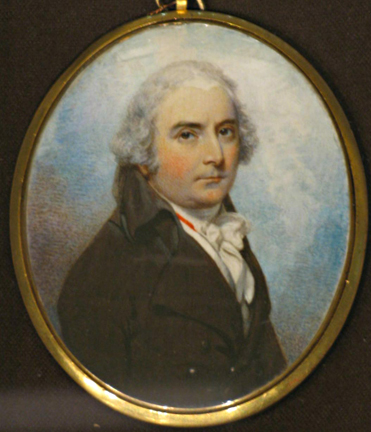
Continued negotiations occurred in May 1781, when Col. Ira Allen traveled under a flag of truce as a commissioner from Vermont to Île aux Noix, located on the Richelieu River near Lake Champlain and the U.S. border. Allen’s formal objective remained the resolution of a prisoner release, but Sherwood’s journal again documents private discussions involving Vermont’s political future. Allen expressly told Sherwood that he was not authorized to engage in negotiations for a union with Great Britain, but Chittenden and Ethan Allen instructed him to discuss Vermont’s situation with Haldimand.[10]
Allen’s comments highlight an important distinction between political discussion and political commitments. Allen contended that Vermont was unprepared to propose any permanent resolutions, and some members of its leadership instead sought neutrality. Nonetheless, Allen indicated that he wished to create a permanent cartel which would allow for “further Negotiation.” Thus, prisoner exchange continued to serve as a means of establishing legitimate communication.[11]

Sherwood remained uncertain regarding Allen’s intentions. In his May 10 entry, Sherwood described Allen as “very cautious & intricate” and continued questioning him for more concrete offers. When asked by Sherwood whether Vermont would commit to permanently joining Great Britain upon the conclusion of hostilities with the American colonies, Allen replied that neither he nor others among Vermont’s leadership would agree to such terms until its populace could reach consensus on the matter. Allen argued that even when its population ultimately reached consensus on the issue, neutrality might represent the maximum extent to which Vermont would choose to cooperate with Great Britain during wartime. Although Sherwood had acquired access and information relative to Vermont’s leaders’ attitudes and intentions regarding negotiations with Great Britain, he did not acquire definitive answers.[12]
Such ambiguity underscores an important aspect when evaluating the affair from an intelligence perspective. Collectors of intelligence generally do not operate in environments where each source’s trustworthiness is an absolute. Therefore, while Sherwood documented statements made by Allen regarding his interest in negotiating with Great Britain, he could also compare those statements with Allen’s earlier remarks when assessing political constraints. Allen’s ambivalence did not preclude Sherwood from collecting intelligence through his continued access or from providing Haldimand with assessments indicating what Vermont’s leaders appeared willing or unwilling to undertake based upon available information.
Pressure on Congress
Congressional recognition of Vermont remained unresolved due to the continuing dispute between Vermont and Congress over the settlement of its territorial claims. On August 20, 1781, Congress declared that settlement of Vermont’s territorial claims was an “indispensable preliminary” for consideration of admission into the federal union or recognition of its independence. Thus, Vermont remained outside the Union while its leaders continued communicating with British officials.[13]

Gov. Thomas Chittenden’s November 14 letter to General Washington provides clear evidence as to how Vermont’s leaders later characterized their policies relative to relations with Congress. In his letter, Chittenden explained that Vermont’s struggles with New York had received little support from Congress and that Vermonters felt increasingly isolated and required military protection against British forces operating from Canada. Under those circumstances, Vermont had chosen “Policy in the Room of Power.”
Further, Chittenden acknowledged Ira Allen’s visit to Canada and noted that political topics were discussed during Allen’s negotiations pertaining to an exchange of prisoners. Chittenden then wrote that, out of necessity, Allen handled those discussions in a manner that protected Vermont without jeopardizing the American cause. Chittenden concluded by stating, “The Plan Succeeded. The frontiers of this State were Not Invaded.” Although Chittenden defended Vermont’s actions, he could not be considered an impartial observer. Chittenden’s letter demonstrates that Vermont’s leadership intentionally viewed these negotiations as an action taken to protect the state. Furthermore, Chittenden’s letter illustrates how British channels affected Vermont’s relationship with Congress. Chittenden asserted that intercepted correspondence from Lord George Germain influenced congressional progress toward resolving outstanding issues between Congress and Vermont where little progress had been made before.[14]
Sherwood as Collector and Assessor
Sherwood’s role supports the argument that the Haldimand Affair should be evaluated within Revolutionary War intelligence history rather than solely as a diplomatic matter. Sherwood not only acted as a messenger between Haldimand and Vermont leaders, but also participated in private conversations with Vermont leaders, recorded their political attitudes, assessed the reliability of various representatives, and transmitted information regarding politics along the northern border. Those facts are further supported by Sherwood’s later career, when Haldimand appointed him officer in charge of secret service activities along the northern frontier in June 1781, where intelligence gathering included, but was not limited to, collecting information regarding American military activity, public opinion, and external threats facing Canada.[15]
Although the Haldimand negotiations ultimately produced no formal agreement whereby Vermont would become a province of Great Britain, the negotiations permitted British officials access to the highest levels of Vermont politics. At Castleton, Sherwood documented Ethan Allen’s frustration with Congress and New York and the conditions under which Allen would continue to negotiate with British authorities. Additionally, at Île aux Noix, Sherwood recorded Ira Allen’s belief in neutrality, reluctance to commit to long-term allegiance, and his desire to have future negotiations take place via the prisoner cartel. In both instances, Sherwood offered Haldimand more than merely the content of official letters.
This provides a distinction between merely conveying information and gathering actionable intelligence. Official correspondence may report Vermont’s “official” position toward British authority; however, Sherwood offered additional contextual information about those persons who delivered that position and the political climate in which they acted. As such, Sherwood’s reporting enabled British authorities to assess Vermont’s intentions in conjunction with their own long-term strategy.
An Intelligence Contest
As history tells us, Vermont was never again to be governed by British authority. Thus, if one interprets British success based solely on reconciliation with Great Britain, then the Haldimand Affair had failed. This perspective fails to recognize the various benefits British officials received from maintaining contact with Vermont’s political elite. While British officials were able to utilize negotiations to obtain ongoing access to Vermont’s political leadership and better understand Vermont’s relations with Congress, New York, and its own populace, the British government gained valuable insight into the terms under which Vermont would consider remaining neutral or making some form of political accommodation.[16]
Such exchanges generated new avenues of opportunity for Haldimand beyond a large-scale military operation, even after America had won its independence. Historian Ian C. Pemberton suggested that negotiations possessed defensive value since they resulted in Vermont being neutralized and thus diminished the potential for congressional unity during times of crisis. In addition, the exchanges provided Vermont’s leaders with an understanding of how British interests enhanced their own domestic status in comparison with congressional non-recognition.[17]
Therefore, it is inaccurate to describe the Haldimand Affair as either solely a British effort to persuade Vermont to resume its former allegiance or as a purely Vermont ruse intended to deceive Congress. Rather, the Haldimand Affair evolved into a two-way intelligence contest wherein each side utilized the exchange for purposes unique to each participant. British authorities employed the exchange for the purpose of acquiring political intelligence and enhancing Canadian security. Conversely, Vermont employed the exchange to enhance its ability to secure protective measures against potential threats while increasing its freedom of action and future options.
[1] Justus Sherwood, “Journal: Miller’s Bay 26th Octr 1780-Part I,” Vermont History 24, no. 2 (April 1956): 101-5.
[2] Ryan L. Wagner, “The Security and Defense of This Province: General Frederick Haldimand’s Intelligence Operations in North America, 1754-1783” (PhD diss., Liberty University, 2026), digitalcommons.liberty.edu/doctoral/7941.
[3] William Slade Jr., comp., Vermont State Papers: Being a Collection of Records and Documents, Connected with the Assumption and Establishment of Government by the People of Vermont (J. W. Copeland, 1823), 68-73.
[4] Lord George Germain to Sir Henry Clinton, February 7, 1781, reprinted in Slade, Vermont State Papers, 150.
[5] Thomas Chittenden to George Washington, November 14, 1781, Founders Online, National Archives, founders.archives.gov/documents/Washington/99-01-02-07403.
[6] Sherwood, “Journal: Miller’s Bay 26th Octr 1780-Part I,” 101-5.
[7] Ian C. Pemberton, “The British Secret Service in the Champlain Valley,” Vermont History 44, no. 3 (Summer 1976): 129-31.
[8] Sherwood, “Journal: Miller’s Bay 26th Octr 1780-Part I,” 103-5.
[9] Sherwood, “Journal: Miller’s Bay 26th Octr-1780-Part I,” 103-5.
[10] Sherwood, “Journal: Miller’s Bay 26th Octr 1780-Part II,” Vermont History 24, no. 3 (July 1956): 211-13.
[11] Sherwood, “Journal: Miller’s Bay 26th Octr 1780-Part II,” 211-13.
[12] Sherwood, “Journal: Miller’s Bay 26th Octr 1780-Part II,” 212-13.
[13] Journals of the Continental Congress, 1774-1789, vol. 21, 1781, ed. Gaillard Hunt (Government Printing Office, 1912), 887-88.
[14] Chittenden to Washington, November 14, 1781.
[15] Pemberton, “The British Secret Service in the Champlain Valley,” 130-31.
[16] Sherwood, “Journal: Miller’s Bay 26th Octr 1780-Part II,” 211-13.
[17] Pemberton, “The British Secret Service in the Champlain Valley,” 140.

Recent Articles
The Intelligence War for Vermont
The Dames of Philipse Manor Hall: Revolutionary Women and Illicit Dutch Tea
On This Week’s Dispatches: Emelia Lehmann on David Steele’s Macabre “Medal”
Recent Comments
"Abigail Hartman Rice, Revolutionary..."
She is my fourth great grandmother.
"Deserter a Day 4..."
Hey there - I'm researching the Anspach-Bayreuth Jager, and I was curious...
"The British “Experiment” to..."
King's Mountain, barely mentioned in many accounts of the American Revolution, was...