

The heady days of the Declaration of Independence, struggle, victory, and a new Constitution were all behind him. Now, within weeks of taking office as President of the United States, George Washington presided over a toxic political atmosphere.
Despite initial hopes for national unity, a vicious partisan press had emerged. Mobs on the frontier flirted with rebellion. And his founding government verged on bankruptcy. Worse, Hamilton and Jefferson were constantly at each other’s throats, fighting bitterly over the Bank of the United States, the scope of federal power, the soul of the new republic. Yet amidst all this chaos his inaugural cabinet, followed by Congress, somehow managed to converge around a single practical problem: cod.
Or more to the point, its glaring absence.
New England’s fishing fleet, once the backbone of the colonial economy, had been crushed by Britain during the war. Now, touring New England waterfronts, Washington witnessed the wreckage of increasingly hungry men on idle docks. He then turned to his two most trusted, brilliant yet bickering lieutenants and called on them to fix this precarious situation. Fast. Together.

What Hamilton and Jefferson eventually co-produced was our republic’s first economic stimulus package, anchored by a little-known profit-sharing plan for fishermen that would outlast every other policy that either man had championed.[1]
A Foundering ‘Founding Fishery’
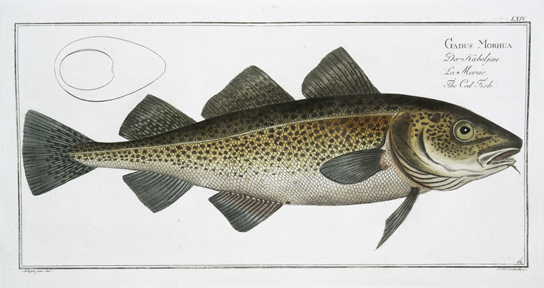
In the colonial era cod was long known to be something far more essential than animal protein. As a commodity, the demersal fish Gadus morhua dominated as New England’s single most valuable export. Salted, dried and occasionally smoked, the preserved flesh fed Caribbean sugar plantations, got traded for molasses, and underwrote the triangle trade. Beyond its food value, the cod fishery had earned a transatlantic reputation as an economic force that generated sailors, ropewalks, gear, coopers, salt works, barrel makers, and shipbuilders. This dynamic ecosystem of many industries all traced back to that one indispensable species.
Knowing this, and determined to break, impoverish and demoralize colonial “traitors,” when the Revolutionary War broke out, the Royal Navy mercilessly targeted cod fleets and fishing infrastructure. It was an effective tactic. Very quickly the colonial fishing industry was, as Jefferson would later describe it, “annihilated . . . their vessels, utensils and fishermen destroyed, their markets . . . lost.”
At war’s end, revival of the cod fishery rose to a top priority. John Adams had carefully negotiated the “liberty to take fish” off Newfoundland and Nova Scotia under the Treaty of Paris (1783), and, looking back, he later regarded having secured those fishing rights as among his top diplomatic achievements. Still, a nation’s legal right to harvest fish (back then, much as it is today across the developing world) meant nothing unless backed by the means to realize it, which meant a fleet of seaworthy boats, food preservation systems, skilled crews, reliable gear, and ample capital to build (or rebuild) this cornerstone of national economic activity.

By 1789, Jefferson was assessing the dire situation. His cod report recorded the many old vessels rotting in drydock, the seasoned fishermen scattered without salary, the dockside infrastructure decaying from want of use. Hungry, restless, unemployed labor was both a wasted resource and a political liability. The socio-economic risk was as obvious to Jefferson and Hamilton as the urgency to galvanize all parties in the right direction. Of course, each man famously held a different vision of what that direction might be.[2]
Coastal Alignment of Interests
As a quintessential nation builder, Hamilton (like Adams) sought a rebuilt cod fleet as “a nursery for naval power,” a generator of maritime trade, a hub for those multiple industrial spokes supporting salt production, rope making, cooperage, shipping. His idea was centrifugal, commercial, and strategic: of a potent fleet that projected American strength and generated federal tax revenue.
Just as naturally, Jefferson came at it from a different angle. To him, a healthy fishery unlocked opportunity but did so evenly, fairly distributed among yeoman families, cottage industries spread out along rural coastlines, while bypassing urban merchants and bankers. He glimpsed in each future cod boat a small democratic enterprise, with ordinary labor and only modest decentralized capital sharing the same voyage, risks, and rewards.
In short, where Hamilton saw a training ground for seamen and an engine of trade, Jefferson saw a mechanism for broad and equitable distribution of wealth. And while both noisily disagreed about nearly everything else in politics, when it came to fisheries, their rival logic quietly converged on an approach that, like hemp threads twisted into rope, intertwined both visions.

Responding to Washington’s mandate, both men set out to generate more vessels at sea, landing more fish, feeding more families, reviving more coastal towns, all without taking on more debt. Bookish Jefferson led with formal research and drafted his February 1, 1791, report to the House. Streetwise Hamilton got busy working behind the scenes.
Shuttling between the more famous founding fathers in the shadows was a lesser-known figure.[3]
The Quiet Deal Broker
Tench Coxe, a loyalist who had turned patriot during the Revolution, was a complex individual. He had proven himself politically resourceful, though for similar reasons was in some circles held initially suspect. Technically he served as Hamilton’s deputy at Treasury, yet for this task had been appointed to help Jefferson gather information, seek advice, and organize intelligence. In that pragmatic role, he formed connective tissue between cabinet and people, trusted by capital and labor alike, and managing to translate their knowledge into policy.
More specifically, the documentary record traces Coxe writing a series of questions to Joseph Anthony, a Philadelphia merchant who had been “bred to the Sea out of Rhode Island” and who was now a partner in one of the city’s leading trading houses. Anthony did not make his money as a political theorist. He had run ships, tracked costs, and watched crews perform under various compensation systems, and that was where his insights lay.
To Coxe’s queries, Anthony answered with practical detail. He described vessel sizes, operating costs, wage structures. Then in the course of discussion he conveyed to Coxe the defining tradition in the New World of a seafaring legacy, one that evolved and was self-organized by cod harvesters among other fishermen who were known, under this informal offshore institution, as “sharesmen.”
This crucial system, also described as “working on Shares” in Anthony’s language, had broad appeal. The distributed aspects resonated with Jefferson’s egalitarian democratic dreams, as well as supporting Hamilton’s need for defined enterprise, long term certainty, and commercial market incentives.
Reinforcing both sides, Anthony emphasized to Coxe that crews were “generally found the most attentive, when their Dependence was on a Share of what they Caught.” In short, fishermen grew more ambitious and focused in vessels where they had real skin in the game. This is the clearest surviving primary statement linking the shares system to productivity. It also offered concrete evidence from the cod trade of the vitality Adam Smith attributed to commercial freedom. As Smith wrote in 1776, “The New England fishery in particular was, before the late disturbances, one of the most important, perhaps, in the world.” Smith attributed that success to the distinctive form of encouragement the colonial fisheries had received: “all the encouragement which freedom can give them, and they have flourished accordingly.”[4]
Now, Coxe has not discovered, much less invented, the sharesman system. But as savvy policy broker he had the good sense to commission and assemble grounded evidence that would document, validate and highlight that custom in a way that would bind the quarreling founders, and get them to adopt its subtle power for federal use. He forwarded Anthony’s letter, answers to the written queries, and a detailed price table under a cover letter dated November 29, 1790.[5]
Indeed, during the very weeks the two cabinet secretaries escalated their squabbling over the national bank, Hamilton’s right-hand man was providing comparative evidence for Jefferson’s report in a way that would shape a bold new policy fiercely embraced by both. It was one of America’s earliest example forms of “secondment,” in which an official gets temporarily reassigned to another agency to share skills, policy expertise, or institutional knowledge while remaining paid by their original employer. This now-common practice has expanded, used to break down silos, fill short-term needs, and cross-fertilize ideas between departments or even between public and external charities or research bodies. But modern scholars treat Coxe’s institutional role as cross-departmental intermediary as unusually productive and cooperative, especially for this early fractious post-revolutionary period.[6]
Economies of Scale
Before this Hamilton-Jefferson collaboration, sharesmen had been no more than informal practice at the vessel level. For any given New England cod boat before embarking, voyage proceeds were divvied up proportionally among the owner, the captain, and each crew member.
Rewards were shared, so if a trip succeeded, everyone gained. Likewise, risk was spread: if it failed, all bore the loss. The owner put up the vessel, gear and provisions as capital. The crew put up their labor, experience, and skill. The captain managed the voyage. Anthony’s evidence showed that share-run vessels outperformed wage-run vessels because crews had direct incentive to work harder, fish smarter, and waste less. And the system was self-enforcing, since a lazy crewman cost every other sharesman money, and would be informally pushed and disciplined by peers or punished by exclusion.
What Jefferson’s report and the resulting legislation did was elevate this local custom into national policy, while avoiding the risks of debt or taxes to spend money the government lacked. The law Washington signed on February 16, 1792 provided federal tax credits to cod vessels, but the credits had to be divided between capital and labor: three-eighths to the vessel owner, five-eighths to the crew. A fair share for both sides. And the split had to be signed and filed before each voyage left port.[7]
Bounty vs Allowance
That policy nearly died in Congress, for reasons that will sound familiar to modern ears. Critics objected that a federal “bounty” for cod fishermen exemplified unconstitutional favoritism of a given sector or, well, a “special interest.” Today’s language might be: “government shouldn’t engage in picking winners.” The constitutional question raised by the policy was real. Did America’s new administration have the authority to subsidize a single industry?
The rescue was both semantic and constitutional. Elbridge Gerry, the Massachusetts representative (and future vice president), pushed to reframe the measure. The payment was not really a “bounty,” he argued. It was, rather, an “allowance” or modified drawback, a return of duties already collected on imported salt that was so essential for use in the fishery. James Madison accepted this interpretation, distinguishing a genuine subsidy from the continuation of a drawback. The name change was decisive for passage, while the underlying structure of the policy remained intact.[8]
Built on Cod
Over nearly two decades during the war, unharvested cod populations were left alone to do nothing but feed and breed. Offshore stocks had likely grown back so dense and abundant as to live up to New England lore, or to French author Alexandre Dumas, “that you could walk across the Atlantic dryshod on the backs of cod.”
Yet the 1792 policy aimed to revive not only a local food source and export commodity, but also the entire cod-harvesting fishery-industrial complex. It pulled an entire web of supporting industries back from the dead: salt works, hemp growers, barrel makers, rope spinners, shipbuilders. Just as Adams and Hamilton hoped, the American cod fishing fleet did go on to become a training ground for the merchant marine and, eventually, for naval capacity.
Even as they fiercely debated financial instruments, the diametrically opposed Founders understood, perhaps more clearly than many modern policymakers do, that natural capital, including renewable soils, wildlife, forests, freshwater, and wild fisheries, remained the bedrock of every nation’s economy. Securing rights-based, incentive-driven access to that capital required scientific evidence, political compromise, and policy collaboration.
The advanced industries Hamilton dreamed of still depended on sustainable resource management. And the democratic opportunity Jefferson championed still required a productive natural asset to share.[9]
Birth of Shared Capitalism
This little-known chapter of post-Revolutionary policymaking formed a cornerstone of what some have found to be a consequential origin story of American exceptionalism. In The Citizen’s Share, historians Joseph R. Blasi, Richard B. Freeman, and Douglas L. Kruse have persuasively argued that this first transformation of fisheries by Jefferson and Hamilton set an historic policy precedent for America’s public and private institutions.
They have traced the cod sharesman system into the broader lineage of American profit-sharing and employee stock ownership. Their contention is that two centuries before Silicon Valley reinvented stock options, New England fishermen were splitting their catch of fisheries “stocks” by proportional shares, in advance, earned over time, and based on performance-based results. The 1792 policy was, in their analysis, the earliest well-documented federal scaling and official endorsement of that principle.
The template of shared ownership grew into innovations such as profit sharing and employee stock options. “America’s first political leaders recognized the rights to economic liberty of a broad group of citizens—the fishermen,” Blasi wrote. By affirming how outcomes depended on shared incentives,
This case also shows the desire to encourage citizens to do the economic work of the country themselves rather than have the state do it for them. Congress did not take over the fishing industry . . . it did not control the prices . . . It did not set up a state-owned company to rebuild the industry. Congress did not impose a tax to pay welfare to the suffering fishermen in order to redistribute wealth from the haves to the have-nots. The public did not organize a campaign of vilification simply to attack the owners and investors in ships. Many of those who [later] supported the profit-sharing idea wanted a fair rewards system consistent with the evidence of how well shared capitalism had worked in the [fishing] industry.
Within a few years, the unprecedented combination of incentives, transparency, and clearly defined rights of that initial federal fishing policy quickly achieved extraordinary gains. It revived coastal industries. It expanded the cod fishery well beyond its lucrative pre-war state of productivity and export value. It equitably created and distributed wealth and fed millions on shore. Perhaps most improbably, it pulled unlikely rivals into harmonic cohesion.[10]
A Lasting Heritage of Sharesmen
America’s past became prologue. By uniting Jeffersonians with Hamiltonians, that initial 1792 cod harvesting stimulus package became America’s first essentially “bipartisan” policy. But it wouldn’t be the last. To the contrary, the founding principle of dividing shares among fishermen, owners, and crew persists to this day.
Two and a half centuries ago, America set out to govern life on land. It took a bit longer to translate this democratic principle at sea. Yet there it remains one of the last places where partisan politics still stops at the water’s edge. How deliciously ironic that the oldest continuous bipartisan policy all started with Founding Feuders Hamilton and Jefferson, at odds over the fate of the republic, yet finding common cause in the future of a fish.[11]
[1] George Washington, diary entries, October 1789, founders.archives.gov/documents/Washington/05-04-02-0116. Jefferson’s description of the fishery’s ruin and British targeting appears in Thomas Jefferson, “Report on the American Fisheries,” February 1, 1791, in Julian P. Boyd, ed., The Papers of Thomas Jefferson, vol. 19 (Princeton University Press, 1974), 208–28; also available at founders.archives.gov/documents/Jefferson/01-19-02-0013-0014. For the broader political context and the Hamilton-Jefferson rivalry as it intersected the fisheries question, see Joseph R. Blasi, Richard B. Freeman, and Douglas L. Kruse, The Citizen’s Share: Reducing Inequality in the 21st Century (Yale University Press, 2013), ch. 3.
[2] Jefferson’s “Report on the American Fisheries” is the central primary source for the fleet’s devastation; see Boyd, ed., The Papers of Thomas Jefferson, 19:208–28. On Adams and the Treaty of Paris fishing provisions, see Marvin L. Simner, “The Significance of Newfoundland Fishing Rights in the 1783 Treaty of Paris,” Journal of the American Revolution, March 20, 2025, allthingsliberty.com/2025/03/the-significance-of-newfoundland-fishing-rights-in-the-1783-treaty-of-paris/. See also Massachusetts Historical Society, “Untangling North Atlantic Fishing, 1764–1910,” March 2015, www.masshist.org/beehiveblog/2015/03/untangling-north-atlantic-fishing-1764-1910-part-1british-claim-to-the-north-atlantic-fishery/. On cod’s role in the colonial economy, see Mark Kurlansky, Cod: A Biography of the Fish That Changed the World (Walker and Company, 1997). For scholarly treatment, see Harold Innis, The Cod Fisheries: The History of an International Economy (Yale University Press, 1940; rev. ed., University of Toronto Press, 1954).
[3] Hamilton’s views on fisheries as nurseries of commerce and naval power are expressed in Alexander Hamilton, “Report on Manufactures,” December 5, 1791, founders.archives.gov/documents/Hamilton/01-10-02-0001-0007. Jefferson’s emphasis on broad-based opportunity for working fishermen runs throughout his “Report on the American Fisheries”; see Boyd, ed., The Papers of Thomas Jefferson, 19:208–28. Blasi, Freeman, and Kruse, The Citizen’s Share, ch. 3, synthesize Hamilton’s and Jefferson’s divergent motivations and their convergence on the sharesmen system.
[4] Adam Smith, An Inquiry into the Nature and Causes of the Wealth of Nations, ed. R. H. Campbell and A. S. Skinner, textual ed. W. B. Todd (Clarendon Press, 1976), 2:577–78.
[5] The Coxe-Anthony-Jefferson documentary chain is preserved in Boyd, ed., The Papers of Thomas Jefferson, vol. 19, specifically: Tench Coxe to Jefferson, November 29, 1790; Joseph Anthony to Coxe, November 27, 1790; Anthony’s answers to Coxe’s queries; and Anthony’s price table. All at founders.archives.gov/documents/Jefferson/01-19-02-0013-0006.
[6] For Coxe’s broader career and political biography, see Jacob Cooke, Tench Coxe and the Early Republic (University of North Carolina Press, 1978). Joseph R. Blasi, “George Washington, Thomas Jefferson, and Alexander Hamilton and an Early Case of Shared Capitalism in American History: The Cod Fishery” (working paper, Rutgers University School of Management and Labor Relations, April 15, 2012), smlr.rutgers.edu/sites/smlr/files/Documents/Faculty-Staff-Docs/Blasi_Joseph_Shared%20Capitalism_Cod%20Fishery.pdf, traces the Coxe-Anthony connection into the lineage of American profit-sharing.
[7] “An Act for the Encouragement of the Bank and Other Cod Fisheries, and for the Regulation and Government of the Fishermen Employed Therein,” February 16, 1792, Statutes at Large of the United States, vol. 1 (Boston, 1848), 229–32. Jefferson’s description of the sharesman system appears in his “Report on the American Fisheries”; see Boyd, ed., The Papers of Thomas Jefferson, 19:208–28. Anthony’s productivity comparison (shares vs. wages) is in his letter to Coxe, same source. Blasi, Freeman, and Kruse, The Citizen’s Share, ch. 3, analyze the economic structure and its implications for profit-sharing history.
[8] The Gerry-Madison reframing is documented in James Madison, “Bounty Payments for Cod Fisheries, [6 February] 1792,” Founders Online, National Archives, founders.archives.gov/documents/Madison/01-14-02-0192.
[9] Jefferson’s “Report on the American Fisheries” details the ancillary industries dependent on the fishery. Hamilton’s “Report on Manufactures,” December 5, 1791, founders.archives.gov/documents/Hamilton/01-10-02-0001-0007, discusses fisheries as a feeder for commerce and naval readiness.
[10] Blasi, Freeman, and Kruse, The Citizen’s Share: Reducing Inequality in the 21st Century (Yale University Press, 2013), especially ch. 3. Blasi, “George Washington, Thomas Jefferson, and Alexander Hamilton and an Early Case of Shared Capitalism in American History: The Cod Fishery”, smlr.rutgers.edu/sites/smlr/files/Documents/Faculty-Staff-Docs/Blasi_Joseph_Shared%20Capitalism_Cod%20Fishery.pdf, is the more detailed scholarly treatment.
[11] For the modern catch share lineage and legacy, see James Workman and Amanda Leland, Sea Change: Unlikely Allies and a Success Story of Oceanic Proportions (Torrey House Press, 2025).

Recent Articles
Last Call for a Dram Seller on the Mohawk River
Payback: Attack on the DeLancey House
A Dear-Bought Victory: The Battle of Bunker Hill and the Siege of Boston, 1775-1776
Recent Comments
"Payback: Attack on the..."
Fascinating account and detailed illustration of how much the AWI also was...
"Shenandoah Martyr: Richard Campbell..."
My ancestry points to this being my grandfather on my mother’s paternal...
"Payback: Attack on the..."
Yes, indeed, a great read as previously commented. And a great fascination...