

BOOK REVIEW: Closing the Ring: George Washington’s War in the North 1778–1781 by Jeffrey A Denman (Havertown, PA: Casemate, 2026) $34.95 hardcover.
When historians and the general public consider the more prominent moments of the American Revolution, they surely think of Lexington and Concord, the battles of Bunker Hill, Trenton, Saratoga, and the Siege of Yorktown. With the exclusion of the latter, the most noteworthy moments for enthusiasts and scholars alike do come earlier, 1775–1778. But what of 1778–1781? Are we overlooking those years, downplaying their importance? In Closing the Ring: George Washington’s War in the North 1778-1781, author Jeffrey A Denman answers in the affirmative.
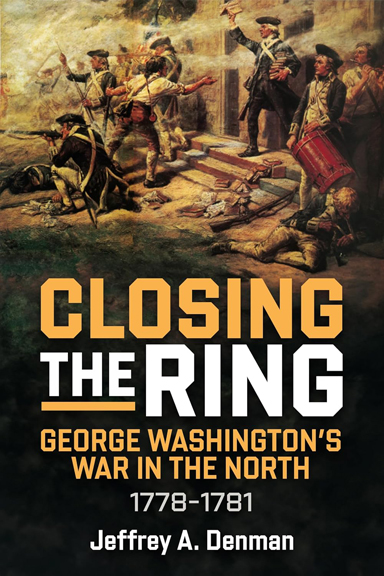 As Denman puts it in his introduction, “Many historians describe the period from the Battle of Monmouth Courthouse in New Jersey (June 1778) to Yorktown (October 1781) as a stalemate. As many see it, no major battles took place, and territory was neither gained nor surrendered.” After stressing that the period was critical to Gen. George Washington’s role as a commander, he says on the scholarship, “Little has been written about this specific time period for the general reader, although it is heavily documented in journals, diaries, and letters from the participants.”
The “stalemate” label, as the author tells, comes from Washington being unable to remove British Gen. Henry Clinton’s army from New York City and Clinton never destroying Washington’s army. For Denman, there is another story in Washington growing into his role during these years which he tells through primary sources like journal entries, correspondence, dispatches, and a variety of secondary ones.
Campaigns like the Hudson Highlands, New Jersey, and Connecticut when British Gen. Bendict Arnold made his return to his home colony to attack Groton Heights are documented while readers also find familiar ground in months leading up to Yorktown along with Arnold’s betrayal. As the title suggests, this is mostly a Washington-centered book and military history. Denman puts a considerable amount of history into just 179 pages.
The reader is met with a barrage of information about troop movements, decisions by commanders, their plans for attack, dates, and primary source quotations in a manner than can be overwhelming. Spacing this period out in a history over 200 pages would have given readers an apt chance to digest information, but to some, this critique may be splitting hairs.
Denman, to assuage the reader after inundating them with so much information in a few pages, gives a summary of what the commander-in-chief went through in the final pages of his last chapter, “I Propose a Cessation of Hostilities.” His choice of adjectives for Washington in Closing the Ring could prove jarring for a general audience, who may be prone to lionize Washington as a superior commander given the simple fact he won the war. In the introduction, he writes, “Washington was not a great military strategist.” Where Demman says Washington shines was in his ability to lead, but his “greatest legacy was his character and how he manifested that throughout the Revolution.” To the author’s point, King George III said as much when learning that Washington resigned his command and retired to farm life after the war, calling him, “the greatest character of the age.”[1]
Although statements that downplay Washington’s military abilities would be blasphemous to the patriotic and proud reader, for historians they are more an effort at an honest assessment. Denman does not look to castigate Washington, but to give the clearest possible portrait of his wartime career. The book belongs in a larger conversation about the Founding Fathers and scholarship seeking to humanize them, but this would be the subtext to the overall purpose for Denman. He provides audiences with a detailed account of a seemingly less remarkable period during the war that provides students of it with a more holistic understanding.

[1] American Battlefield Trust. “1783: George Washington Cements His Legacy,” July 31, 2024. www.battlefields.org/learn/articles/1783-george-washington-cements-his-legacy.
PLEASE CONSIDER PURCHASING THIS BOOK FROM AMAZON IN HARDCOVER or KINDLE.
(As an Amazon Associate, JAR earns from qualifying purchases. This helps toward providing our content free of charge.)

Recent Articles
Closing the Ring: George Washington’s War in the North, 1778–1781
The Long, Sad Life of the Continental Frigate Delaware
James Wilson and Popular Sovereignty: Recovering the Democratic Foundations of the American Constitution
Recent Comments
"The Milford Connecticut Cartel"
I am interested, if you found any of the Milford Connecticut ladies...
"Gotthold Frederick Enslin: A..."
Holy smokes! I'm the researcher who did all the work for Conduct...
"“We Will Cross at..."
VDHR historians do not research every historical marker. This is usually done...