

After two hundred and fifty years, there couldn’t possibly be any more stories hiding away in the Declaration of Independence, right? The shelves groan with the collective weight of all the books written about it, not to mention the untold gallons of ink expended by social commentators, historians, political scientists, cultural critics, activists, radicals, and heads of state the world over analyzing what Jefferson meant by all men being created equal, what a self-evident truth is, or how one can pursue happiness. Of all the mines of human history, the Declaration has to rank among the most picked over. There simply cannot possibly be any more gold left in this one. Last year, when I began yet another excavation of the Declaration, what became my book Tyrants and Rogues: Understanding the Declaration of Independence, I could scarcely have dreamed there was any more precious metal still hiding down there. I was wrong.
Finding it does require traveling deep down into the crevasses of the mine. Americans usually can’t be bothered to do this. They typically stop with those stirring phrases in the opening sentences. For a time, recently, they even recited them before the big game on Super Bowl Sunday: whenever the Fox Network had the rights to broadcast the Super Bowl in the early 2000s, they programmed a long pregame sequence with famous retired football players and coaches standing in front of famous American places reading phrases from the Declaration, further cementing that day as America’s second national holiday. But they only read the first paragraphs and some of the bits at the end. The entire body of the document received no attention from TV producers or the NFL. For the vast majority of Americans, the opening lines are all there is to the Declaration of Independence.
But if we want to truly understand the document—to grasp what Jefferson and the Continental Congress were worried about on July 4, 1776 and to make sense of who they meant by the “we” of “we hold these truths to be self-evident”—it pays to go much deeper into the mine. Down there lies an untold story and an equally unnoticed procedural move that change how we see both the Declaration and the American founding itself.
* * *
Jefferson assembled the grievances that make up the body of the Declaration in a specific order. The first dozen are about executive overreach. They list all the specific examples of King George III and his assistants, especially members of his Cabinet and royal governors in the colonies, taking steps to destroy American liberty. Those acts of tyranny include wielding the royal veto on American laws, dissolving American legislatures, occupying American cities with soldiers, and even blocking colonial attempts to encourage foreign immigration. The next ten grievances concern Parliament. Jefferson and Congress rejected all of Parliament’s attempts to make laws on colonists’ behalf without their having any representation there. The last set of grievances focused on the first year of the Revolutionary War. Here, the drama increases. Just look at the verbs: in the first few grievances the King was “fatiguing” American colonists. Now he’s murdering them.
The original rough draft that Thomas Jefferson submitted to Congress on June 28 had twenty-nine grievances. We know he was working diligently on this particular part of the document in the few days leading up to his deadline. A little more than a week before he had to turn it in, Jefferson let John Adams have a peek. Whether or not the author knew it, Adams made at least two fugitive copies of Jefferson’s draft and sent them home to Massachusetts, one to Abigail and another to a friend in Boston. From Adams’s copies, we know that at some time in the last week of June Jefferson added three grievances, one to each of the three sections of the body. He added one to the executive overreach section, one to Parliament’s “pretended legislation” list, and one to the war grouping.
It’s likely the first two came from John Adams himself, since they both involved issues he was directly involved with and interested in. But the third is more of a mystery.
That grievance, inserted by Jefferson in tiny script on the middle of the third page of his manuscript copy, reads: “He has constrained our fellow citizens taken captive on the high seas to bear arms against their country and to become the executioners of their friends and brethren, or to fall themselves by their hands.” This accusation, rife with evocative phrases, is about impressment—the eighteenth-century English practice of filling out ships’ crews through forced recruitment.

Impressment sparked outrage wherever the Royal Navy tried it. Sending press gangs out to roam around British and American cities looking for any idle seafarer they could coerce into service was an ugly business. Controversy always followed this officially sanctioned kidnapping, and often it led to civil unrest. In 1747, press gangs in Boston caused a three-day riot as hundreds of the city’s inhabitants fought back, breaking windows, throwing the deputy sheriff in the stocks, and setting boats on fire.[1]
Impressment, by definition, seems to be the polar opposite of “life, liberty, and the pursuit of happiness.” It stands to reason that if the Royal Navy had been pressing colonial Americans to serve on Royal Navy ships against their will in 1775-1776, it would be something the Declaration of Independence would want to feature.
Except, they weren’t.
Admiral Samuel Graves, commander of the Royal Navy squadron in North America, had done his best not to press American colonists. Late in 1775, he said “we have hitherto avoided as much as possible entering American seamen on board the King’s ships,” stating they would either immediately try to escape or, worse, assist “their Countrymen in rebellion.” A thorough investigation of the Naval Documents of the American Revolution, the massive effort begun during the Kennedy Administration to publish all the evidence concerning anything afloat during the Revolutionary War, turns up surprisingly little impressment. There are more than 6,000 pages of documents concerning naval affairs during the fifteen months between the start of the Revolutionary War and the Declaration of Independence. In all those pages, I found five instances of Royal Navy captains seizing less than two-dozen colonial Americans during that time. None of them were forced to “bear arms against their country” or “become executioners.”[1]

Until page 429 of volume five of the Naval Documents. There, 6,200 pages in, the editors included a two-sentence affidavit, published in a Philadelphia newspaper, that detailed the saga of a ships’ mate named William Barry. Sometime late that spring, Barry, on board a small ship named Grace operating out of Philadelphia, was seized by a Royal Navy warship the HMS Roebuck near the mouth of the Delaware River. The Roebuck’s captain, Andrew Snape Hamond, ordered Barry and his fellow crew to serve onboard his ship against their will.[2]
On May 7, 1776, Barry would be one of several prisoners forced to “bear arms against their country.” Afraid that the city might be bombarded, Revolutionaries in Philadelphia sent what protection they had—a flotilla of “gondolas,” which were rather pathetic rowboats with a single cannon mounted on the front – to go out and engage Hamond’s Roebuck and his small group of ships. Booms from the cannons could be heard in Philadelphia that afternoon, as the gondolas fought a long battle opposite Wilmington, Delaware. The Roebuck was raked with cannonballs after it ran aground on the shoals. Hamond decided to take his damaged ship and William Barry away from the treacherous Delaware River Basin and went south to the lower Chesapeake Bay, to aid the embattled Lord Dunmore, Virginia’s royal governor, who had holed up on a small island named Gwynn’s to try to stop the smallpox raging through his forces.[3]
Those forces included hundreds of runaway enslaved people from Maryland and Virginia, after Dunmore had issued a proclamation offering emancipation to Virginia’s enslaved people the November before. Hundreds of enslaved men, women, and children risked the dangers of getting caught trying to find the governor, or contracting a lethal disease once they did reach him. One enslaved person seeking freedom had recently pulled up onto Gwynn’s Island in a stolen canoe. William Barry stole it right back, using it to run away from Hamond and the Roebuck. By June 8, he was in Baltimore where he recounted his story about how he had been “obliged to fight against [his] friends” in the battle with the gondolas off Wilmington.
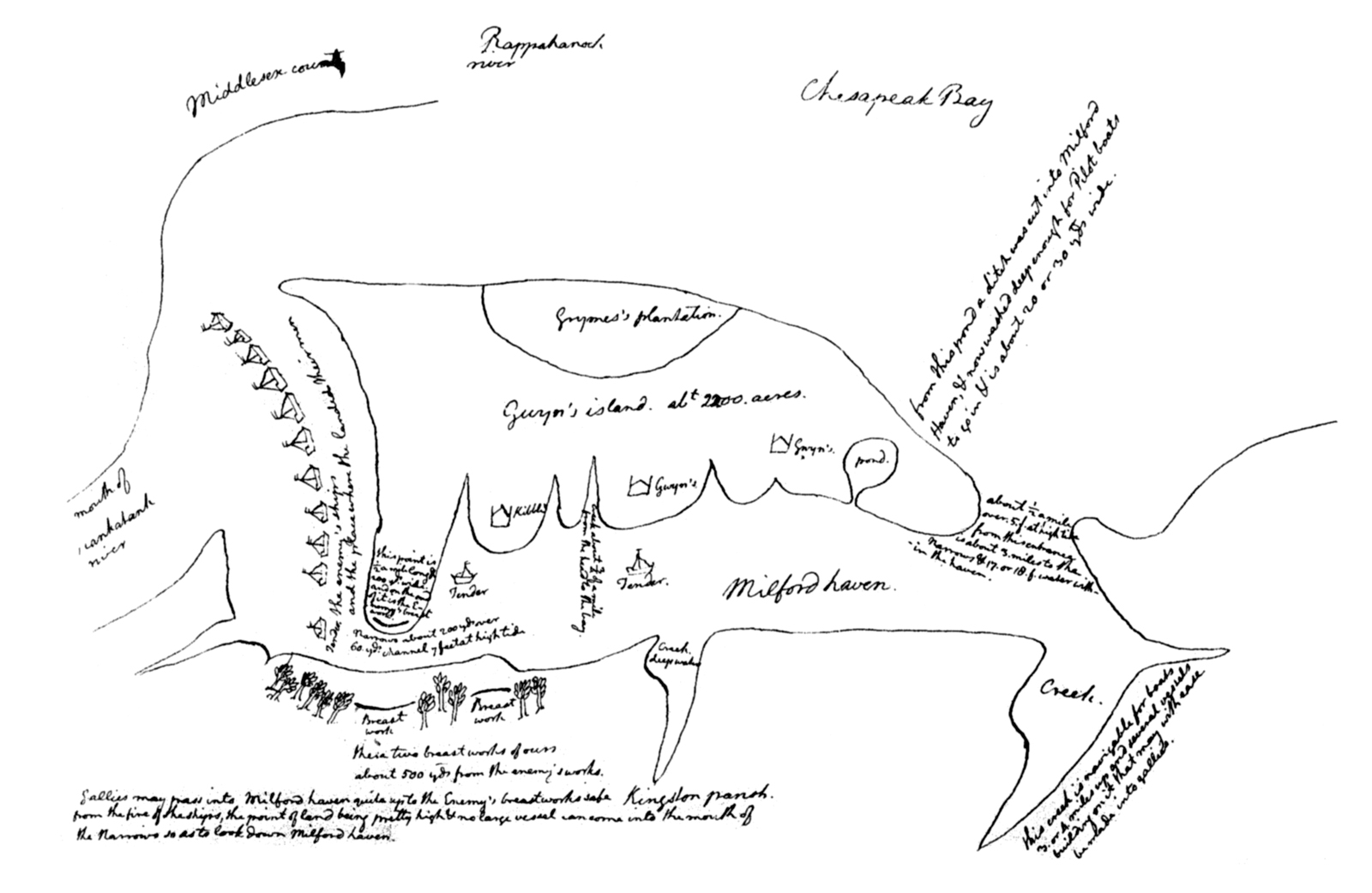
The testimony Barry gave in Baltimore was printed in a Philadelphia newspaper on June 12—one day after Thomas Jefferson got the assignment to write the Declaration of Independence.[4] We cannot be sure if he personally read the story, but there is powerful circumstantial evidence that his eyes would have been drawn to it. We do know he was VERY concerned about what was happening on Gwynn’s Island, given that his papers contained an extraordinarily detailed sketch of the island, where Dunmore’s forces were, and the fleet assembled on one side that Barry escaped from. The Barry story mentioned Gwynn’s—and it was one column over from another story about Gwynn’s. All Jefferson would’ve had to do was move his eyes two inches to the right to see it.

And then there’s the timing. The impressment grievance was not in Jefferson’s draft when John Adams read it in the third week of June. It is one of the three added after that, in the week before he turned in the final draft. At some point during the last few days of June, it appeared.
Eureka! Gold! The likelihood that this one particular instance of impressment, especially given that Barry’s published testimony provides almost the exact same words as Jefferson’s freshly added grievance (both invoke the notion of fighting against their friends) is strong evidence that this one incident served as the basis of this grievance. Although it was long established in Anglo-American culture that impressment was not only a detestable act but the epitome of tyranny it seems very likely that William Barry’s singular adventure was the impetus for an entire charge in the Declaration of Independence. His experience of being constrained and forced to fight against his countrymen is a story hidden no longer.
* * *
There’s more. The draft Jefferson turned in would eventually have twenty-nine grievances to it. In their editing sessions of July 2 and 3, the delegates to the Continental Congress pored over the draft making suggestions and edits. Again, the sentences that we are most familiar with survived intact. Where Congress made the majority of their edits were in this section, particularly with the war grievances.
There were initially seven war grievances. The King had waged war against us (#23), burned our towns and destroyed our lives (#24), transported foreign mercenaries to kill us (#25), employed “merciless Indian savages” also to kill us (#26); and impressed our sailors (#27). Numbers twenty-eight and twenty-nine came under extraordinary scrutiny by the members of Congress. One was an accusation of the King inciting “treasonable insurrections” of Americans with the promises that if they did, they would earn financial rewards and property (#28). The other, far longer than any that had come before, was Jefferson’s screed against the trans-Atlantic slave trade. It was a 168-word diatribe, complete with underlined and capitalized words, that referred to the practice as an “assemblage of horrors,” “piratical warfare,” and “execrable commerce.” It was actually in two parts: the first being in the past tense about how the King had promoted the slave trade in the colonies, and then it pivoted to the present tense, saying “he is now exciting those very people to rise in arms among us,” a reference primarily to Dunmore’s emancipation proclamation.
Jefferson’s slave trade grievance caused a ruckus in Congress. “Southern gentlemen whose reflections were not yet matured to the full abhorrence of that traffic” objected, he later remembered. But not only them. “Our northern brethren also I believe felt a little tender under those censures, for tho’ their people have very few slaves themselves yet they had been pretty considerable carriers of them to others.” [5] Jefferson squirmed as delegates took their pens to this particular part of his draft. They cut the reference to “treasonable insurrections” and the past tense portion of the slave trade grievance. The present tense part, however, was more than acceptable. Alerting the colonial population to British attempts to “incite,” “excite,” or otherwise “tamper with” the enslaved population in America had been one of their chief concerns over the past year.[6] Whereas news of slave insurrections had been one of the most concealed and silenced topics in print before the 1775, now it was something the Revolution’s leaders broadcast as widely as they could. One British official wrote at the end of 1775, “the newspapers were full of Publications calculated to excite the fears of the People . . . Massacres and instigated insurrections were Words in the mouth of every Child.”[7] That had not happened accidently; patriot political leaders like John Adams, Benjamin Franklin, and their colleagues had put those words in their mouths.
The delegates to Congress were not going to let this opportunity slip away. After all their investment making the public aware of British conspiracies to get enslaved people to participate in putting down the Revolution, they had to feature it in the Declaration. So they wrote a new phrase: “He has excited domestic insurrections amongst us.” The term “domestics” was a popular euphemism for enslaved people in 1776. They added it to the grievance referencing Native peoples aiding the King, in effect crafting a double-shot at the King for plotting to get all sorts of people to help destroy American liberty. That grievance would now read: “He has excited domestic insurrections amongst us and has endeavoured to bring on the merciless Indian savages, whose known rule of warfare is an undistinguished destruction of all ages, sexes, and conditions.”
* * *

Then they did something that has gone almost entirely unnoticed for two hundred and fifty years. Had they stopped there, the order of the final grievances would have been: 23. Waging war; 24. Destroyed our lives; 25. Foreign mercenaries; 26. Enslaved people and Native people; 27. Impressment.
But that’s not the order in which they appear in the Declaration. The final copy does not end with impressment. That means someone in the room made a motion to swap the order of the final two grievances.
On Jefferson’s rough draft, now preserved at the Library of Congress, there are two tiny Xs marked in pencil next to the final grievances that indicate the swap. In even tinier handwriting Jefferson wrote “He has constrained, etc” next to where the impressment grievance was now to appear. That is the only suggestion of the swap. Ever after, when Jefferson made copies of his rough draft for his friends, like for James Madison in 1783, he silently made the swap, as if it had been his idea all along.
In all of our many, many studies of the Declaration, only one scholar has noticed this before. In 1943, Julian Parks Boyd, who would soon become the editor of the Papers of Thomas Jefferson, auditioned for the job by writing a forensic analysis of all the minute changes to the Declaration’s drafts as it went through its many rounds of editing. In The Declaration of Independence: Evolution of the Text, Boyd wrote exactly four words about what happened: “Congress swapped the sequence.”[8] That’s all. Not why they did so—or what it might mean. It has been a swap not heard ’round the world.
* * *
So what? Why did they make this move? None of the other grievances were switched around like this. Why these two?
Perhaps it was the problems surrounding impressment. Although impressment was undoubtedly a visceral charge, it was lacking in factual evidence and massive public outcry for the first year of the war. This was certainly not the case with African Americans and Indigenous people in 1775-1776. Congress needed the grievances to be iron-clad, to prove to the “candid world” their reasons for revolution were unimpeachable. William Barry was already carrying a great deal of water for the final one to rest on his shoulders.
Or maybe the swap was made was to placate Jefferson, who really wanted the grievances to end with a statement on slavery. We don’t know who raised their hand to suggest the change. Maybe it was Jefferson himself. But someone did.
Whoever made the motion, the swap tells us a great deal about what was going on in the minds of the fifty-five delegates to the Congress on July 4, 1776. There was and is enormous power in those two tiny pencil marks. It was not an accident that the bloody and visceral language of the twenty-seventh grievance seems like a rhetorical climax to the “long train of abuses” listed in the Declaration. The delegates took specific steps to ensure everyone who read or listened to the Declaration in 1776 would have that feeling. They were adamant that fears of enslaved and Native peoples working with the King must conclude the list. Even though it has gone almost entirely unnoticed, it is clear that, with purpose and intention, Congress made certain that the Declaration’s grievances would end with race.
All that fuss about the last few grievances reveals an extraordinary amount of contingency and chance. Jefferson, Adams, Franklin, and their colleagues rushed about during those hot days of late June and early July 1776 making lots of changes to this part of the Declaration, in part as a response to stories that were “ripped from the headlines.” There are still things we are still learning about those hectic days. Even in this most picked over of mines, hidden treasure remains. But what they landed on: embedding those particular words at that particular spot in that particular document proved to be a powerful statement about who was and was not included as part of the American people on July 4, 1776.
We need to understand the consequences of what happened during those days, of the power of the words Jefferson and Congress chose to feature at the Declaration’s climax. There were no asterisks there to exempt all the African Americans or Native peoples who sided with the Revolutionaries, of which there were considerable numbers. Rather, they were all lumped together as one collective set of enemies, working with the tyrant King, to deprive Americans of their life, liberty, and their capacity to pursue happiness. The notion that people of color are somehow not fully part of “us” or the “we” is not a recent phenomenon. It is as old as the United States itself.
[1] Christopher P. Magra, Poseidon’s Curse: British Naval Impressment and the Atlantic Origins of the American Revolution (Cambridge University Press, 2019).
[1] William Bell Clark, ed., Naval Documents of the American Revolution (Washington, D.C., 1963-), 2:17, 139, 189, 987, 1269; 3:513.
[2] Clark, ed., Naval Documents of the American Revolution, 5:429.
[3] William Hogeland, Declaration: The Nine Tumultuous Weeks When American Became Independent (Simon & Schuster, 2011), 38-41.
[4] Pennsylvania Journal, June 12, 1776.
[5] Thomas Jefferson, Autobiography, in Merrill D. Peterson, ed., Thomas Jefferson: Writings (Library of America, 1984), 18.
[6] Robert G. Parkinson, Thirteen Clocks: How Race United the Colonies and Made the Declaration of Independence (University of North Carolina Press, 2021).
[7] John Richard Alden, “John Stuart Accuses William Bull,” William & Mary Quarterly 3rd Series 2 (1945): 320.
[8] Julian Parks Boyd, The Declaration of Independence: Evolution of the Text (Library of Congress, 1943), 30.
Recent Articles
From Roxbury to Exeter: The Evolution of a Revolutionary Song
This Week on Dispatches: Davis Richardson on Lafayette, Jefferson, and Revolutionary Ideas
An Irruption into Canada: The Planned Winter Campaign of 1778
Recent Comments
"“We Will Cross at..."
VDHR historians do not research every historical marker. This is usually done...
"Thomas and Peter Costner..."
I wanted to issue a short correction. In the article, I stated...
"Washington’s Invalid Corps: Wounded..."
I think some members of the Invalid Corps garrisoned Fort Trumbull in...