



On October 13, 1775, Congress resolved to buy four merchant ships and convert them to warships. Three more ships were soon acquired. A naval committee was established. The Continental Navy was created.
On December 11 Congress authorized a new committee to devise ways and means of developing the navy. A member of the congress from each colony was elected to the committee. That committee reported on December 13, and after a short debate, congress resolved “That five ships of thirty-two guns, five of twenty-eight guns, three of twenty-four guns, making in the whole thirteen, can be fitted for the sea.”[1]
William Whipple, delegate to the congress from New Hampshire, wrote that thirty-one days after the December 13 resolution Joshua Humphreys “laid the plans of several men-of-war” before the marine committee.[2]
Building of the ships was parceled out to various major shipbuilding yards of the colonies. The greatest number of ships, four, was assigned to shipyards along Philadelphia’s Delaware Riverfront. One of thirty-two guns, later to be named Washington and commanded by Thomas Read, was assigned to the Eyre Brothers yard. The second of thirty-two guns was to be commanded by Nicholas Biddle and named Randolph, built by Wharton and Humphreys. Another, of twenty-eight guns, later to be named Effingham and commanded by John Barry, was given to the Grice yard. Finally, the smallest, of twenty-four guns was assigned to the Warwick Coates yard. Those Philadelphia ships were built under the close supervision of the marine committee. To exercise its control the committee formed a Commission for Building the Philadelphia Frigates. Functioning under the commissioners were four sub-committees.[3]

The Warwick Coates shipyard was on the extreme southern end of the Delaware River waterfront in the Southwark area of Philadelphia, not far from the Humphreys yard. Construction of the twenty-four gun ship was assisted by Richard Dennis and workers from the adjacent yard. She was built to the design provided by Joshua Humphreys.[4]
On June 6, 1776, the frigate was named Delaware. Capt. Charles Alexander was assigned to command. Alexander was an experienced officer, having commanded several vessels for the Pennsylvania and Continental navies.[5]
Delaware was launched on July 10, 1776. Like many early Continental ships, she was likely painted black below the waterline with yellow sides broken by gunports with black mouldings and topped with a black gun ridge. Completion was slow for lack of resources.[6]
By December, General Washington’s army had retreated from New York through New Jersey and was losing men rapidly. It camped on the Pennsylvania side of the Delaware River Valley north of Philadelphia. The Philadelphia Associators militia under Gen. John Cadwalader and many Philadelphia men went to join Washington in defense of their city. Alexander, Barry, Read, and other Continental navy captains volunteered to take what men and cannons they could acquire and reinforce the army.[7]

As congress fled to Baltimore, Robert Morris of the marine committee remained in Philadelphia, intent on getting the active ships of the Continental navy out of the city to sea. He also wanted to get Delaware out.
On Viewing the Frigate Delaware I thought it possible to get her away before Genl Howe coud get here I have therefore set about it stoutly, a Number of People, scarce as they now are her, are at Work on her, the Sails will be bent, Anchors to the Bows, Stores on bd and everything in some forwardness tomorrow. I have sent an Express to the General informing him of my design & requesting him to send down Capt Alexander his Officers & such Seamen as are willing.[8]
Washington forwarded the letter to Cadwalader, but the Philadelphian had a role to play in Washington’s Christmas celebration and did not release Alexander and his men.[9] Morris remained in the dark and frustrated. After asking the Pennsylvania Council of Safety for help, and getting none, he wrote congress,
a kind of stupor seems to have seized everybody that ought to give us assistance, so that it is inconceivable how slowly all work goes on & with how much difficulty we can get anything done. I have applied to the Council of Safety to order down some Tradesmen to finish the Delaware, if possible, they wish but fear to Comply and if they do not she must after all remain here.[10]

Alexander finally returned on December 26, with news of Washington’s crossing the Delaware and his victory at Trenton.[11] With Captain Alexander in Philadelphia and the threat passed for the winter, work on Delaware picked up. Even troops of the Maryland militia were “helping to fitt out the Deleware.” The Pennsylvania Navy Board provided workmen and supplies, and as she was finally ready, iron for ballast.[12]
As a result, in March, John Adams was able to write his son, “Yesterday, I took a Walk upon the Wharves, to see the Navigation. The new Frigate called The Delaware, is hawled off, into the stream and is ready to sail. Captain Alexander is to command her. She makes a fine Appearance.”[13]

On April 8, Captain Alexander was ordered to take Delaware to sea, train his crew, and then patrol the coast.[14] On April 11, Adams wrote his wife that “The fine new Frigate, called the Delaware, Capt. Alexander, has sailed down the River. I stood upon the Wharf to see the fine figure and Show she made.”[15]
It was a short cruise. Delaware was back in Philadelphia by April 30 and ordering supplies throughout the summer.[16]
In May 1777, twelve officers stationed in Philadelphia presented a petition to the marine committee via Capt. John Barry, who was the senior Continental naval officer in Philadelphia. The officers were requesting better pay and allowances, “it Being impossible for us to Support Ourselves & Families much More to Lay in the Smallest Stores for Sea – That Several of us are Under Sailing Orders & Others will no Doubt Shortly follow.”[17] In addition to their petition the officers, including several assigned to Barry’s and Alexander’s commands, including Alexander’s 3rd Lt. Joseph Greenway, announced they would not do duty until their grievances were redressed.
Barry angrily recommended courts martial, which were approved by the marine committee. He and Read presided. After issuing a verdict of guilty and recommending dismissal, the captains recommended that the officers apologize to the marine committee and ask for reinstatement. The committee accused the officers of trying “to extort increase of pay and allowances from the public.” As a result, congress resolved that the officers be “dismissed and their commissions be rendered void and of no effect.” That decision was reversed the next day after the officers visited the committee and applied for reinstatement.[18]
In early June, John Adams observed the Continental ship Andrew Doria and “the fine new frigate Delaware moored at Fort Island.” Fort Island was the base of the Pennsylvania navy. In the middle of the month, congress resolved that Continental navy ships should cooperate with the Pennsylvania navy and the two boards met to resolve command and control.[19]
On the Fourth of July 1777, ships of the Continental navy and Pennsylvania navy gathered in Philadelphia to mark the first year of national independence. They dressed ship and sailors manned the yards and tops. A delegation led by President John Hancock, with the members of the marine committee and other dignitaries, was rowed out to Delaware. When they boarded, the crew rendered a thirteen-gun salute.[20]
A small British fleet commanded by Capt. Andrew Snape Hamond blockaded the Cape May channel, the entrance to the Delaware river. In response to the marine committee’s urging, the navy board of the middle department formed a plan to open the channel to merchant shipping. Continental ships were to be stationed there to protect incoming and outgoing ships from the blockading force. On August 5, the commanding officer of the Andrew Doria was given a force of four Continental navy vessels and two Pennsylvania navy vessels to carry out that mission. He was also advised that Captain Alexander had been instructed to give him as many men from his ship as he needed. Rather than do so, as senior captain Alexander assumed command of that force.[21]
Before Alexander got his force down the bay, on August 21, an observer informed the Pennsylvania navy board,
At 6 o’clock this morning one of the Enemies Ships and 2 schooners abreast of Bombay Hook. At 2 o’clock this afternoon Captain Alexander, the frigate Delaware have out a signal for getting underway, sending the smallest vessel ahead with himself in the senter and the other ships with the five vessels in the rear.[22]
The British force was led by the frigate Pearl accompanied by her tender and two schooners. She had been anchored off Bombay Hook since morning while the schooners were foraging along the shore for water and provisions. Upon sighting Alexander’s force, at 3 p. m. Pearl fired several guns to warn her schooners and at 4:30 turned downriver and fired more guns to signal the others to withdraw. Seeing Pearl turn down river, Alexander captured one of the schooners full of provisions and tacked back upriver. Unknown to Alexander, about 5 p. m. Pearl ran aground and was vulnerable until 10 p.m.[23]
A similar confrontation occurred on August 24, when Alexander took his force down river only to be confronted by three frigates, Liverpool, Camilla, and Pearl. He retreated quickly, outrunning the British who had to be more cautious in the narrow channel.
Seemingly oblivious to the strength of the British now moving up the bay, the navy board of the middle department gave Alexander instructions to attack them.[24] Preparing for that mission, he issued a set of signals to be used by the captains of the ships under his command to provide warning, and to receive his commands to assemble, organize for engagement, employ specific ships, chase, leave off chase, and withdraw.[25]
Captain Hamond’s fleet consisted of the forty-four-gun Roebuck, thirty-two-gun Pearl, twenty-eight-gun Liverpool and Solebay, twenty-gun Camilla and sixteen-gun Merlin.[26] Alexander moved his force off Billings Port, New Jersey behind the first set of channel obstructions. On September 15 he sent Robert Morris a warning:
you may Sune expect to here of the Enemy having Billings Port in Possession and your strength by water [his force] of no service, for one hundred men crossing at or below Chester at night [might] have it in Possession by morning and Command Your Batteries and what other Vessels may be stationed there
If that occurred, Alexander concluded, “your city will much sooner be in their hands if Attention is not given to the [British] Vessels.” He understood that, if Billings Port were in British hands, he could not remain, and British ships could arrive to begin removing obstructions, clearing the way to attack the forts defending Philadelphia. Alexander moved his force back to Fort Island.[27]
A British fleet carrying Gen. William Howe’s Army landed troops at Head of the Elk River in Maryland on August 25. After recovering and reorganizing, General Howe led his army into Delaware and then Pennsylvania. After defeating Washington’s army at the Battle of Brandywine on September 11, part of his army moved into Wilmington and Hamond took his naval detachment there.
By September 25 British troops were near Philadelphia. As they approached the city, congress ordered the frigates still building in Philadelphia, Washington and Effingham, to be taken up the river to be stripped and scuttled. Alexander’s Delaware was the largest ship left to defend the city.[28] On September 26, a British observer reported,
Near to Mud Island . . . the rebel fleet are lying, and consist of the Delaware frigate of twenty-eight guns, 12 and 9 pounders; the Province ship, [Montgomery] of eighteen 9 pounders; two large briggs, of ten and eight guns; two Zebec’s of ten guns each; eight smaller armed vessels; thirteen gallies, each one 18- pounder on board; two floating batteries, of ten and nine 18-pounders, seventeen fire vessels, besides a great number of fire rafts.[29]
That day the continental marine committee informed Capt. John Hazelwood, commodore of the Pennsylvania navy, that “orders are this day sent to the Commander of the Continental armed Vessels to be subordinate to your Command in defending the River.” Hazelwood then ordered Alexander,
to proceed with your Ship & Ship Montgomery & the Fly Sloop all under your command, up to the City of Philada & there to do every thing in your power with the force with you to annoy the enemy should they attempt to come into our City; & should you see them preparing any works for Cannon, or hawling Cannon near this River, You are in that case to send a Flag on Shore & warn them if they do not desist in making any preparations of fortifying any where, that you will in that case fire on the City, & as repetition of order on this occasion is unnecessary, must leave the conduct & management of the whole to your prudent & effectual management.[30]
In accordance with those orders, Alexander led his force northwest upriver, passing the Schuylkill and turning north into the Southwark area of shipyards where Delaware was built, arriving on the morning of the 27th.[31] Enroute he had drafted a letter to the commanding officer of the British army in Philadelphia:
its my Entintion to Prevent the Efusion of Blod as much as in My Pour therefore I do Aquant you if you Atimpt to throw Up Any Works So as to Anoay Any Vessils from Passing or Repassing I shall Give Orders for the City to be Demolished you most Luck on the Blod of the Woman & Childron to Lay at your Duor.[32]
The British artillery was already in place and had been warned, but they had been ordered not to fire unless fired on. One light battery that had been moved to a wharf and positioned facing down river had missed the order. As Delaware, in the lead, came within 400 yards, that battery opened fire.
Alexander returned fire with Delaware’s bow gun. At that, the shore batteries opened fire with no immediate effect. Alexander tacked to get off a broadside. But, in tacking, the ship slightly grounded on the shoal at the south end of Windmill Island. As the sailors urgently reworked the sails, the ship was momentarily a stationary target, the type target for which army gun crews are trained. A British observer recorded,
our artillery being extremely well directed . . . She was 2 or 3 times on fire owing to one of our shot having drove through her caboose, it not being easily extinguished was also owing to one of our Royal Howitzers having burst within her near the bows.
That second shot caved in the deck and added fuel of shattered timbers to the caboose fire. The forward gundeck of the ship was ablaze. Alexander had to get his men off the ship before the fires reached the gunpowder on deck and in the open magazine. With one man already killed and six wounded, Captain Alexander struck his flag. The other Frigate and four Gallies in great haste put about and went back to the fort.[33]
The British dispatched a boat with grenadiers, an engineer, and carpenters. They axed out the burning timbers and threw them overboard. The grenadiers directed the crew into boats, landed them near Old Swedes Church in Wilmington and marched them thirty miles to the Pennsylvania State House in Philadelphia. To avoid further punishment and possible transfer to the Walnut Street Prison, some signed on to the Royal Navy and were sent to augment the crew of Roebuck.[34]
While moving north, Alexander had given his force orders that “All the Shallops flats or Boats you Can find on the Pisylvania Shoar you are to take off or Destroy them By fire or Otherways.” They did not succeed. The British “found . . . about 50 Boats of all sorts and procured a Durham boat.” Now General Howe had what he needed to send troops to cross the river, march south, and take Billings Port from the rear, as Alexander had warned.[35]
Without American on-scene reports of the action, General Washington was wondering what had happened. On October 3, he reported to the Continental Congress that,
we have sustained an additional loss in the capture of the Delaware. She fell into the Enemy’s hands in a day or two after they were in possession of the City, and in a manner not yet well understood. Some have supposed the Crew mutinied, while another report is, that she was disabled in her Rudder by a shot and drove on shore.[36]
That was not the end of the war for either Captain Alexander or Delaware.
Alexander and his officers were taken to Philadelphia and confined in the Pennsylvania State House (Independence Hall). On the night of November 30-December 1, Alexander and four of his officers, including Lieutenant Greenway, engineered a daring escape. They climbed up in the clock tower, removed the wooden panels blocking the belfry and, using the weights removed from the clock, threw lines over the side on which to descend.[37]
Soon Alexander was in contact with the marine committee of congress, then in York, Pennsylvania. In January 1778, a letter from the Middle States Continental Navy Board informed General Washington at Valley Forge that,
The Bearer Captain Alexander late of the frigate Delaware is well informed of the Situation of Shipping at Philadelphia, & is of the opinion that with a little Assistance the Enemy might be annoyed greatly in their Trade and Shipping whilst the river continues full of ice . . . The few naval Officers here are very anxious to do something against the Enimy whilst the present Opportunity offers.[38]
Alexander and others did get that opportunity. A letter from George Washington later that same month stated,
Captain Alexander to whom I have given an order to take several pieces of Cannon with a proper Supply of Ammunition that he, in conjunction with other Gentlemen of the Navy may endeavor to interrupt the Enemy’s shipping in their passage up and down the River.[39]
Delaware had also been taken as a captive to Philadelphia. The now-HMS Delaware was placed under Commander James Watt as part of Capt. Andrew Snape Hamond’s squadron. He was ordered to take men off prize ships and enlist them as crew.[40]
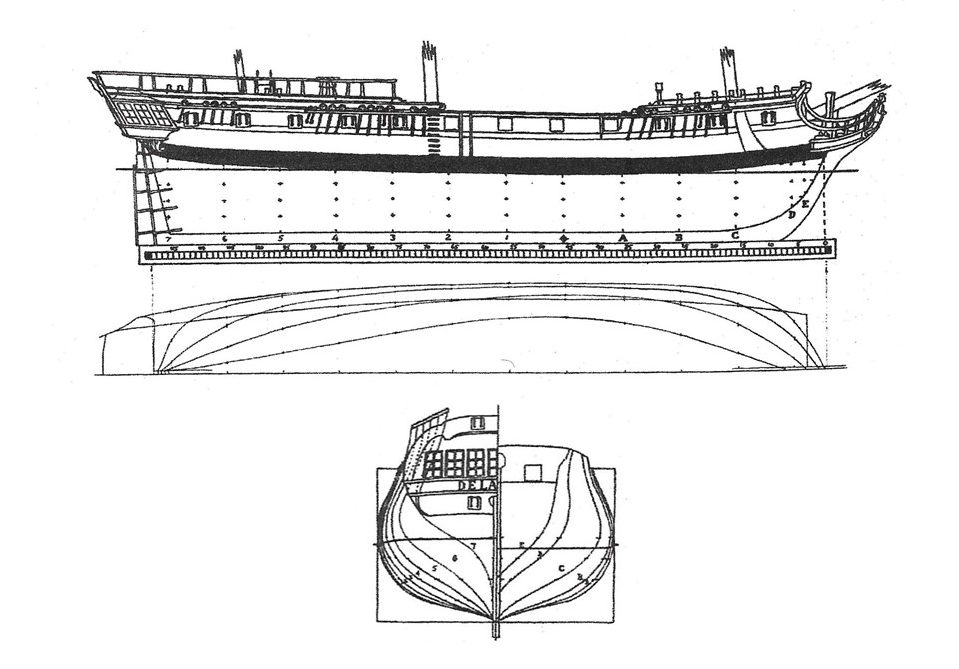
As they assessed her capabilities, Admiral Howe optimistically reported to the Admiralty that,
Dimensions of the Armed Ship named the Delaware . . . Length on the Gun Deck, 121 Feet . . . The Ship lately built, Mounts twenty four Guns on the Upper Deck; And when furnished with proper Artillery, capable of carrying twelve Pounders with great facility.[41]
Later he reported that he had stripped another ship and “our nine-pounders have been taken from that Ship for Arming the Delaware frigate; the guns of which (cast in this country) have been inspected and are deemed unserviceable.”[42]
On June 6, 1779, HMS Daphne captured the American privateer Oliver Cromwell. Delaware and the privateer Union were in company and so shared in the prize money. On December 1 Delaware escorted a convoy of supply ships to Bermuda, brought some 100 officers and men, and stayed to defend the island. She and the troops arrived in time to forestall an attack by four American naval vessels. On April 21 and 23, 1780, Iris, Delaware, and Otter captured the American privateers Amazon, General Wayne, and Neptune off Sandy Hook and Iris and Delaware brought them into New York. HMS Delaware, commanded by Capt. Christopher Mason, also served during the siege of Charlestown, South Carolina, in 1780.[43]
During those years, Captain Alexander was also back in action. In December 1778, he was captain of the Pennsylvania twelve-gun privateer sloop Elizabeth. By May 1779, he was commanding the Pennsylvania fourteen-gun privateer brigantine Active. In March 1782 he signed on as captain of the Pennsylvania fourteen-gun privateer ship General O’Reilly. He and his ship were lost at sea.[44]
At the end of the war, HMS Delaware was sold to Mary Hayley, a well-born, cultured, twice-widowed, wealthy owner of a large British trading company in partnership with the Rotch family of Nantucket and New Bedford. She renamed her United States and sailed for Boston to collect pre-war debts. She immediately became part of Boston society and connected with revolutionary leaders. She got her money and outfitted United States for whaling and sealing.
United States operated out of Boston to the Falkland Islands, taking its harvest to England. Hayley remarried for aristocratic connections and sold United States to the DeBauque Brothers in late 1786. Francis Rotch commissioned her in August 1787 under the name Dauphin and operated her between Brazilian waters and France. In May 1794, Dauphin arrived at Charleston, South Carolina. She was sold at auction on June 23 to Jean Bouteille who converted her to a privateer. In March 1795, she sailed. Her ultimate fate is unknown.[45]
[1] “Wednesday, December 13, 1775,” Worthington Chauncey Ford, et. al. eds., Journals of the Continental Congress (JCC), 34 Volumes (Library of Congress, 1904-1937), 2:425-427.
[2] M.V. Brewington, “The Design of Our First Frigates,” American Mercury Vol. VIII (January 1948), 15.
[3] “John Wharton to Continental Congress, July 25, 1781,” JCC, 21:178. “Organization for the Building of the Four Philadelphia Frigates, [Philadelphia, January 1, 1776],” William Bell Clark, ed., Naval Documents of the American Revolution (NDAR),13 Volumes (Naval History Division, 1968).3:561-562.
[4] When she was launched in July 1776, Joshua Humphreys recorded her dimensions in his notebook along with those of Randolph which was built in his shipyard. “Demensions of the Delaware frigate of 28 Guns [Philadelphia] [July 10],” NDAR 5:1018.
[5] “Charles Alexander,” Continental Naval Officers 1776-1785, Naval History and Heritage Command (NHHC), www.history.navy.mil/research/library/online-reading-room/title-list-alphabetically/o/officers-continental-usnavy-mc-1775-1900/continental-navy-officers-1775-1785.html.
[6] Joshua Humphreys recorded her details as Length Gun deck from the aft side of the Apron to the fore side rudder. 119. Length Keel for Tonnage 96. – Extream breadth 32. “Delaware I,” Dictionary of American Naval Fighting Ships (DANFS) (Naval History and Heritage Command, 2004) states: “Fr: dp. 563; l. 119’11”; dph. 9’9”; a. 22 12-pdr., 6 6-pdr.).”
[7] “November 30,”JCC, 6:995.
[8] “Robert Morris to John Hancock, Philadelphia, Decembr 13, 1776,” NDAR, 7:475-476.
[9] “George Washington to Robert Morris, Head Quarters near Coriell’s Ferry, December 14, 1776,” NDAR, 7:482.
[10]“Robert Morris to Pennsylvania Council of Safety, Philada. Decr. 20th 1776,” NDAR, 7:534. “Robert Morris to John Hancock, Philadelphia, Decembr 23, 1776,” NDAR, 7: 576.
[11] “Robert Morris to John Hancock,” Philadelphia, December 26. 1776, NDAR, 7:600.
[12] “Captain George Cook to the Maryland Council of Safety, Philedelphia December 31st 1776,” NDAR,7:659. “Minutes of the Pennsylvania Navy Board, State Navy Board [Philadelphia] April 5th 1777,” NDAR, 8:277
[13] “John Adams to Charles Adams,” Philadelphia, March 30, 1777, NDAR, 8:227.
[14] “Continental Marine Committee to Captain Charles Alexander, April 8, 1777,” NDAR, 9:295-296. Outletters of the Continental Marine Committee and Board of Admiralty, l:92.
[15] “John Adams to Abigail Adams [Philadelphia] Ap. 11 [1777],” NDAR, 9:321.
[16] “Commissioners Of the Continental Navy in Account With the Frigate Delaware [Philadelphia],” NDAR, 5:1047.
[17] “Lieutenants Petition to the Continental Congress,” NDAR, 8: 972-973.
[18] “Journal of the Continental Congress, Philadelphia, July 23, 1777,” NDAR, 9:321. “Journal of the Continental Congress, [Philadelphia] Monday, July 28, 1777,” NDAR, 9:327. Tim McGrath, John Barry: An American Hero in the Age of Sail (Westholme Publishing, 2010), 119.
[19] “John Adams to Abigail Adams [Philadelphia] June 8. 1777,” NDAR, 9:75. “Continental Navy Board of the Middle Department to Robert Morris. Continental Navy Board [Philadelphia] 13th June 1777,” NDAR, 9:107. Continental Navy Board of the Middle Department to the Pennsylvania Navy Board. Continental Navy Board 14th June 1777,” NDAR 9:110.
[20] John Adams to Abigail Adams, July 5, 1777, Founders Online, National Archives, founders.archives.gov/documents/Adams/04-02-02-0216. “Pennsylvania Packet, Tuesday, July 8, 1777 Philadelphia,” NDAR. 9:243.
[21] “Continental Navy Board of the Middle Department to Captain Isaiah Robinson, Continental Navy Brig Andrew Doria,” NDAR, 9:711. “Minutes of the Pennsylvania Navy Board. State Navy Board [Philadelphia] August 7th, 1777,” NDAR, 9:721-722.
[22] “Leeson Simmons to the State Navy Board, August 21, 1777,” Minutes of the Pennsylvania Navy Board Series 1, 5:538.
[23] “Journal of H.M.S. Pearl, Captain John Linzee. Friday 21 August 1777, Fortescue Island,” NDAR, 9:778. Libel Filed Against Prize Schooner Pearl’s Tender in Pennsylvania Admiralty Court, August 26, 1777,” NDAR, 9:821.
[24] “Continental Navy Board of the Middle Department to Captain James Josiah, Continental Navy Ship Champion [Philadelphia],” NDAR, 9:806.
[25] “Captain Charles Alexander’s Signals for the Fleet in the Delaware, August 25, 1777,” NDAR, 9:807.
[26] “Narrative of Captain Andrew Snape Hamond [Roebuck in Chesapeake and Delaware Bays, September 1 to September 13, 1777],” NDAR, 9:925.
[27] “Captain Charles Alexander to Robert Morris. Charles Alexander, Delaware Frigate off Billings Port, Septr 15th, 1777,” NDAR, 9:928.
[28] “Orders to All Vessels in the Delaware River,” NDAR, 9:955. McGrath, John Barry, 121.
[29] Robert Francis Seybolt, “A Contemporary British Account of General Sir William Howe’s Military Operations in 1777,” in Proceedings of the American Antiquarian Society, New Series XL, 83-84.
[30] Continental Marine Committee to Commodore John Hazelwood, Lancaster, 26th September 1777,” NDAR, 9:969. “Captain John Hazelwood to Captain Charles Alexander, Sept 26, 1777,” NDAR, 9:970.
[31] Rick Atkinson, The Fate of the Day (Crown, 2025), 159. Alexander got as far as “Reed St.” which is south of Queen Village and north of Pennsport, the two neighborhoods that are today considered to comprise area of south Philadelphia that was originally the Southwark district. grokipedia.com/page/Southwark,_Philadelphia#ref-1.
[32] “Captain Charles Alexander to the Commanding Officer of the British Army at Philadelphia, Delaware, frigate off Philadelphia, Nov. [sic. Sept] 27, 1777,” NDAR, 9:974. The letter was not sent. It was discovered by the British on Delaware after she was captured.
[33] “Journal of Captain John Montresor, Philadelphia, Sept. 27, 1777,” NDAR, 9:973-974. The reason I believe that both hits were forward is that the “caboose” to which the British observer referred was the “cookstove.” The fire of the stove would have been extinguished before going into battle. Nevertheless, the stove on a frigate is normally forward on the gundeck. Thus, there could have been embers and plenty of other flammable material nearby including gunpowder. The second hit nearby would have added fuel to the fire. Some writers have assumed that the “caboose” or galley was in a small shed aft such as on some merchant ships or that Delaware had a “caboose” such as a ship-of-the-line, which was the large, elevated, bulging area, astern for the commodore, captain, and officers’ mess and other facilities.
[34] “Journal of Captain John Montresor,” NDAR, 9:974. Michael C. Harris, Germantown (Savas Beatie. LLC., 2020), 157. Harris cites Thomas McGuire, The Philadelphia Campaign 2 Vol. (Stackpole Books, 2007), 2:34. If true, the landing of the crew at Old Swedes Church, Wilmington, for the thirty-mile march to the State House in Philadelphia is deliberately cruel punishment when they were captured only four miles from the state house and adjacent prison.
[35] “Charles Alexander to Officers of the Pennslvania and Continental Navies [off Philadelphia, September 27, 1777],” NDAR, 9:974.
[36] “George Washington to Continental Congress, October 3, 1777,” John C. Fitzpatrick, ed., The Writings of George Washington from the Original Manuscript Sources, 1745-1799 (U. S. Government printing office, 1933), 9:298.
[37] Journal of Captain James Parker,” NDAR, 10:645.
[38] “Continental Navy Board of the Middle Department. Letter to General George Washington of January 22, 1778,” NDAR,11:188.
[39] “General George Washington to Francis Hopkinson,” NDAR 11:213.
[40] “Journal of H.M. Armed Ship Delaware, Commander James Watt, November 1777,” NDAR, 10:582. “Disposition of Captain Andrew Snape Hamond’s [sic.] Squadron,” NDAR, 11:196. “Captain Andrew Snape Hamond RN to Commander James Watt, RN, [Philadelphia],”NDAR, 12:164.
[41] Gardner Weld Allen, A Naval History of the American Revolution 2 Vol. (Houghton Mifflin Company, 1913), 1:28. Howard I. Chapelle, in The History of the American Sailing Navy: The Ships and Their Development (W.W. Norton & Co. Inc., 1949), 77 says that when Delaware was taken into the Royal Navy, “her measurements were taken off as 117’ 9 ½” on the berth deck, 32’ 10 ½” beam, and 9’ 8 ½” depth of hold.”
[42] Vice Admiral Viscount Howe, “Letter to Secretary of the Admiralty Phillip Stevens of January 20, 1778,” NDAR, 11:169.
[43] “USS Delaware (1776),” Wikipedia. Citing The London Gazette, January 22 and September 10, 1782.
[44] “Active.” Charles Henry Lincoln, Naval Records of the American Revolution (NRAR) (Library of Congress, 1906), 218. “Elizabeth,” NRAR, 280. William Bell Clark, “The Captains Club,” Pennsylvania Magazine of History and Biography 81, no.1 (January 1957):57.
[45] “Delaware 1776,” Wikipedia.


One thought on “The Long, Sad Life of the Continental Frigate Delaware”
The former frigate Delaware, as was noted, was sold at Charleston to Frenchman Jean Bouteille in 1794 in wartime. Both US and British officials were alarmed, and tried to prevent Bouteille from doing anything warlike with his ship. Bouteille, probably noting that a substantial part of the ship was already rotten, removed her quarterdeck, forecastle, and quarter-galleries. He painted the resulting low-profile ship all black, and departed Charleston in 1795 for Port-de-Paix, on the north coast of Haiti, opposite the island of Tortuga. No further record exists of the ship, so it is likely that she foundered in a hurricane, the last of the original 13 Continental Navy frigates. Oak ships typically rotted in 15 years, so parts of her survived 19 years.