


On June 25, 1776, nine days before the Continental Congress would adopt the Declaration of Independence, the Pennsylvania Council of Safety passed a resolution authorizing a committee to “purchase the whole or part of a Plantation at Billingsport on which said Fortifications are to be erected at the Expense of Congress.”[1] Ten days later, on July 5, the council ordered the purchase money paid: six hundred pounds Pennsylvania currency for ninety-six acres of farmland on the Delaware River. It was the first land purchase made by the United States of America, the day after independence was declared.[2]
The deed, recorded in Deed Book C at the Gloucester County Courthouse in Woodbury, New Jersey, tells its own story. The sellers were Margarett Paul, widow, and her son Benjamin Weatherby, both of Greenwich Township, Gloucester County. The buyers were George Clymer and Michael Hillegas, designated “Treasurers of the Thirteen United Colonies of America.” For six hundred pounds, the Paul family conveyed their plantation at Billingsport—a point of high land fronting the Delaware where the river narrows and turns—to the new nation, forever.[3] The Paul family had long been associated with this stretch of the Delaware; the locality itself bore their name, and the community that grew around the site would eventually become the borough of Paulsboro.[4]
The purpose of the purchase was military. A fort would rise on those ninety-six acres to anchor the southernmost line of underwater obstacles blocking the Royal Navy’s path to Philadelphia, the seat of Congress and the political heart of the Revolution. The transaction attracted little fanfare then and has attracted less since. Yet it marked the moment when American sovereignty ceased to be purely rhetorical and became territorial. With six hundred pounds and a deed to a New Jersey farm, the Continental Congress took its first step toward building the physical infrastructure of an independent nation.
The Vulnerable Capital
Philadelphia in 1776 was the largest city in British North America, a thriving port of roughly thirty thousand inhabitants, and the meeting place of Congress. Its position on the Delaware River was both its commercial lifeline and its strategic vulnerability. If British warships could navigate the river, they could bombard the city, land troops, and decapitate the Revolution.

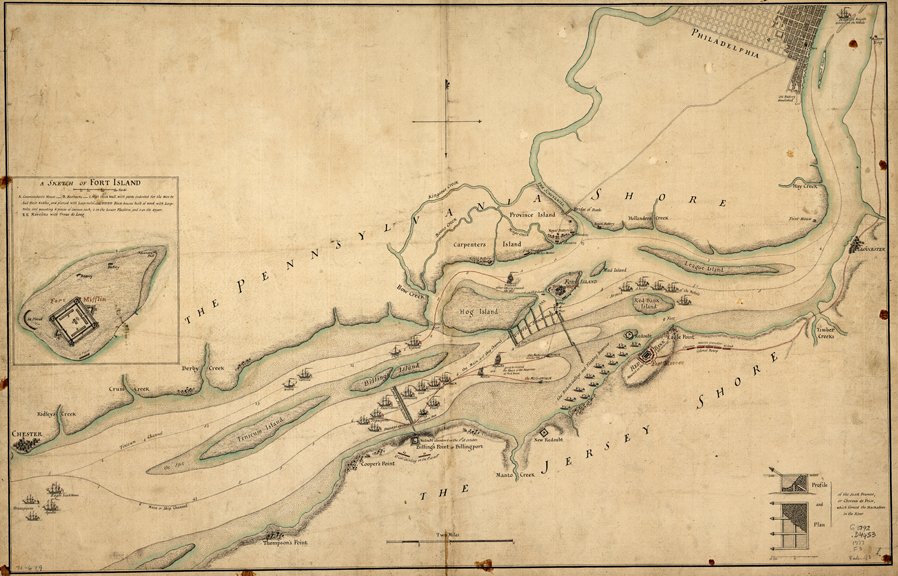
Efforts to guard the river had begun more than a year before independence. On June 30, 1775, the Pennsylvania General Assembly created the Committee of Safety. Benjamin Franklin was unanimously elected its president.[5] Under Franklin’s leadership, the committee assembled a state navy, established thirteen alarm posts along the Delaware from Cape Henlopen to Frankford Creek, and commissioned a novel system of underwater obstacles called chevaux-de-frise.
As early as June 15, 1776, the council resolved that chevaux-de-frise be sunk across the channel at Billingsport, placed sixty feet apart and at a height ensuring no more than six feet of water over them at low tide. Robert Smith, the Scottish-born master builder who had designed Carpenters’ Hall and the steeple on Christ Church, was authorized to “purchase material and employ a sufficient number of Hands to convey the above Resolve into immediate execution.”[6] By August, the council drew an order of five hundred pounds in Smith’s favor for constructing the chevaux-de-frise and other works at Billingsport.[7]
The chevaux were enormous timber-framed boxes, roughly thirty to forty feet square, weighted with approximately thirty tons of stone and sunk into the riverbed so that iron-tipped spikes angled downstream just beneath the waterline. Any ship attempting to pass risked having its hull ripped open. Three lines were deployed across the Delaware: at Marcus Hook, at Billingsport, and between Fort Mifflin and Fort Mercer. But the chevaux alone were not enough. Without fortifications on shore to protect them, the British could simply dismantle the obstacles at leisure. The defensive plan therefore required a trio of forts—and it was the need for the southernmost of these that brought Congress to its resolution of July 5.
The First Federal Acre
The sequence of decisions recorded in the Council of Safety minutes reveals how quickly events moved. On June 25, the council appointed Col. Daniel Roberdeau, George Clymer, David Rittenhouse, Owen Biddle and James Biddle as a committee to hire engineers and draft fortification plans for Billingsport. The same resolution authorized the land purchase at congressional expense.[8] On July 4 the council resolved that an engineer be requested to lay out the military works and ordered John Nixon and the committee of accounts to pay the purchase money, “and charge it account of Congress, being six hundred pounds.”[9] By July 15, the deed was recorded.

The implications were enormous. A government that had existed for barely twenty-four hours as the sovereign authority of an independent republic was purchasing private land within a constituent state for national defense. No constitutional framework yet existed to authorize such an act. The Articles of Confederation would not be drafted for another year. The Property Clause of the Constitution, granting Congress explicit authority over federal property, lay more than a decade in the future. The Fort Billingsport purchase was an improvisation—one of many the Continental Congress would make as it learned, by doing, what it meant to govern.
The Polish Engineer’s First Assignment
With the land secured, the question became who would design the fort. The answer arrived that summer in the person of Thaddeus Kosciuszko, a young military engineer from the Polish-Lithuanian Commonwealth who had studied fortification and artillery at the Royal Academy in Warsaw and the military schools of Paris.[10] Arriving in Philadelphia after a Caribbean shipwreck, Kosciuszko sought out Franklin, took a geometry examination administered by David Rittenhouse—the same surveyor who sat on the Billingsport committee—and won Franklin’s endorsement. On August 30, 1776, he submitted his application to Congress and was assigned to the Continental Army the following day.
Franklin put Kosciuszko to work immediately on the Delaware River defenses. During September and October 1776, Kosciuszko laid out an ambitious design for Billingsport: a 180-foot-square redoubt with parapets for soldiers and stations for eighteen cannon, protected from inland assault by breastworks, a deep moat, and a row of abatis—sharpened logs facing outward. On October 18, his commission as colonel of engineers was formalized at sixty dollars per month. Six days later, the Council of Safety paid him fifty pounds as a reward for his Billingsport work and charged the sum to Congress.[11] It was Kosciuszko’s first engineering assignment in America—the opening chapter of a career that would take him to Saratoga, where his defensive works helped secure the pivotal American victory, and to West Point, where he designed the fortifications that Benedict Arnold would later attempt to betray.
A Fort Never Finished
More than one thousand laborers and skilled workmen from New Jersey, Pennsylvania, Virginia, and South Carolina began construction. Fifty thousand feet of three-inch planks were purchased for the project. But the gap between Kosciuszko’s grand design and revolutionary logistics was immediately apparent. Materials were scarce. Skilled labor was scarcer. The garrison troops who would eventually defend the fort were needed elsewhere. The ambitious plan was scaled down repeatedly.

Robert Smith, who had designed the chevaux-de-frise, supervised construction of the barracks through the bitter winter of 1776–1777. Working in frigid conditions along the river, the fifty-five-year-old architect fell ill. The Pennsylvania Evening Post reported on February 13, 1777, that “last Tuesday morning Mr. Robert Smith, architect, died at his house in Second street in the 55th year of his age.”[12] He was buried in an unmarked grave in the Friends burial ground. Col. John Bull was appointed superintendent of the works four days later, authorized to hire up to five hundred laborers.[13]
That spring, the Pennsylvania Navy Board issued a sobering report concluding that the works at Billingsport could not be completed before the expected appearance of the British fleet and that the fort was militarily untenable.[14] Kosciuszko himself had by then departed for the Northern Army. Into this troubled situation arrived Maj. Gen. Philippe du Coudray, a French artillery officer whose promised rank had infuriated American generals Knox, Greene, and Sullivan. Assigned to survey Philadelphia’s defenses, du Coudray argued for Billingsport over Fort Mifflin as the principal anchor of the river defense, petitioning both the Continental Board of War and Congress in late August and early September.[15] His recommended expansions made an already impossible timeline worse. He drowned on September 15, 1777, when his horse bolted off the Schuylkill Ferry.
On August 1, 1777, Gen. George Washington made a personal inspection of Fort Billingsport and Fort Mercer, accompanied by the Marquis de Lafayette—the only recorded occasion on which Washington entered South Jersey during the war.[16] What he found was discouraging. The fort had been reduced to roughly one quarter of its planned size. In a draft letter to Washington that September, Brig. Gen. Anthony Wayne recommended that the two bastions at Billingsport “be enclosed and mounted with eight pieces of artillery and manned with about five hundred troops,” and that Red Bank be similarly reinforced with five hundred men who, with the New Jersey militia, could prevent the enemy from penetrating from that direction.[17] It was a plan for a fort that existed largely on paper.
Maj. Gen. Nathanael Greene, sent by Washington to assess the defenses, confirmed the worst. The chevaux-de-frise, Greene reported, could not be raised or removed unless two vessels were fastened to each frame and lifted by the swelling tide—and American fire from the forts would sink those vessels first. But he noted a fatal weakness: because all the breastworks and armament at Billingsport faced downriver, the fort was “not prepared in the rear thereof to resist any force by small arms.”[18]
Evacuation
The British never had to test the fort’s defenses from the river. Having learned of the chevaux-de-frise from Loyalist informants, Gen. Sir William Howe chose an overland route to Philadelphia via the Chesapeake Bay. After defeating Washington at Brandywine on September 11, 1777, the British occupied Philadelphia unopposed on September 26. Congress had already fled to Lancaster. But the three lines of chevaux-de-frise and three forts still blocked naval resupply. Howe’s army was effectively besieged in the city it had captured.

On September 28, Washington ordered Col. William Bradford to evacuate Fort Billingsport’s garrison to Fort Mifflin. But it was already too late. That same night, the British 10th and 42nd (Royal Highland) Regiments—approximately fifteen hundred troops under Lt. Col. Thomas Stirling—marched out of Germantown toward the fort.
Brig. Gen. Silas Newcomb, commanding the South Jersey militia from his headquarters at Woodbury, received intelligence that the enemy was landing opposite Marcus Hook. He “immediately called in my out guards & marched to a heighth, on the Salem road, about 15 miles from Philadelphia.” On the morning of October 2, the two forces clashed. Newcomb was shocked to discover the British numbered not four hundred, as reported, but fifteen hundred, and that they were sending flanking parties to surround him. “I thought it prudent to retreat,” he wrote, “which we did in tolerable order, keeping a constant fire in our rear.”[19]
Bradford, who had arrived at Billingsport to find a garrison ravaged by desertion—roughly one hundred militia and an artillery company reduced to a dozen men—ordered the evacuation. Continental Marine Lieutenants Dennis Leary and William Barney of the brig Andrew Doria worked urgently to transfer ammunition and men by boat to Fort Mifflin. Bradford’s men set fire to the barracks and cookhouse, spiked what cannon could be spiked, and loaded the rest into the galley Franklin and a guard boat. By noon the British were coming through a cornfield adjacent to the fort. There was an exchange of shots as the last of the garrison pushed off from shore.[20]
Lieutenant Colonel Stirling left three hundred men in the fort and took the rest on a foraging expedition into the Jersey swamps, where he lost men to Newcomb’s militia. Within three days the British had evacuated Billingsport, but they returned on October 7 to begin dismantling the chevaux-de-frise. By October 21, a passage seventeen feet wide had been opened near the Jersey shore, and six British warships—including the sixty-four-gun HMS Augusta—had passed through the gap toward Forts Mercer and Mifflin. What followed was some of the most ferocious fighting of the war: the Hessian repulse at Red Bank, the explosion of HMS Augusta, and the devastating bombardment that finally reduced Fort Mifflin. The Delaware was open by mid-November.
In the aftermath, Washington assessed the significance of the position he had lost. In a dispatch to Congress on November 6, 1777, he wrote that he wished to repeat that Billingsport was of far greater importance than all the forts and galleys combined.[21] It was a striking admission—and, in hindsight, a vindication of the instinct that had led Congress to purchase those ninety-six acres in the first place.
The Precedent
Fort Billingsport’s military career did not end in 1777. After the British evacuated Philadelphia in June 1778, Patriot forces reoccupied and rebuilt the fort, manning it until 1781. During the War of 1812, Gen. Ebenezer Elmer rehabilitated it as a militia training center for over two thousand men. By 1825 it was described as desolate. In 1834 the War Department sold the tract for two thousand dollars.[22]
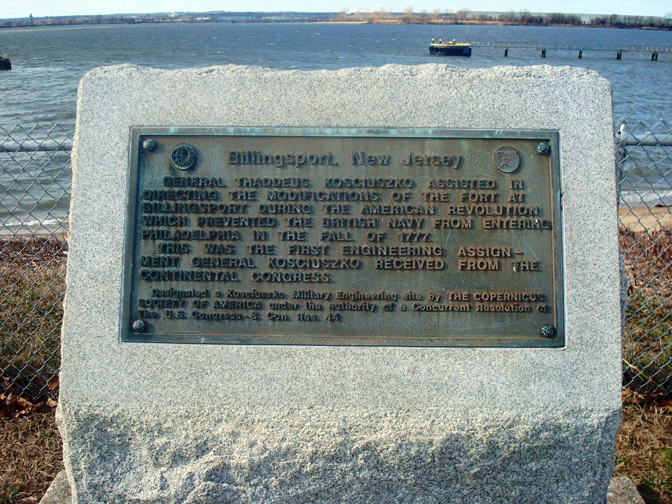
Today the site is a small public park in Paulsboro, wedged between oil refineries. A few plaques mark the spot. In 1966, a Philadelphia Inquirer reporter found the old fort “just a large hole in the ground overgrown by weeds and briars,” behind a fence on oil company property. A National Park Service historian at Independence Hall told the reporter that the site represented the first property acquired by the United States and had “significant historical value,” but conceded it had been “largely forgotten.”[23]
Brig. Gen. Edwin H. Simmons, who retired as Director of Marine Corps History and Museums, grew up on Billings Avenue in Paulsboro and explored the fort’s ruins as a boy in the 1920s and 1930s. His boyhood friend Francis Ignazewski’s father, a carpenter at the nearby refinery, had once found a musket in the fort’s remains. Simmons devoted decades to championing Billingsport’s place in history, writing and lecturing on the subject, and presenting a framed copy of Maj. Charles Waterhouse’s painting Evacuation of Fort Billings to the mayor of Paulsboro during the Bicentennial.[24] It is thanks in large part to Simmons and to local historians like Wayne Philipp that the story has survived at all.
The deeper significance of the July 5, 1776, deed lies not in what Fort Billingsport became but in what it represented. In purchasing private land for national defense before any constitutional framework existed to authorize the act, the Continental Congress established a precedent—however informal—that would reverberate through the entire subsequent history of federal property. The Land Ordinance of 1785, the Northwest Ordinance of 1787, the Property Clause of the Constitution, the Louisiana Purchase of 1803: all built upon the principle that the national government could acquire, hold, and dispose of land for the public good. The deed in Book C at Woodbury was the first expression of that principle.
It is also a reminder that the American Revolution was not merely a war of ideas. On the morning of July 5, 1776, the delegates who had proclaimed liberty the day before turned to the gritty work of defending it. They bought farmland. They hired engineers. They sank boxes of iron-tipped spikes into a river. The first acre of federal land was not a symbol; it was a fortification—imperfect, understaffed, never completed, and ultimately abandoned. That it mattered anyway is perhaps the most useful lesson Fort Billingsport has to offer. Sovereignty, in 1776 as now, required more than words on parchment. It required dirt under the nation’s feet.
[1] Pennsylvania, Minutes of the Council of Safety, vol. 10 (Harrisburg, 1852), 619.
[2] Ibid., 631.
[3] Deed, Margaret Paul and Benjamin Weatherby to George Clymer and Michael Hillegas, July 5, 1776, Deed Book C, p. 280, Gloucester County Courthouse, Woodbury, NJ.
[4] John Clement, “Billingsport,” Proceedings of the New Jersey Historical Society (October 1912).
[5] “Editorial Note on the Pennsylvania Committee of Safety, 30 June 1775,” Founders Online, National Archives, founders.archives.gov/documents/Franklin/01-22-02-0048.
[6] Pennsylvania, Minutes of the Council of Safety, vol. 10, 603.
[7] Ibid., 700.
8 Miecislaus Haiman, Kosciuszko in the American Revolution (New York: Polish Institute of Arts and Sciences in American, 1943), 9-10.
9 Pennsylvania, Minutes of the Council of Safety, 10:672, 683, 695, 705, 719.
[10] Haiman, Kosciuszko in the American Revolution, 9–10.
[11] Pennsylvania, Minutes of the Council of Safety, 10:672, 683, 695, 705, 719.
[12] Pennsylvania Evening Post, February 13, 1777.
[13] Pennsylvania, Minutes of the Council of Safety, vol. 11 (Harrisburg, 1852), 125, 142.
[14] Samuel Stelle Smith, Fight for the Delaware, 1777 (Monmouth Beach, N.J.: Philip Freneau Press, 1970), 8–9.
[15] Philippe du Coudray, report to the Continental Board of War, August 29, 1777; E. H. Simmons, “Fort Billings: A Step Back in Time,” On Stream (Mobil Paulsboro Refinery) 2, no. 3 (June 1981): 1, 3.
[16] “April Researcher,” sidebar to Fort Billings feature, unknown publication, n.d., Fort Billingsport vertical file, Gloucester County Historical Society.
[17] Draft of Wayne’s letter, p. 3, vol. 4, Wayne Papers, September 1777, Historical Society of Pennsylvania.
[18] Nathanael Greene, report on the river defenses, quoted in ibid.
[19] Silas Newcomb to William Livingston, October 4, 1777, quoted in Robert W. Harper, “Abandonment of Ft. Billings Saved Militia,” Gloucester County Times, December 10, 1978.
[20] Charles R. Smith, Marines in the Revolution: A History of the Continental Marines in the American Revolution, 1775–1783 (U.S. Government Printing Office, 1975), 168–170.
[21] George Washington to the President of Congress, November 6, 1777, Founders Online, National Archives, founders.archives.gov/documents/Washington/03-12-02-0136.
[22] Jeffery M. Dorwart, Invasion and Insurrection: Security, Defense, and War in the Delaware Valley, 1621–1815 (University of Delaware Press, 2008).
[23] Thomas A. Dau, “Revolutionary War Fort Nearly Forgotten by History,” Philadelphia Inquirer, July 3, 1966.
[24] E. H. Simmons, Brig. Gen. USMC (Ret.), letter to Michael Frisby and T’Mara Pollard, Loudenslager Elementary School, Paulsboro, NJ, November 19, 1986.


One thought on “The Nation’s First Acre: Fort Billingsport and the Birth of Federal Land Acquisition”
Interesting story. The 1st Continental Congress passed a resolve creating an Association. This Association was the “government” until Maryland approved the Articles in 1781. The Council of Safety and Committee of Safety were labels “interchangeable” until they ran out of money and were abolished.