

As word of the outbreak of war at Lexington and Concord spread among the British colonies in North America, they accelerated efforts to build military forces, often as ad hoc militia companies organized at the county level that would then later be amalgamated into regiments and brigades. The companies might be named for the men they elected captain or otherwise reflected some unique attribute the volunteers wanted to note. Pennsylvania, for example, boasted companies with informal monikers such as the “Silk Stocking Company,” and the “Lady’s Light Infantry.”[1] On June 14, 1775 the Second Continental Congress resolved to raise ten companies of riflemen from Pennsylvania (six companies), Maryland (two companies), and Virginia (two companies.) Suddenly, all those independent companies closer to the frontier had a place to go and a purpose. They would be the first men directly recruited into the Continental Army and serve as light infantry.
The Pennsylvania companies initially came from Cumberland, Berks, York, Northampton, and Lancaster counties, “all of which—with equal justice—claim the honor of supplying the first troops to the Continental army.”[2] Recruits were so enthusiastic that the battalion swelled and on June 22 Congress expanded the Pennsylvania allotment from six to eight companies. Eventually, they were consolidated into a large battalion and placed under the command of Col. William Thompson.[3] Congress commissioned Thompson directly on June 25 to command this new rifle battalion, making him the first colonel commissioned into the Continental Army. All across the Pennsylvania frontier, men flocked to the new standard. The first companies arrived outside Boston on July 25, the last on August 18.
Among those men were John Brady and his son Samuel, who joined Capt. John Lowdon’s rifle company, primarily from Northumberland County. Lowdon, a widower, gathered seventy men and marched directly to Boston.[4] At the time, nothing marked father or son as any more special than the thousands of other men laying siege to Boston. Samuel, however, would go on to a career as a continental officer ranging freely in the contested Ohio Country, regularly scouting and skirmishing with Native Americans and becoming part of American folklore on the frontier. By the middle of the nineteenth century, stories about Brady had been repeated enough to spread, evolve, and make him an American myth. Thus, Samuel Brady became a legend and historian Cecil Hartley could rhetorically ask, “Who has not heard of Brady—captain of the spies?—Of his perilous adventures by field and flood?—Of his hair-breadth escapes in the imminent deadly breach?—Of his chivalrous courage?—Of his unmatched personal activity?”[5] But that all lay in the future. In 1775, Samuel Brady was just another soldier going to war with his father.
John Brady was born of Irish stock in 1733 and eventually settled in Shippensburg, Pennsylvania with his wife Mary Quigly. There, she gave birth to their first child, Samuel, sometime in 1756 or 1758.[6] John served in the militia during the French and Indian War, mostly fighting French-allied Native Americans. He likely crossed paths with William Thompson. They both served as captains in Lt. Col. John Armstrong’s 2nd Battalion in the Pennsylvania militia.[7] After the war, the Brady family moved to the west branch of the Susquehanna River. So, when Samuel marched off to his first war, he was going with two accomplished veterans.
In the siege lines outside Boston, the riflemen were a mixed bunch. Their weapons reached much farther than the smoothbore muskets that many New Englanders carried. James Thacher, a surgeon with the Americans, proclaimed, “These men are remarkable for the accuracy of their aim; striking a mark with great certainty at two hundred yards distance . . . their shots have frequently proved fatal to British officers and soldiers who expose themselves to view, even at more than double the distance of common musket-shot.”[8] Accustomed to doing for themselves, the riflemen did not take well to discipline. They were celebrated in the summer, but had worn out their welcome by the fall. Benjamin Thompson, after walking the lines, pronounced the riflemen a problem:
Of all useless sets of men that ever incumbered an army, surely the boasted riflemen are certainly the most so. When they came to the camp they had every liberty and indulgence allowed them that they could possibly wish for. They . . . were under no restraint from the commands of their officers, but went when and where they pleased, without being subject to be stopped or examined by any one, and did almost intirely as they pleased in every respect whatever.[9]
The specifics of Samuel Brady’s service outside Boston are difficult to confirm. Most stories appear after he became a frontier legend. But they bear some examination. During the siege, the British and Americans waged a forage war on the islands and coasts around Boston harbor to remove livestock. At one point, Lowdon’s company was involved in repulsing a British landing at Lechmere’s Point.[10] Thompson’s men waded through chest-high water at high tide to the attack. The captain apparently thought Brady too young for the mission and left him off the duty, but Samuel turned up anyway, was the second man on the island, and “behaved most gallantly.”[11] On a separate occasion, Brady and Captain Lowdon were sitting on a fence viewing the British defenses when a cannonball struck the fence, throwing both to the ground. Brady was reportedly the first of the two to jump to his feet and confirm they were both uninjured.[12]
Three rifle companies accompanied the American invasion of Canada in the fall of 1775, but Brady’s company remained in Boston. In March 1776, the remaining riflemen led the way south from Boston to New York as Gen. George Washington repositioned his army.[13] The same month, Congress promoted Thompson to brigadier, and Lt. Col. Edward Hand took command of the regiment.[14]

Enlistments in the rifle battalion were due to expire on July 1 and Congress authorized an extra month’s pay for those re-enlisting for two more years. Samuel Brady re-enlisted. Capt. John Doyle’s Independent Company joined the 1st Pennsylvania Regiment on November 25, 1775 and remained with the regiment through August 31, 1778.[15] On July 16, 1776 Brady was promoted to 1st lieutenant in Doyle’s company.[16] He had just turned twenty-one. Also in 1776, John Brady separated from his son and accepted a captaincy in the 12th Pennsylvania, possibly about the same time as his enlistment in the rifle battalion was expiring.[17]
Nineteenth century biographical sketches, written to establish or capitalize on Samuel Brady’s legend, place him at every major battle with Washington throughout 1776 and 1777.[18] They often do not hold up well. Betsy Swope, a family genealogist, attributed Samuel Brady’s promotion to bravery he demonstrated at the Battle of Long Island.[19] But, Brady’s limited war records confirm the promotion occurred before the major battles.[20] At least some of Hand’s riflemen opposed the British landings at Gravesend Bay in August and the regiment was assigned to Nathaniel Greene’s Division during the Long Island campaign, but there are no specific Samuel Brady stories that go with the campaign.
At the Battle of Trenton on December 26, 1776, Hand’s regiment was assigned to Brig. Gen. Alexis Roche de Fermoy’s brigade, which attacked Hessian pickets and blocked the road to Princeton.[21] Hand’s men had a similar role in the second battle of Trenton (January 2, 1777), delaying British forces advancing from Princeton, and eventually ended up at Assunpink Creek. It was the first time a unit of riflemen directly confronted Hessian and British light infantry and the Americans performed well.[22] There is no reason to doubt Samuel Brady’s participation in the battle.
At the Battle of Princeton (January 3, 1777), Brady reportedly advanced too far forward with Colonel Hand and the two were nearly surrounded. Brady cut a horse out of a team, presumably from artillery supporting Mercer, threw Hand on the horse, mounted it behind him, and escaped in the confusion.[23] As is the case in other Brady stories, the sources come from the nineteenth century. Men from the 1st Pennsylvania were assigned to Brig. Gen. Hugh Mercer’s brigade, which was nearly overwhelmed in the engagement that began outside Princeton.[24] But, Hand’s Pennsylvanians are generally associated with reinforcements brought to the battle by General Washington, who saved the day after Mercer’s collapse.[25] While the timing neither confirms or contradicts the Brady story, it does raise more questions than answers.

During the course of the war’s first two years, the number of riflemen in the 1st Pennsylvania continuously declined and in May 1777 it was reassigned to the Pennsylvania Brigade, eventually under the command of Brig. Gen. Anthony Wayne. By then, most men were equipped with smoothbore muskets.[26] The unit participated in the Philadelphia campaign and was present at the Battle of Paoli (September 22, 1777), including Doyle’s Independent Rifle company and a young Lt. Samuel Brady.[27] In one of the more popular nineteenth-century profiles of frontier heroes, Cecil Hartley relates a story associated with Brady in some detail:
At the massacre at Paoli, Brady had been on guard, and had laid down with his blanket buckled round him. The British were nearly on them before the sentinel fired. Brady had to run; he tried to get clear of his blanket coat, but could not. As he jumped a post and rail fence, a British soldier struck at him with his bayonet, and pinned the blanket to the rail, but so near the edge that it tore out. He dashed on; a horsemen overtook him and ordered him to stop. Brady wheeled, shot him down, and ran on. He got into a small swamp in a field. He knew of no person but one being in it beside himself; but in the morning there were fifty-five, one of whom was a lieutenant. They compared commissions; Brady’s was the oldest; he took the command and marched them to headquarters.[28]
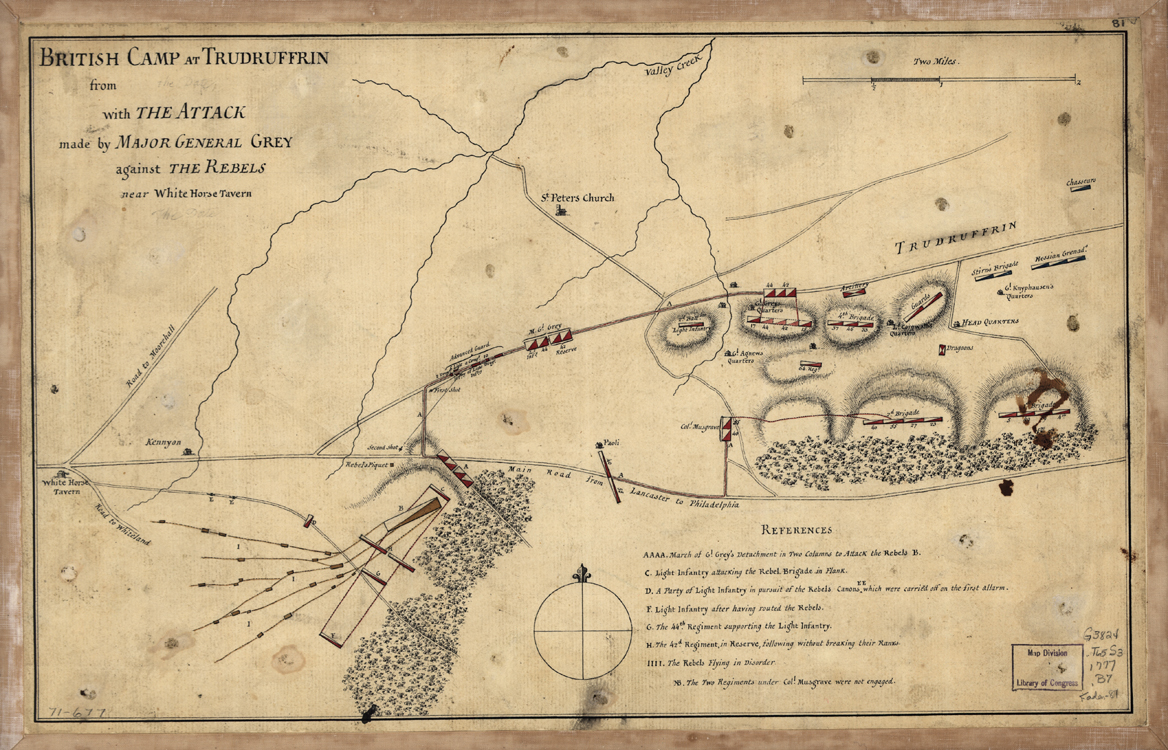
The story was credible enough for Thomas McGuire, the battle’s premier historian, to take at face value.[29] Brady’s unit, Doyle’s Rifle Company, was assigned picket duty and largely taken by surprise in the darkness. Brady’s performance of his duties makes it a story less likely to be repeated in the interest of establishing his legend, ironically lending the story an air of veracity. Hair’s-breadth escapes became an essential ingredient of later Samuel Brady stories, but the near-miss at Paoli is circumstantially credible.
Brady was almost assuredly present in the winter encampment at Valley Forge. Doyle’s Independent Company was moved to the 11th Pennsylvania Regiment on December 16, 1777; the 11th Pennsylvania was part of the 2nd Pennsylvania Brigade at Valley Forge and the Battle of Monmouth (June 28, 1778).[30] Shortly after, Doyle, and presumably his company, moved to the 6th Pennsylvania Regiment under Lt. Col. Josiah Harmar on July 1, 1778.[31]
Brady’s biographers assert that Brady served at Monmouth, but the record is less certain.[32] In the late spring of 1778, he joined the 8th Pennsylvania under Col. Daniel Brodhead, but Brady’s biographers and service records are unclear about the date. Brady re-enlisted and took the oath of allegiance on Mount Joy at Valley Forge on May 12.[33] The 8th Pennsylvania Regiment was then serving in the Western Department, headquartered at Pittsburgh.[34] (The 8th Pennsylvania does not turn up in modern orders of battle for the fight at Monmouth).[35] Brady was likely en route to Pittsburgh when the Battle of Monmouth occurred. Curiously, rosters for the 8th Pennsylvania list Brady as a transfer from the 6th Pennsylvania, rather than the 11th, which may have been an administrative convenience. Brady was finally promoted to captain on August 2, 1779 as a member of the 8th Pennsylvania.[36]
Separating fact from myth is always a challenging pursuit on the frontier, where records range from non-existent to limited and are often contradictory. Historians end up relying on stories recorded decades after the fact, often second- or third-hand, which is particularly perplexing for a figure as legendary as Sam Brady. Although his renown begins on the western frontier, we can draw some conclusions from the available evidence of his service in the east. By 1778, when he traveled to Pittsburgh for a new phase in his military career, Samuel Brady was a grizzled veteran of some of the most intense fighting in New England and the mid-Atlantic. He proved his commitment to the cause by re-enlisting, twice, and stood out from his fellow privates enough to earn an officer’s commission. Although some of his feats on the frontier were no doubt embellished, Brady’s service in the east laid a foundation that makes many of them worth consideration. There was more to Sam Brady than the myths that might otherwise make him easy to dismiss.
[1] William A. Pencak and Barbara Gannon, “Pennsylvania in the American Revolution,” William A. Pencak, Christian B. Keller, and Barbara A. Gannon, eds., Pennsylvania: A Military History (Yardley, PA: Westholme Publishing, 2016), 57.
[2] Ibid, 57. New Englanders, of course, might disagree, but the volunteer companies from the region all predated the Congressional resolution!
[3] John A. Bonin, Thompson’s Rifle Battalion: The Original Unit of the Army of the United Colonies (Carlisle, PA: U.S. Army War College, Strategic Studies Institute, April 2025), 15-16.
[4] The Blairsville Record, Sketches of the Life and Indian Adventures of Captain Samuel Brady, A Native of Cumberland County, Born 1758, A few Miles Above Northumberland, PA (Lancaster, PA: S.H. Zahm & Co., 1891), 4. These are a collection of articles published in The Blairsville Record, which was published in the town of Blairsville, PA between 1858 and 1869, with an exception for the Civil War. Library of Congress, Chronicling America, The Blairsville Record, chroniclingamerica.loc.gov/lccn/sn85025175/. The Blairsville Record spells Lowdon’s name Lowden, which gets repeated in other source material. Payroll records confirm Samuel Brady in January 1776 as a private in the 1st Continental Troops, which had been the 1st Pennsylvania. In those records, Captain Lowdon’s last name is spelled “Lowdon.” In his history of Thompson’s Battalion, John Bonin takes Lowdon as the proper spelling. Bonin, Thompson’s Rifle Battalion, Appendix B.
[5] Cecil B. Hartley, Life and Adventures of Lewis Wetzel, the Virginia Ranger; to Which are Added Biographical Sketches of General Simon Kenton, General Benjamin Logan, Captain Samuel Brady, Governor Isaac Shelby, and Other Heroes of the West (Philadelphia: G.G. Evans, 1859), 191.
[6] Belle McKinney Hays Swope, History of the Families of McKinney-Brady-Quigley (Chambersburg, PA: Franklin Repository Printery, 1905), 156. Swope offers up a birthdate in 1756. Hartley places Brady’s birth in 1758 and his became the widely accepted account of Brady’s life. Hartley, Life and Adventures of Lewis Wetzel, 193. The Blairsville Record accepts 1758 as the date, but appears to have just copied Hartley’s text word for word. Blairsville Record, Sketches in the Life of Captain Sam Brady, 4. Brady’s grave in West Liberty, West Virginia records his birthday in 1756. Findagrave: Cpt Samuel Brady, www.findagrave.com/memorial/14860235/samuel-brady.
[7] Bonin, Thompson’s Rifle Battalion, 7-8. Swope, History of the Families of McKinney-Brady-Quigley, 144-145.
[8] James Thacher, Eyewitness to the American Revolution: The Battles and Generals as seen by an Army Surgeon (Stamford, CT: Longmeadow Press, 1994), 31.
[9] Benjamin Thompson, “The American Soldiers are Dirty, Nasty, Insubordinate, and Quarrelsome,” in Henry Steele Commager and Richard B. Morris, eds., The Spirit of Sevent-Six: The Story of the American Revolution as Told by Participants (New York: Harper & Row Publishers, 1958), 154.
[10] Samuel J. Newland, The Pennsylvania Militia: Defending the Commonwealth and the Nation: 1669-1870 (Annville, PA: Commonwealth of Pennsylvania, Department of Military and Veterans Affairs, 2002), 121; Bonin, Thompson’s Rifle Battalion, 18.
[11] Blairsville Record, Sketches of the Life and Indian Adventures of Captain Samuel Brady, 4. The Record does not specifically tie this event to Lechmere’s point, but actions there most closely approximate the company’s record outside Boston, so the reference to Brady’s gallantry is certainly plausible.
[12] Ibid., 4. Although there’s no corroborating evidence of this episode, it is also plausible. Brady knew Lowdon and the British occasionally threw shells at American positions.
[13] Bonin, Thompson’s Rifle Battalion, 19.
[14] Ibid., 22.
[15] U.S. Revolutionary War Service Records, 1775-1783, Publication number M881, NARA Catalog id 570910, Record Group 93. The return is for Doyle’s company during the period January 1, 1777 through August 31, 1778. The return itself is undated. The 1st Continental Regiment was reorganized and redesignated as the 1st Pennsylvania Regiment on January 1, 1777. Because the Brady card for the regimental roster refers to the makeup after January 1, 1777 it is likely a return for the redesignated 1st Continental/1st Pennsylvania.
[16] Swope, History of the Families of McKinney-Brady-Quigley, 156; Blairsville Record, Sketches of the Life and Indian Adventures of Captain Samuel Brady, 4; Hartley, Life and Adventures of Lewis Wetzel, 194. According to John Doyle’s service record, he was commissioned captain of the new company on the same day, July 16, 1776, which joined the 1st Pennsylvania on November 25, 1776. U.S. Revolutionary War Service Records, 1775-1783, Publication number M881, NARA Catalog id 570910, Record Group 93. The records list Brady as a “Capt. Lt” with a date of promotion of July 17, 1776, but the date refers to his promotion to lieutenant and his “captain lieutenant” rank as his final rank during the Revolution. The Pennsylvania Archives for Doyle’s Independent Company give Brady’s commission as a first lieutenant on September 5, 1776. John Blair Linn and William H. Egle, eds., Pennsylvania in the War of the Revolution, Battalions and Line. 1775-1783, Volume X, (Harrisburg, PA: Lane S. Hart, State Printer, 1880), 326.
[17] Hartley, Life and Adventures of Lewis Wetzel, 194.
[18] Ibid., 194.
[19] Swope, History of the Families of McKinney-Brady-Quigley, 156.
[20] U.S. Revolutionary War Service Records, 1775-1783, Publication number M881, NARA Catalog id 570910, Record Group 93. This pay stub dates his service in the 8th Pennsylvania on September 2, 1778. A subsequent pay stub, certificate 7784, dated February 22, 1785, confirms his service in the 8th Pennsylvania after August 1, 1780. The Pennsylvania Archives for Doyle’s Independent Company give Brady’s commission as a first lieutenant on September 5, 1776, after the Battle of Brooklyn, which may be the source of Swope’s dating of Brady’s lieutenancy.
[21] Bonin, Thompson’s Rifle Battalion, 28.
[22] Ibid., 28; David Price, The Road to Assunpink Creek: Liberty’s Desperate Hour and the Ten Crucial Days of the American Revolution (Lawrenceville, NJ: Knox Press, 2019), 90-92.
[23] Blairsville Record, Sketches of the Life and Indian Adventures of Captain Samuel Brady, 4; Hartley, Life and Adventures of Lewis Wetzel, 194. The story suggests Brady retrieved a horse from a wagon, artillery, or limber team and would have been more likely during the delaying actions before Cornwallis on January 2.
[24] Mark Maloy, Victory or Death: The Battles of Trenton and Princeton (El Dorado Hills, CA: Savas Beatie, 2018), 161.
[25] Ibid., 130-131; Price, The Road to Assunpink Creek, 160-161.
[26] Bonin, Thompson’s Rifle Battalion, 28.
[27] Thomas J. McGuire, Battle of Paoli (Mechanicsburg, PA: Stackpole Books, 2000), Appendix B.
[28] Hartley, Life and Adventures of Lewis Wetzel, 195.
[29] McGuire, Battle of Paoli, 104.
[30] Mark Edward Lender and Gary Wheeler Stone, Fatal Sunday: George Washington, the Monmouth Campaign, and the Politics of Battle (Norman, OK: University of Oklahoma Press, 2016), 456.
[31] “Adjutant General to Mr. Harry L. Dayton, January 17, 1916,” US Revolutionary War Service Records, 1775-1783, Publication number M8881, NARA Catalog ID, 570910, Record Group 93.
[32] Hartley, Life and Adventures of Lewis Wetzel, 194; Charles H.L. Johnston, Famous Scouts Including Trappers, Pioneers, and Soldiers of the Frontier (Boston: L.C. Page & Company, 1910), 98. Johnston asserts Brady fought so well at Monmouth that he was promoted for his actions in the battle. Swope, History of the Families of McKinney-Brady-Quigley, 157. Swope argues that the brevet promotion was August 2, 1779. A copy of a receipt for $880 paid to Brady on September 16, 1779 for recruiting services lists him as a captain, not a captain-lieutenant.
[33] Valley Forge Muster Roll, Samuel Brady, valleyforgemusterroll.org/soldier-details/.
[34] Linn and Egle, Pennsylvania in the War of the Revolution, 644.
[35] Lender and Stone, Fatal Sunday, Appendix B; William R. Griffith IV, A Handsome Flogging: The Battle of Monmouth, June 28th, 1778 (El Dorado Hills, CA: Savas Beatie, 2020), 168-170.
[36] Linn and Egle, Pennsylvania in the War of the Revolution, 650.


2 Comments
Eric, I like that you emphasized Samuel Brady’s commitment to the Patriot Cause and his early war contributions, which can be corroborated. It is too easy to dismiss people associated with myths. Even if Brady retired to private life after the Battle of Monmouth, his contributions are notable and should be recognized. Well-done and interesting sleuthing!
Thanks, Gene. Fold3 is a godsend. I really am tempted to dig into more of Brady’s myths to get a better handle on them. Which ones seem plausible, which ones don’t, and which ones can we “verify” after a fashion? The only reason I had heard his name decades ago is that there’s a rest-stop on the Ohio turnpike called “Brady’s Leap,” in honor of his alleged jump across the Cuyahoga River. (Wrote about that unverifiable feat, elsewhere.) I’ve been stopping there since I was a kid. In any event, his service, like that of thousands who served elsewhere, ought to be remembered whether or not they became legends.
It will have to wait, though. Other projects beckon.