



On July 21, 1776, the once-peaceful morning was broken by the sounds of musketry as a Cherokee war party, under Chief Old Abraham, attacked the frontier fort known as Fort Watauga, also known as Fort Caswell, near present-day Elizabethton, Tennessee. This attack was not successful, and it led to an eventual several-day siege on the fort as the frontier militia held off the Cherokee onslaught. With the fear of advancing militia reinforcements, the Cherokee soon broke the siege.[1] The aftermath of this battle led to further skirmishes between Cherokee and frontier militia forces, and to an eventual Long Island of the Holsten (Avery) Peace Treaty, though the agreement proved unstable. This treaty later failed, leading to continued unrest and violence along the frontier as white settlers both failed to follow the treaties and pushed further into Cherokee land.
The Siege of Fort Watauga is a clear illustration of the broader frontier violence during the American Revolution. This battle shows what was to come in terms of American expansion, violence, and oppression that would take place after the birth of the young nation. It is also a clear example of how, while the colonies were themselves in the middle of civil war, the Native tribes were torn on how to respond.
Background
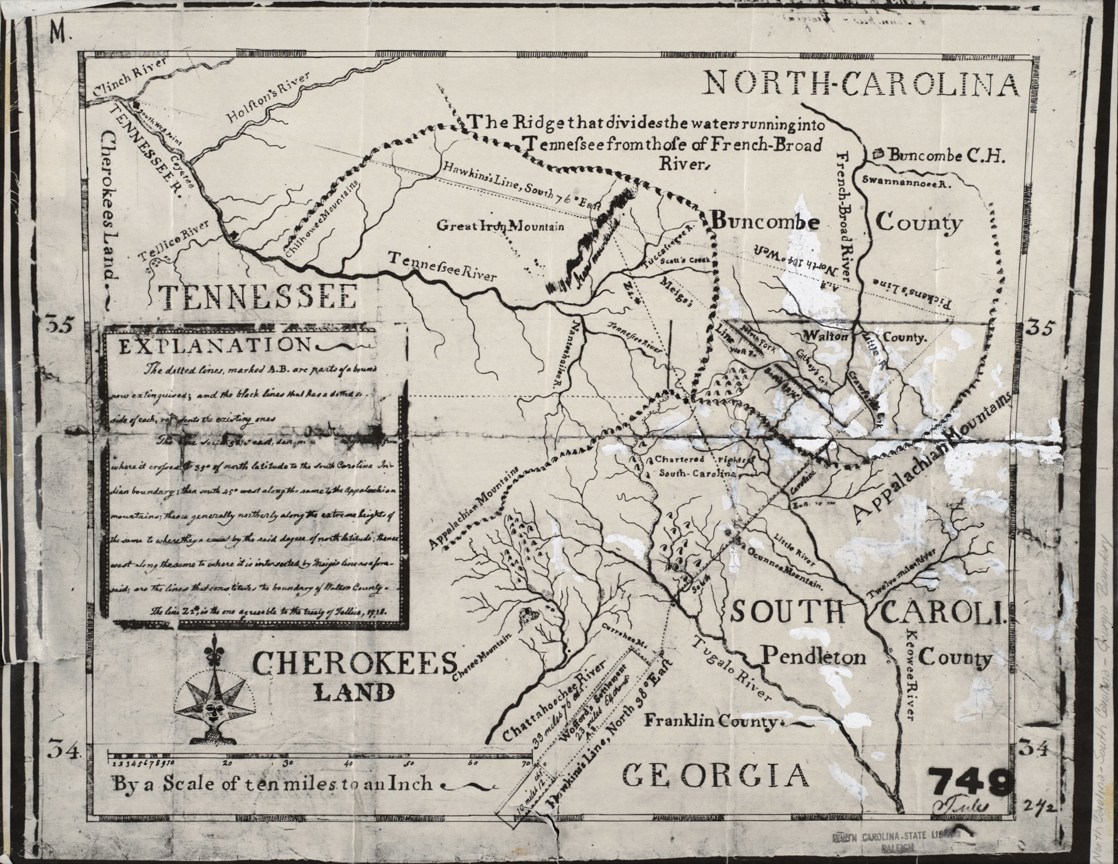
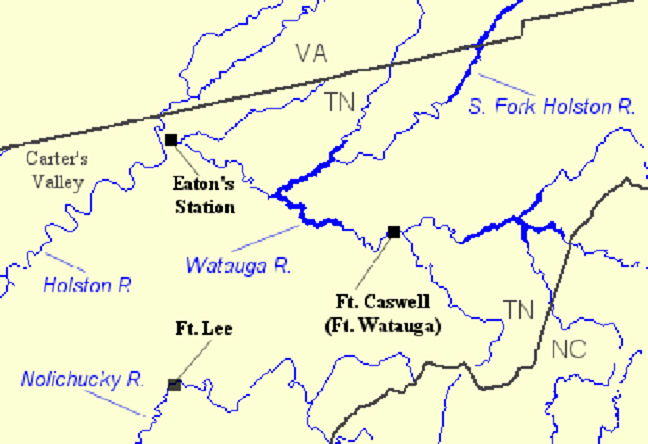 Fort Watauga’s construction started in 1775 and was completed in 1776. This fort was established to protect settlers in the area, who would come to be known as the Wataugans. These colonial settlers, who had been in the area for some time, recently finalized a land lease with the Cherokee in 1775, with the Treaty of Sycamore Shoals. This agreement constituted a ten-year lease of over twenty million acres of land.[2] The settlers, though they were in clear violation of the Proclamation of 1763 that prohibited settlement west of the Appalachians, argued themselves into the right due to this treaty. After the completion of the treaty, due to the need for protection, several forts and blockhouses were constructed for the defense of these Wataugans, including Fort Watauga and Fort Lee.
The Treaty of Sycamore Shoals led to a split among Cherokee leaders and factions. Those under Chief Little Carpenter were largely in favor of the treaty. Little Carpenter, the primary diplomat for the Cherokee due to his orator skills, strongly advocated for peace and working with colonial governments to protect the Cherokee. Those who opposed the treaty were largely led by Dragging Canoe, War Chief and Little Carpenter’s son.[3] He thought that the treaty was unfair and would only lead to settlers taking more land from the Cherokee. The Indian Agent for the Crown, Alexander Cameron, made note of Dragging Canoe as “the only young warrior of note now over the hills.”[4] Tensions due to the treaty between the Cherokee and settlers in the Watauga valley began to escalate. In May 1776, an ultimatum was issued by the Cherokee ordering the Wataugans to leave in twenty days or face war.


These Cherokee warnings were issued by Crown Indian Agents Alexander Cammeron and Henry Stuart. The two later wrote to the Wataugans, urging them to leave the area and warning them of the great danger that the Wataugans are in if they did not leave. “We have lately found a general discontent among the Indians, particularly among the young people on account of the new settlements . . . Those of Watauga,” the letter later stated, while they knew it was an inconvenience to relocate, that it was “but trifling when compared to the danger in which you find yourself, your families and effects must be exposed to a merciless, vengeful Enemy.”[5]
Despite these warnings, the Wataugans decided to stay in the area and to prepare for the Cherokee attack. The settlers took refuge in the forts, while those still working on nearby Fort Lee, under John Sevier, halted construction and headed to Watauga.
The Cherokee split into three war parties, with the first under Dragging Canoe attacking Eaton’s Station, those under the Raven attacking the settlements in Carter’s Valley, and lastly those under Old Abraham attacking Fort Watauga.
Battle
With the threat of attack, the settlers at Fort Watauga found themselves in the command structure of Col. John Carter, Capt. James Robertson, and Lt. John Sevier.[6] On the Cherokee side, Old Abraham, one of the war chiefs allied with Dragging Canoe, led the attack on the Fort. The earliest known account of the battle, published in a newspaper in late August, gave these details:

A correspondent has favored us with extracts of letters from officers of rank in Fincastle, from which we learn, that on Sunday the 21st of last month (the day before the engagement mentioned in our last) a large party of Indians attacked the Watauga fort, in which were 150 men. They fired on a great number of women who went out at day break to milk their cows, and chased them into the fort, but providentially did not kill one of them. They fired briskly on the fort till 8 o’clock, but without effect, and then retired with considerable loss, as was supposed from the quantity of blood found; but they returned to the attack, and were besieging the fort six days after, as a messenger who was slipped out informed our men on Holstein.[7]
John Waddill wrote of the attack in his 1849 pension application:
The Indians attacked us first from the North Side, a small part having crossed the river. The others immediately attacked us from the South Side . . . The Indians commenced attack in the morning, about 9 o’clock. They retired about a mile and there remain for two or three weeks. Some of them went up Holson. They killed three men and a boy, and took a boy prisoner, whom they afterwards burnt. In about two or three weeks, they moved off, spreading themselves along the frontier, and continued in fighting them until Col. Christian’s Expedition.[8]
Being unable to take the fort, and with the threat of colonial reinforcements, Old Abraham and his warriors retreated. They were later caught by those very reinforcements, and a skirmish ensued. The newspaper report provided details about this skirmish:

There were supposed to be 500 women and children in this little fort, who fled there for shelter on hearing that the Indians were marching into that part of the county . . . The number of Indians concerned in the different ravages lately committed in Fincastle amount to 6 or 700, some say 800; and yes, sudden as their attack was, they murdered in all their butchering parties but 18 persons, and wounded 6, whilst our men killed, in the skirmishes with them 26 on the spot (as many were carried off dead) took one prisoner, and wounded at least as many as they killed.[9]
Most historians, when writing about this battle, pull from the works of James Ramsey Lyman Draper, who both wrote a highly dramatized accounts of the battle and mention how John Sevier heroically pulled Catherine Sherrill, his future wife, to safety over the fort wall.[10] Draper gave no sources for this story, and no known first-hand account corroborates it.
Aftermath
After the siege, American forces would lead further expeditions into Cherokee territory, expeditions that decimated the Cherokee. The main expedition was under the command of Brig. Gen. Griffith Rutherford, whose men blazed a path of destruction through Cherokee territory.[11] This expedition would eventually lead to a peace treaty, forcing the Cherokee to give more land to the settlers, a treaty is known as the Avery Treaty, or the Treaty of the Long Island. The peace would be fragile at best, with violence flaring up again due to settlers soon breaking the treaty.
The siege at Fort Watauga is a clear example of frontier warfare of the time, and an example of the violence that ensued in the subsequent years as Americans continued to push further westward into Native territory. The violence spanned generations, but was soon largely forgotten by the general public.
[1] Dunlap’s Pennsylvania Packet, The general advertiser (Philadelphia), August 27, 1776.
[2] Jared Dease, “Primary Source: The Transylvania Purchase and the Treaty of Sycamore Shoals, March 17, 1775,” ANCHOR: A North Carolina History Online Resource. 2024, www.ncanchor.org/anchor/primary-source-transylvania.
[3] Natalie Inman, “‘A Dark and Bloody Ground’ American Indian Responses to Expansion during the American Revolution,” Tennessee Historical Quarterly 70, no. 4 (2011): 258–75.
[4] Alexander Camerson to John Stuart, June 18th, 1774, enclosure to John Stuart to Thomas Gage, July 3, 1774, Thomas Gage Papers, William L. Clements Library, Ann Arbor, MI; John P. Brown, “Eastern Cherokee Chiefs” Chronicles of Oklahoma 16, No 1 (March 1938):19.
[5] Copy of a letter from Henry Stuart and Alexander Cameron to the inhabitants of Watauga and others settled on this side of the boundary line, addressing Indian grievances over new settlements made on their lands and ordering their relocation, May 7, 1776, The National Archives, Kew, UK, CO 5/77.
[6] Samuel C. Williams, “WILLIAM TATHAM, WATAUGAN,” Tennessee Historical Magazine 7, no. 3 (1921): 154–73.
[7] Dunlap’s Pennsylvania Packet, The general advertiser (Philadelphia), August 20, 1776.
[8] John Waddill pension application R. 10977 Case Files of Pension and Bounty-Land Warrant Applications Based on Revolutionary War Service, ca. 1800–ca. 1912. Record Group 15. Records of the Veterans Administration. National Archives and Records Administration. National Archives Identifier (NAID) 111474477, p. 13.
[9] Dunlap’s Pennsylvania Packet, The general advertiser (Philadelphia), August 27, 1776.
[10] J. G. M. Ramsey, The Annals of Tennessee to the End of the Eighteenth Century: Comprising Its Settlement, as the Watauga Association, from 1769 to 1777: A Part of North-Carolina, from 1777 to 1784: The State of Franklin, from 1784-1788: A Part of North-Carolina, from 1788-1790: The Territory of the U. States, South of the Ohio, from 1790 to 1796: The State of Tennessee, from 1796 to 1800 (J. Russell, 1853), 156, 157, 158. Lyman Copeland Draper, King’s Mountain and Its Heroes: History of the Battle of King’s Mountain, October 7th, 1780, and the Events Which Led to It (Blue and Gray Press, 1972), 420.
[11] Andrew Meaden pension application S. 4,188. Case Files of Pension and Bounty-Land Warrant Applications Based on Revolutionary War Service, ca. 1800–ca. 1912. Record Group 15. Records of the Veterans Administration. National Archives and Records Administration. National Archives Identifier (NAID) 196237632.

One thought on “Fort Watauga and the 1776 Cherokee Siege”
Thank You so much for your knowledge concerning this Native People. Facts unknown remain blown with the winds of time, never to settle peacefully.