


In the midst of the French and Indian War, with dusk settling over the Loyalhanna Creek and volunteer soldiers firing at shadows in the dark, George Washington confronted an “inexcusable but understandable military blunder.”[1] Mistaking their fellow soldiers for enemy combatants in the midst of heavy fog and failed communication, two battalions of Virginians fired upon one another. Confronting the chaos, Washington rode into the friendly fire, between the lines, knocking muskets upwards with his saber in order to halt the skirmish. He later recalled that in this moment he “never was in more imminent danger” in his entire life.[2]
Historiography
Although the incident at Loyalhanna left a defined experience on Washington’s life and leadership, it is only scantily covered by other first-person reflections and accounts. The earliest record of the event is in Washington’s orderly book, where the entry for November 12, 1758, the evening of the event, includes, “where the Skirmish was this Evening and to Carry a proportion of Spades in Order to Enter the Dead Bodies.”[3] Michael Lindenmuth, a private in the Pennsylvania Regiment, wrote in his own journal that the dead were buried the next day “with sorrowful hearts.”[4] Five days later, it was reported by Gen. John Forbes to Gen. James Abercrombie including the details, “unfortunately our partys fired upon each other in the dark by which we lost two officers and 38 privates killed or missing. Wee made three prisoners from whom wee have had the only Intelligence of the Enemys strength, and which if true give me great hopes.”[5] Soon afterwards, Horatio Sharpe mentioned it in a letter to William Pitt.[6] The Pennsylvania Gazette covered it on November28 and 30, respectively, specifying that one of the prisoners was from Lancaster County.[7] In 1787, Washington recounted the event to his friend and aide, David Humphreys, noting “tho related from Memory, It is I believe to be depended upon.”[8] Finally, the skirmish was mentioned in 1816 and 1818 by Bullitt’s description of a story told by his uncle and by William Findley’s personal account in the Niles’ Register. The retold Bullitt depiction has the greatest contrasts with all the other accounts, placing the blame on Washington for the mishap, but Findley’s personal account specified that “the British officer paid no attention” to the message of Washington’s arrival on the scene, that the troops firing “could not be stopped till he had to go in between the fires,” and that Washington “threw up the muzzles of their guns with his sword.”[9]
Although there are some minor discrepancies between the accounts concerning certain details such as the number of men in the skirmish (most likely Washington’s or Forbes’s several hundred), the number of casualties, who held the most blame, and how many prisoners were taken, they mostly agree with the overall pattern of events, with the exception of Bullitt’s description, though this was a retelling of a previously heard account by a relative rather than a direct recounting.
Many recent accounts that examine Washington’s biography and effectiveness in leadership mostly ignore or brush over this incident, or treat it as insignificant.[10] This is surprising considering how Washington himself describing the incident as being the moment his life was “in as much jeopardy as it had ever been before or since.”[11] Despite Washington classifying this moment as intensely personal and memorable, he seems to have only referenced it in personal conversations with Findley and with Humphreys, encouraging the incident to be “committed to the flames” if not useful.[12] Perhaps biographies and analyses do not regularly cover the incident because of the lack of first-hand accounts, or because some aspects of it were discovered only recently. It was only in 2025 that archeological reports utilizing both ground penetrating radar and a gradiometer discovered the precise location for the battle, including musket balls, buckles, and buttons that demonstrated perpendicular bullet trajectories, including crossfire.[13] Archaeological survey of the artifact field suggests a location approximately two miles from the Loyalhanna camp, aligning closely with Washington’s own recollection rather than later accounts that place the encounter farther away.[14] In spite of how little it has been covered or contemplated, the friendly fire incident appears to have been a significant moment on Washington’s leadership.

The friendly fire incident of November 12, 1758
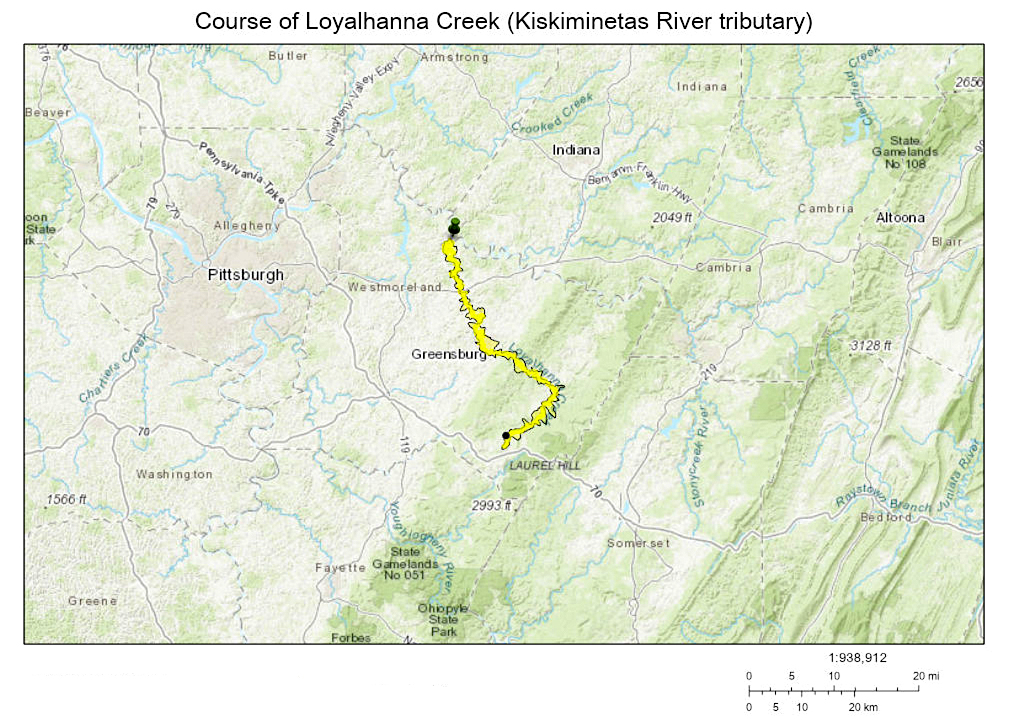
In the midst of the French and Indian War, Gen. John Forbes sent Col. Hugh Mercer and his detachment to pursue a French and Native American raiding party that was seen near the Loyalhanna Creek. The creek is regularly only a few feet deep, and it averages thirty to forty feet wide across its fifty-mile run, consisting of moderate pools, slower-flowing rocky areas, and places with more turbulent water flowing over rocks, gravel, or stones. The surrounding area is marked by deciduous trees, hills, and occasional meadows traditional to the Western Pennsylvania landscape.[15] As this creek is one of the larger streams in the Laurel Highlands, it is easily found, but not easily tracked as it weaves itself between the Appalachian hills, which rise two thousand feet above the valley bottoms and stretch for many miles, creating an almost impenetrable barrier for the movement of European wagons.[16] This made it an ideal battleground for the Indian recruits for whom “rivers are no obstacles to them.”[17]
Raiding parties were especially brutal, driving cattle and horses before them and killing the ones that were unwanted. These raids, relying heavily on surprise, were a crucial part of the French battle strategy, desiring to both incapacitate the enemy and to “disrupt enemy communications.”[18] Washington recalled that this particular raid had a purpose “to reconnoiter our Camp, and to ascertain our strength.”[19]
Though it was approaching dusk, hearing intense, severe conflict that seemed to approach the camp, Washington, with the permission of Forbes, gathered volunteers to aid Colonel Mercer in the conflict. When Washington was within a half of a mile of the perceived skirmish, the firings that had alerted them ceased. Washington sent scouts ahead to communicate his position to Mercer.[20] It was gathering dark, and a heavy fog had settled into the region, typical of November Western Pennsylvania weather along streams at dusk where fog has played a role in other local river confusion.[21] As Washington’s men approached Mercer’s, both regiments opened fire on one another.
In the midst of the battle, in order to gain control of the men, Washington realized the crisis and rode his horse between the parties, using his saber to knock the guns upward to keep them from firing on their comrades in arms, bringing the “trigger happy men to their senses.”[22] Despite his frame offering a six-foot-two-inch target, Washington left the skirmish unscathed by bullets from either side, effectively halting the tragic miscommunication crisis.[23]

Like other officers at the time, Washington seemed to understand the crisis as it was happening, which set them apart from the soldiers from both Virginia regiments. Although serving as soldiers, the individuals in both Virginia regiments were largely planters and craftsmen.[24] They were not as accustomed to battle as the officers. This lack of training and experience, along with the terrain’s specific challenges, most likely played a crucial role in spooking the soldiers. Furthermore, issues of trust likely played a role in the conflict. Not only were there dangers imposed by the colonists’ mistrust of British leadership (ultimately resulting in the Revolutionary War), but there was also a mistrust between the populace and the soldiers, with the Maryland Gazette calling the Pennsylvania and Virginia soldiers drunkards and gamblers.[25]
In contrast to the confusion between the men, the situational awareness of the officers allowed them to not only to realize the dangerous impacts of firing on unknown, seemingly enemy combatants, but to warn the soldiers who were willing to listen to them. Despite the officers understanding the nature of the crisis, the discrepancies in various details of what exactly happened demonstrate the confusion that framed the skirmish. Although the fog that caused the crisis was literal, it exemplified the cognitive fog that faced the military groups. The shame of firing on fellow soldiers, loss of life, and loss of leadership (one officer was killed), demonstrated the destructive extent of the crises that they recognized in the midst of the battle.
Washington’s leadership which led to the end of the conflict[26] was embodied in clear action rather than verbal speech alone or even the waving of a hat as expressed by Bullitt. When Washington chose to ride between the soldiers and literally smack the rifles of his men to keep them from firing at the supposed enemy, his direct intervention exemplified the personal command he later employed in other conflicts.
Another example of leadership in action was seen in 1756 when Washington had Sgt. Nathan Lewis executed in front of the Virginia Regiment for his second demonstration of cowardice after he ordered his men to retreat during a skirmish with a raiding party. Washington purposefully delayed his execution until new recruits arrived in the camp so that “all of his way of thinking will take warning from his death,” as he explained to the lieutenant-governor of Virginia, “as the Newly-draughted Recruits for the Regiment may be here by that time to see it executed; and it will be a good warning to them.”[27]

The friendly fire incident was recognized by multiple officers who attempted to halt the skirmish. However, it was Washington’s actions that were remembered as bringing a close to the fight.[28] A combination of his situational awareness, risk, and active leadership had an indelible effect on the soldiers who were firing into the darkness at unseen assailants.
The skirmish that preceded the friendly-fire incident had an important effect on the overall war effort. Forbes had been trying for months with countless scouting parties to gather accurate intelligence of the enemy.[29] This skirmish provided that and turned the tide of the war for the British, allowing them to capture three prisoners, two Indians and one white man.[30] The white man was a British soldier who had joined the French, therefore facing a death sentence for bearing arms against the crown.[31] The prisoner revealed the vulnerability and weakness of Fort Duquesne, on a strategic waterway route, a major enemy strongpoint and supply base, and the base of operations for many of the raids on the colonists. This motivated Forbes to push ahead with a force of 2,500 picked men and odds now stacked in his favor.[32]
Interestingly, the loss of life and miscommunication of the friendly fire incident are not portrayed as the main focus of the event. Rather, when covered in both recollections by both the British officers, such as Forbes, as well as the newspapers such as the Pennsylvania Gazette, it is viewed as unfortunate but resulting in productive advancement for the war effort. The only exception to this is the hearsay story given by Bullitt, which counters the more contemporary accounts. Perhaps this indicates an emphasis on Washington’s leadership prowess rather than his miscommunication as the focus of the collective memory.
Conclusion
Just as Washington castigated the “Chimney Corner Politicians” who made military decisions without ever having visited the battlefield, so his leadership emerged from the coals of experience, loss, and hard-earned lessons.[33] Leadership forged by fire has long-lasting impacts on the individual and the organization. The fact that Washington found this such a crucial moment in his reflections, but it was subsequently played down by biographers and analysts, demonstrates that something significantly personal happened to Washington at this juncture. This is the type of leadership moment that becomes an internal catalyst to transition with confidence from dealing with friendly fire incidents as a colonel to dealing with global politics as a continental general and eventually the first president of the United States.
Washington’s own classification of the incident as his life’s greatest jeopardy underscores its personal significance, offering insight into the experiences that informed his later Revolutionary command.
[1] Fred Anderson, “The General Chooses a Road: The Forbes Campaign of 1758 to Capture Fort Duquesne [First Installment],” Western Pennsylvania History 42, no. 2 (1959): 392.
[2] George Washington, “Remarks” (autograph manuscript, ca. 1787–1788), page 9, Fort Ligonier Collection, Fort Ligonier, Ligonier, Pennsylvania; transcription available in National Park Service, “George Washington’s ‘Remarks,’“ Becoming George Washington Teacher Resource Guide, www.nps.gov/common/uploads/teachers/lessonplans/Remarks-by-George-Washington1.pdf.
[3] “Orderly Book, 12 November 1758,” Founders Online, National Archives, https://founders.archives.gov/documents/Washington/02-06-02-0106.
[4] Doug MacGregor and Melissah Pawlikowski, eds., “‘This Wretched World’: The Journal of John Michael Lindenmuth,” Pennsylvania History: A Journal of Mid-Atlantic Studies 74, no. 3 (Summer 2007): 390–91.
[5] John Forbes to James Abercromby, November 17, 1758, in Alfred Procter James, ed., Writings of General John Forbes Relating to His Service in North America (Menasha, WI: Collegiate Press, 1938), 255–56.
[6] Horatio Sharpe to William Pitt, November 28, 1758, in Gertrude Selwyn Kimball, ed., Correspondence of William Pitt, When Secretary of State, with Colonial Governors and Military and Naval Commissioners in America, vol. 1 (New York: Macmillan, 1906), 410–11.
[7] Pennsylvania Gazette, November 30, 1758.
[8] Washington, “Remarks”, 6.
[9] William Findley, “General Washington,” Niles’ Weekly Register 14, no. 11 (May 9, 1818): 179–80.
[10] Gordon S. Wood, Revolutionary Characters: What Made the Founders Different (New York: Penguin Press, 2006). Joseph J. Ellis, American Creation: Triumphs and Tragedies at the Founding of the Republic (New York: Random House Large Print Publishing, 2007): 3. Ron Chernow, Washington: A Life (Penguin Press, 2010): 771; Edward G. Lengel, General George Washington: A Military Life (New York: Random House Trade Paperbacks, 2007). John Ferling, The Ascent of George Washington: The Hidden Political Genius of an American Icon (New York: Bloomsbury Press, 2009).
[11] Washington, “Remarks”, 9.
[12] Washington, “Remarks”, 12.
[13] Erin McCreary, “Geophysical Survey of the Friendly Fire Incident, French and Indian War, Pennsylvania,” paper presented at the 89th Annual Meeting of the Society for American Archaeology, 2024 (tDAR id: 499713).
[14] Washington, “Remarks,” 8.
[15] “Loyalhanna Stream,” Laurel Highlands Trout Trail, n.d., www.laurelhighlandstrouttrail.org/loyalhanna.
[16] Matthew C. Ward, Breaking the Backcountry: The Seven Years’ War in Virginia and Pennsylvania, 1754–1765 (Pittsburgh: University of Pittsburgh Press, 2003).
[17] William Smith, An Historical Account of the Expedition against the Ohio Indians in the Year 1764 (Philadelphia: T. Jefferies, 1766), 39.
[18] Ward, Breaking the Backcountry, 117.
[19] Washington, “Remarks,” 8.
[20] Findley, “General Washington.”
[21] Zadok Cramer, The Navigator: Containing Directions for Navigating the Monongahela, Allegheny, Ohio, and Mississippi Rivers (Pittsburgh: Cramer & Spear, 1811).
[22] Anderson, “General Chooses a Road,” 392.
[23] Findley, “General Washington.”
[24] Ward, Breaking the Backcountry.
[25] Maryland Gazette, November 25, 1756.
[26] Washington, “Remarks,” 9.
[27] Ward, Breaking the Backcountry, 232. George Washington to Robert Dinwiddie, October 1756, in The Papers of George Washington, Colonial Series, vol. 3, ed. W. W. Abbot (Charlottesville: University Press of Virginia, 1984), 77–79.
[28] Findley, “General Washington.”
[29] Anderson, “General Chooses a Road,” 109–138.
[30] Ward, Breaking the Backcountry. Forbes to Abercromby, November 17, 1758, in James, Writings of General John Forbes, 255–56.
[31] Anderson, “General Chooses a Road,” 392.
[32] Ibid., 109–138.
[33] Ferling, The Ascent of George Washington.

2 Comments
Footnote #1 is incorrect. The author of the article is Niles Anderson, not Fred Anderson. Fred probably was in high school in 1959.
“Chimney Corner Politicians” Perfect label for those highfalutin know-it-alls. They were then; they are now.