

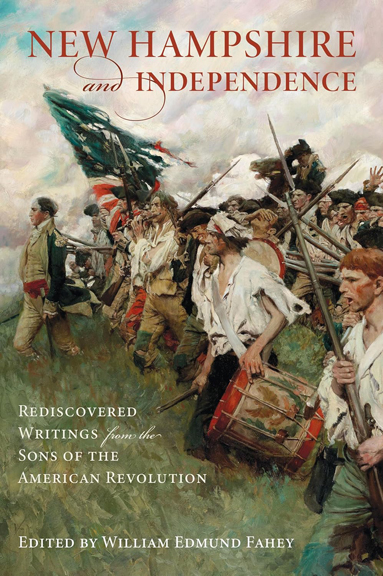
BOOK REVIEW: New Hampshire and Independence: Rediscovered Writings from the Sons of the American Revolution edited by William Edmund Fahey (Charleston, SC: History Press, 2026). $34.99 Cloth, $24.99 Paperback
The guidelines set for submissions to the Journal of the American Revolution ensure the articles exhibit the best practices of today’s historiography. They mandate that the writing presents a scholarly, well-documented examination of a topic. The resulting fastidious research, writing, and documentation has not always been common practice.
 Today’s historians have major advantages over those preceding them. Not only are new sources of information continually being discovered, but the internet also provides ever-expanding access to material in a manner barely imagined by researchers of only a generation or two ago. Furthermore, detailed scholarly standards developed in the twentieth century have helped define the best practices for research and writing.
With relatively limited sources and no real standards, early historians often spent their time simply telling a story rather than examining information for cause and effect. Much of the writing included sweeping generalizations along with the near total exclusion of cultures and races other than white European. Further, mentions of the common person, daily life, women, and even Tories seldom appeared as writers concentrated on great men and great events.
But, in their defense, those early authors had a much more primal goal than determining the whys and why-nots or even simply telling the country’s history. They were attempting the creation of a national heritage – a legacy and a set of heroes for the new United States. The rest of the world’s countries already possessed an indigenous inheritance: it had been built and handed down through the eras of each country’s existence. It went a long way towards defining the legitimacy of each country and lacking it created a challenge for the infant United States. American historians attempted to solidify a rather tenuous footing upon which the United States could stand within the world. William Fahey’s New Hampshire and Independence offers evidence of those efforts.
The author is a college-level history and humanities professor who, in addition to belonging to several organizations promoting early American history, is the historian for the New Hampshire chapter of the Sons of the American Revolution. Serving in that latter role inspired the author to gather together some examples of early accounts of the state’s Revolutionary War history prepared by members of the SAR.
The book’s layout is in four “Parts” but, in reality, there are only two. Three of the parts contain several short chapters outlining New Hampshire’s Revolutionary-era history, notable people, and providing sources of information for further research (including both the written word and history-oriented organizations). The other part – well over half the book and its true core – consists of six pieces each covering in some detail different aspects of the Revolutionary history of the state. Topics include an overview of the war years, activities leading up to the war, the early months around Boston, Bunker Hill, the Sullivan campaign, and John Langdon’s activities in the post-war years. The writing of the articles clearly is intended to glorify New Hampshire’s role in the Revolution and, to some extent, minimize the influence of other states.
All of the pieces originally had been delivered as speeches before meetings of the organization between 1897 and 1910 and later appeared either as a pamphlet or in a magazine. There are numerous illustrations ranging from period pieces to photos of reenactors, likely all selected by the author.

The book is not a scholarly work. It does not contain notes, a bibliography, or even an index. Within the text of the six articles there are occasional mentions of sources, but they are not common and always reference secondary sources. To its credit, one article does contain a baker’s-dozen endnotes, most of which are from primary sources. The sources of all the illustrations are credited in the captions.
While not a book to be used as a principal source of information on New Hampshire’s role in the Revolution, it does have some value to a researcher. The chapters outlining the state’s involvement in the war do provide some basic information for someone new to the topic but the reader must understand that there are many more sources with much more detail available. The six articles also give the reader some information but are quite biased in their presentation. The reader can also find value in those articles as examples of research and writing of an earlier period of historiography at a time when the process of research and writing was just starting to move toward what we expect today.
Whatever a reader takes from New Hampshire and Independence, they can compare/contrast it with what professor Fahey sets as his parameters for the success of the book. He writes at the end of the first chapter, “If readers of this book conclude that the work is infused with a pious air, then I consider the book a success.” But, he goes on to say that his use of “pious” is not in the sense of “unthinking nationalism or unquestioned acceptance of the actions of a people as perfect by reason of blood or soil.” The author then defines the word in the classical sense and hopes that the reader will view the book with that in mind. It is his hope that the reader will apply that sense of piety to considering “how recollection and commemoration are as much a part of a people’s identity as memory is to any flourishing person.” That is the heart of New Hampshire and Independence.
PLEASE CONSIDER PURCHASING THIS BOOK FROM AMAZON IN HARDCOVER OR PAPERBACK.
(As an Amazon Associate, JAR earns from qualifying purchases. This helps toward providing our content free of charge.)


Recent Articles
Last Call for a Dram Seller on the Mohawk River
Payback: Attack on the DeLancey House
A Dear-Bought Victory: The Battle of Bunker Hill and the Siege of Boston, 1775-1776
Recent Comments
"Payback: Attack on the..."
Fascinating account and detailed illustration of how much the AWI also was...
"Shenandoah Martyr: Richard Campbell..."
My ancestry points to this being my grandfather on my mother’s paternal...
"Payback: Attack on the..."
Yes, indeed, a great read as previously commented. And a great fascination...