


In the story of the Revolutionary War in the south, William Hill has long enjoyed the reputation of a true hero of the backcountry. Very early in the southern conflict, Hill picked up the banner of revolution and led efforts to defeat the Loyalist and British forces in rural northwestern South Carolina. In a time when the British were ascendant, Hill was one of few daring to challenge Tory mastery of the backcountry. Hill commanded hundreds of soldiers in his wartime career, but his credentials as a hero received a body blow with the publication of a pension application from one of them. The pension application related a tale with enough cowardice and shame to ruin Hill’s reputation.
William Hill was born in northern Ireland in 1741 of Scots-Irish parentage.[1] He emigrated to Pennsylvania, remaining there only briefly. He quickly moved to South Carolina, lured, as were many of his colleagues, by the availability of inexpensive land. He settled in the New Acquisition, present-day York County. In April 1762 he received a land grant of 100 acres on Bowers Mill Creek.[2] He was twenty-one years old.
In 1776, the state assembly provided a loan of £1,000 to Hill to establish an iron works.[3] The loan, generous as it was, proved insufficient. The next year, he entered into a partnership with Isaac Hayne, a wealthy low country planter and merchant. In the meantime, Hill obtained land grants centered on Allison Creek in present-day York County, ultimately amassing 15,000 acres. He started operations with his Aera works in 1778, adding the Aetna works in 1787.[4]
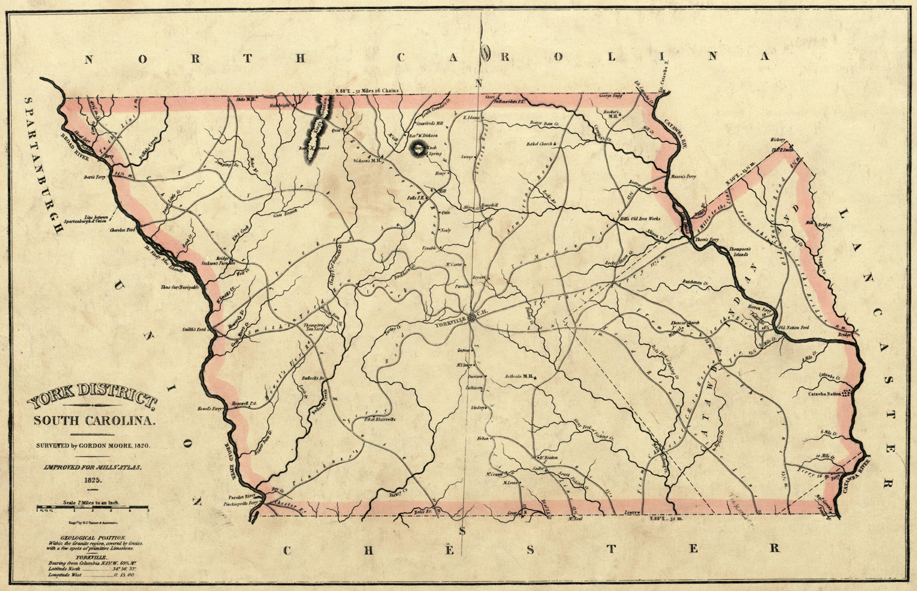
In 1779, Hill paid for a newspaper advertisement, seeking to sell iron household necessities as well as cannons, swivel guns, and “any size Cannon Ball.”[5] It was Hill who supplied American forces with the bulk of their cannon balls during the 1780 Siege of Charlestown.[6] After the siege, Hill’s supplying the Americans incurred the wrath of the occupying power.[7] Lt. Col. George Turnbull, commander of the British garrison at Rocky Mount, sent Capt. Christian Huck, a Loyalist seemingly determined to set new records for outrages against the Whig population, to destroy Hill’s iron works.[8]

At the time of Huck’s mission, Hill was a political leader, serving in the legislature since 1779.[9] His military role was less clear. Historian Michael Scoggins asserted that Hill’s iron works became the headquarters for the New Acquisition Regiment of Patriot militia in the dark days following the fall of Charlestown.[10] If so, the iron works would have made an irresistible target to a man of Huck’s inclinations.

Scoggins’s assertion has a great deal of merit. Hill recounted a story, often repeated, about the beginning of his militia career. After Charlestown surrendered, Cols. Andrew Williamson and Andrew Pickens, the most prominent Whig militia commanders in the backcountry, accepted the British offer of reconciliation and took oaths of loyalty to the British government. The commanders of the New Acquisition militia, Col. Samuel Watson and Lt. Col. William Bratton, summoned the regiment to a meeting.[11] Here, the colonels “did not encourage the men, but much the reverse . . . It appeared to them that any further opposition to the British would not avail.” Shortly afterward, a commissioner from the government appeared in the area to take oaths of loyalty. Having called an assembly, he read a British proclamation asserting that the Continental Congress had given up Georgia and South Carolina, and worse, that the Continental army was vastly reduced in size and hiding in the mountains, impotent and useless.[12] At this point, Hill interrupted the commissioner and took over the presentation.[13] He told the crowd that the proclamation contained lies; Congress had resolved to regain the southern states; Washington’s army was stronger than ever, and had sent an officer with a large army to fight in the south. Hill reminded the audience members of their duty and their oaths of support to independence. The commissioner, visibly shaken for his safety, withdrew. The militia then elected Andrew Neel as their new colonel, Hill as lieutenant colonel.[14]
With Hill the lieutenant colonel of the regiment, it made sense that the iron works would serve as its headquarters. In mid-June, a prominent Loyalist named Matthew Floyd raised thirty men and offered his services to Turnbull, “all volunteers, to serve the King.”[15] Turnbull appointed Floyd colonel of militia and placed him in command of the district. Floyd quickly began operations against the Whigs. The New Acquisition militia learned of Floyd’s activities, which “much distressed the Inhabitants” of the area. Seeking to right the balance, Colonel Neel took the regiment to the western region of the district, the location of Floyd’s base.[16]
On June 17 Huck reached the iron works with a force of British Legion dragoons and a body of Loyalist militia under Capt. Abraham Floyd, son of the colonel. Sources diverge strongly on how well the iron works were defended. Hill insisted that Neel had taken the bulk of the regiment, leaving only a dozen men to defend the militia headquarters.[17] Huck asserted the rebels mustered 150 men and mounted a strong defense overcome only by his exertions.[18] Historian Anne King Gregorie carved a middle way, writing that the iron works, “although carefully guarded,” fell to the British.[19] The Loyalists, Legion and militia razed Hill’s works to the ground.

With his livelihood ruined and his position exposed, Hill had much to gain and little to lose. He left his family in the New Acquisition and joined Col. Thomas Sumter, another backcountry leader stirred to action by recent events.[20] Ultimately, Hill became a regimental commander under the umbrella of Sumter’s militia brigade.

Sumter distinguished himself by taking the field in the early days following the loss of Charlestown. In late July 1780, the Continental forces in the deep south were in a shambles. Most of the regular soldiers became prisoners of war in Charlestown in mid-May. The few remaining below North Carolina fell victim to Lt. Col. Banastre Tarleton at the Waxhaws at the end of the month. Sumter, undeterred by the Continental losses and the malaise that accompanied them, resolved to attack the British frontier outpost at Rocky Mount.[21] As Hill related the events, the attack failed due to the Loyalists’ reinforcement of the fort’s walls with logs and clay. In retreat, the Whigs took note of a small house near the fortified position. A fire in the smaller house would ignite the larger. Hill and a sergeant were able to set the roof of the small house on fire amid a flurry of musket balls, but their courage availed little when a storm arose and extinguished the fire.[22] The Battle of Rocky Mount was a milestone in the southern war, an act of defiance in the face of overwhelming odds. Among many beneficial effects, there was bad news: Colonel Neel was killed. With Neel gone, Hill assumed command of the regiment.
Hill fought in Sumter’s next battle a week later at Hanging Rock, another British fort in the British frontier defensive line. Sumter was more successful this time, but Hill was wounded in the fighting.[23]
Two days after the American disaster at Camden on August 16, Tarleton surprised Sumter at Fishing Creek and achieved an overwhelming victory over the Whig militia. Sumter soon regained strength, and defeated a British detachment on November 9. Hill’s memoir mentioned both battles briefly, but said nothing about his role in either.[24]

In his memoir, Hill wrote of the Battle of Blackstock’s Farm on November 20, and his participation in the Battle of Kings Mountain. Hill noted that his wound prevented his riding a horse without putting his arm in a sling, and he deferred command of his regiment to Lt. Col. James Hawthorne. As Hill described matters, he remained with “the rear guard.”[25] Hill insisted there “was very little military subordination,” meaning what today is called command and control. “All that was required was that every Officer & man should ascend the mountain so as to surround the enemy.”[26] The author of an extensive thesis on Hill credits the militia colonel with directing the battle from behind the scenes, asserting that Hill, “more than any one man,” was responsible for the Patriot victory.[27] Although a sincere tribute, this directly contradicts Hill himself, who claimed no laurels for Kings Mountain other than the distinction of serving in the army that fought there.[28]
Hill wrote of the Battle of Musgrove’s Mill, an engagement in August 1780 where neither Hill nor Sumter was present. Hill then ended his discussion of the war, and began his account of the political efforts in South Carolina to form opposition to Great Britain.[29]
Most of the information known about Hill comes from his memoir. Information available on him after Blackstock’s Farm is scanty. Although it was clear he remained active politically, his military role is opaque, and here, we meet Samuel Walker, a private in the backcountry militia. Walker was born in northern Ireland in 1760 and emigrated to America. In 1836, he began the process of filing an application for pension benefits for his service in the Revolutionary War.[30] At the time of his application, he was seventy-six years old. The events in his application had taken place fifty-six years earlier.
Walker stated that he volunteered for service in 1778 at Fishing Creek, South Carolina, in Capt. John McClure’s company. McClure recruited his company from the Fishing Creek, Rocky Creek, and Sandy River districts of the backcountry. His men were drawn from “the Knoxes, Walkers, Marrows, McClures and Johnsons.”[31]
Walker saw no action until 1780, when “the British & Tories had almost taken possession of South Carolina.” He then saw battles in a head-spinning rush: Mobley’s Meeting House, Ramsour’s Mill, Rocky Mount, Hanging Rock, and Blackstock’s Farm. His narrative put events into a sequential hash, with service at Fort Granby following Mobley’s Meeting House and preceding Ramsour’s Mill, Huck’s Defeat after Hanging Rock and before Blackstock’s Farm. Walker stated that he “continued in the service of his country till the close of the war.”
The duration of his service was apparently questioned by the pension examiners. Walker returned on May 22, 1837, insisting “he now recollects that he served in Sumter’s Brigade & Hampton’s Regiment, Barrett’s troop and McClure’s company.” With this amendment to his application, he tendered affidavits by Robert McCormick, a veteran who swore he knew Walker and remembered his presence at many of the named battles.
Walker added a second amendment on July 26, 1837. [32] McCormick again supported the claim with an affidavit. Walker once more set out the individual engagements that formed his militia experience, starting in 1778, with active service beginning in 1780 at Mobley’s Meeting House. He described his experience at Blackstock’s Farm, but this time placed service at Fort Granby after Blackstock’s. From Fort Granby, he marched with Sumter to Orangeburg “and took it from the British.” He then joined Capt. Jacob Barnett’s troop, part of Henry Hampton’s regiment of South Carolina state troops. While with Hampton, Walker participated in Sumter’s abortive effort to halt relief of the British garrison under siege at Ninety-Six. He stated that his unit foraged their horses for two weeks, returned to Orangeburg for three weeks, then he was discharged, having completed ten months with Hampton’s light dragoons. He concluded by insisting he had served two years and two months with the militia, another ten with the state troops.
Walker returned with a third amendment to the application on February 8, 1838. McCormick added another affidavit. In this fourth try, much shorter than its predecessor, he summarized his entitlement to benefits and added an additional claim for unpaid compensation for wartime service “which was justly due him.”
In all of his application depositions Walker shared few details besides where he served, but he mentioned one experience at Blackstock’s Farm. He related:
Blackstock’s; there had a fight with Colonel Tarleton, a British Colonel at which place General Sumter was wounded in the shoulder and had it not been for Colonel Hill, we would have taken every person there. He behaved so cowardly that he had his side arms taken from him and a wooden stick in its place in the scabbard.
What to make of this astounding tale? William Hill, hero of Rocky Mount and wounded at Hanging Rock, disgraced for cowardice on the battlefield. How reliable is the account by Samuel Walker?
Overall, pension applications have been praised as “perhaps the single most important resource ever made available to Southern Campaign researchers.”[33] While the praise is merited, it is nonetheless possible that individual pension applicants were unscrupulous or unworthy. After all, the pension statutes provided government benefits at a time when such things were scarce. They provided a refuge for desperate people with no other recourse, as well as a target for the frankly dishonest looking for ready money. The sad fact is that people will lie for money.
With this caution in mind, Walker’s pension application generally seems valid, even though it bears the scars of aging. The engagement at Mobley’s Meeting House took place in early June 1780.[34] Sumter moved against Rocky Mount at the end of July, and fought Hanging Rock on August 6. Blackstock’s Farm took place on November 20. Huck’s Defeat, listed out of sequence, was only marginally so; it occurred on July 12. Fort Granby, also out of sequence, was more so. But nothing in this sequence is in any way out of line with the vast run of pension applications – incorrect dates and inaccurate sequences are common in these documents. As long as we accept that memory fades with time, none of these matters represents a problem.
Some of the details in the application align well with other sources. John McClure was a well-known figure in the southern war who recruited men from several districts, including Fishing Creek where Walker started. McClure and his men fought at Mobley’s Meeting House, Huck’s Defeat and Rocky Mount. Walker noted that he fought at Hanging Rock, where “Capt. McClure was mortally wounded and carried to Charlotte, North Carolina and died in about two weeks.” McClure did in fact die from his wounds in Charlotte nine days after the August 6, 1780 battle.[35]
Walker noted that his unit arrived at Ramsour’s Mill “just after the Battle was fought to a close,” which agrees with Hill’s recollection that he and his unit “were going to attack a large body of Tories that had collected at a place called Ramsour’s Mill,” but Gen. Griffith Rutherford beat them to the punch.[36]
Walker’s claim of service with McClure beginning in 1778, but fighting in no engagements until Mobley’s Meeting House in mid-1780, leave a two-year gap may have been an effort at deception, but are more likely the tricks of an old man’s memory. The confirmatory details seem too strong to accuse Walker of fabrication.
Walker’s recollections of service in Henry Hampton’s regiment of light dragoons, beginning in the spring of 1781, are in some ways garbled but are generally consistent with the regiment’s activities. But Walker claimed to have received his discharge for ten months of service with Hampton in late June. If this is when he was discharged, his time with Hampton could not have exceeded four months. If he was simply mistaken, and served ten months with Hampton, then his application had startling omissions, most notably service at the Battle of Eutaw Springs fought September 8, 1781. This problem is the first serious concern with what Walker asserted; that is, it cannot be easily explained away as a trick of memory.
With this discrepancy in mind, we turn to Walker’s extraordinary allegations against William Hill. Hill, a hero of the backcountry, received plaudits universally for his physical and moral courage throughout the war and the difficult times that followed. How, then, was he a coward at Blackstock’s Farm? Walker was very specific. Not only did Hill fail in his responsibilities, his men knew it, and disciplined him for it.
At first blush, it is tempting to toss out the story as patent nonsense. However, there is a gaping omission in the war record of Colonel Hill, and in this we find the potential for credibility in Walker’s scandalous assertions. The chronology in Hill’s memoir stopped at Blackstock’s Farm. He discussed the battle briefly, mentioned nothing of his own role, and ended any discussion of his military record. What could explain his reticence? He was little short of bombastic in much of what he wrote, so his sudden shyness is puzzling. The silence suggests to the reader that he was hiding something.[37]
Other records shed very scant light into his military activities after Blackstock’s Farm. On July 8, 1781 Sumter enumerated several of the regimental commanders in his brigade, including Hill, in a letter to his commanding officer.[38] One historian inferred he was still in command of a regiment in October 1781.[39] These records lead to an obvious question: would Sumter have kept a known coward in command of a regiment?
Although unlikely, one can proffer two ways for Hill to keep his command. First, Sumter was wounded at Blackstock’s Farm, and carried off the field in distress. He may never have learned of Hill’s issues. Second, Sumter valued loyalty very highly. Hill was always loyal to Sumter. His memoir was an intense, personal tribute to Sumter. Had Sumter kept Hill after his disgrace, Sumter could always count on his undying loyalty, which, ultimately, was what he got from Hill.
Both scenarios strain credulity. As to the first, Sumter was a hands-on leader who would have learned of misconduct by one of his regimental commanders. The second pushes the envelope too far. Frankly, there seems no way Sumter would have allowed Hill to remain in command after Blackstock’s Farm if there were any substance to Walker’s story.
The gap in Hill’s military record is not different from most militia officers, of whom often little is known. Hill is the exception only to the extent he chose to write about the events leading to the Battle of King’s Mountain.
Historian C. Leon Harris wrote that Walker was probably mistaken on his starting year, and 1780 was more likely than 1778.[40] Historian Will Graves added that he believed Walker was not in Hampton’s regiment of state troops; among other reasons, it defied common sense that he would fail to mention ten months of service in an application for benefits based on length of service. The pension examiners apparently agreed with both points, in that Walker was awarded benefits for six months of militia service, roughly the time of those battles initially documented in his first application, Mobley’s Meeting House to Blackstock’s Farm, all of which occurred in 1780.
Graves made a compelling case that Walker’s claim for benefits through service in Hampton’s regiment was more than a glitch of memory. There was a Samuel Walker in Hampton’s regiment, but he died in 1782. The pension file contained a record of an indented certificate issued for the deceased Samuel Walker. The indent established “Samuel Walker” as a bona fide veteran of Barnett’s troop in Hampton’s regiment.[41] The record was dated April 24, 1837. The living Samuel Walker filed his amendment the next month, on May 22, 1837, in which he “now recollects” service with Hampton. Graves was right. The timing of the amendment was not a coincidence: “this veteran, in seeking to prove his service, had the SC Audited Account records searched and learned that someone by that name received an indent for service” under Hampton and decided to take advantage of it.
Graves established that Samuel Walker lied for money. His claim for benefits via Hampton was a fabrication. Graves’s work placed Harris’s critique in a different light. Harris established that he could not have begun his service until 1780, not two years earlier as he claimed. At first blush, one might assign this two-year discrepancy to faulty memory or to an effort to dissimulate. In light of Graves’s revelations, it is difficult to regard the claim for two years of additional benefits innocently.
Although both researchers were too tactful to state expressly, there was no question their work accurately painted Samuel Walker as a liar. His claim for benefits under Hampton was a fabrication. Do we now discard the rest of Walker’s claim?
Oddly, perhaps, no. The pension examiners, unimpressed with his claim for service under Hampton, awarded him benefits for service under McClure. While his efforts to push his enlistment date back two years tainted his claim, it was not fatal, and no one, the researchers included, suggested his claim for militia benefits was a lie.
Even so, Walker’s allegations against Hill had no bearing on the validity or extent of his claim. It was entirely irrelevant, and the reason he included it is mysterious. Why would an elderly pension applicant, obviously struggling to obtain benefits, gratuitously insult a militia colonel in his official paperwork? Desperate as he was to collect benefits, it seems incongruous he would have risked offending a friend or admirer of Colonel Hill working in the pension bureaucracy.
One possibility was the toll of age on memory. Walker may simply have remembered the event incorrectly, or wrongly named Hill as the target of the humiliation. Walker and Hill, neighbors in civilian life, fought in different regiments at Blackstock’s Farm. Walker had enlisted in McClure’s unit, an independent company. McClure cooperated with several units, usually the formation commanded by then-Capt. Edward Lacey. One source asserted that McClure, for a time, commanded a company within the New Acquisition militia.[42] Regardless of the formalities of the affiliation, Walker almost certainly knew Hill. By late July, McClure and Lacey had cemented their association in a formation usually referred to as the Chester District Militia, which Lacey commanded after McClure’s death.[43] Both Lacey and Hill commanded regiments at Blackstock’s Farm, Hill in the center, Lacey on the right flank. Walker, in a neighboring regiment, had less contact with Hill, but even with this in mind, Walker’s account was very specific. A colonel, even of an adjacent unit, stood out from the others, and it seems unlikely that a soldier could make such an egregious mistake, particularly of an officer he knew.
Bias is a more likely explanation. It can masquerade innocently as “point of view.” Perhaps Walker had a reason to attack Hill in his pension application. The chances for a colonel to offend a private are legion, and we can only speculate on what Hill did to get on Walker’s bad side. At some point in his service, he may have had an altercation with Hill, which he never forgot and never forgave. When his chance came for some kind of retribution, he grabbed it. Samuel Walker’s application provides a valuable, yet potentially painful lesson in the use of pension applications.
[1] Anne King Gregorie, “Hill, William,” in Dumas Malone, ed., Dictionary of American Biography, vol. 9, Hibben−Jarvis (New York: Charles Scribner’s Sons, 1932), 48−49; Stephen McDaniel Marlowe, “Colonel William ‘Billy’ Hill: The Patriot Iron Master Who Turned the Tide” (masters’ thesis, Winthrop University, 2002), 42.
[2] Thomas Cowan, “William Hill and the Aera Ironworks,” Journal of Early Southern Decorative Arts 13, no. 2 (November 1987), 5.
[3] Gregorie, “Hill, William,” 48.
[4] Cowan, “William Hill and the Aera Ironworks,” 4, 8.
[5] Gregorie, “Hill, William,” 48; Marlowe, “Patriot Iron Master,” 45.
[6] Gregorie, “Hill, William,” 49.
[7] Cowan, “William Hill and the Aera Ironworks,” 14.
[8] George Turnbull to Charles Cornwallis, June 15, 1780, in Ian Saberton, ed., The Cornwallis Papers: The Campaigns of 1780 and 1781 in the Southern Theatre, 6 vols. (Uckfield, UK: The Navy and Military Press Ltd, 2010), 1:140; Turnbull to Cornwallis, June 19, 1780, in Saberton, Cornwallis Papers, 1:143.
[9] Cowan, “William Hill and the Aera Ironworks,” 6.
[10] Michael C. Scoggins, The Day it Rained Militia: Huck’s Defeat and the Revolution in the South Carolina Backcountry, May–July 1780 (Charleston: The History Press, 2005), 75.
[11] A. S. Salley, Jr., ed., Col. William Hill’s Memoirs of the Revolution (Colombia, SC: The State Company, 1921), 6.
[12] The proclamation encouraged inhabitants to return to their farms and warned Whigs of severe penalties for continued rebellion, “Address to the Inhabitants of Charlotte,” June 11, 1780, in Saberton, Cornwallis Papers, 1:129. The rest of Hill’s version of the proclamation may have been an ad lib by the commissioner, or perhaps a trick of Hill’s memory.
[13] On the matter of Hill’s conduct at the meeting, we refer to Hill’s grandson, Confederate general D.H. Hill, who wrote to Lyman Draper that his father tried to dissuade the elder Hill from writing the memoir. He “was in his dotage” and the “egotism of the book was enormous.” Scoggins, Huck’s Defeat, 58.
[14] Hill’s story found confirmation of its broad outline in the pension application of Samuel Gordon, S30441, Southern Campaigns American Revolution Pension Statements & Rosters, revwarapps.org/s30441.pdf: “Colonel Watson refused to command us any longer,” after which several men “joined the Army of the Whigs wherever we could find them, we were under the command of Colonel Neel.”
[15] Turnbull to Cornwallis, June 16, 1780, in Saberton, Cornwallis Papers, 1:142.
[16] Salley, Col. Hill’s Memoirs, 8.
[17] Ibid., 8.
[18] Turnbull to Cornwallis, June 19, 1780, in Saberton, Cornwallis Papers, 1:143.
[19] Gregorie, “Hill, William,” 49.
[20] Salley, Col. Hill’s Memoirs, 8−9.
[21] Banastre Tarleton, History of the Campaigns of 1780 and 1781, in the Southern Provinces of North America (Dublin, 1787), 96; Blackwell P. Robinson, ed., Revolutionary War Sketches of William R. Davie (Raleigh: North Carolina Department of Cultural Resources, 1976), 10−11.
[22] Salley, Col. Hill’s Memoirs, 11−12.
[23] Ibid., 13.
[24] Ibid., 13−14.
[25] Ibid., 22.
[26] Ibid., 22.
[27] Marlowe, “Patriot Iron Master,” 87, 98−99, 106−108.
[28] Marlowe based his position on a pamphlet written by D.H. Hill, “Col. William Hill and the Campaign of 1780,” privately published in 1919. While one is tempted to suggest the younger Hill’s paper was fueled by private stories from his grandfather, it seems far more likely that General Hill, entranced by the legends of his famous ancestor, simply intended a tribute to him.
[29] Salley, Col. Hill’s Memoirs, 27.
[30] Pension Application of Samuel Walker, S3448, Southern Campaigns Revolutionary War Pension Statements & Rosters, revwarapps.org/s3448.pdf.
[31] The quote is from Joseph Gaston, a Whig militiaman and cousin of McClure, in “A Reminiscence of the Revolution,” written in 1836. It is reprinted in Chalmers Gaston Davidson, Gaston of Chester, Based Chiefly on the Notes and Records Preserved by Judge Arthur Lee Gaston (Davidson, N.C.: Davidson Printing Co., 1956), 134.
[32] At least, this is the date on the amendment. McCormick’s supporting affidavit bore a date of July 26, 1878, which Will Graves, in transcribing the documents, concluded was probably 1838. I tend to the view that both the amended application and the affidavit were prepared on the same day, as they were on both other occasions, making the date for both July 26, 1837. For the purposes of Walker’s dealings with Colonel Hill, the sequence and dating of the second and third amendments are largely academic.
[33] L.E. Babits and J.B. Howard, “The North Flank at Guilford Courthouse: A New Interpretation Based on Materials Recovered by Metal Detectorists,” Journal of the Southern Campaigns of the American Revolution 25, no. 6 (September 2025), 40n2.
[34] Probably. Sources place the event between May 26 and June 11, with June 8 achieving greatest support. For our purposes, any of these dates will suffice.
[35] McClure’s date of death is controversial. The nine days in the text is from the pension application of John Walker, W9875, Southern Campaigns American Revolution Pension Statements & Rosters, revwarapps.org/w9875.pdf.
[36] Salley, Col. Hill’s Memoirs, 8. Here, Hill’s memory failed him. Col. Francis Locke commanded the Patriot side at Ramsour’s Mill.
[37] In this same vein is Hill’s audited account, which contains a claim for compensation as a militia colonel for 286 days in 1780, with no similar claim for 1781, Audited Account Relating to William Hill, South Carolina Department of Archives and History, www.archivesindex.sc.gov/ArchivesImages/S108092/S108092007100204000/images/S108092007100204000.pdf, 2−3.
[38] Thomas Sumter to Nathanael Greene, July 8, 1781, in Dennis M. Conrad, Roger N. Parks, Martha J. King, and Richard K. Showman, eds., The Papers of General Nathanael Greene, vol. 8: 30 March–10 July 1781 (Chapel Hill: University of North Carolina Press, 1995), 8:511. Sumter’s letter compels the conclusion that the absence of a claim for compensation as a militia colonel in 1781 is an administrative matter, not a gap in service. The file is a mess. For example, it contains a petition by a William Hill for service as a private in Sumter’s brigade. The signature on the petition is vastly different from Hill’s signature on the receipt for colonel’s compensation, and the petition is clearly from another William Hill. Audited Account Relating to William Hill, 31.
[39] Edward McCrady, The History of South Carolina in the Revolution 1780−1783 (New York: The MacMillan Company, 1902), 514.
[40] Harris was accurate. A concise summary of the experience of McClure’s company in the years 1775−1780 is in Scoggins, Huck’s Defeat, 38. It included, among other major engagements, service in the Georgia campaign of 1778−1779, whose absence from Walker’s application is glaring.
[41] The deceased Samuel Walker is the subject of the Audited Account Relating to Samuel Walker, South Carolina Department of Archives and History, www.archivesindex.sc.gov/ArchivesImages/S108092/S108092015100418000/images/S108092015100418000.pdf. A transcription of some of the contents is at revwarapps.org/sc2043.pdf.
[42] Scoggins, Huck’s Defeat, 38, 140, 149; J.D. Lewis, “The New Acquisition District of Militia,” The American Revolution in South Carolina, www.carolana.com/SC/Revolution/patriot_militia_sc_new_acquisition_district_regiment.html.
[43] South Carolina Audited Account Relating to James McClure, SC5322, Southern Campaigns Revolutionary War Pension Statements & Rosters, revwarapps.org/sc5322.pdf; Gaston, “A Reminiscence of the Revolution,” 139.



3 Comments
I believe anoher possible explanation exists for the statement from Samuel Walker. Having considered William Hill’s memoirs many times over the years, I do believe his career mostly ended at Blackstocks. However, I think you will find that many of the Fishing Creek area men share that status. Their area of SC had been extremely active over the summer and Fall of 1780 but then went quiet once Cornwallis left for North Carolina. It looks like Col Lacey went home and built a local fort from which they kept the local peace. Hill was from the next district and may have followed in Lacey’s footsteps. Which brings the real question? What about Hill’s Memoirs? They are obviously a testament to his friend Edward Lacey along with an accusation against Sumter’s rival, James Williams. Many SC historians like to cherrypick his memoirs by taking parts from Rocky Mount and Hanging Rock but then completely disavowing the detailed story about Sumter and Lacey’s clash with Williams during August and September of 1780, ending with Williams’s death at Kings Mountain. I believe perspective and bias come strongly into play but recognizing that does not change the bare facts laid out in the memoir. As I recall, William Hll’s grandson admitted to family embarrassment over the Memoirs because Hill spoke so highly of his own role in the early events of June 1780. (his ‘egoism’). The Memoirs were written before the pension applicatons came out. The memoir did not receive a lot of circulation but may have been read locally. Samuel Walker may have been exposed to the memoir and been motivated to talk about Hill’s questionable behavior at Blackstocks because of it. He was a John McClure man, little reason for him to get excited about Hill’s memoir which pretty much left John completely out of the picture. From Walker’s point of view, John McClure was a major hero who led the first active resistence to British Occupation in the South. I originally found the stories in the Gaston family history. McClure’s mother was sister to Justice Gaston.
There seems little doubt that but for the so-called “egotism” that drove Hill’s memoir, we would know very little of his career. The wide availability of pension applications has established that Walker was one of few men with anything, right or wrong, to say about Hill. Given the thin state of the historical record, I tend to proceed hesitantly in assessing Hill’s career. After all, there were scores of officers in and around Sumter about which we know very little, and Hill stands out only to the extent of his self-promotion. I agree that the fact his memoirs cut off in 1780 suggests his involvement may have receded. At the same time, the few records we have tell us he retained a regimental command, implying a continued commitment to the fight. You may be right that partisanship in favor of McClure drove Walker to write what he wrote. Hill was not bashful about his admiration for Lacey and his antipathy for Williams. With his demonstrated willingness to express his emotions, I have seen the absence of McClure from his memoir more as focus than disregard. However, his omission of McClure may well have been interpreted by a dedicated McClure partisan as a slight to a hero of the rebellion. Thanks for sharing your insights.
So nobody else brought Hill’s alleged cowardly behavior up for over a half century? Sounds like Walker may have had an axe to grind.