



Although the Revolutionary War was winding down by the year 1782, there was still raiding across Long Island Sound between the British-Loyalists forces on Long Island and the Patriot forces in Connecticut. The raids which engaged both soldiers and citizens alike were often revenge seeking, creating a somewhat civil war between factions in the region. Armed whaleboats from both sides of the sound cruised its waters on a regular basis. Distinct whaleboat units were even being commissioned. Forces such as the Loyalist Armed Boat Company of New York City and the Jabez Fitch Company of Independent Volunteers of Connecticut ranged the Long Island Sound’s shores late into the war.[1] Considering all the recorded raids from 1781 through 1783, it is apparent that many more raids were being initiated from the Connecticut mainland where the Patriot whaleboat men were emboldened by American success in the war. The British and Loyalists on Long Island acted in defense, protecting their holdings in the occupied area.
Throughout the war the British built fortifications on the north shore of the island to protect and defend its army and resources. Militant Loyalist refugees also aided in this endeavor. The establishment of a large garrison post and Loyalist refugee camp near Fort Franklin at Lloyd’s Neck defended this key position and acted as a post to initiate raids on Norwalk and Stamford. Regiments such as the 3rd Battalion of Delancey’s Brigade, Governor Wentworth’s Volunteers, the Loyal New Englanders and the Associated Loyalists were quartered for long periods of time in the Lloyd’s Neck area.[2] Due to the ongoing plundering of New England vessels and the presence of French forces in the area the British also employed German troops to bolster the British defense on the island. In 1780, German Grenadiers and a jӓger corps were quartered at Jamaica and Flushing. These units were also present on Long Island in 1781 and by 1782 the 2nd Anhalt-Zerbst Battalion, the Waldeck Regiment and some Hesse-Hanau jäger recruits were added to the numbers.[3]
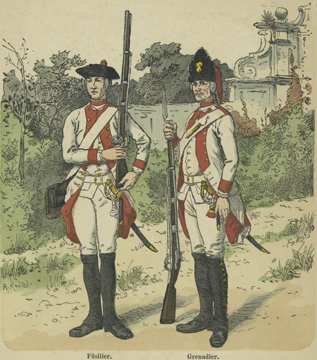
Recently, this author was been made aware of a German memoir highlighting the activities of a soldier in the Anhalt-Zerbst regiment on Long Island in the year 1782. The Anhalt Zerbst Battalion was from the small German state of Anhalt-Zerbst and supplied the British allies a total of 1,160 men throughout the Revolutionary War. The Anhalt-Zerbst regiments spent most of the war acting in garrison duty or as recruits in both Canada and New York. A large number of recruits were sent to New York in August 1781.[4]
The memoirs by Johann Wilhelm von Krause are a collection of journals spanning the years 1757 to 1798. They are titled, “Johann Wilhelm von Krause Memories.”[5] Historically, von Krause enlisted in the Anhalt-Zerbst military due to financial need in 1781, and his memoirs describe him as being an artillery lieutenant. Volume VI of the collection, titled “Sea Voyage,” records his life from April 1782 to April 1783, including his deployment to North America in the Revolutionary War.[6] He wrote all his memoirs in 1815-16 but that he relied on journals that he kept daily from when he was younger.[7] The memoirs are a recording of the author’s travels and his military duties. They go into great detail about his involvement in designing and defending a fortification at Brandon’s Bay on the north shore of Long Island. The memoir appears to be the only record of the events that happened in the area.

Volume V of the memoirs describes von Krause’s joining the Anhalt Zerbst regiment in 1781 and that he initially was sent to Jever, in northern Germany. There he received specialized training in surveying and sketching maps and fortifications.[8] Volume VI opens with his departure from Horumersiel, Germany on April 8, 1782 with 800 men from various German units. The ships arrived off Halifax, Nova Scotia on July 2. After a short stay in Halifax, von Krause was informed that he was to accompany an elite force of recruits to New York. One hundred and fifty men (including artillerymen) and two officers were sent to New York. The memoir mentions,
That it was only around New York that there were still frequent mutual raids being made by small corps along the shores of the Long Island Sound.[9]
On July 12, 1782 the recruits arrived in Brooklyn. After a few days of rest they were ordered to break camp due to potential enemy movement:
The rebels were said to have established themselves at several points. The Hessians and English are down at Richmond on Staten Island-the Loyalists stand on New York Island. The Zerbsters, and several battalions of Englishmen, were to reinforce the eastern outposts at Huntington and Smithtown, and to repel the Connecticutters if they came across the Sound.[10]

This reinforcement in the memoir notes a jӓger company marched in the lead and that von Krause followed with two field pieces and thirty-six men.[11] Colonel Ludwig Johann Adolf von Wurmb, commander of the jӓgers, wrote in another source about this same movement towards Huntington in June 1782:
I marched here on the 10th with the Jaeger Corps and in several days I will march with the 17th and King’s American Dragoon Regiments and the Jaegers to Huntington and will remain in that area for a time.[12]
In the memoir, von Krause’s force is noted as passing by Flushing and Mosquito Bay:
The view of Oyster Bay and the surrounding countryside was delightful; Towards evening, the rich fields of Huntington were reached, stretching picturesquely around a wide bay (Brandon’s Bay). The left wing extended to the left onto a peninsula that seemed to reach far into the Devil’s Belt (Sound), dotted with lovely country houses. The right wing remained before the town.[13]

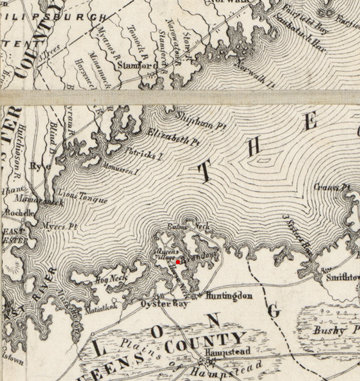
Brandon’s Bay or Brandon’s Harbour is shown on several seventeenth- and eighteenth-century Long Island maps. They all denote Brandon Bay as the waters of Huntington and Northport Bays of today. The left wing mentioned was the British encampments which extended into West Neck and Lloyd’s Neck.
On July 22, the memoir describes that the right wing broke camp at the earliest hour, and around noon this wing, numbering at most 1,500 men, occupied the old lines (entrenchments). The garrison of these lines had been forced to move further east to Smithtown.[14] The reinforcing force was made up of Hessian and Loyalist troops and officers with engineers. The entrenchments had been poorly maintained and the barracks were in a deplorable state. The rear of the lines were open to attack as the redoubts only covered Brandon’s Bay to the west.[15]
The entries in the memoir from July 23 to 29 describe von Krause’ contributions to the repair and rework of the entrenchments and gun emplacements. Von Krause described his activities, referring to himself in the third person:
Wilhelm hurried to his nest—sketched the immediate surroundings of the post currently occupied and the fortified lines, traced some modifications he deemed necessary –calculated the requirements for repairs and new works, in terms of materials, manpower and time.[16]
By July 28 von Krause was able to show his designs to the commanders. His ideas were welcomed and put into the final plans.
On August 2 several British officers, engineers, conductors and constables examined the ground in preparation for the construction:
The following morning, the adjutant brought English conductors and about 200 men from each German and loyalist company with the order: Wilhelm should be at their aid. They deliberated for a long time, about the point where to begin, about the necessary tools, where to get them—Wilhelm’s plan was, in English form, in their hands.[17]
Many of the entrenching tools were unusable and too little, and blacksmiths were unable to repair them. Von Krause and the English engineers came up with solutions to get the blacksmith’s forges back working and to cut sod from nearby valleys and gardens for the earthen embankments of the entrenchments. Wagons and horses were acquired. The horses were to be used to haul the artillery. Lumber was taken from wherever it could be found, from empty warehouses, barns and stables.[18]
Work on the fortifications proceeded from August 5 to the 9th. The memoir includes a detailed plan and section of the entrenchments drawn by von Krause. Under the main drawing is the legend, “Proposal for fortification, a part of the entrenchment on the west side of the valley.”[19]
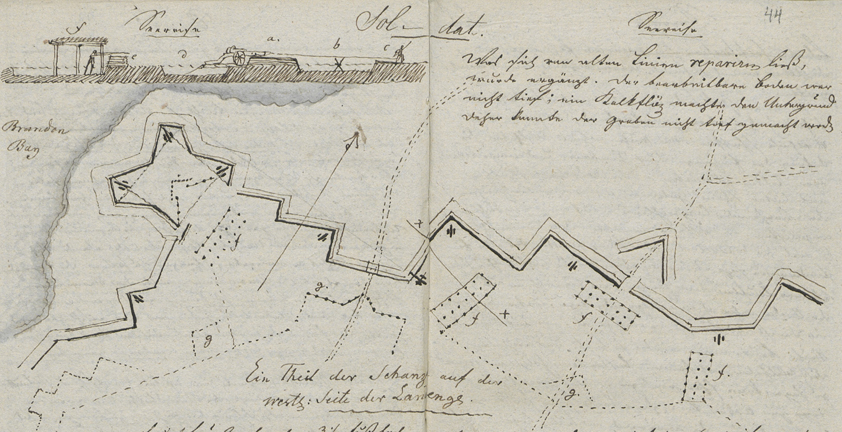
The memoir continues with more details and particulars about the construction. The soil for digging was not workable due to underlying limestone so the trenches of the fort could not be made very deep. The parapet walls were also made low so as to hit the enemy in the “trouser buttons.”[20] Cannons were arranged to fire over the parapets and the earth was to be dug out behind the parapet to defend the garrisoning troops. The blockhouses were designed for shelter and defense from all sides, but they were not weatherproof. A rear palisade provided defense for retreating troops. The entrances to the fortifications were covered with tambours and a few redans.[21]
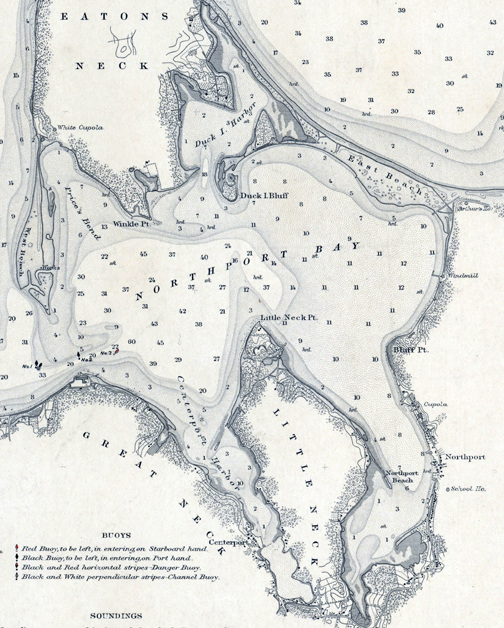
The drawings of the fortifications and their descriptions aided this author in determining the most probable location for the fortifications. The entrenchments were, according to the memoir, close to Eaton’s Neck. It is also noted on the von Krause plan that they were located on the east side of Brandon’s Bay. The plan drawing shows a protrusion of shoreline and mentions that the entrenchments were located on the west side of a valley. In studying many nineteenth century coastal maps of the Huntington area this author was able to locate a similar valley and land protrusion with the same orientation to the bay. The location is Bluff Point in what would have been known as Great Cow Harbor at the time, or today’s Northport. Bluff Point was the best natural position when considering the defense of the inner part of Great Cow Harbor. It was also the highest point of land in the area.
A period account of the harbor describes why a fort on the bay would be essential for its defense.
Great Cow Harbor is navigable for vessels of 200 tons burden or more. Here common tides rise and fall about 8 feet and the highest not less than 12 feet. This is the best harbor anywhere about Long Island. Little Cow Harbor (Centerport) and Huntington Harbor are much shallower. They will admit vessels of about 70 tons.[22]
The memoir entries of August 10 and 11 continue with rumors that a Rebel army had crossed at Throg’s Neck and defeated the Loyalist posts near there.[23] The work on the fortifications at Brandon’s Bay was then ordered to be expedited.
On August 13-14 von Krause noted,
Several rumors now spread from the eastern part of the island that hostile enemy privateers from Rhode Island and Connecticut were swarming around—and that French soldiers were also among them.[24]
On the 14th the men in camp were armed day and night and towards evening of the 15th an alarm was sounded from Smithtown. On August 16 at daybreak volley fire could be heard in the distance. A small force was ordered to reconnoiter the eastern coast and after a few cannon shots there the detail returned. The easterly bay was full of enemy vessels with men coming ashore.[25] This flanking maneuver seems likely to have taken place from the Long Island Sound side of a small isthmus that connects to Eaton’s Neck. The attackers most likely crossed here and approached Bluff Point along the beachfront of Brandon’s Bay. Von Krause also wrote that ships were battling in the bay itself.
He recorded that part of the enemy attacked the left wing and then right wing of the fortifications:
Now they attacked the left wing of the entrenchment—They fired briskly into the densest ranks—they separated to regroup at other points—they stormed a flat area, but were driven out again with the bayonet , no quarter was given—It was a hot morning—The tumult arose again on the right wing—a blockhouse caught fire—and while attention was focused there, where they were fighting almost in platoons , the enemy would soon have succeeded in holding the western lines on the bay—but grape shot of the rather light gun were now working effectively.[26]
The next entry records that the enemy retreated after the grape shot barrage and continued to withdraw until they were out of range. The fort’s defenders pursued. The Loyalist troops fought bravely but suffered from the fire of the retreating troops and from gunboats. By 4 o’clock the enemy had completely retired to their ships and left the area.[27]
Von Krause’s reported “17 dead men—3 officers—and many seriously wounded.”[28] The dead from both sides were buried and the prisoners taken to Hempstead and put onto British ships. After the attack von Krause was employed in completing the rest of the fortifications:
Wilhelm received the order: to complete the rest of the line in the German style—in the intervening hours to survey the surrounding areas à coup d’oeil.[29]
After adding to the lines at Brandon’s Bay, the memoir records a few other expeditions to the inland of New York State until the Anhalt Zerbst’s departure out of New York City in August 1783.
Today, this intriguing story is hidden history in a relatively unknown foreign memoir. Physical evidence of the construction of these fortifications at Brandon’s Bay no longer exists. The terrain at Bluff Point was levelled in the early twentieth century by the Steers Sand and Gravel Company who mined the area for sand over an extended period.[30] Any archaeological remains would have been removed at that time.
From time to time the occasional cannonball is found in the area. In 1999 a cannonball was found in the dunes fronting the Long Island Sound at the small isthmus connecting Northport to Eaton’s Neck.[31] There is also a small collection of cannonballs in the Northport Historical Society from the Northport area. Other artifacts were found in the area north of Bluff Point in the early twentieth century before any sand mining operations took place.
Interestingly, the layout of the fortifications at Brandon’s Bay was a rather unique design in the context of other British forts of Long Island from the period. Most constructions were simple square redoubts that were built at dominating positions. The Brandon’s Bay fortifications may have been based initially on a simple square redoubt in its northwestern corner, but its entrenchments were extensively elongated across the valley beyond. These outer entrenchments took on a more Vauban style of design. The fortifications were set in front of the dominating height, built low and hugging the shoreline like an extended gun battery. All these observations add to the mystery of this position and its history. The story becomes a rare glimpse of later Revolutionary War events in the important struggle between Long Island and the New England mainland.
*A special thank-you to Henry Retzer for introducing and providing translations of the Von Krause memoirs.
[1] Kenneth MacCallum, “The Armed Boat Company and the Great Whaleboat Battle of 7 December 1782,” Loyalist Trails 2023-49, December 4, 2023.
[2] National Archives of Canada RG 8, Series I (“C” series), Vol. 1895, Loyalist Muster Rolls.
[3] Revolution in America: Confidential Letters and Journals 1776-1784 of Adjutant General Major Baurmeister of the Hessian Forces (Rutgers University Press, 1957), 505.
[4] Muster roll of Anhalt-Zerbst recrtuis, Erasmi Garitz and W[illiam] Porter DS, July 20, 1781, German Auxiliaries Muster Rolls, 1776-1786 (bulk 1781-1783) [Box 1, Folder 1William L. Clements Library, University of Michigan.
[5] Johann Wilhelm von Krause, Erinnerungen, University of Tartu digital archive, dspace.ut.ee/collections/1ce29b72-89ba-4ff4-8d21-053a45ca8a69.
[6] Von Krause, Erinnerungen, Vol. 6., trans. Henry Retzer.
[7] “Johann Wilhelm von Krause, Memoirs,” Baltic Historical Commission, balt-hiko.jimdoweb.com/online-publikationen/j-w-von-krause-erinnerungen/.
[8] Von Krause, Erinnerungen, Vol. 5., trans. Henry Retzer, 170.
[9] Von Krause, Erinnerungen, 6:26.
[10] Ibid, 62.
[11] Ibid.
[12] Freiherr von Jungkenn Papers, 5:65, William L. Clements Library, The University of Michigan.
[13] Von Krause, Erinnerungen, 6:67.
[14] Ibid., 6:68.
[15] Ibid.
[16] Ibid., 73.
[17] Ibid., 77.
[18] Ibid.
[19] Ibid., 78-9.
[20] Ibid.
[21] Ibid., 80.
[22] Zell Morris Gould, and Henrietta M. Klaber, Colonial Huntington, 1653-1800, 2nd ed. (Huntington Press, 1960), 78.
[23] Von Krause, Erinnerungen, 6:80.
[24] Ibid., 81.
[25] Ibid., 82-83.
[26] Ibid., 83.
[27] Ibid., 85.
[28] Ibid.
[29] Ibid., 88-89.
[30] Northport NY – Historic Photos and More, Steers Sand & Gravel – “The Pit”.
https://www.facebook.com/media/set/?set=a.739402419420976&s=15.
[31] Ron Morrison, “Cannon Ball Unearthed on Beach,” The Observer, June 10, 1999, Page 7


One thought on “An Obscure Fort and Battle at Brandon’s Bay, Long Island, 1782”
Fascinating account of a poorly known episode. I think you might more specifically name Northport/ Cow Harbor as the current, and much better known, name for Brandon Bay. Also, the sandy isthmus (or tombolo) stretching from Northport to Eaton’s Neck is today’s Asharokan.