



John Trumbull of Connecticut today is rightfully famous as a painter of Revolutionary War scenes. Some of his best paintings were enlarged by him and painted in the rotunda in the United States Capitol, where they can be viewed to this day.
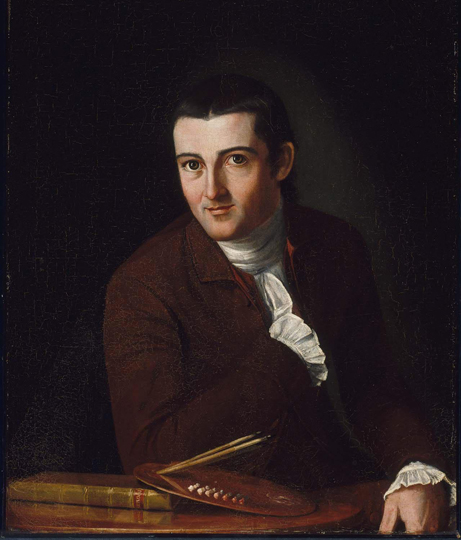
Less familiar is that Trumbull twice came under fire at the Battle of Rhode Island on August 29, 1778. It was the only time during the war that Trumbull’s life was at risk from hostile action. He came under fire on two different occasions; one time bullets landed all around him. He could have been so wounded that he would never have been able to paint again; or he could have been killed. Instead, he escaped unscathed.
Trumbull was very proud of his service at the Battle of Rhode Island, yet in the latest (very fine) works on Trumbull, Trumbull’s military service at the Battle of Rhode Island is mentioned but not in detail.[1] This is understandable given that Trumbull earned his fame as a painter and not as a military officer. But Trumbull himself probably would have preferred for biographers to have spent more time describing his service at the Battle of Rhode Island. We know this because Trumbull had a Massachusetts officer who witnessed his courage under fire that day pen a letter that Trumbull attached as an appendix to his autobiography, and Trumbull also spent four pages in his autobiography explaining his exploits during the battle.[2]
John Trumbull was born in Lebanon, Connecticut, in 1756 to Jonathan Trumbull, Sr. and Faith (Robinson) Trumbull. His father served as governor of Connecticut from 1769 to 1784. Although he was the youngest of six children, his lineage opened doors for John as a young adult. He graduated from Harvard in 1773; in Boston he expanded his interest in painting after meetings with John Singleton Copley.

When the Revolutionary War started, Trumbull was appointed as adjutant to Brig. Gen. Joseph Spencer of Connecticut. On July 27, 1775, he became an aide-de-camp to Gen. George Washington. Not comfortable in this post, he accepted a commission as a brigade major on August 15, 1775, and participated in the seizure of Dorchester Heights during the Siege of Boston. On June 28, 1776, he was appointed deputy adjutant general to Maj. Gen. Horatio Gates, with the rank of colonel.[3] While serving with Gates in the Northern Department, in upstate New York, Trumbull recommended that the Americans fortify a hill near Fort Ticonderoga named Mount Defiance, but Gates ignored the advice. In July 1777, a British army made plans for placing artillery on top of Mount Defiance, but the Americans abandoned Fort Ticonderoga before the artillery on the eminence opened fire.[4]
Trumbull’s first appearance in Rhode Island occurred in February 1777. He accompanied Brig. Gen. Benedict Arnold of Norwich, Connecticut, to Providence, Rhode Island. The two officers served under Maj. Gen. Joseph Spencer, commander in chief of the Rhode Island theater. In December 1776, a strong British force had invaded and seized Newport, Rhode Island, as well as the rest of the island on which the port stood, Aquidneck Island (Aquidneck Island was also sometimes called Rhode Island). Arnold’s plan was to gather New England militia to attempt to retake Newport, but there were nowhere near enough troops available. Trumbull wrote to John Hancock, president of the Continental Congress, to confirm his recent appointment to Arnold’s staff in Providence. He added that he had “remained in this chaos, until this day, endeavouring to introduce some regularity and discipline; and in the hope of an opportunity of attacking the enemy on Rhode Island. Our expectations are now destroyed by the impossibility of obtaining a number of troops sufficient for the proposed purpose.”[5]
Trumbull resigned in a huff from the Continental army by letters dated February 22, 1777 because of a dispute over his time of service. Congress had mistakenly dated his commission as colonel only to September 1776, when he had been serving as adjutant general for the Northern Department since June of that year. Congress later offered to correct the error if Trumbull apologized for the rude tone in his letter to Congress, but a sensitive and stubborn Trumbull refused to do so.[6]
Trumbull thereafter occasionally served in a military capacity on a volunteer basis. For example, in early September 1777, acting as a go between for his father, the governor, John traveled to Providence to inform the Rhode Island Council of War that Connecticut was now prepared to support a “descent” upon Newport.[7] This major effort to capture Newport from the British, occurring in September and October of 1777, was called Spencer’s Expedition after its commander, Maj. Gen. Joseph Spencer. Although Massachusetts, Connecticut, and Rhode Island raised some eight thousand militiamen who marched to Rhode Island, the expedition fizzled.[8]

The most serious American effort to retake Newport occurred in July and August 1778. A powerful French naval squadron, under the command of the Comte d’Estaing, arrived off of Narragansett Bay in late July. This first joint operation of the new allies, the United States and France, began with the promise of victory but ended in bitter failure. The hopes of the allies began to dim when Admiral Lord Richard Howe appeared in sight of Newport on August 9. D’Estaing set sail after Howe’s squadron the next day, with Howe sailing to the south and the French squadron following. But just as d’Estaing was preparing to attack Howe, a storm arose and the action was called off. It turned out to be a hurricane, forcing the ships in both navies to ride out the storm. The French ships suffered more storm damage than did the Royal Navy’s. When the storm subsided, d’Estaing decided to cease his effort to assist in the capture of Newport and sail to Boston where his damaged ships could be repaired.[9]
Meanwhile, the new American commander in the Rhode Island theater, Maj. Gen. John Sullivan of New Hampshire, had moved his army of more than 11,000 onto the northern part of Aquidneck Island on August 8. A week later he had them march south and halt in front of well-built defensive fortifications the British had established north of Newport. Sullivan had his soldiers dig siege lines. But after learning of d’Estaing’s decision to take his ships to Boston, and then hearing about a British reinforcement gathering on Long Island intended to trap the American army on the island, Sullivan pulled his troops back north on the night of August 28. He established a defensive line across the northern part of the island, with Butts Hill Fort at the center. He also left behind units intended to slow the progress of any advancing enemy troops.[10]
When the British commander of the Newport garrison of some 6,000 soldiers, Gen. Sir Robert Pigot, the next morning discovered the retreat of the American army, he acted decisively, hoping to attack the rear of Sullivan’s force as it retreated off the island. He sent a strong column of British soldiers up the East Road and another strong column of German and Loyalist regulars up the West Road.[11]
Major actions took place on both roads.[12] Col. John Trumbull, who had volunteered to serve as an aide-de-camp under General Sullivan during the campaign, saw action in both places.


On the East Road, the action began when Massachusetts troops hiding behind a stone wall off Union Street ambushed a portion of the British 22nd Regiment that had marched from the East Road west toward Middle Road. Then on the Middle Road as the advanced American forces retreated, Col. Henry Jackson’s Additional Continental Regiment from Massachusetts surprised the British 43rd Regiment with a volley. The British column continued marching towards Quaker Hill. There the British vanguard tangled with some Continentals, including a Massachusetts regiment commanded by Col. Edward Wigglesworth. The Americans fought well and even overran a British artillery piece. But the professional British troops pushed forward, retook their artillery piece, and pressed on.[13]
General Sullivan had a decision to make. Should he reinforce his advanced troops and turn these skirmishes into a general engagement? Or should he follow his original plan and have the advanced troops retreat so they could join his main force stationed behind stone walls to the north in front of Butts Hill Fort? Sullivan chose the latter option.
Enter Ebenezer Mattoon of Amherst, Massachusetts, who would serve as a general of the Massachusetts militia from 1799 to 1818 and as a representative in the Massachusetts State House of Representatives and from 1801 to 1803 as a Congressman in Washington, D.C. At the Battle of Rhode Island, he was a twenty-three-year-old lieutenant in Col. Nathaniel Wade’s Massachusetts State Regiment.
When John Trumbull was writing his autobiography late in his life, he asked Mattoon to pen a letter that described what Mattoon saw Trumbull do on August 29, 1778. Mattoon obliged, sending Trumbull a letter dated November 13, 1837. Mattoon wrote the following in the introduction to his letter:
In compliance with the request in your note of the 6th instant, I cheerfully communicate to you my recollections of what I saw of you on the . . . 29th of August, 1778, in the retreat of our army from Newport to Butts Hill . . .
In General Sullivan’s expedition on Rhode Island in the summer of 1778, I was present, a lieutenant in Colonel Wade’s Regiment. Having seen you in the northern campaign in 1776, I recognized you as aide to General Sullivan . . .
After the French fleet had left us, a council of war was held [by Sullivan and his top officers], in which it was resolved that our troops should retreat to the north end of the island. The east and west roads were taken [by our army] on the island.
In effecting this retreat, Colonel Wigglesworth, who commanded the rear-guard on the East Road, was ordered to check and retard the enemy as much as lay in his power. From the cover of stone walls and old buildings, he was able greatly to embarrass the enemy’s march. When he arrived at . . . Quaker Hill, he gained a favorable position for checking and harassing the enemy, which he did bravely against four times his number of men, until his perilous situation induced General Sullivan to call him off.
The general, seeing the enemy outflanking [Wigglesworth], issued an order for his retreat, and appointed you to carry it to him. While Wigglesworth was warmly engaged and you were carrying the order, the enemy and all his movements were in full view of General Sullivan, who was in front of the second line of our army on Butts Hill. His distance from Colonel Wigglesworth was more than a mile, one-half of which you were compelled to ride through a shower of the enemy’s shot. At that anxious moment I stood very near the general, as he was sitting upon his horse, and beheld you distinctly the whole distance. As soon as the enemy discovered you, and probably suspecting your object, they opened a fire upon you from six or eight pieces of their cannon. I, and others around me, were every instant looking to see you fall, as it seemed impossible that you should escape. On your return from this most adventurous exploit, General Sullivan said, “your escape has been most wonderful.”[14]
Trumbull, in his autobiography, also described his adventures on the East Road. As he was riding his horse down Butts Hill towards Quaker Hill, he recalled seeing “a round shot or two” from British cannon “drop near me, and pass bounding on.” As Trumbull carried on, he came upon a mortally wounded French officer and then a mortally wounded officer from Boston. Trumbull recalled, “grapeshot began to sprinkle around me, and soon after musket balls fell in my path like hailstones.”[15] With words, Trumbull was painting a harrowing scene.
When he arrived on the summit of Quaker Hill and rode to Colonel Wigglesworth’s side, Trumbull warned the colonel that the troops marching towards his rear from the west side were not blue-coated Continentals, rather they were blue-coated German regulars. A surprised Wigglesworth followed Sullivan’s order and Trumbull’s advice to retreat back to the main American lines.[16]
The action during then shifted to the West Road. German soldiers three times charged the American positions on the West Road, but were repelled each time. On the third attempt, the Germans were reinforced by more German soldiers and a Loyalist regiment. The key to the defense of the West Road was the Artillery Redoubt, which stood in the middle of the road. It was held by the 2nd Rhode Island Regiment. Behind a stone wall next to the redoubt was the 1st Rhode Island Regiment, later called the Black Regiment. About 125 of its privates were formerly enslaved men who had obtained their freedom by enlisting for the duration of the war. Another fifty soldiers of color were free Black, Indian or multiracial men, many of them veterans of the 1777 campaigns. For most of them, it was their first time under fire and they fought well. The commander of the 1st Rhode Island, Col. Christopher Greene, commanded an entire brigade and not just his regiment during the battle.
After the third and final charge the enemy forces retreated, this time leaving their dead and wounded on the field. Colonel Trumbull was again called upon, this time to lead a large brigade of Massachusetts militia under the command of Col. Solomon Lovell to attack the rear of the fleeing enemy troops. Lovell, a farmer in peacetime, lacked combat experience. Accordingly, the commander of the American troops on the West Road, Maj. Gen. Nathanael Greene of Rhode Island, ordered Trumbull to lead the brigade.[17]
Mattoon recalled what happened on the West Road:
In the afternoon, a vigorous attack was made upon Colonel Greene, who was stationed with a detachment west of the west road on the island. You were directed by General Sullivan to go and take command of General Lovell’s Massachusetts militia, and get into the rear of the enemy who were attacking Colonel Greene. These men [under Trumbull’s command] were formed into a column, as if almost by magic. You had led them but a short distance, before you were assailed with a brisk fire of musketry from the enemy, secreted in a copse of wood and in an old building. At the same time, a broadside was fired upon you from a [British] gun brig lying a little distance off [the western shoreline].
Notwithstanding these fires, you continued your march, until coming to a stone wall. The front platoon or division grounded their arms, ran forward, and instantly levelled the wall for a sufficient length for the whole column to pass without obstruction. The platoon immediately resuming their arms, the column advanced, and soon put the enemy to flight.
Seeing the order and rapidity of this movement, General Sullivan exclaimed that the movement would do “honor to the oldest regiment of the army.” The enemy engaged with Colonel Greene, and perceiving this bold and successful adventure, instantly retreated, and thus escaped a capture.[18]
In a letter to his father, Trumbull added some details of his service on the West Road. “Before we gained our posts,” Trumbull wrote, “the enemy gave way to the Continental troops and ran so precipitously that we had time only to give them two or three fires on their flank, which added wings to their flight.”[19] Still, enemy fire had shattered the arm of a lieutenant colonel in the regiment, who was likely marching at the front, near Trumbull riding on his horse.

In a contemporary letter published in a Boston newspaper a few days after the battle, Trumbull recalled that next he rode up a hill to reconnoiter the German positions, where he found himself “instantly within musket shot of their whole line—I retreated, you may well believe, to my men with full speed.”[20] Trumbull’s successful advance ended the infantry action of the Battle of Rhode Island. The second night after the battle, Sullivan’s army was ferried safely off the island to the mainland at Tiverton, Rhode Island. The campaign was over.
Mattoon concluded his 1837 letter to Trumbull: “Your preservation in each of these most daring and perilous enterprises, I have ever considered as little short of a miracle, and a most remarkable interposition of Providence for your safety.”[21]
Trumbull departed Connecticut for Nantes, France, in May 1780, intending to oversee a commercial opportunity. When that fell through, he travelled to London to study art under the talented painter Benjamin West. He made the trip across the English Channel despite the war in North America continuing unabated. British authorities threw Trumbull in jail under suspicion of his being a spy, where he wallowed for seven months. He was fortunate he was not hanged as a spy, in retaliation for the recent hanging of the British spy John André. As it turned out, Trumbull was imprisoned under mild conditions. Rhode Island-born Gilbert Stuart, also in London, occasionally visited him.[22] Had the British known the details of Trumbull’s service during the Battle of Rhode Island, he might have received much harsher treatment.
[1] See Richard Brookhiser, Glorious Lessons: John Trumbull, Painter of the American Revolution (New Haven, CT: Yale University Press, 2024), 30, and Paul Staiti, Of Arms and Artists: The American Revolution through Painters’ Eyes (New York: Bloomsbury, 2016), 166. Staiti also wrote about four other artists: Charles Willson Peale, John Singleton Copley, Benjamin West, and Gilbert Stuart. A recent book with a military focus does describe in some detail Trumbull’s day at the Battle of Rhode Island; see Damien Mott Cregeau, Portraits of Patriots: Colonel John Trumbull and Five Fellow Patriots from Connecticut in the American Revolution (P&D Creative Enterprises, 2025). Cregeau’s book ends in 1778; a second volume is planned.
[2] John Trumbull, Autobiography, Reminiscences and Letters of John Trumbull, from 1756 to 1841 (New York: Wiley and Putnam, 1841), 52-56 and Appendices, 304-08.
[3] See Mark M. Boatner III, Encyclopedia of the American Revolution (Mechanicsburg, PA: Stackpole Books, 1994), 1119; Stati, Of Arms and Artists, 164.
[4] See Brookhiser, Glorious Lessons, 26-27; John F. Luzader, Saratoga: A Military History of the Decisive Campaign of the American Revolution (New York: Savas Beatie, 2008), 48, 55-56, and Appendix, 376-77; Ebenezer Mattoon to John Trumbull, November 13, 1837, in Trumbull, Autobiography, Appendix, 306-07.
[5] Quoted in Christian McBurney, The Rhode Island Campaign: The First French and American Operation in the Revolutionary War (Yardley, PA: Westholme, 2011), 26 and 28.
[6] See Brookhiser, Glorious Lessons, 27-28; Luzader, Saratoga, 173; John Trumbull to President of the Congress, February 22, 1777, in Trumbull, Autobiography, 39-42; President of the Congress to John Trumbull, March 22, 1779, in ibid., 42-44; John Trumbull to James Lovell, undated (March 1777), in ibid., 44-45; John Trumbull to James Lovell, March 16, in ibid., 45-47.
[7] See McBurney, Rhode Island Campaign, 35.
[8] Ibid., 35-45.
[9] Ibid., 112-35.
[10] Ibid., 135-74.
[11] Ibid., 175.
[12] Ibid., chapter 8.
[13] Ibid., 179-82.
[14] See Ebenezer Mattoon to John Trumbull, November 13, 1837, in Trumbull, Autobiography, Appendix, 305..
[15] Trumbull, Autobiography, 52-53.
[16] Ibid., 53.
[17] McBurney, Rhode Island Campaign, 192.
[18] Ebenezer Mattoon to John Trumbull, November 13, 1837, in Trumbull, Autobiography, Appendix, 306.
[19] John Trumbull to Jonathan Trumbull, Sr., August 30, 1778, in “Trumbull Papers,” Massachusetts Historical Society Collections, 7th Ser., vol. 3 (1902), 16-17. See also Trumbull, Autobiography, 55-56.
[20] Extract of a Letter from an Officer of Distinction (John Trumbull), Camp at Rhode Island, August 30, 1778, in Independent Ledger (Boston), August 31, 1778.
[21] Ebenezer Mattoon to John Trumbull, November 13, 1837, in Trumbull, Autobiography, Appendix, 306.
[22] See Stati, Of Arms and Artists, 167-71; Brookhiser, Glorious Lessons, 33-41.

Recent Articles
David Steele’s Macabre Medal
The Loyalist Experience and Aftermath in Revolutionary Philadelphia
America’s Original Stimulus Package: A Catalytic, Consequential Fishing Policy
Recent Comments
"David Steele’s Macabre Medal"
Excellent article. Most interesting. Well done.
"La Petite Guerre and..."
This is a fascinating examination of the distinction between European *petite guerre*...
"James Wilson and Popular..."
Kelly – thanks for this contribution to the growing body of work...