

BOOK REVIEW: Major General Richard Montgomery: The Making of an American Hero by Michael P. Gabriel. (McFarland, 2026) $49.95 paperback
Michael P. Gabriel has released the second edition of his biography of Brig. Gen. Richard Montgomery, a British-born Patriot who sought a quiet life of farming only to take up arms once more against the empire he once fought for. In Major General Richard Montgomery: The Making of an American Hero, Gabriel tells his story through the early years of his military career until his last moments during the Battle of Quebec in December 1775.
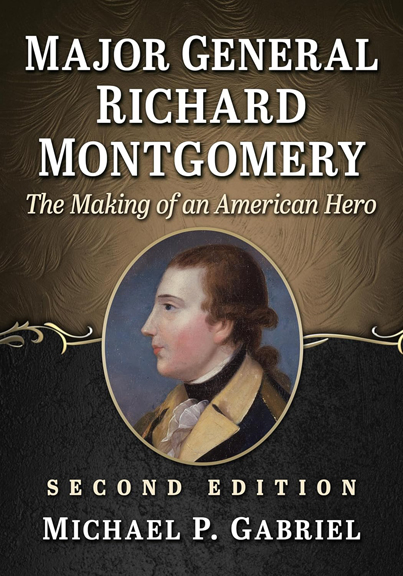 Gabriel’s first edition was released in 2002. As the author notes in his preface, there is not an abundance of scholarly works on the general. The year 1966 saw the first release of a biography in that century by A.L. Todd, Richard Montgomery: Rebel of 1775, but this was a work for middle school students. Hal T. Shelton released a scholarly biography 1994, yet Montgomery hasn’t seen an outpouring of interest since. A few factors could account for this.
Firstly, he lived only to see the beginning of the war. Montgomery’s death came December 31, 1775, as the Continental Army pushed into British Canada against Provincial Governor Guy Carleton. The war had only been underway since April. Secondly, accompanying Montgomery at Quebec was the later traitor of the war, Benedict Arnold. Arnold’s long career, including not only his betrayal, but also his actions in leading the Americans to victory at the Battle of Saratoga against British Gen. John Borgoyne in 1777, make him a more appealing subject for historians.
Nevertheless, Gabriel makes a convincing case in a relatively short work of just over 170 pages for Montgomery’s name belonging among the most courageous and selfless martyrs for the cause.
Montgomery’s story begins in Dublin, Ireland, when he was born on December 2, 1738. The youngest of three sons with one younger sister, at sixteen he attended Trinity College in Dublin, but left after two years. The outbreak of the French and Indian War presented the opportunity to pursue a career in the military as his father, grandfather, and oldest brother had done. His father Thomas Montgomery purchased his son’s commission as an ensign dated September 21, 1756. Leaving Cork, Ireland in May 1757, the young officer sailed with the 17th Regiment of Foot for Halifax, Nova Scotia, for what was his first military campaign.
Fighting not only in the North American theater but also in the West Indies, Montgomery to join in a siege of Havana, Cuba. He emerged from the war with the rank of captain. His disillusionment with military service came when he was passed over for promotion to major. He sold his captaincy on April 6, 1772.
The next chapter of his life brought him to the colonies not as a soldier but as a resident of New York after finding it appealing for its opportunities. This was where he sought a life as a gentleman farmer, away from the dangers and disappointments of military service. He married Janet Livingston of the prominent New York Livingston family. This life was short-lived. By 1775, he found himself serving as a delegate to the New York Provincial Congress and being offered the rank of brigadier general for the Continental Army.

Gabriel’s work is as much a personal tale of Montgomery as it is a history of his military career. Letters between the general and his wife, along with correspondence with his brother-in-law and founding father Robert Livingston, give a personal touch to the study. Readers follow his fatal journey beginning with his role in the invasion of Canada, departing Fort Ticonderoga on August 28, 1775.
Gabriel’s most compelling chapter, Chapter 9: The Making of An American Hero, stresses the significance of Montgomery’s death in the immediate sense and in the nation’s history. If the Continental Congress learned something from this failed invasion of Canada, Gabriel says it was the pitfalls of short-term enlistments. He quotes President John Hancock on that point: “The untimely Death of General Montgomery, alone . . . is striking Proof of the Danger and Impropriety of sending Troops into the Field under any Restriction as to the Time of their Service.” Arnold’s men’s enlistments were expiring, leading to the conclusion that perhaps if they had more time, Montgomery would not have acted as he did on December 31.
Outside of the conflict, the first-ever biography of Montgomery by Jedediah Morse was published in 1794, linking him to President George Washington through comparing both to the Roman Patrician Cincinnatus, a comparison usually reserved for Washington exclusively for his willingness to step away from public life for that of a farmer.
With Great Britain and the United States at war again in 1812, Montgomery’s death could not be ignored. Warhawks like Congressman Henry Clay felt an invasion of Canada would create a new national figure to “avenge the fall of the immortal Montgomery.” One recruiter in New York said he would rather “bleed on the tomb of Montgomery” than submit to Great Britain.

Montgomery’s legacy is with us even today. Gabriel says sixteen states have counties named in his honor, ranking him tenth, only outdone among figures who did not achieve the presidency like Benjamin Franklin, Nathanael Greene, Francis Marion, and the Marquis de Lafayette.
For the historian of the early years of the revolution, Gabriel has given their library a touching addition through what may be called a tragedy. Montgomery bears the traits of a selfless figure in taking up a cause courageously only to meet his untimely death when he could have chosen a quiet civilian life. What if he had lived? Would he have been among names like Washington in more popular circles? We can only speculate and admire his sacrifice.
PLEASE CONSIDER PURCHASING THIS BOOK FROM AMAZON IN PAPERBACK.
(As an Amazon Associate, JAR earns from qualifying purchases. This helps toward providing our content free of charge.)

One thought on “Major General Richard Montgomery: The Making of an American Hero”
Thank you for your review. I like your focus on his legacy, which is remarkable. What is the difference between the first and second editions? Did the author find new sources or offer new interpretations in the second edition?