

Understanding the important role played by the Dutch Republic[1] in the American Revolution is challenging. Few scholarly books and articles provide substantive details, and the role of the Dutch Republic is rarely adequately addressed in general histories of the period.[2] Nonetheless, the Dutch did play an important role—albeit a reluctant one—in aiding the united American colonies in their successful pursuit of independence in a period of “great power competition” during the American revolution.
Background
Prior to 1581, the Netherlands as well as other parts of northern Europe were governed by the Spanish Empire. In 1581, the seven provinces making up the Netherlands united and revolted and after an “eighty-year war” won their independence from Spain, creating the confederation of the Dutch Republic (1581–1795). To aid in the rebellion, Britain sent 7,600 soldiers to the Netherlands to fight against Spain, which began a long-running Anglo-Dutch friendly relationship. The Dutch rose to become a major seafaring and economic power in Europe, usually allying with Britain against their rival France.
For some Americans, the Dutch revolt against the Spanish served as an example of a successful effort by a group of loosely-connected provinces to overthrow an imperial power.[3] For example, Benjamin Harrison wrote to George Washington in June 1780 about the dismal state of affairs: “Indeed my friend it requires fortitude in a statesman to bear up against such multiple evils . . . Keep in remembrance the brave the preserving Prince of Orange, his difficulties were not less than yours, his vexations as numerous and yet success cround [crowned] his labors.”[4]
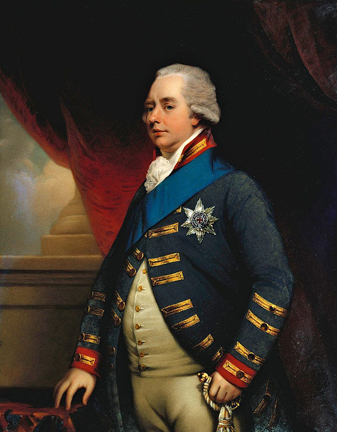
The Dutch Republic confederation consisted of seven provinces: Holland, Zealand, Utrecht, Guelderland, Overyssel, Groningen, and Friesland. Each differed in size, religion (Protestant and Catholic), location (maritime or inland), and political structure (democratic or aristocratic). The president or stadtholder, William V of Orange, served as the head of the government holding command over military forces but could not declare war or conclude peace. Decision making within the Dutch Republic was so complex that one scholar commented, “nobody could find a solution to even the simplest of problems.”[5]
The Dutch Republic had two political classes to determine policy: the stadholder or English party, headed by William V, and the anti-stadholder or anti-Orange party which had the support of merchants in Amsterdam and the province of Holland who saw England as a threat. The Dutch were politically divided, resulting in Dutch decision making being lengthy, complex and frustrating.[6]
John Adams in a letter to Congress, as late as March 1781, wrote of the Dutch Repubic:
The Nation has indeed been in a violent fermentation and Crisis. It is divided in Sentiments . . . There are Enthusiasts for Peace and Alliance with England, and there are Advocates for an Alliance with France, Spain and America, and there are a third Sort, who are for adhering in all things to Russia, Sweeden and Denmark. Some are for acknowledging American Independence, and entering into Treaties of Commerce and Alliance with her: others start at the Idea with Horror, as an everlasting Impediment to a Return to the Friendship and Alliance with England . . . In this perfect Chaos of Sentiments and Systems, Principles and Interests, it is no wonder there is a Languor, a Weakness and Irresolution that is vastly dangerous in the present Circumstances of Affairs.[7]
Interests and Great Power Politics
The Dutch Republic had three core interrelated interests: neutrality, free trade, and freedom of navigation. Given the size and state of preparedness of the republic’s military in the 1770s, they were no match for either Britain or France. By maintaining neutrality, they avoided having to spend resources preparing for or waging a costly war while continuing to expand trade with other nations.[8] The Dutch were the greatest supplier of goods by sea and could avoid having their ships and cargos seized provided they remained neutral.[9] To support free trade, freedom of navigation on the high seas became a key policy component.

America, desperate for funding, war and other supplies, hoped to persuade the Dutch to support their cause. In April 1777, John Adams wrote his wife Abigil that the Dutch, whom he referred to as the “Treasury of Europe,” were unwilling to loan America funds.[10] While appeals to the historical relationship between the Dutch and Americans were made, the Americans also emphasized the benefits to Dutch commercial interests.
Prior to the 1775, England regulated trade to its North American colonies, excluding most foreign merchants, which generated revenue and promoted the growth of the English merchant marine. The 1778 American Commissioners Memorandum to the Dutch struck at the unfair and unjust English monopoly on shipments to America. “No Nation is more interested in this event than the Dutch, because it was against them that the Establishment of the monopoly was chiefly intended. The great object of commercial policy with the States of Holland was and is the carrying Trade.” It further emphasized the point: “America has in form renounced her connection with Great Britain, and is maintaining her rights by Arms. The consequence of her success, will be the re-establishment of Commerce upon its antient, free and general footing. All Nations are interested in this success; but none so much as the Dutch. From them therefore America in a most special manner looks for support.”[11]
France sought to sway the Dutch to join with them, but at a minimum sought to keep them neutral. If the Dutch allied with Britain, France would be forced to expend military resources to secure its northern border and to block Dutch ports. In addition, Holland was one of the chief suppliers of French naval stores and provisions which in turn generated significant trade and profit for the Dutch.[12]
Britain sought the Dutch Republic’s support, in part due to their historical allegiance, but would be content for them to remain neutral and to abide by previous commitments and treaties. For example, in 1674, the Anglo-Dutch Commercial and Maritime Treaty was signed to regulate the conduct of each nation in the event one of them was at war. The treaty prohibited shipping arms and munitions to the other’s enemy but allowed normal trade as well allowing trade in naval stores which would not be considered contraband of war.[13]

After France’s entry into the war in 1778, the British stopped, inspected, and seized naval stores and war material cargo of any neutral ships including Dutch. While the British permitted the Dutch to trade with France, this new British policy of seizing naval stores violated the 1674 treaty from the Dutch perspective, but they were powerless to object against the power of the British navy. Their commercial interests suffered. Nevertheless, munitions, arms, and other war material continued to be shipped to the Dutch Caribbean island of St. Eustatius to be sold to the Americans. It was so profitable that even if two of three cargos were seized, significant profits could be made. Between January and May 1776, eighteen Dutch vessels with gunpowder and ammunition sailed to St. Eustatius for ultimate delivery to America.[14]
St. Eustatius (Sint Eustatius)
St. Eustatius is a six mile long and two milewide saddle-shaped island in the Caribbean, southeast of the Virgin Islands. In 1636, the Dutch West India Company took possession of this barren island and by 1756 it was an important and very profitable free port, open to all nations, supporting the trans-Atlantic slave trade and other trade. As one historian noted, “St. Eustatius and the thirteen North American colonies were natural allies in the war against [British] mercantilist protectionism.”[15]
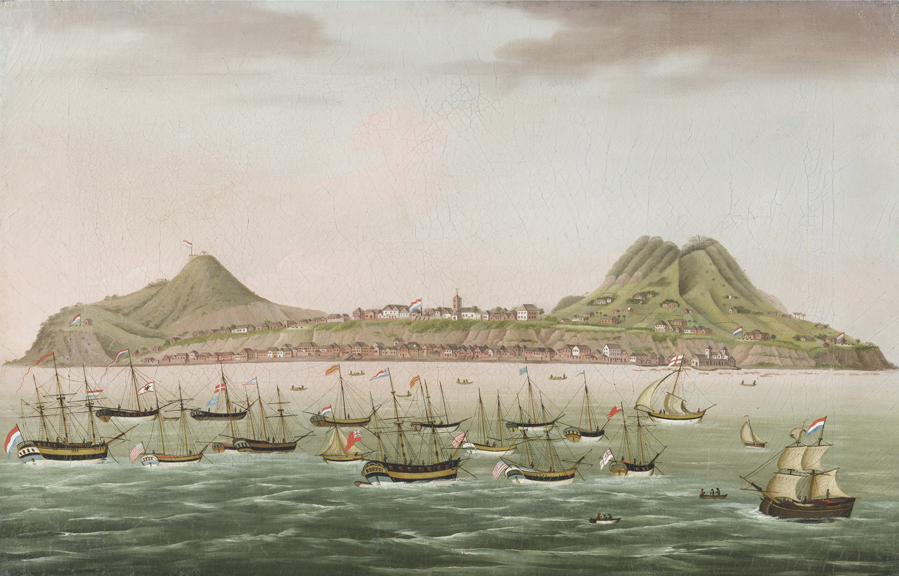
On the eve of the revolutionary war, purchases of arms and gunpowder by the colonies from the Netherlands increased even though the British navy stationed ships to enforce its rule on shipments of arms and munitions. Powder was such a major concern that John Adams proposed in October 1775 to have one or two ships enter the port of Antigua by flying the Dutch colors to seize the powder stored there as well as to seize Dutch-owned powder at St. Eustatius, of course paying the Dutch later after seizure.[16] With exportation of materials from Dutch ports difficult, cargo including munitions were sent via the coast of Africa to St. Eustatius, which was then purchased by American agents and shipped to the colonies.[17]
As business boomed, the number of ships visiting the island, known as the “Golden Rock” increased annually—from 2,000 in the early 1770s, to more than 3,500 by 1779. Indigo, tobacco, grain, and other colonial products were exchanged for munitions and gunpowder, generating enormous profits.[18] As noted by the British Admiral George Rodney, “This rock of only six miles in length and three in breadth has done England more harm than all the arms of her most potent enemies and alone supported the infamous American rebellion.”[19]
To add insult to injury, on November 16, 1776, Fort Orange at St. Eustatius fired the first salute to an American-flagged vessel.[20] While this “salute” did not have Dutch governmental sanction, it nevertheless was viewed by the British as an affront to their sovereignty.
The League of Armed Neutrality
As the war expanded, other nations were affected, impeding commerce. Ships and their cargoes were confiscated, primarily by the British. Catherine II of Russia declared a policy of armed neutrality in March 1780 for the “Honor of the Russian Flag, and the Safety of the Commerce and Navigation of her Subjects, and will not suffer that any Injury should be done to it, by any of the belligerent Powers.”[21] Russia proposed a coalition of nations to adhere to a series of policies designed to safeguard shipping convoys with armed escorts. [22]
Denmark, Norway and Sweden quickly joined the League. In August 1780, Prussia, Austria, and Portugal joined. Spain pledged to respect the league. Britain, desperate to cut off French naval stores and ship timber as well as munitions, needed to prevent the Dutch from joining the league. Even as Dutch diplomats were meeting with the Russians, England declared that if the Dutch joined they would “leave us no alternative and must be treated as the secret enemies of that nation which they ought to be the firmest friends.”[23] Under no circumstances would Britain allow the Dutch to join the league. The capture of Henry Laurens gave them the excuse to declare war on the Dutch Republic.
Laurens of South Carolina was appointed by Congress on October 26, 1779, to negotiate a $10 million loan and at the same time serve as a commissioner to negotiate a proposed treaty of amity and commerce with the Netherlands. The British captured his ship along with his papers which contained a draft of the Amsterdam Pact of Amity and Commerce, as well as other correspondence between American and Dutch officials outlining financial aid to the colonies.[24] Using the Laurens documents as a pretense, on December 20, 1780, Britain declared war against the Netherlands.[25] After the declaration, British strategy became simply to blockade the coast of the Netherlands and the eastern approaches of the English Channel to prevent neutrals from carrying contraband, and to seize Dutch possessions and ships on the high seas.
On February 5, 1781, the British captured St. Eustatius. Admiral Rodney confiscated two hundred ships, captured two thousand Americans, and seized goods valued at three-million-pound sterling.[26] Rodney highlighted that without the “infamous island of St. Eustatia, the American rebellion could not possibly have subsisted.”[27] In November 1781, a French force recaptured St. Eustatius and the island was returned to Dutch rule. The island would never again receive the wealth and attention it had previously.
Enter John Adams
Since 1776, some American political leaders looked for foreign support through funding, political leverage, and military assistance. Yet early in the war there were differences. For example, as the noted historian Stacy Schiff noted: “John Jay hoped to win the war without French involvement of any kind. John Adams hoped to win the war without French funding. Washington hoped to win the war without French troops. Franklin hoped to win the war.”[28] There was little incentive for the Dutch to support the American effort early in the war. By August 1779, John Adams recognized the importance of trade with the Dutch and advocated for Congress to send a minister to the Hague.[29] He also highlighted that there was little prospect of obtaining a loan from the Dutch. He wrote to Congress,
The prospect of a loan in Europe, after every measure that has been or could be taken, I think it my duty to say frankly to Congress, is very unpromising. The causes of this are very obvious, and cannot be removed; the state of our country itself and the course of exchange would be sufficient to discourage such a loan if there were no other obstruction, but there are many others. There are more borrowers in Europe than lenders; and the British loan itself will not be made this year at a less interest than seven and a half per cent.[30]
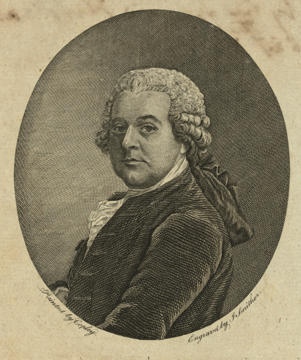
In June 1780, without an official charter, Adams traveled to the Dutch Republic to help secure a loan, decreasing American dependence on French aid. In December 1780, Adams reported to Congress: “In short, I cannot refrain from saying that almost all the professions of Friendship to America, which have been made, turn out upon Trial to have been nothing more than little Adulations to procure a Share in our Trade. Truth demands of me this Observation.” Adams concluded that the Dutch were reluctant to provide political or financial support given the lack of American progress in the war and fear of the British.[31] Prior to the declaration of war by Britain against the Dutch in December 1780, Adams concluded, “there was extreme reluctance to take any step, do anything rash, that might upset the British.”[32] He noted, “War is to a Dutchman the greatest of evils.”[33]
On December 29, 1780, Congress appointed Adams as minister to the Dutch Republic to seek recognition of the United States, establish a treaty of friendship and commerce, and most importantly secure funding via loans. Adams wrote to Edmund Jennings on December 31, 1780:
The Dutch have an Understanding peculiar to themselves. They dont think like other Men upon any Thing. If they go to War with England, I doubt whether they will make a Treaty with Us. They must be odd and unaccountable. They will trade with Us, notwithstanding, as ravenously as possible. They think themselves profound Politicians but they are the most short sighted I ever saw. They are not even Sagacious to get Money. It is Patience and Industry alone that acquires it here.[34]
For five months, Adams was unable to make progress given the unwillingness of Dutch leaders to listen to a representation from an unrecognized United States. Frustrated, Adams wrote to the President of Congress on October 15, 1781 highlighting that his letter of credence was being considered but that it was still in doubt whether it would be accepted: “It appears to have been for this Century and an half at least the national Character to manage all the World as long as they could, to keep things undetermined as long as they could, and finally to decide suddenly upon some fresh Motive of Fear.”[35] Adams embarked on what he termed “militia diplomacy” to sway public opinion.
In April 1781, Adams drafted a sixteen-page document called the “Memorial to the States General,” addressing reasons for a US—Dutch alliance. He saw that it was published in various newspapers and distributed widely across the nation. The document emphasized the historical relationship between the Dutch and the Americans, specifically in New York and New Jersey; the close ties between the two nations in terms of religion, government, and history; mutual interests in commerce; the fact that each nation fought for its independence; and the natural alliance which existed between the two nations.[36]
On April 19 the Netherlands invited Adams to present his credentials as ambassador to the Dutch government at the Hague and in May Adams presented his case to the President of the States General.[37] Within the Dutch Republic, opinions were split on whether siding with the Americans was in the interest of the Republic. “The Dutch,” Adams wrote, “are so indolent, so divided, so animated with party spirit, and above all so entirely in the power of their chief, that it is very certain that they will take the proposition ad referendum immediately and then deliberate upon it a long time.”[38] When news of the British defeat at Yorktown was received by Adams on November 23, 1781, he demanded the Hague answer his petitions and renewed his public campaign to convince the Dutch public to ally with the United Sates.[39]
Several provinces began recognizing American independence. On April 19, 1782, the States General resolved that “Mr. Adams shall be admitted and acknowledged in the quality of ambassador of the United States to Their Mighty Mightiness’s.”[40] The Netherlands became the second nation to recognize the United States. At the Hague on April 22, Adams was received by the Prince of Orange in a formal recognition ceremony.[41] In May he hoisted the American flag over its first embassy.
On June 11, 1782, with the aid of Joan Derk van der Capellen tot den Pol, a Dutch nobleman who advocated for the American cause since the early days of the revolution, Adams negotiated a loan of five million guilders, or two million dollars, at five percent interest with three Amsterdam banking houses.[42] This loan was less than the ten million dollars needed, but it became the foundation for American credit in Europe. News of the Netherland’s recognition reached Philadelphia in September 1782, but it was soon to be overshadowed by the signing of a treaty of amity and commerce between the Netherlands and the United States on October 8.[43]
So What was the Dutch Support to the American Revolution?
Any military must have sufficient arms, munitions, and other supplies to wage war. The colonies had limited capabilities to produce them and looked to their allies to provide them. The Dutch Republic sold quantities of these supplies to American buyers, specifically early in the war from St. Eustatius. While difficult to quantify the total amount of supplies purchased from the Dutch, they obviously supplemented those provided by France and Spain, or purchased from clandestine suppliers.
The Netherlands contributed indirectly to the American Revolution by providing loans to France and Spain to support their war effort. The specifics of these loans have limited documentation in English.[44] As a major economic power, the Dutch banks and investment houses were key in obtaining loans and credit for the new American government—specifically due to the inability of Congress to tax. John Adams successfully secured a loan from Dutch bankers in 1782, but it was the Dutch banks and investment houses that were critical to the new republic in the late 1780s and 1790s.
As noted by the U.S. Department of State:
After fighting between the Americans and the British ended in 1783, the new U.S. Government established under the Articles of Confederation needed to pay off its debt but lacked sufficient tax authority to secure any revenue. The government struggled to pay off the loans, stopping payments of interest to France in 1785 and defaulting on further installments that were due in 1787. The United States also owed money to the Spanish Government and private Dutch investors, but focused on paying off the Dutch because Amsterdam remained the most likely source of future loans, which the United States successfully obtained in 1787 and 1788, despite its precarious financial state. Although the federal government was able to resume debt payments, total federal expenditures exceeded revenues during many years in the 1790s. Hamilton therefore sought additional loans on Dutch capital markets, although the improved U.S. financial situation made these loans easier to obtain. These private loans from Dutch bankers also helped pay off loans owed to the Spanish Government, back pay owed to foreign officers, and U.S. diplomatic expenses in Europe.[45]
The Dutch were critical in providing timber and naval stores to support the French navy, contributing to their readiness and their support to the cause. Furthermore, once war was declared by Britain on the Dutch, the British were forced to deploy British naval ships to block Dutch ports and interdict shipping that might have been available for deployment to North America.
Unlike the French, who clearly supported the American cause, the Dutch were split. Baron Joan Derk van der Capellen tot den Pol was an ardent and overt supporter of the American revolution and worked to change the minds of the Dutch public to the American cause. In 1781, he anonymously published a pamphlet highlighting the need to replace the hereditary stadholderate in the Netherlands with a democratic form of government based on popular sovereignty.
After Britain declared war on the Netherlands, Adams negotiated a treaty of amity and commerce, whereby the Dutch recognized the new nation—a political win to help the U.S. at the negotiating table with the British in 1783.
Like France, the Dutch did eventually ally with the United States, but unlike the French, they provided indirect support. Many of the Dutch actions benefiting the cause in America were done primarily for selfish motives—often based on their commercial interests and opportunity for profit. Nevertheless, the alliance with the Dutch Republic, which occurred after Yorktown, probably figured in the calculations by the British to begin negotiations with the newly declared United States. Bottom line, the Dutch served an important role as a reluctant ally during the American revolution.
[1]The Dutch Republic was a confederation of seven provinces in what is today the nation of the Netherlands. The republic existed from 1579 to 1795. Officially called the Republic of the Seven United Netherlands, it is also referred to as the United Provinces of the Netherlands. While “Holland” is often used in conversation to refer to the Netherlands, for purpose of this paper when Holland is used it refers to the province.
[2] A recent exception is John Ferling, Shots Heard Round the World: America, Britian, and Europe in the Revolutionary War (New York: Bloomsbury Publishing, 2025).
[3] Kieran J. O’Keefe, “The Dutch Revolt and Historical Memory in the American Revolution,” The International History Review, 43 (2021), 567-578.
[4] Benjamin Harrison to George Washington, June 16, 1780, founders.archives.gov/documents/Washington/03-26-02-0304.
[5] David Syrett, Neutral Rights and the War in the Narrow Seas 1778—82 (Fort Leavenworth, Kansas: Combat Studies Institute U.S. Army Command and General Staff College, undated), 11.
[6] Friedrich Edler, The Dutch Republic, and the American Revolution (Baltimore, MD: The John
Hopkins Press, 1911), 11-14.
[7] John Adams to the President of Congress, March 19, 1781, www.masshist.org/publications/adams-papers/index.php/view/ADMS-06-11-02-0154.
[8] Edler, The Dutch Republic, 15.
[9] Ibid.
[10] John Adams to Abigail Adams, April 3, 1777, founders.archives.gov/documents/Adams/04-02-02-0149.
[11] The American Commissioners: Memorandum for the Dutch, March 31, 1778, founders.archives.gov/documents/Franklin/01-26-02-0148.
[12] Edler, The Dutch Republic, 19.
[13] Syrett, Neutral Rights, 12.
[14] Edler, The Dutch Republic, 40.
[15] Victor Enthoven, “The Abominable Nest of Pirates: St. Eustatius and the North Americans, 1680-1780,” Early American Studies, 10 (Spring 2012), 242.
[16] John Adams to James Warren, “A Proposal Regarding the Procurement of Powder, October 12, 1775,” founders.archives.gov/documents/Adams/06-03-02-0100-0002.
[17] Enthoven, “The Abominable Nest of Pirates,” 288.
[18] Ibid., 291-292.
[19] Ibid.
[20] Edler, The Dutch Republic, 45, Enthoven, “The Abominable Nest of Pirates,” 241, Barbara W. Tuckman, The First Salute (New York: Knopf, 1988), 15.
[21] John Adams to the President of Congress, No. 40, April 10, 1780,” founders.archives.gov/documents/Adams/06-09-02-0092.
[22] Edler, The Dutch Republic, 140—141.
[23] Syrett, Neutral Rights, 28.
[24] Franklin’s Journal, December 18, 1780–January,29 1781, founders.archives.gov/documents/Franklin/.1-34-02-0115.
[25] Syrett, Neutral Rights, 31.
[26] Enthoven, “The Abominable Nest of Pirates,” 293. Edler, The Dutch Republic, 182-3.
[27] Elder, The Dutch Republic, 187. There are various spelling for the island—St. Eustatia and St. Eustatius.
[28] Stacy Schiff, “America Was Once the Country Begging Richer Allies for Help,” The New York Times, April 7, 2024.
[29] Edler, The Dutch Republic, 94.
[30] Edler, The Dutch Republic, 79.
[31] John Adams to the President of Congress, No. 26, December 14, 1780, founders.archives.gov/documents/Adams/06-10-02-0234.
[32] David McCullough, John Adams (New York, NY: Simon and Schuster, 2001), 252.
[33] John Adams to the President of Congress, December 18, 1780, founders.archives.gov/documents/Adams/06-10-02-0241.
[34] John Adams to Edmund Jenings, December 31, 1780, founders.archives.gov/documents/Adams/06-10-02-0262.
[35] John Adams to the President of Congress, October 15, 1781, founders.archives.gov/documents/Adams/06-12-02-0012.
[36]A Memorial To their High Mightinesses, the States General of the United Provinces of the Low Countries, April 19, 1781, founders.archives.gov/documents/Adams/06-11-02-0204.
[37] Edler, The Dutch Republic, 216.
[38] Ibid., 223.
[39] McCullough, John Adams, 270.
[40] Ibid.
[41] McCullough, John Adams, 271. Elder, The Dutch Republic, 228-229.
[42] McCullough, John Adams, 271.
[43] VIII. Final Text of the Dutch-American Treaty of Amity and Commerce: A Translation, September 6, 1782, founders.archives.gov/documents/Adams/06-13-02-0162-0011-0002.
[44] William V. Wenger, “Key to Victory: Foreign Assistance to America’s Revolutionary War,” Journal of the American Revolution, April 12, 2021, allthingsliberty.com/2021/04/key-to-victory-foreign-assistance-to-americas-revolutionary-war/.
[45]United States Department of State, Office of the Historian, US Debt and Foreign Loans 1775 -1785, history.state.gov/milestones/1784-1800/loans.

Recent Articles
James Bass & William Taburn, Nansemond Indian Nation Patriot Warriors: A Call for Research
My Family Arrived at this Place: A Loyalist Ranger’s Road from Saratoga
Freedom Round the Globe: A World History of the American Revolution
Recent Comments
"Hero to Zero? Remembering..."
Arnold was the hero of Saratoga "the best general on either side"...
"From Roxbury to Exeter:..."
Hello Otis, Thank you for your kind note. I was interested to...
"The Milford Connecticut Cartel"
Elizabeth, unfortunately none of the accounts of this incident identify any Milford...