

BOOK REVIEW: The Loyalist Experience and Aftermath in Revolutionary Philadelphia by Kimberly Nath (Brookline, 2026) $32.95 hardcover.
In an 1813 letter to his former congressional colleague Thomas McKean, John Adams provided his own conjecture as to what percentage of the American population actively supported the American Revolution. Clarifying McKean’s own inexact claim that “the great Mass of the People were zealous in the Cause of America,” Adams noted significant regional variation in support (with New York, Pennsylvania, and the Southern colonies outside of Virginia seeing a nearly even division between Patriots and Loyalists). As a result, he speculated that allowing for two-thirds of the population to have been Patriots would be a fair estimate of the revolution’s popular support.[1] In most popular recitations of the American Revolution, the other third, those that did not support the revolution, are cast as “enemies” in a tale of national birth. Professional historians have generally held more nuanced views towards the disaffected third, and attention to Loyalists has enriched our understanding of the conflict and its impacts.[2] This is especially true of more recent scholarship. Well-received works like Maya Jasanoff’s Liberty’s Exiles: American Loyalists in the Revolutionary World as well the general dominance of imperially-minded approaches to revolutionary history have recovered the degree to which Loyalist ideology developed alongside Patriot ideology. As these works have shown, up until the final descent towards independence, loyalism and patriotism could be accurately described as mutual attempts to solve a common problem rather than diametrically opposed sides in a civil war.[3]
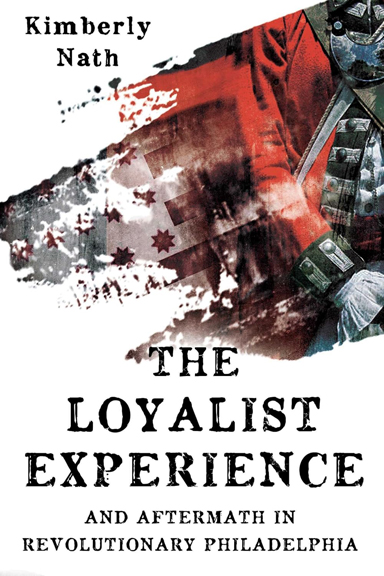 Kimberly Nath’s The Loyalist Experience and Aftermath in Revolutionary Philadelphia enriches our understanding of this topic with a geographically targeted exploration of Philadelphia’s Loyalist population during the revolution. As she shows throughout the book, the particular events of the revolution in Philadelphia led to unique experiences for the region’s Loyalists which adds a great deal of nuance to more general narratives about loyalism. Prior to independence, much of the revolutionary conflict in Philadelphia was modulated through long-standing political disputes between the established governing class tied to the Penn Family and the colony’s Quaker elite, and the amalgamated interest of professional men, artisans, more recent immigrants, and others who sought to disrupt the proprietary order. Furthermore, many of the city’s Quakers, encouraged by their faith’s emphasis on pacifism, either remained neutral or softly sided with the British. Thus, Philadelphia had a strong local path to loyalism that fit into existing political cleavages that encompassed far more than one’s opinion about British imperial policy in the 1760s and 1770s. During the Revolutionary War, Philadelphia was occupied by the British from September 1777 to June 1778 and many Loyalists came to the city to live under their protection. While occupying the city, the British Army relied on local elites like Joseph Galloway and Samuel Shoemaker (both subjects of chapters in Nath’s work) to maintain order and keep the city functioning. After the British departed for New York in 1778, the Pennsylvania and Philadelphia governments, reputed to be the most radical of the new states, retaliated against local Loyalists, pursuing an agenda of aggressive property seizure that sought to deprive Loyalists of membership in the political community.
Nath persuasively argues that the experience of Philadelphia’s Loyalists highlights “the Revolution as not only a political struggle but also a social and economic restructuring” that encompassed more than just the fight over independence. Instead, she shows that the revolution was “also a struggle over identity, belonging, and the material foundations of citizenship.” Through the targeting of Loyalists’ property, Patriots created an enduring link between patriotism and property which “helped solidify the new state governments by tying loyalty to tangible rewards” while also “illustrating how the revolutionaries built a new polity by defining who belonged – and who did not – through the ownership of land and goods.”[4] This emphasis on the relationship between property and citizenship is one of the most compelling portions of the book.
The bulk of the book consists of four case studies of prominent Loyalist families in Philadelphia that explore the strategic choices Loyalists had to make when faced with significant societal disruption. As Nath notes in her introduction, these case studies are necessarily limited in scope; the position and prominence of each of the people profiled made them atypical in eighteenth century society. Even so, she uses the rich archival material left behind to craft highly compelling narratives that, while not representative, “allow us to reconstruct the inner world of Loyalists in ways not possible for the majority” who did not leave behind the kind of archival record her subjects did.[5]
Each of the case studies provides different variations on the Loyalist experience. The first, the story of Elizabeth Graeme Fergusson, a woman from a prominent Philadelphia family who married a Loyalist who would later flee the city, is told as a tale of opportunity. Separated from her husband as a result of his political beliefs, Graeme Fergusson used the turmoil of the Revolution to advocate for her own independence. The portrait of Graeme Fergusson that emerges is striking: she was the onetime fiancé of Benjamin Franklin’s son William (later governor of New Jersey) and also achieved a level of independent literary fame in the 1760s. Caught in a problematic marriage given the persecution of Loyalists in Philadelphia, she made a series of legal petitions to try to separate her identity (and property) from that of her husband. Over the course of the petitions Nath profiles, readers see how Graeme Fergusson developed her own statements of belonging and belief that were distinct from her husband’s.
The second case study involves the Galloways. Joseph Galloway was prominent figure in late-colonial Philadelphia and served in the First Continental Congress before declining to serve in the Second Congress due to his loyalty to the crown. During the British occupation, Galloway was appointed by Gen. William Howe to serve as Philadelphia’s de facto mayor (his actual title was Superintendent of Police and Ports). After the British left Philadelphia, Galloway fled first to New York and then eventually to England with his daughter Elizabeth, where he would remain until his death. His wife Grace was left behind in Philadelphia to try to defend the family’s property from seizure by the Patriot government. Nath uses the diary she kept during this time to “reveal the precarious position of elite Loyalist women” who “had been raised with privilege, education, and expectations of wealth and status” that were denied by the societal shifts engendered by the revolution. The record of “loneliness, anxiety, and longing” she left behind speaks to “the emotional cost” of a revolution which left her family “irreparably damaged.”[6]
Similarly to the Galloways, the Shoemaker-Rawle family were prominent Loyalists who collaborated with the British and then had to navigate the consequences. Much like Grace Galloway, Rebecca Rawle Shoemakers’ adult daughters from a previous marriage were left to defend the family’s position while Samuel Shoemaker and Rebecca fled the city. Unlike the Galloways, however, the Shoemaker-Rawles returned to the city after the war concluded and they worked to overcome the stigma of loyalism (although they never renounced their allegiance to Britain) and reclaim their property. Their story “illustrates the layered costs of the Revolution” which “shaped” the family’s “lives long after the fighting ended.”[7]

The final case study concerns Matthias Aspden, a merchant who fled Philadelphia prior to Independence and continued to maintain emotional links to the city for the rest of his life. Aspden’s trials illustrate “a more intimate and painful dilemma” within the Revolution. “His loyalty,” Nath writes, “left him dispossessed, while his sense of identity left him heartbroken. In this way, the aftermath of the Revolution was just as traumatic as the war itself – a lifelong separation from home and the certainty that the America he cherished no longer existed for him.”[8]
Nath’s final chapter moves beyond the stories of Loyalists to profile the lasting impact of British occupation on Philadelphia. Drawing on lost property ads placed in the city’s newspapers after the occupation had ended, Nath argues that the Revolution occasioned a shift in how goods – both luxury and quotidian – functioned in political terms. In general, this argument seems to rehash that of previous scholars like T.H. Breen who have already illuminated in detail how material culture intersected with revolutionary ideology. Even so, the chapter makes a strong statement about the impact of the occupation on Philadelphia and how it left long coattails as the city’s residents pursued “the redefinition of belonging in legal, social, and cultural terms.”[9] The shift in perspective from Loyalists to material culture in the chapter is somewhat awkward; it does not truly fit with the rest of the book other than through its connection to the occupation of Philadelphia. Given that fact, the book might have been better served had Nath framed it as an exploration of how the occupation and its aftermath shaped definitions of citizenship rather than framing it as an exploration of loyalism.
Where the book is strongest is in Nath’s sympathy towards her subjects. She repeatedly emphasizes the importance of humanizing the revolution and moving beyond tired tropes to understand the ways in which it impacted diverse individuals. In this goal, she ably succeeds. Where the book could be improved is in the nuance of its overall argument. Loyalism, as a phenomenon, was both complex and elusive. It meant different things to different people. As shown by some of the people she chronicled (Elizabeth Graeme Fergusson’s political split with her husband and Joseph Galloway’s critiques of British policy in the 1760s before his eventual decision to remain loyal in the 1770s are notable examples), loyalism itself was not a hard-and-fast category that remained static across one’s life. By not critically examining the complexities of what being a Loyalist meant in practice, Nath misses an opportunity to further move past the “caricature” that has often defined remembrance of loyalism in the past and offer something truly new about what it meant to remain loyal to Britain during the American Revolution.[10]
PLEASE CONSIDER PURCHASING THIS BOOK FROM AMAZON IN HARDCOVER or KINDLE.
(As an Amazon Associate, JAR earns from qualifying purchases. This helps toward providing our content free of charge.)

[1] John Adams to Thomas McKean, August 31, 1813, Founders Online, National Archives, founders.archives.gov/documents/Adams/99-02-02-6140.
[2] See for example: Robert M. Calhoon, The Loyalists in Revolutionary America, 1760-1781 (Harcourt Brace Jovanovich, 1973); Bernard Bailyn, The Ordeal of Thomas Hutchinson (Belknap, 1974); and John Ferling, The Loyalist Mind: Joseph Galloway and the American Revolution (Pennsylvania State University Press, 1977). For recent surveys of loyalism, see for example: Rebecca Brannon, and Joseph S. Moore, eds., The Consequences of Loyalism: Essays in Honor of Robert M. Calhoon (University of South Carolina Press, 2019); and Brad A. Jones, Resisting Independence: Popular Loyalism in the Revolutionary British Atlantic (Cornell University Press, 2021).
[3] Maya Jasanoff, Liberty’s Exiles: American Loyalists in the Revolutionary World (Knopf, 2011). The neo-imperial school is arguably the dominant historiographical framework for writing about the Revolution at present. More than other schools of interpretation it provides pathways for integrating loyalism into a holistic understanding of the Revolution. See for example: Steven Pincus, The Heart of the Declaration: The Founders’ Case for an Activist Government (Yale University Press, 2016); Justin A. Du Rivage, Revolution Against Empire: Taxes, Politics, and the Origins of American Independence (Yale University Press, 2017); Amy Watson, Patriots Before Revolution: The Rise of Party Politics in the British Atlantic, 1714-1763 (Yale University Press, 2025); Trevor Burnard and Andrew Jackson O’Shaughnessy, Republic and Empire: Crisis, Revolution, and America’s Early Independence (Yale University Press, 2025); Patrick Griffin, The Age of Atlantic Revolution: The Fall and Rise of a Connected World (Yale, 2023); and Andrew David Edwards, Money and the Making of the American Revolution (Princeton, 2025).
[4] Kimberly Nath, The Loyalist Experience and Aftermath in Revolutionary Philadelphia (Brookline, 2026), 6.
[5] Nath, The Loyalist Experience, 25.
[6] Nath, The Loyalist Experience, 52.
[7] Nath, The Loyalist Experience, 75.
[8] Nath, The Loyalist Experience, 94.
[9] See for example: T.H. Breen, The Marketplace of Revolution: How Consumer Politics Shaped American Independence (Oxford University Press, 2004).; Nath, The Loyalist Experience, 121
[10] Nath, The Loyalist Experience, 155.

Recent Articles
The Rise and Fall of Captain John Manley
Remembering the Revolution: Little Compton, Rhode Island
Last Call for a Dram Seller on the Mohawk River
Recent Comments
"Payback: Attack on the..."
Thank you all for your kind words. I was very lucky in...
"Payback: Attack on the..."
Joseph Orchard, how fun! Oliver DeLancey avoided having the property confiscated, and...
"Second Coming of a..."
Hi Ann. Thank u for this! Jeremiah Jack is my eighth grade...