


It should not be surprising to find Native American Patriots and men who intermarried into Native American families among the thousands of men who served during the American Revolution. Two of these men were James Bass and William Taburn, and today we can trace their relationship to the Nansemond Indian Nation. Linking these men with their traditional tribal heritage is an extremely complex task requiring both research and partnerships.[1]
Background

Today the Nansemond Indian Nation is one of eleven tribes officially recognized by the State of Virginia. The federal government recognizes seven Virginia tribes and a total of 574 tribes nation-wide, including the Nansemond Indian Nation that received federal recognition in 2018.[2] The recent recognition of the Nansemonds is complicated by a four-century history of efforts to exterminate Native American heritage in Virginia. When the Jamestown settlers arrived in Virginia in 1607 one of the first groups of Native Americans they met were the Nansemonds. Chief Powhatan ruled Tsenacomoca, a confederation of thirty tribes including the Nansemonds whose principal village was located on the west side of the Nansemond River in present Chuckatuck, Suffolk, Virginia.[3]
After a series of wars, a group of Nansemonds converted to Christianity. A Christian Nansemond woman, Elizabeth, married Englishman John Bass in 1638, and current members of the Nansemond tribe are largely descended from this group. Traditional Nansemond lands were under constant pressure from English settlement. In the early 1700s several Christian Nansemond families moved to the northern edge of the Great Dismal Swamp in Norfolk County, today the City of Chesapeake, Virginia. In 1901, James Mooney, a Smithsonian anthropologist, visited Norfolk County and identified sixty-one families with Nansemond tribal heritage. Over many years others migrated south and west.[4] These facts are important in understanding the Revolutionary service of James Bass and William Taburn.
It is difficult to identify Virginia’s Native Americans with Revolutionary service because laws and practices implemented by the government attempted to eliminate individual liberties and remove any record of indigenous heritage.[5] More recently, the Racial Integrity Act of 1924, amended in 1930, banned interracial marriage in Virginia. In practice, one was either all “white” or “colored” including anyone with Native American blood. This policy continued in Virginia until 1967 when the U.S. Supreme Court ruled the practice unconstitutional in the case Loving vs. Virginia. To complicate identifying those of mixed race or Native American heritage, Dr. Walter Ashby Plecker, the head of Virginia’s Bureau of Vital Statistics from 1912 to 1946, altered birth certificates. His successor continued to alter birth certificated through 1959. Plecker changed anyone self-identifying as “Indian” to “colored.”[6] “In 1975 Virginia repealed its segregation and racial definition laws altogether.”[7]
James Bass
James Bass was born in August 1760 in Norfolk County, Virginia, on the Bass family homestead on the northern edge of the Great Dismal Swamp, near the headwaters of the Deep Creek, a portion of the watershed that forms the Southern Branch of the Elizabeth River. James and his family previously petitioned for their rights, guaranteed in the Treaty of the Middle Plantation of 1677, to live as free men, carry weapons, farm and hunt game that was plentiful on the edges of the Great Dismal Swamp. The family petitioned the court on multiple occasions during the eighteenth century to prove they were Indians, but laws and social norms were working against indigenous identity.[8]
On November 26, 1775, while at the Town of Suffolk, Col. William Woodford issued an order calling for 100 members of the Princess Anne District Minute Battalion to join his eleven-company regiment to defeat Loyalist and British regular forces in Virginia. That same day, Lt. Col. Charles Scott of the 2nd Virginia Regiment, with four companies, encamped near James’s home on the only road between Suffolk and Great Bridge. Woodford also reported that a patrol led by Lt. William Sanford of his 2nd Regiment engaged an armed Loyalist party, inflicting one casualty and dispersing the remaining men who disappeared into the swamp. The area around James’s home had become a combat zone. The next day Maj. Alexander Spotswood joined Scott with two additional companies, and they advanced to challenge the forces of Lord Dunmore, Virginia’s royal colonial governor, occupying the Great Bridge. Col. Woodford followed a few days later with five more companies and the heavy wagons and supplies. James Bass would have witnessed Woodford’s army march past his home and answered Woodford’s call.[9]
On the morning of December 9, 1775, fifteen-year-old James Bass, personal weapon in hand, was one of an estimated fifty Princess Anne District minuteman who responded to Colonel Woodford’s call for volunteers to reinforce his companies. At Great Bridge James served in the company of Capt. James Moody and Lt. William Porter. These small minute companies were likely attached to Woodford’s larger 2nd Virginia companies to streamline command and control while providing added infantry manpower. All the Princess Anne District minutemen men known to have served that morning were from south and west of Great Bridge because Dunmore’s forces controlled the north end of the causeway, the only land route that linked Princess Anne and the most populus portion of Norfolk County to points south and west.[10] The most well-known and celebrated local man present that day was William “Billy” Flora. Flora was not the only man of color there that day, he was joined by James Bass and Ned Streeter, there may have been others.[11]
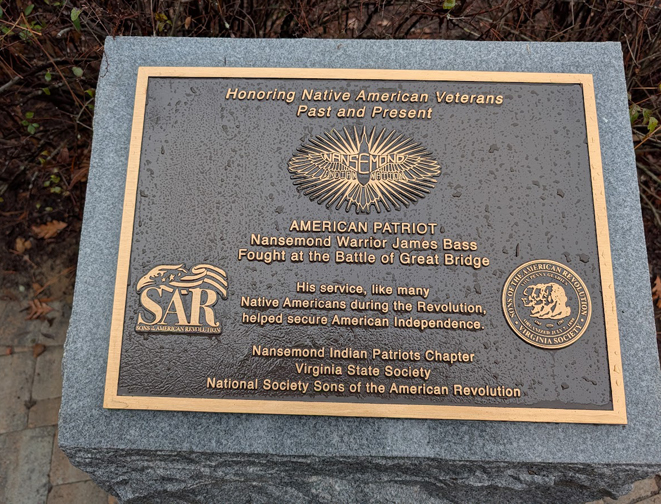
James Bass left us no record of his actions during the Battle of Great Bridge, only that he was present. James continued to serve as a minuteman, providing local security in the Tidewater area south of the James River. His tour of duty continued for nine months through August 1776 when Lord Dunmore departed Virginia, ending the immediate military threat. Virginia also increased the number of regular regiments to fifteen, ending the minute system of defense and resorting to traditional militia for local security. James served two additional militia tours and experienced several skirmishes but “no general engagement.” During his second tour, possibly during the Philadelphia Campaign of 1777-78 or the Mathews-Collier Raid of 1779, his unit served as far north at Prince William County, Virginia. His third tour involved duty south of the James River with Capt. Henry Cornick, from Princess Anne County, and he mentioned service near “Nansemond old town” or Mattanock Town, today a seventy-one-acre Nansemond Historical site in the City of Suffolk, Virginia.[12]

After the war Bass and his family remained in Norfolk County, but like many Revolutionary War veterans he later relocated to Bedford County, Tennessee, in 1819, with his family, for land and greater opportunity.[13] Bass received a land grant in 1829 in the portion of Bedford County, located on the north bank of the Duck River that later became part of Marshall County. In 1836 he was taxed on 188 acres of land. Bass probably died in late 1849 or early 1850 and was buried on his land there. He lived his final years and is interred in Marshall County, named for Supreme Court Chief Justice John Marshall who, as a lieutenant in the Culpeper Minute Battalion, served alongside James Bass at Great Bridge on December 9, 1775.[14]
William Taburn
William Taburn was born in Northampton County, North Carolina, about 1756-58. At the time of the Revolution, Taburn lived in Granville County, about eighty miles west of his birthplace. William’s grandparents lived in western portions of Isle of Wight County, Virginia, near the North Carolina border that later became Southhampton County in 1749. His parents migrated south to Northampton County, North Carolina, before William was born.[15] Unlike James Bass, whose pension application provides little detail about his service, William Taburn’s is filled with information. His Revolutionary journey is quite interesting; he found himself in several well-known engagements.[16]
William Taburn described four different tours of duty. His first enlistment was in the newly authorized 6th North Carolina Regiment in the late spring of 1776. This tour involved one of the shortest enlistments in the Continental Army. He initially enlisted for two and one half years into a company led by Capt. Jesse Saunders. His company needed a wagon and team to move their baggage to Wilmington, the designated assembly area, 200 miles away. Taburn stated, “I was importuned again and again to let my Waggon go with them, but I felt great repugnance to this course.” Taburn agreed to a discharge, in exchange for loaning his wagon and team to the company. He eventually found a teamster, John Davis, to take custody of his property, care for it and bring it back. In return Taburn agreed to tend Davis’s crops in his absence. Both men and the company leadership lived up to the agreement, Taburn tended Davis’s crops and Davis returned with his wagon and team after delivering the company baggage to Wilmington.[17]
Taburn served his three remaining tours as a member of the Granville County militia. In early 1779 Capt. Richard Taylor led his company from Oxford, Granville County to Cross Creek (Fayetteville), on to Wilmington, through South Carolina and into Georgia, a 600-mile movement. Taburn recalled that his regimental commander, Lt. Col. Archibald Lytle, placed him under arrest for a day for getting drunk and cursing at him.[18]

William Taburn was one of 1,100 Patriots surprised by a British assault during the Battle of Brier Creek, near Screven, Georgia, on March 3, 1779. In a well-designed encirclement involving a fifty-mile march, a regular British battalion led by Lt. Col. Marc Prevost struck Gen. John Ashe’s Patriot brigade positioned with their back against a swamp. Taburn’s regiment, positioned on the left and led by Lieutenant Colonel Lytle, reportedly broke without firing a shot. In this brief but decisive action the British retained control of Georgia. Estimated casualties in killed, drowned, wounded and captured run as high as half the Patriot force. Many of the men that survived the battle, like Taburn, simply made their way home. Taburn was surprised when he returned to Granville County and found his company commander, Capt. Richard Taylor, already there.[19]
Willaim Taburn next found himself at Cowan’s Ford on February 1, 1781, the opening engagement in British Gen. Charles Cornwallis’s pursuit of Gen. Nathanael Greene’s southern army. Once again called to duty in the Granville County militia, and led by Capt. James Fuller, Lt. Thomas Bradford, and Ens. Blake Maulder, he headed south. Taburn’s company joined others under the command of Lt. Col. Thomas Farmer from Orange County. In route Captain Fuller received a wound to the foot and was replaced by Capt. Shadrach Parish.[20]
North Carolina Patriot militia under command of Gen. William Lee Davidson guarded the eastern side of multiple potential crossing sites on the Catawba River. General Greene split his army and began moving north. Davidson then concentrated his forces on two fords, Battie’s and Cowan’s. General Cornwallis desperately needed to avenge the British loss at Cowpens two weeks earlier and recover the 500 prisoners being marched north into Virginia. First Cornwallis had to cross the raging Catawba to begin the pursuit. He positioned his units on the west bank of the Catawba River at these two fords waiting for the water levels to drop before attempting to cross.[21]
Anticipating a rapid advance to catch and engage General Greene, Cornwallis did the unthinkable: he burned his tents, heavy wagons and significant supplies to configure his forces as light infantry. He then feinted a crossing at Battie’s Ford and advanced across the Catawba River at Cowan’s Ford during the early morning hours of darkness. Probably by error, the British column, led by the Brigade of Guards, took the deeper wagon ford rather than the shallower horse ford. The two crossings diverged as they entered the river and the exits on the east bank were separated by a few hundred yards, but this distance was critical. The wagon ford was lightly defended by only twenty-five men of Gen. Davidson’s North Carolina militia; he positioned most of his men at the shallower horse ford anticipating the crossing there and held others in reserve. Four feet of water in the river and a wicked current knocked men off their feet and swept them downstream, the swift water and Patriot muskets produced British casualties, but the men pressed forward, accompanied by their generals. General Cornwallis’s horse was shot but made it to the shore, his two brigadier generals were thrown from their horses into the current but managed to make it to the riverbank.
General Davidson was riding a large black horse when he arrived from the wagon crossing. According to Robert Henry, an American soldier at the horse ford, Davidson was shot shortly after he arrived at the ford as he repositioned his men to place fire on the British Brigade of Guards as they exited the water. The Guards were loading and firing while on the riverbank. William Taburn was part of that small detachment at the horse ford and was positioned near enough to General Davidson to hear his words when he was hit: “Help me down boys, I am a Dead man – give the news to the men at the Island and above.” Henry’s schoolmaster, Robert Beatty, continued to fire but was hit and yelled for Henry to “run.”[22]
Taburn called Davidson, “the ablest, kindest & best officer that ever commanded an army.” Taburn described what happened next:
We were soon thrown into confusion by the death of our Beloved General; the Enemy took advantage of it, crossed the river – overpowered our men and put us to flight – we scampered for life and made our way as well as we could to the Widow Torrance’s [or Tarrant’s] land where we stopped and reformed.
At the tavern, the Patriot assembly area, pouring rain left their powder wet and weapons useless, Lt. Col. Banaster Tarleton charged with his horsemen, ending any cohesive defense. Taburn ran and, “fell in with an old Horse without a Saddle or Bridal,” mounted it and traveled for a day to learn he only covered twelve miles. He then followed the river west toward Salem, carefully avoiding the enemy, before taking a more direct path directly to Granville County and home.[23]
Shortly after he arrived home Taburn developed a serious fever that prevented him from joining his reassembling company. After recovering he started off and met up with members of his company returning home. The men reported that they were discharged and the new draftees needed their weapons. A few days later they learned of the Battle of Guilford Courthouse.
Taburn’s final tour of duty was during the summer of 1781, this time under Capt. William Hargrove Searcy. His company marched from Oxford, Granville County to Cross Creek. There Gen. John Butler marched his unit to Raft Swamp, southwest of Cross Creek, where British and Tories were reportedly organizing. Captain Searcy received a furlough and Taburn acquired Searcy’s gun. General Butler assigned Taburn as a cook and he served in that capacity until the news of Cornwallis’s surrender at Yorktown arrived and he received a discharge. Like most militiamen his discharge was verbal, ending his Revolutionary War service. William Taburn received a pension on March 4, 1831, nearly blind and an inmate at the “Poor House of Granville County.” He died on February 4, 1835, at the age of about eighty-nine. Like James Bass, he lies in an unmarked grave.[24]
Researchers’ Challenge
The original pension record of James Bass mentions nothing about his race. Transcribers cross-referenced his information and located him on the 1830 Bedford County, Tennessee Census as a “free colored.” Research by Paul Heinegg also identifies James Bass as a free man of color.[25] In Taburn’s case his pension application clearly states he was “a free man of Color” and includes a statement from William Hill, North Carolina’s Secretary of State, indicating that from 1777 to 1835 all persons between the ages of sixteen and fifty, “without regard to color,” were required to perform militia duty.[26] This statement was added in 1845 when William Taburn’s widow, Nelly Evans Taburn, filed for a pension after her husband’s death. There is nothing in either man’s pension file to indicate they had Native American ancestry or linkages to the Nansemond Nation.
We are only able to make these connections through the work of Paul Heinegg and close coordination with members the Nansemond Indian Nation and the Nansemond Indian Chapter of the Sons of the American Revolution (SAR). The Nansemond Indian Chapter SAR is one of only two Native American chapters in the United States. William Taburn is the Patriot ancestor of Keith Anderson, the Chief of the Nansemond Indian Nation and a member of the SAR. James Bass is an uncle of the assistant tribal chief of the Nansemond Indian Nation.
In his recently-published demographic study of Revolutionary soldiers from the states of Georgia, North and South Carolina and Virginia, Douglass Dorney Jr. compiled multiple elements of data extracted from surviving pension files. This study included analysis of 8,579 pension applications that identified only ten Native Americans. However, he identified “About two hundred pension applications on of free men of color” and there is no question that some of these men were of mixed-race or full Native American ancestry, or at some point these families intermarried. The actual number of Native Americans that served the Patriot cause will likely never be known, but it is certainly a much larger number than the surviving pension applications will ever reveal.[27] Our challenge as Revolutionary War researchers is to identify these men, one at a time, working with the eastern tribes to access family and tribal records. A necessary first step is building trust with tribal communities while protecting contemporary tribal equities. This entire effort is complicated by a four-century history of laws and practices designed to exterminate Native American heritage and identity.[28]
[1] James Bass Pension Application, S1745, revwarapps.org/s1745.pdf; William Taburn Pension Application, W18115, revwarapps.org/w18115.pdf; The “Taburn” surname used in this article has numerous spellings in the historical record including Taburn, Tabour, Taborn, Tabourn and possibly others. Descendants of William Taburn married members of the Nansemond Indian community.
[2] Secretary of the Commonwealth of Virginia, “State Recognized Tribes,” www.commonwealth.virginia.gov/virginia-indians/state-recognized-tribes/;Virginia Division of Legislative Services, State and Federal Recognition of Tribes in Virginia, dls.virginia.gov/groups/VaTribes/112024_state_federal_recognition.pdf; USA.gov, “Federally recognized American Indian tribes and Alaska Native entities,” www.usa.gov/indian-tribes-alaska-native; Nansemond Indian Nation, nansemond.gov/.
[3] Helen C. Roundtree, Pocahontas’s People, The Powhatan Indians of Virginia Through Four Centuries (University of Oklahoma Press, 1989), 6, 43, 84-85, 105-108.
[4] Nansemond Indian Nation, nansemond.gov/.
[5] Roundtree, Pocahontas’s People, 166-67.
[6] Caitlin Snook, “The Racial Integrity Act of, 1924: An Attack on Indigenous Identity,” National Park Service, available, www.nps.gov/articles/000/racial-integrity-act.htm; Roundtree, Pocahontas’s People, 249.
[7] Roundtree, Pocahontas’s People, 249.
[8] Roundtree, Pocahontas’s People, 161.
[9] Robert L. Scribner & Brent Tarter, eds., Revolutionary Virginia the Road to Independence (University of Virginia Press, 1978), 4:270-71, 477-479; William Woodford to John Page, November 29, 1775, identifier MS 2013.3, Special Collections, John D. Rockefeller Jr. Library, Colonial Williamsburg Foundation; “Plan of Princess Anne and Norfolk Counties,” Map 178?, Library of Congress Geography and Map Division, Washington, DC, http://hdl.loc.gov/loc.gmd/g3884v.la001333.
[10] James Bass Pension Application, S1745; The author identified twelve local men who served at Great Bridge on December 9, 1775, Woodford left no accounting of the local units on his official manpower reports to the Virginia Committee of Safety made the day after the battle. Revolutionary Virginia, 5:101. The Princess Anne District included the Borough of Norfolk, the counties of Princess Anne, Norfolk, Nansemond and Isle of Wight.
[11] Patrick H. Hannum, “William ‘Billy’ Flora: Revolutionary Service Beyond Great Bridge” Journal of the American Revolution, June 17, 2026; allthingsliberty.com/2026/06/william-billy-flora-revolutionary-service-beyond-great-bridge/; Patrick H. Hannum, “Virginian Ned Streater, African American Minute Man,” Journal of the American Revolution, December 7, 2021, allthingsliberty.com/2021/12/virginian-ned-streater-african-american-minute-man/.
[12] H. R. McIlwaine, ed., Journals of the Council of the State of Virginia (Virginia State Library, 1831), 1:78, 83, 168, 252; The last record of a Virginia minute battalion was the composited Second Minute Battalion that operated between May and November 1776. Pension application research by the author and E.M Sanchez-Saavedra, A Guide to Virginia Military Organizations in the American Revolution, 1774-1787 (Virginia State Library, 1978), 24-25. Mattanock Town is located at 1001 Pembroke Lane, Suffolk, VA and serves as the Nansemond Indian Nation headquarters. Capt. Henry Cornick served between 1778 and 1781. Brenard Heitman, Historical Registrar of Officers of the Continental Army During the War of the Revolution (Rare Book Shop Publishing Co. Inc., 1914), 171.
[13] Norfolk County Personal Property Tax Lists, 1791-1812, and 1813-1824, Microfilm nos. 147 & 250, Library of Virginia, Richmond, Virginia; Pension Application of James Bass S1745; David Hackett Fischer and James C. Kelly, Bound Away, Virginia and the Westward Movement (University of Virginia Press, 2000), 138-140.
[14] Early Tennessee/North Carolina Land Records, Roll: 112, Book: 11, Tennessee State Library and Archives; Nashville, Tennessee; Jane Wallace Alfred, Revolutionary War Patriots of Marshall County Tennessee (Webb Printing Company, 1976), 5, 6, 40, 49 & 97; John Stokes Adams ed., An Autobiographical Sketch by John Marshall (University of Michigan Press: 1937), 5; Paul Heinegg, Free African Americans of North Carolina, Virginia and South Carolina from the colonial period to about 1820 (Clearfield Co. Inc., 2005), 1:7, 376-7.
[15] Rountree, Pocahontas’s People, 107-08 & 160-62, Nansemond families remained near the Great Dismal Swamp but others who lived in Southampton County dispersed, probably many across the border to neighboring Northampton County, North Carolina, and beyond; Heinegg, Free African Americans, 2:1128-1132, Heinegg spells the family name “Taborn.”
[16] Taburn, Pension Application, W18115.
[17] Taburn, Pension Application, W18115; Heitman, Historical Registrar, 363 & 482.
[18] North Carolina maintained military districts throughout the Revolution and regularly composited company-sized units from multiple counties to form a battalion or regiment for tactical employment. Based on Taburn’s pension statement Lieutenant Colonel Lytle’s 6th North Carolina Continental Regiment was reinforced by his militia company, Lindley S. Butler, “Lytle, Archibald,” NCpedia, www.ncpedia.org/biography/lytle-archibald.
[19] Taburn, Pension Application, W18115; Brier Creek, American Battlefield Trust, www.battlefields.org/learn/revolutionary-war/battles/brier-creek; Mark M. Boatner II, Encyclopedia of the American Revolution, “Brier Creek” (Stackpoole Books, 1994), 113-14.
[20] Taburn, Pension Application, W18115.
[21] William A. Graham, General Joseph Graham and His Papers on North Carolina Revolutionary History (Edwards & Broughton, 1904), 288-306.
[22] Graham, General Graham Papers, 293-94; Taburn, Pension Application, W18115; R. Lamb, Journal of Occurrences During the Late American War (Wilkerson & Coutrney, 1809), 343-346; Robert Henry and David Vance, Narrative of the Battle of Cowan’s Ford, February 1st, 1781 and Narrative of the Battle of Kings Moutain (D. Scheneck, Sr., Reece & Elam, Printers, 1891), 11-12.
[23] Taburn, Pension Application, W18115.
[24] Taburn, Pension Application, W18115.
[25] Paul Heinegg, Free African Americans, 1:7 & 376-7.
[26] Walter Clark, State Records of North Carolina, Laws 1715-1776 (Nash Brothers Book and Job Printers, 1904), 23:244-47, addresses the 1746 militia law. William Hill was Secretary of State of North Carolina from 1811 to 1857, and his name appears quite frequently on North Carolina pension applications, his annotations are not always accurate, particularly in reference to service in the 10th North Carolina Regiment.
[27] Pension Application of Stephen Freeman, BLWt2393-100, revwarapps.org/blwt2393-100.pdf; Pension Application of Robert Mursh (Marsh) W8416, revwarapps.org/w8416.pdf; “Robert Mursh,” 18th-Century People, Colonial Williamsburg, www.colonialwilliamsburg.org/discover/18th-century-people/stories-of-american-indian-life/robert-mursh/.
[28] Douglas R. Dorney Jr., Revolutionary War Soldiers of the Southern States: A Demographic View (Westholme Publishing, 2026), xvii, 63, 125 & 135.

Recent Articles
James Bass & William Taburn, Nansemond Indian Nation Patriot Warriors: A Call for Research
My Family Arrived at this Place: A Loyalist Ranger’s Road from Saratoga
Freedom Round the Globe: A World History of the American Revolution
Recent Comments
"Hero to Zero? Remembering..."
Arnold was the hero of Saratoga "the best general on either side"...
"From Roxbury to Exeter:..."
Hello Otis, Thank you for your kind note. I was interested to...
"The Milford Connecticut Cartel"
Elizabeth, unfortunately none of the accounts of this incident identify any Milford...