

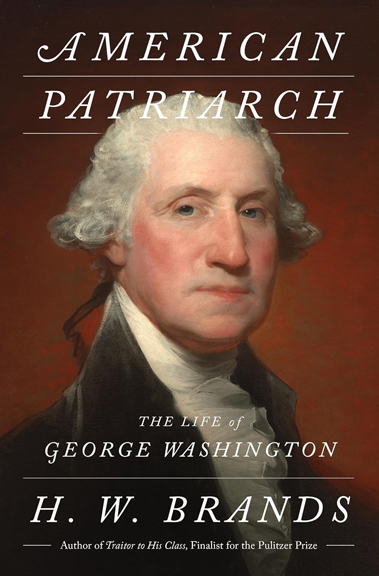
American Patriarch: The Life of George Washington by H. W. Brands (New York, NY: Doubleday, 2026) $40.00 hardcover.
The prolific historian H. W. Brands has added to his Revolutionary Era portfolio (previous books include Founding Partisans, Heirs of the Founders and Our First Civil War) with his biography of His Excellency, American Patriarch: The Life of George Washington. Brands’s latest work tells the story that many are already familiar with, but his use of primary source material, especially Washington’s letters and diary entries, makes the book truly original in allowing Washington to tell most of the story.
 American Patriarch goes back in history to the settlement of the Old Dominion in the seventeenth century in the book’s first section, “Virginia.” Washington’s parents are real people whose brief stories show the world that Washington was born and raised in. The second section, “Ohio,” focuses almost entirely on Washington’s adventures in the Ohio River Valley. Washington was an active explorer of the area, becoming first a surveyor and then a land speculator. His knowledge of the terrain drew the attention of Virginia governor Robert Dinwiddie, who gave Washington his first military command. Washington, due to his inexperience, started the hostilities that became the French and Indian War. Brands devotes a great deal of text to the expeditions Washington was involved with. Washington’s descriptions of the events demonstrate that the young Virginian was a talented writer.
The demands of society pushed Washington to search for a wife, and so the wealthy and attractive Martha Dandridge Custis enters the story in “A Young Man’s Fancy.” Washington’s marriage to her made him quite wealthy and raised his social status. Elected to the House of Burgesses, Washington saw his land claims curtailed by the Proclamation of 1763. The legislation passed by Parliament to tax the colonies turned Washington into a strong advocate of colonial rights. His selection as a delegate to what became known as the First Continental Congress made him a “national” figure. Parts IV through VIII are all about the years that Washington spent as the commanding general of the Continental Army, especially in the settings of Boston, New York, and Yorktown. “Cincinnatus,” the title of Part IX, was Washington’s effort to leave public life for good and take up private pursuits at his beloved estate, Mount Vernon. Duty called again because the new independent nation was struggling to survive on its own.
The greatness of George Washington is truly evident in the chapters about his two administrations as the first President of the United States. His time in office, where there were no precedents to follow, were tumultuous. One may not realize how much Washington had to deal with as the first chief executive: getting the nation out of debt; making treaties and alliances with Indian nations; the yellow fever epidemic of Philadelphia; the French Revolution and the Neutrality Proclamation; dealing with “Citizen Genet”; the Whiskey Rebellion; the Jay Treaty imbroglio; and finally refereeing the increasingly bitter squabbles between his Cabinet secretaries, Jefferson and Hamilton. Brands devotes several chapters to these situations, showing how Washington was able to survive.
The final part of the book, “Mount Vernon,” is very brief, just like Washington’s retirement from power. He answered the call of duty one more time during the Quasi-War with France, but fortunately he never took the field (at the cost of his relationship with John Adams). The story of his unexpected death from epiglottitis in December 1799 is followed by a description of his will and the provisions he made for his enslaved people.
Brands sums up the life of Washington with an essential question: “What was his secret? What made him so great?” He was brave, resourceful, decisive, and diligent, but Brands makes it clear that what made His Excellency truly stand out was one thing: character.
Character was the key to Washington’s success. Different gifts were required by those who came after him. Foremost was aptitude in what Washington couldn’t abide – partisan politics. Washington was the first president, and the last to head a party. What others had to strive for, Washington received without the asking. The others depended on their parties, which soon gained a monopoly on the recruiting of presidential candidates. Even the celebrated generals who followed Washington into the presidency—Jackson, Grant, Eisenhower—had to choose a party to get there. Henry Lee might more insightfully have said that Washington was first in war, first in peace and last of his kind in America. There was one Washington. There would be no others. (page 576)

American Patriarch: The Life of George Washington, is another excellent work by H. W. Brands. As previously mentioned, the words of Washington tell most of the story, and that fact makes this book stand out above others.
PLEASE CONSIDER PURCHASING THIS BOOK FROM AMAZON IN HARDCOVER or KINDLE.
(As an Amazon Associate, JAR earns from qualifying purchases. This helps toward providing our content free of charge.)
Recent Articles
Freedom Round the Globe: A World History of the American Revolution
Trade, Land, Speculation: William Kerin Constable in the Age of Revolution
David Steele’s Macabre Medal
Recent Comments
"Hero to Zero? Remembering..."
Arnold was the hero of Saratoga "the best general on either side"...
"From Roxbury to Exeter:..."
Hello Otis, Thank you for your kind note. I was interested to...
"The Milford Connecticut Cartel"
Elizabeth, unfortunately none of the accounts of this incident identify any Milford...