




Sedition in the Côte-de-Beaupré
Historical accounts of the American invasion of Quebec in 1775 often reduce the campaign to movements on a map: Benedict Arnold’s march through the Maine wilderness, Richard Montgomery’s death in the snow of the Lower Town, and the British fleet’s arrival that forced an American retreat.[1] Beneath that high drama lay a more intimate conflict: a civil war within the rural parishes of the Saint Lawrence Valley, where the outcome of the attempted “Fourteenth Colony” was negotiated in farmhouses and taverns rather than council chambers.
Quebec City, founded in 1608 as the principal fortified administrative center of New France, lay much closer to key British and American strongholds than is sometimes appreciated. Quebec City is approximately 100 miles (about 160 km) from the nearest point on the U.S. border, specifically the Jackman, Maine crossing.[2] Its connections to important British and American centers were measurable and potentially traversable, which helps explain why events in the St. Lawrence Valley so quickly became entangled with the political and military crises unfolding to the south.
Among the thousands of French Canadians who navigated the treacherous political currents of Quebec in 1775, wavering between the ancient authority of the Crown and Church and the new, intoxicating promises of the Continental Congress, one name emerges from the archival silence with startling clarity: Augustin Lacroix. He was not a general, nor a seigneur (wealthy landowner), nor a man of letters (educated). He was a third-generation French farmer from Saint-Féréol.[3] Yet, in the spring of 1776, when the British royal commissioners François Baby, Gabriel Taschereau, and Jenkin Williams conducted their inquisition into the loyalty of the rural population, they singled him out with a condemnation found nowhere else in their extensive journal. They did not merely label him a rebel; they branded him “one of the most disloyal subjects in the parish”.[4]
The severity of this designation invites a close reconstruction from the surviving record. Why did a fifty-year-old patriarch, deeply rooted in the soil of the Côte-de-Beaupré, risk his farmland, his family, and his life for a foreign insurgency? What specific acts constituted “sedition” in a rural parish? And how did the grand geopolitical machinations of the Philadelphia Congress, manifested in their “Letter to the Inhabitants,” filter down to the snowy banks of the Montmorency River to radicalize a rural grandfather?[5] By dissecting the specific charges leveled against Augustin Lacroix including incitement, military service at Sault Montmorency, and the obstruction of loyalist neighbors, we can illuminate the broader mechanisms of the failed Canadian Revolution.

The Primary Dossier: The Journal of 1776
In May 1776, as the American army retreated south in disarray, Gov. Guy Carleton faced a province in administrative collapse. The militia structures had been subverted by American-sympathizing officers; the courts were non-functional; and the authority of the seigneurs had been openly flouted. Carleton commissioned three loyalists named François Baby, Gabriel Taschereau, and Jenkin Williams to tour the parishes. Their mandate was to re-establish King George III’s authority, purge the militia of traitorous officers, and identify the ringleaders of the “sedition.”[6]
The commissioners traveled from village to village, assembling the inhabitants, reading the riot act (metaphorically and often literally), and taking testimony from loyalists who had been silenced during the American occupation.[7] The resulting journal, Journal par MM. Baby, Taschereau et Williams, is a list of the “bad subjects” (mauvais sujets).[8] This document is not a neutral administrative record; it is a prosecutorial artifact, created in the immediate aftermath of a suppressed insurrection.
When the commissioners arrived in Saint-Féréol, a parish nestled in the rugged terrain inland from the Saint Lawrence River, they uncovered a sophisticated revolutionary cell. The journal entry for this parish is unusually detailed, identifying a hierarchy of treason that had effectively replaced the royal government.

Table 1: The Official British Record Analysis.[9]
| Accused Individual | Role & Charge | Implication for Lacroix |
| Bonaventure Lessard | The “Rebel Captain.” He accepted a commission from the Congress to replace the royal captain. | Lacroix operated under the aegis of a formalized alternative authority, not as a lone wolf. |
| Caron du Plaquet Chevalier | The Village Innkeeper (cantinier). Scribe who “wrote answers to Congress” and spread “fantastic rumors.” | The inn was the headquarters. Lacroix’s “sedition” likely took place here, where Chevalier provided the venue and literacy. |
| Augustin Simard & Chrétien Giguère | Collaborators. | Lacroix was part of a committed cadre, a “Committee of Safety” in all but name. |
| Augustin Lacroix | “Incited young men,” “stood guard at Sault,” “always talking of sedition,” “opposed passage of loyalists.” | Lacroix was the activist of the group—the recruiter, the soldier, and the enforcer. |
The specific phrasing regarding Lacroix, “In short, he was one of the most disloyal subjects in the parish” suggests that while Lessard held the title and Chevalier held the pen, Lacroix held the influence.[10] He was one of the men who converted passive discontent into active military recruitment.
Incitement and Sedition
The journal notes that Lacroix “incited several young men from this parish to join the rebels”.[11] In the context of eighteenth-century rural Quebec, this was a profound transgression against the social order. The “young men” were the labor force of the parish. By recruiting them, Lacroix was not only challenging the King but also usurping the traditional authority of the parish priest and the père de famille (father).

This charge reveals Lacroix’s status. A young, propertyless man would not have the standing to “incite” others effectively. Only a man of age and established reputation could sway the youth to disobey the neutrality urged by the clergy. This aligns with the genealogical evidence of his age, suggesting a generational rift where the elder Lacroix led the youth against the established elite.
The journal links Lacroix’s “always talking of sedition” with the innkeeper Chevalier’s dissemination of “bruits fantastiques” (fantastic rumors).[12] This phrase is a euphemism for the effective propaganda war waged by the rebels. In the absence of official news, the vacuum was filled by the rhetoric of the Continental Congress, which Lacroix evidently mastered and repeated. The “sedition” was not merely grumbling; it was a systematic delegitimization of British rule, perhaps involving the public reading of letters from Gen. Philip Schuyler or Gen. Richard Montgomery, interpreted through the lens of local grievances.
The Man: Genealogy and Social Position
Augustin Lacroix was no marginal figure or transient laborer. He was, in fact, a scion of one of the Côte-de-Beaupré’s founding families, a man with deep, generational roots in the region’s soil. Born on April 28, 1726, in Sainte-Anne-de-Beaupré, his lineage traced back through his parents, Augustin Lacroix (1680–1757) and Jeanne Paré (1685–1757), to the mid-seventeenth century. The Paré and Lacroix families were interwoven through decades of intermarriage and farming, granting him a vast social network composed of cousins, in-laws, and lifelong neighbors.[13] When he spoke of sedition, he spoke not to strangers, but to people who had known him since birth.
His life was one of established commitment: he married Marie Anne Gagnon on November 14, 1746, in Saint-Joachim, meaning by the time of the American invasion in 1775, he had been a married man for nearly thirty years.[14] At forty-nine years old, Augustin Lacroix held the patriarchal status of an elder in the demographic context of the time. He had adult children, including a son also named Augustin who married in 1773. This is a crucial detail: the “young men” he was later recorded as inciting may well have included his own sons or nephews. His rebellion, therefore, was not the rash act of a hot-headed youth but a calculated risk taken by a man with significant assets to lose, including his land, his livestock, and the legacy he had spent a lifetime building.
Despite his branding as a traitor, Lacroix did not flee with the retreating Americans in 1776, unlike other prominent collaborators such as Clement Gosselin or Moses Hazen. He remained in Saint-Féréol. He died on August 25, 1796, at the age of seventy, and was buried in the consecrated ground of Sainte-Anne-de-Beaupré.[15]
This survival speaks volumes about British imperial governance after the Conquest. The administration’s response to sedition in 1775–1776 must be understood within the framework of the Quebec Act of 1774, which had deliberately secured the loyalty of French Canadians by restoring French civil law, protecting the free exercise of Catholicism, and permitting Catholics to hold public office.[16] Rather than abandon that conciliatory framework during the American invasion, Governor Carleton applied it pragmatically.
Although the authorities maintained lists of “bad subjects,” they largely avoided exemplary executions or mass reprisals. The decision to allow a vocal seditionist such as Lacroix to remain on his farm suggests that imperial officials prioritized social stability and clerical cooperation over vengeance. To hang a fifty-year-old patriarch deeply embedded in parish life would have undermined precisely the accommodation the Quebec Act was designed to secure.
Revolution Context and Timing of Lacroix’s Rebellion
The transformation of Augustin Lacroix from a provincial farmer to a noted insurgent was not a sudden pivot, but a calculated response to the political destabilization of the St. Lawrence Valley between 1774 and 1776. His rebellion followed a distinct timeline, moving from quiet dissent to physical blockade.
In October 1774, the Continental Congress published the “Letter to the Inhabitants of the Province of Quebec,” a piece of propaganda designed to pull French-Canadians into the American fold. For a man like Augustin Lacroix, living in the Beaupré parishes, this news didn’t arrive via official channels but through the tavern networks and trade routes connecting Montmorency to the surrounding districts. The rhetoric of the letter, attacking the Quebec Act and the British administration, found a receptive audience in a man who had seen his land occupied by Gen. James Wolfe’s army only fifteen years prior.
By the spring of 1775, the fall of Fort Ticonderoga signaled that an American invasion was no longer a threat, but a reality. At this stage, Lacroix’s rebellion was vocal. He began “talking of sedition,” specifically targeting the twin pillars of authority: British law and the Catholic Church’s right to collect tithes. Since the clergy largely supported the British Crown, resisting the tithe was a direct political strike. As Fall 1775 arrived, Governor Carleton issued a desperate call for the local militia to defend Quebec City against the advancing Americans. This is where Lacroix moved from words to action. He established himself at a strategic chokepoint—the Montmorency River. Here, he actively blocked loyalist volunteers from the parish of Saint-Joachim who were attempting to reach the city to join the British defense. By physically obstructing the King’s subjects, Lacroix transitioned from a disgruntled farmer to a tactical asset for the American “Congressionists.”
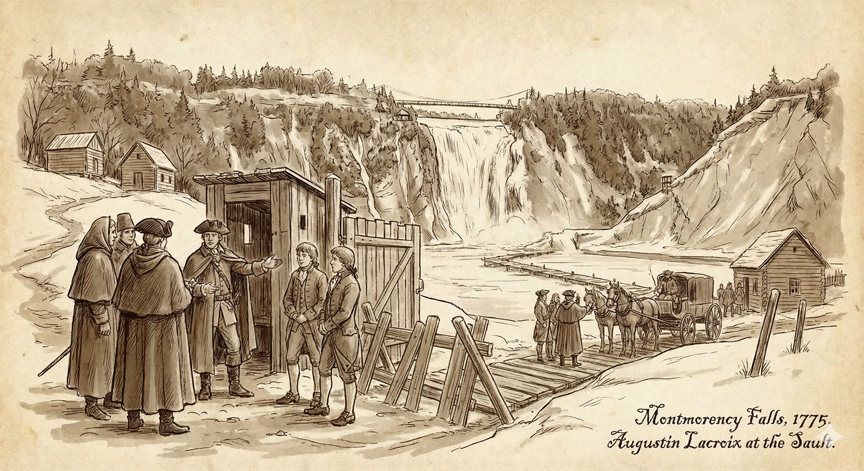
During the bitter winter of 1775, as Benedict Arnold and Richard Montgomery besieged Quebec City, Lacroix stood guard at Sault Montmorency. His role was essentially that of a blockade commander, ensuring that no supplies or reinforcements from the eastern parishes reached the British garrison. The rebellion carried a steep price. On April 10, 1776, in the final, desperate weeks of the American siege, Augustin Lacroix Jr. died at the age of thirty. Whether the cause was the smallpox epidemic that decimated the rebel-aligned parishes or a casualty of the ongoing skirmishes, the death of the younger Augustin coincided exactly with the collapse of the American effort.
When the British fleet finally broke through the ice in May 1776, the Americans were forced into a chaotic retreat. Lacroix did not flee; he withdrew to Saint-Féréol and disarmed, returning to the shadows as the British military regained control of the coast. His “rebellion” did not go unnoticed. In late May 1776, a British Commission of Inquiry arrived in the Beaupré parishes to identify traitors. Lacroix was formally recorded in the Commission’s journal with the damning label: “Most Disloyal.” He was identified as a primary agitator who had not only spoken sedition but had actively incited the local youth to join the American cause.
Despite the “Most Disloyal” label and the personal tragedy of 1776, Augustin Lacroix survived another twenty years in the very shadow of the British administration he had fought. He died in August 1796 and was buried in Sainte-Anne-de-Beaupré. He left behind a family that, while outwardly returning to the quiet life of “Cultivateurs,” carried the legacy of a man who had briefly, but decisively, pushed back against the British Crown.
Sault Montmorency and the Geography of Resistance
As the journal defines the charges against Lacroix, the landscape of Sault Montmorency defines what his “guard dut”’ meant in practice. The second specific charge against Lacroix was that “He stood guard at Sault.”[17] To the modern eye, this might appear a minor detail, but geographically and tactically, it places Lacroix at the fulcrum of the siege of Quebec.
The Sault Montmorency (Montmorency Falls) is a geographic sentinel located approximately six miles east of Quebec City. Here, the Montmorency River, flowing from the Laurentian highlands, plunges 272 feet into the Saint Lawrence basin. The river forms a natural, formidable moat between the parish of Beauport (to the west, toward Quebec) and the parishes of the Côte-de-Beaupré (Ange-Gardien, Château-Richer, Sainte-Anne, Saint-Féréol) to the east.
In 1775, there were only specific points where this barrier could be crossed, primarily a ford above the falls and a bridge crossing. Control of these crossings was critical: if you held the Sault, you controlled the flow of traffic between the eastern countryside and the capital.
Lacroix’s vigil at the Sault was performed on a site already scarred by conflict. In July 1759, sixteen years prior during the French and Indian War, British Gen. James Wolfe had established a large, fortified camp on the east side of the falls, exactly where Lacroix’s parish lay.[18] Wolfe had launched a disastrous frontal assault across the tidal flats below the falls, which the French repulsed with heavy slaughter.
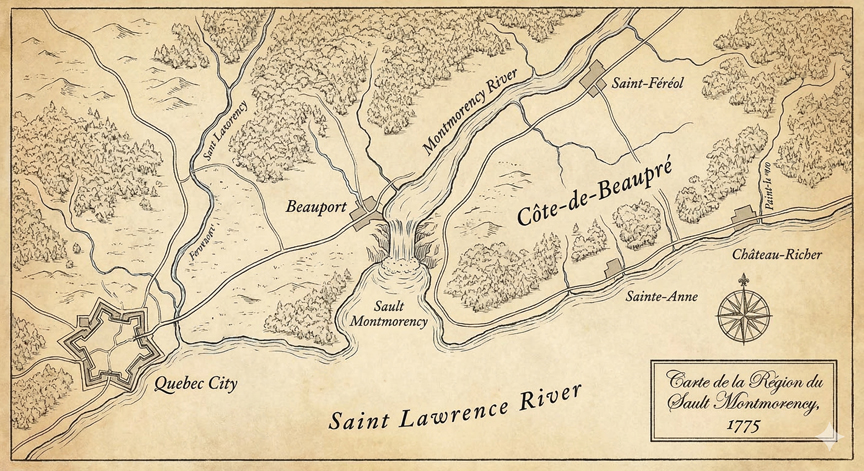
It is plausible that Lacroix, then thirty-three years old and living in a parish directly behind the Montmorency–Beauport defensive line, participated in the French militia resistance during the 1759 campaign. The French victory there relied heavily on local militia drawn from nearby parishes, with roughly 10,000 regulars and militia defending the line against Wolfe’s assault. Although no document names him directly, his age, location, and the universal militia obligations of New France make his participation a reasonable historical likelihood.
For a man of Lacroix’s age, the Sault was a symbol of French resistance. Standing guard there against the British in 1775 was a grim re-enactment of the defense of 1759. The “American camp” at the Sault was likely a re-occupation of Wolfe’s old earthworks or the French defensive lines.[19]
Tactical Objective: The Blockade of Quebec
Why did the Americans need a guard post at Sault Montmorency, and why was Lacroix staffing it?
- Starvation Strategy: The besieging Americans relied on starving the British garrison into surrender as their primary strategy. The parishes of the Côte-de-Beaupré were the breadbasket of the region. Lacroix’s duty was to ensure that no grain, cattle, or firewood crossed the Montmorency River to feed the British troops and the urban population of Quebec City. Wolfe had earlier burned over 1,400 farms and 23 villages to deprive the French of resources.
- The Eastern Flank: The Americans were concentrated to the west (Plains of Abraham) and the north (Palais suburb). The eastern approach via Beauport was their rear guard. Lacroix was protecting the American supply lines from a potential British sortie or a loyalist relief force coming from the east.
The Baby Journal records a specific incident: Lacroix “opposed the passage of St. Joachim’s habitants when they attempted to go offer their services to the governor last fall”.[20] This incident illuminates the civil war within the Canadian peasantry. Saint-Joachim parish, located further east than Saint-Féréol, was the site of the Seminary of Quebec’s farm. The influence of the clergy, who were staunchly loyalist, was stronger there. When Carleton called for the militia to muster to save the city in the autumn of 1775, the men of Saint-Joachim responded.
To reach Quebec City, the Saint-Joachim loyalists had to cross the Montmorency River. Augustin Lacroix, standing guard at the crossing, physically blocked them. This was an act of high treason. It was also an act of fratricidal violence. Lacroix was not fighting “Redcoats”; he was leveling his musket at his own neighbors, men he likely met at market or mass, to prevent them from aiding the British Crown.
Sedition, Tithes, and the Philadelphia Letter
The charge that Lacroix was “always talking of sedition” leads us to ask what, exactly, he was saying.[21] A farmer does not invent political theory in a vacuum. His rhetoric was supplied by the propaganda machinery of the Continental Congress, specifically the “Letter to the Inhabitants of the Province of Quebec.”
The Letter, approved by Congress in October 1774, was translated into French and printed by Fleury Mesplet (who later founded The Montreal Gazette). It was smuggled into the province by merchants like François Cazeau and distributed through the tavern networks. In Saint-Féréol, the innkeeper Chevalier acted as the node for this information, but Lacroix was the broadcaster.[22] Based on the content of the Letter and the socio-political context of the Quebec Act, we can reconstruct the arguments Lacroix likely made to “incite the young men.”[23]
The British Parliament passed the Quebec Act in 1774, expanding the province’s borders and guaranteeing the free practice of the Catholic faith. On the surface, this should have pleased the habitants. However, the Congress’s Letter argued that this was a gilded cage. The Letter warned that the Act did not grant religious freedom as a right, but only as a “precarious tenure” dependent on the King’s will.[24]
Lacroix likely argued: “What the King gives today, he can take away tomorrow. Only the Congress offers rights that come from nature, not the Crown.” This was the most critical wedge issue. The Quebec Act restored the legal right of the Catholic Church to collect tithes, a practice that had become largely voluntary (and frequently evaded) since the British Conquest of 1760.[25] For the habitants, the return of the tithe was a 4 percent to 10 percent tax on their harvest, payable to a clergy that was increasingly viewed as an arm of the British administration.
The Americans, and their local proxies like Lacroix, promised the abolition of the mandatory tithe. When Lacroix “talked of sedition,” he was likely saying: “Join the Americans, and you will keep your grain. Support the British, and you will give it to the priest.” This explains why he was able to recruit the “young men.” Perhaps he offered them immediate economic relief.
The Letter explicitly cited the “Swiss Cantons” as a model where Catholics and Protestants lived in harmony and liberty.[26] This historical analogy was designed to counter the priests’ sermons that the “Bostonians” were anti-Catholic heretics. Lacroix would have used this to argue that an alliance with the Protestant colonies did not mean the loss of their soul, but the gaining of their liberty, like the Swiss.
The journal notes the circulation of “bruits fantastiques” (fantastic rumors).[27] In the desperate winter of 1775, with Quebec City under siege, information was scarce. Lacroix and Chevalier likely filled this void with exaggerated accounts of American victories, the imminent arrival of a massive French fleet (a persistent and hopeful rumor among the habitants), and the total collapse of British power globally. These rumors were tactical: they maintained morale and kept the undecided from defecting to the British side.
The Siege and the Defeat
While the records place Lacroix at the Sault and in the parish, his actions must be mapped against the timeline of the American invasion.
Phase 1: The Incitement (Summer/Fall 1775)
As Arnold approached via the Chaudière and Montgomery via the Saint Lawrence, Lacroix was active in Saint-Féréol, stripping the loyalty of the militia away from the Crown. This was the period of “incitement,” stripping the royally appointed Captain Lessard of his influence and installing the rebel infrastructure.
Phase 2: The Blockade (November 1775)
As Carleton tried to rally the relief column from Saint-Joachim, Lacroix executed the blockade at Montmorency Falls. This action directly contributed to Carleton’s isolation within the walls of Quebec. The “young men” Lacroix recruited effectively neutralized the Loyalist sentiment in the eastern Côte-de-Beaupré.
Phase 3: The Siege (Winter 1775-1776)
During the long, bitter siege, Lacroix’s role at the Sault was one of logistics and surveillance. The American army, suffering from smallpox and exposure, relied on the “disloyal” parishes for firewood and food. Lacroix was part of the supply chain that kept the Continental Army alive in the snow.
Phase 4: The Collapse (May 1776)
The arrival of the British relief fleet in May 1776 shattered the siege. The American army retreated in chaos. This left Lacroix and his cell in Saint-Féréol exposed. They had gambled everything on an American victory, and they had lost.
The Aftermath
The return of British order brought the commission of Baby, Taschereau, and Williams. Their journal was the instrument of the “Reign of Terror” or what passed for it in Quebec.
The Punishment of Reputation
Unlike the American Revolution in the Thirteen Colonies, which saw mass confiscations and exile for Loyalists, the Canadian reaction to the “Patriots” was tempered. Lacroix was not executed. He was not imprisoned in the Dauphin Gaol. His punishment was the public stripping of honor.
Being recorded as “one of the most disloyal” ensured that Lacroix would be watched. It likely meant:
- Disarmament: Confiscation of his weapons.
- Billeting: Forced housing of British troops in his home without compensation.
- Social Stigma: The restoration of clerical authority meant that the “disloyal” were often denied sacraments or marginalized in the parish until they performed public penance.
Governor Carleton’s leniency, known as the “policy of accommodation,” was strategic.[28] He realized that “sedition” was widespread. To hang every Lacroix in the province would be to depopulate the countryside. Instead, the British focused on securing a nominal loyalty. They accepted that the hearts of the habitants might belong to the memory of France or the dream of liberty, but their muskets must belong to the King.
Lacroix’s quiet death in 1796, twenty years after his rebellion, stands as a testament to this pragmatic truce. He lived long enough to see the American colonies win their independence, while his own province remained firmly British, a reality he had fought, however briefly, to change.
Conclusion
From the perspective of Saint‑Féréol in 1775, Augustin Lacroix was not merely a footnote in a British officer’s journal. He was a protagonist in a rural tragedy. His life offers a window into the radical possibilities that briefly flourished in Quebec during the winter of 1775.
He represents a specific type of revolutionary: the mature, landed patriarch who saw in the American invasion a chance to rectify local grievances, specifically the tithe and the seigneurial dues. His “sedition” was a rational economic and political choice, fueled by the rhetoric of the Continental Congress and enforced by the barrel of a musket at the Montmorency Falls.
To label him “disloyal” is to adopt the perspective of General Carleton. From the perspective of Saint-Féréol in 1775, Augustin Lacroix, whose bloodline eventually reaches the present author, was a patriot of a revolution that simply failed to arrive and a freedom that was delayed for over two hundred years. When Canada became independent in 1982, with the patriation of the Constitution and the end of all remaining British legislative authority, a part of his dream became real.
[1] Kevin Pawlak, “Richard Montgomery: The American Martyr Mourned on Both Sides of the Atlantic Ocean,” Emerging Revolutionary War Era, emergingrevolutionarywar.org/tag/battle-of-quebec/.
[2] Detroit, an important British post in the Great Lakes interior, lay roughly 844 miles, or 1,358 kilometers, southwest from Quebec City when measured by straight‑line distance. Boston, the nearest major revolutionary center on the Atlantic seaboard, was about 307 miles, or 494 kilometers, south from Quebec City. These distances underscore the strategic reality that Quebec, though remote in cultural and political terms, was not geographically isolated.
[3] L. C. Tanguay, Dictionnaire généalogique des familles canadiennes depuis la fondation de la colonie jusqu’à nos jours, Vol. 5 (Montréal: E. Sénécal, 1888), 71.
[4] Journal par MM. Baby, Taschereau et Williams, 1776 (Quebec, Aegidius Fauteux, 1929), 12.
[5] Letter to the Inhabitants of the Province of Quebec (Philadelphia: William and Thomas Bradford, October 1774).
[6] Journal par MM. Baby, Taschereau et Williams.
[7] The Riot Act, formally titled An Act for Preventing Tumults and Riotous Assemblies, and for the More Speedy and Effectual Punishing the Rioters (1 Geo. 1. St. 2. c. 5), received royal assent on 20 July 1715 and came into force on 1 August 1715.
[8] Journal par MM. Baby, Taschereau et Williams.
[9] Journal par MM. Baby, Taschereau et Williams and Bulletin de la Société historique franco-américaine (1946 and 1947), 57.
[10] Journal par MM. Baby, Taschereau et Williams.
[11] Ibid.
[12] Ibid.
[13] Tanguay, Dictionnaire généalogique, 71.
[14] Certificate of the Publication of the Marriage Banns, parish of Sainte-Anne-de-Beaupré. Witnesses: Antoine Dion; Pierre Lacroix; Voble, priest; René Portneuf, priest. In Quebec, Canada, Notarial Records, 1637–1935.
[15] Tanguay, Dictionnaire généalogique, 71.
[16] Great Britain, Parliament, “An Act for making more effectual Provision for the Government of the Province of Quebec in North America,” 14 Geo. III, c. 83 (June 22, 1774). See also Margaret Laniak Herdeck, “The Origins, Evolution, and Political Consequences of Britain’s New Catholic Policy: From the Conquest of Quebec to the Eve,” unpublished dissertation, www.tara.tcd.ie/bitstreams/149c2b1b-d15a-4bd5-aca3-c0ee0fcc4880/download.
[17] Journal par MM. Baby, Taschereau et Williams.
[18] John Knox, An Historical Journal of the Campaigns in North America, for the Years 1757, 1758, 1759, and 1760 (London: W. Johnston and J. Dodsley, 1769), 2:71–85. See also William R. Griffith, IV, “Conquering a Continent: The Battle of Quebec,” American Battlefield Trust, www.battlefields.org/learn/articles/conquering-continent-battle-quebec.
[19] Journal par MM. Baby, Taschereau et Williams.
[20] Ibid.
[21] Ibid.
[22] Journal par MM. Baby, Taschereau et Williams; Bulletin de la Société historique franco-américaine (1946 and 1947), 55.
[23] Paul J. Cornish, “Quebec Act of 1774,” The First Amendment Encyclopedia, firstamendment.mtsu.edu/article/quebec-act-of-1774/. See also Sebastian van Bastelaer, “That Damned Absurd Word Liberty: Les Habitants, the Quebec Act, and American Revolutionary Ideology, 1774–1776,” Journal of the American Revolution, August 5, 2019, allthingsliberty.com/2019/08/that-damned-absurd-word-liberty-les-habitants-the-quebec-act-and-american-revolutionary-ideology-1774-1776/; see also Journal par MM. Baby, Taschereau et Williams.
[24] “Letter to Inhabitants of Quebec.”
[25] Quebec Act of 1774.
[26] “Letter to Inhabitants of Quebec.”
[27] Journal par MM. Baby, Taschereau et Williams.
[28] Great Britain, Parliament, “An Act for making more effectual Provision for the Government of the Province of Quebec.”

Recent Articles
Dumpling Pond: Legend, Folklore, and Local Memory in Greenwich, Connecticut
The Rise, Disgrace, and Redemption of Timothy Bedel
The Lost Founder: James Wilson and the Forgotten Fight for a People’s Constitution
Recent Comments
"“To sport with Long’s..."
This is a fascinating and well sourced article that vividly describes the...
"The Final Cruise of..."
Built in France in 1777, frigate Deane sailed for America in early...
"Attack in Westchester: Emmerich..."
Ms. West, Please let me know when you write your new article....