



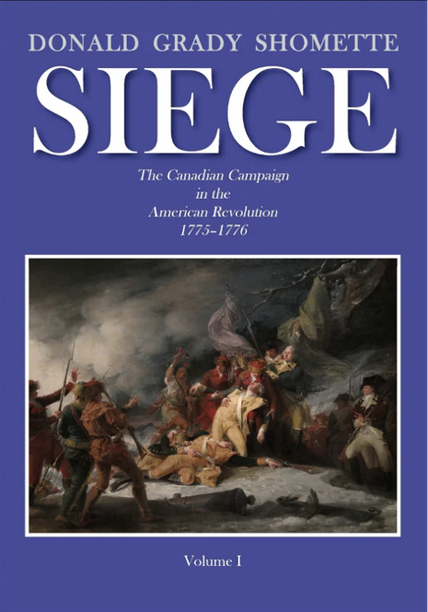
BOOK REVIEW: Siege: The Canadian Campaign in the American Revolution, 1775-1776 by Donald Grady Shomette (Heritage Books, 2025) Two volumes, paperback, $77.00
In its first year, the American Revolution was unstoppable. The outbreak of war at Lexington and Concord was followed by the capture of Fort Ticonderoga and victories at Moore’s Creek Bridge (North Carolina), Great Bridge (Virginia), Sullivan’s Island (South Carolina), Gwynne’s Island (Virginia), and the British evacuation of Boston. Now styling themselves “Continental,” Congress and its armies began looking beyond the thirteen colonies. Major General Charles Lee attempted an invasion of East Florida, and Congress sent Benedict Arnold and Richard Montgomery against Canada in separate approaches.
 While Lee never made it through Georgia, the Canadian campaign was carried through to its unsuccessful conclusion. Americans tend to compartmentalize the Canadian campaign as early foolishness that contributed nothing to their ultimate success. That is a fair assessment, but along with the failure came great heroism and the beginnings of storied careers.
Donald Grady Shomette’s Siege: The Canadian Campaign in the American Revolution, 1775-1776 is deeply researched, well-written, and long. Mr. Shomette is an expert in maritime history and underwater archeology who has written several books on the Chesapeake Bay. He said once, “I pick a subject, topic, person, or field that has been little investigated and is of interest to me, and research it to death.” He has done that again, here.

The result is a detailed, matter-of-fact narrative that is generally free of high-minded interpretation. This is a good book for readers who want to know what happened, in detail. Shomette writes in an easy, confident style, and his heavy reliance on original sources shows he has done his work. Still, a few common errors sneak through: he refers to George Washington’s Virginia Regiment of the French & Indian War as “militia,” and repeats the old propaganda that Lord Dunmore, the last royal governor of Virginia, burned Norfolk to the ground.
The length and detail of Shomette’s work provide an opportunity for readers well-versed in the Revolution to gain new perspectives on the men of the war. Valcour Island was, it has been argued, Benedict Arnold’s finest hour before his treason. Major Christopher Greene of Rhode Island, later the victor at Fort Mercer, makes an early appearance in Arnold’s arduous trek up the Kennebeck River. So, too, do Daniel Morgan of Virginia and Henry Dearborn of New Hampshire, both captains. They, like Greene, were captured in the attack on Quebec City but were eventually paroled and exchanged. Arnold and Dearborn were fortuitously reunited in 1777 during the Saratoga Campaign. Morgan’s famous riflemen served alongside Dearborn’s musket-wielding light infantry as an effective combined-arms force, earning America its first large battlefield victory.
Mark Anderson’s The Battle for the Fourteenth Colony: America’s War of Liberation in Canada, 1774–1776 is thirteen years old but remains the go-to book on the Canadian campaign. Shomette’s new book is a worthy update and has the advantage of at least one newly rediscovered source (Edward Wigglesworth’s diary). Limited distribution from Heritage Books may keep it from fully competing with Anderson’s work, but anyone serious about understanding this part of the war will want to read them both.


Recent Articles
Trade, Land, Speculation: William Kerin Constable in the Age of Revolution
David Steele’s Macabre Medal
The Loyalist Experience and Aftermath in Revolutionary Philadelphia
Recent Comments
"David Steele’s Macabre Medal"
Excellent article. Most interesting. Well done.
"La Petite Guerre and..."
This is a fascinating examination of the distinction between European *petite guerre*...
"James Wilson and Popular..."
Kelly – thanks for this contribution to the growing body of work...