


Introduction
When most people think of medals, they think of portable discs often suspended from a ribbon and made of metal (frequently gold, silver, or bronze) that commemorate a deed, an event, or an achievement. Revolutionary War veteran David Steele’s medal was neither circular nor metal, embossed nor engraved. He received it not from the government, nor from an institution, not for services rendered or accomplishments attained, but from and for himself only—with assistance from a British saber. David Steele’s “medal,” as he referred to it for over fifty years, was essentially a part of himself, a piece of bone from his own skull shorn by a blow to the head that left him maimed for life. Detached from his physical body but never far away, Steele kept this memento of his wartime experience safe in his possession for more than half a century, proof of his participation and a sobering reminder of the human price of American independence.
This curious piece of material culture (if indeed it can be called that) now rests in the stacks at the University of Virginia’s Albert and Shirley Small Special Collections Library. Safeguarded and donated by later generations of the Steele family, this bone fragment is a tantalizing remnant of the American Revolution and a battle that occurred in North Carolina nearly 250 years ago. Wounded at the Battle of Guilford Courthouse on March 15, 1781, David Steele sustained multiple serious wounds to his head, shoulders, and back, somehow surviving and returning to his home in Virginia to manage a tavern where he lived for another fifty-nine years with his wife and their children. Yet his war-time experience and his medal remained a defining part of his identity, both during and after his lifetime, and inspired the next generation of Americans and their allies.
Steele’s Virginia
As with many Revolutionary stories, David Steele’s began in Virginia. Born around 1756, he was raised in the beautiful Blue Ridge Mountains, in what was first part of Augusta County and later Rockbridge County. The town where he resided was called Midway (sometimes spelled Medway),[1] the halfway point between Staunton in the north and Lexington in the south and located along an important and ancient roadway called the Great Indian Road or the Philadelphia Wagon Road. The Steele family operated a log tavern in Midway where the stagecoach stopped midday for lunch and to change horses, and the town was often referred to as “Steele’s Tavern” after this local landmark.[2] There, a young David Steele lived with his wife, Mary “Polly” Steele (née Moore), whom he wed in 1778, and their three children: Janet (also recorded as Jeanette or Jane), Mary, and John David, Jr.
David Steele could trace his lineage to a long line of Steeles who had emigrated to Virginia from Ireland in the early 1700s. While the extended Steele family owned huge swaths of land and built fine houses in the region, it was David’s simple tavern that became one of the most famous destinations. During and after the American Revolution, Steele hosted French nobility including a future marquis and a future king. Local tradition also claims that two presidents, likely Andrew Jackson and James Polk, stopped by the tavern on their way to Washington, D.C.[3] While the log tavern building no longer exists, it was said to have been located along the main road so that “people could step from the stage coach on to the steps of the tavern porch,” a perfect destination for weary travelers and mail carriers traveling along the mountains in what was then the western colonial frontier.[4]

Battle of Guilford Courthouse
Steele’s time as a soldier was a brief yet significant part of his story, and the surviving documentary and material traces of his life revolve almost entirely around his role in the American Revolution. Due to lost or destroyed records (as well as other Revolutionaries named David Steele), it is difficult to pinpoint the moment when Steele first became involved in the fight for independence.[5] Recently married and a young father running an important local business, he appears to have served his country as a volunteer rifleman rather than an enlisted soldier. In Virginia, nearly all men between the ages of sixteen and fifty were required to serve in their local militias and could be called upon to serve for a period of weeks or months when the Continental Army needed support.[6] Whether he had served in prior conflicts is not known, but by February 1781, Steele was engaged as a private in the Virginia militia marching to North Carolina to support Gen. Nathanael Greene.
Following the American victory at the Battle of Cowpens in South Carolina in January 1781, American troops retreated to Virginia for reinforcements and drafted men from Augusta and Rockbridge Counties into a Virginia militia unit led by Capt. James Tate. One recruit was a clergyman named Samuel Houston, a neighbor of Steele, who was “called to go as a private from the congregation of New Providence, in his 23d year . . . He went cheerfully, with others, to try the labors and exposures of the camp.”[7] Houston kept of diary of his month-long military service from February 26 to March 23, and his experiences probably resembled Steele’s.[8] Most of his account documents their long march south, sometimes covering as many as twenty or thirty miles a day, with several recruits deserting along the way.[9] Steele is not mentioned by name, but it is likely that he was among this group walking from Midway to Guilford.[10]
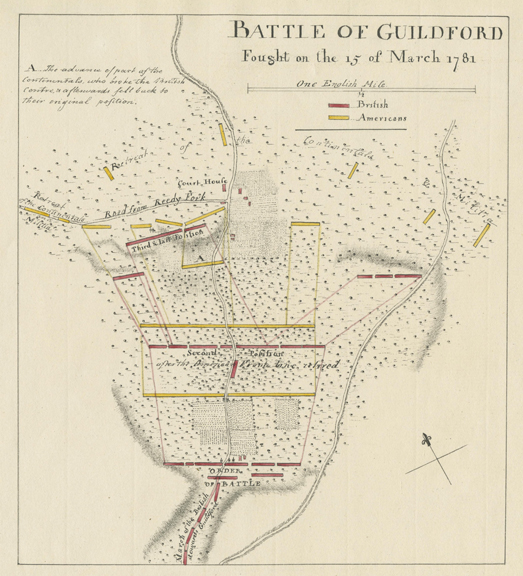
The Battle of Guilford Courthouse on March 15, 1781, was the largest and one of the bloodiest battles of the Southern Campaign. 4,400 Americans (a mix of volunteer militiamen from North Carolina and Virginia and seasoned soldiers from the Continental Army) commanded by General Greene met a force of about 1,900 British troops under Gen. Charles Cornwallis in a battle that lasted nearly two-and-a-half hours. American troops were divided into three lines: the North Carolina militia as the first line of defense, followed by 1,200 Virginia militiamen, including Houston and Steele, stationed as a second line within a forested area, and a third line of Continental soldiers at the rear.[11]
Fighting was intense, with the Virginia militia experiencing the brunt of the British attack as lines became disorganized during the battle. Houston recalled that the worst of the fighting came during the militia’s retreat, when “the [British] light horse came on us, and not being defended by our own light horse, nor reinforced—though firing was long ceased in all other parts, we were obliged to run, and many were sore chased, and some cut down. We lost our major and one captain then, the battle lasting two hours and twenty-five minutes. We all scattered.” Many men were killed, wounded, or taken prisoner during the retreat.[12] Those who managed to escape kept running, walking, or crawling for fourteen miles until they reached safety, many supporting and carrying their wounded comrades. In all, an estimated 1,300 Americans were killed, wounded, taken prisoner, or reported missing.[13]

David Steele was not among those like Houston who ran to safety but instead “was cut down in the retreat, and left for dead.”[14] Despite his injuries, Steele was able to make his way back to his company the day after the battle, as did many others who were thought lost. Houston recounted that on March 16, “we were rejoiced by men coming in we had given out for lost.”[15] Virginia politician Archibald Stuart, who fought alongside Steele and Houston, recalled that he saw “Steele the morning after the battle he had so many Sabre wounds that I considered it impossible he could recover & when I parted from him had not the most distant expectation of ever seeing him again.”[16]
Examining Steele in 1830, nearly fifty years after the battle, Surgeons W. Boyd and Thomas Coalter confirmed the destructive and permanent nature of his injuries: “he received seven wounds in his head several of which manifestly appear to have passed through the skull to the brain, inflicting permanent and serious injury to the bones on each side of the head especially to the parietal & Temporal bones on the left side, by which the left eye appears to have been seriously injured.”[17] Among Steele’s other injuries were wounds to his shoulders and back and a cut to the scapular bone that permanently disabled his shoulder.[18]
Historical accounts and family histories debate the impact of these injuries to Steele’s physical appearance. Rev. William Henry Foote, who posthumously published Houston’s diary, recorded that “the scar of a deep wound over one of [Steele’s] eyes, was frightful to strangers, through his long life.”[19] Other visitors to Steele’s Tavern described Steele has handsome and made no reference to facial scars.[20] A family history written in the 1970s suggests the Steele did have scars but wore his red, curly hair long to hide them.[21] In the end, he may have looked something like Winston Graham’s fictional British antihero, Capt. Ross Poldark, who received a deep facial scar under similar circumstances during the Revolution yet (as seen in the Masterpiece TV adaptation starring Aidan Turner) remained quite captivating.
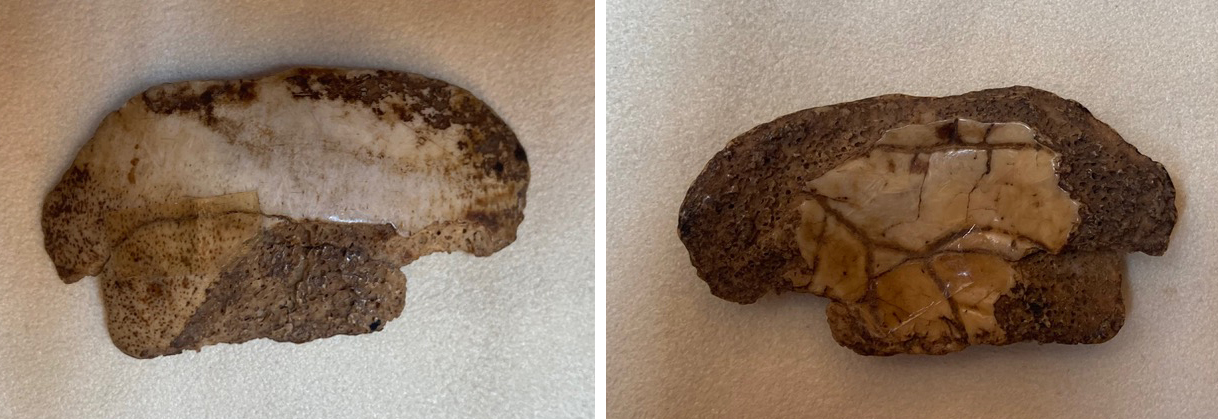
Whatever the impact to his appearance, David Steele’s survival and return to his life in Virginia is remarkable. In addition to scars and trauma of the battle, Steele brought with him a curious item: a fragment of his own skull. He wore a silver plate on his head to cover the missing piece, and stored the skull fragment at his tavern for the rest of his life. If he hid his scars, he did not hide this bone and allegedly kept it “to show to his friends, saying it was the only medal he had to show.”[22] This remnant was preserved by his family for generations and now rests at the University of Virginia’s Special Collections Library, a tribute to Steele’s sacrifice and a reminder of the brutality of the American Revolution.

The “Medal”—An Object Study
Let us assess his “medal” for a moment. It is a curious item, elliptical in shape and roughly two inches at its longest point and one inch wide. Based on the surgeons’ accounts, the fragment is most likely from Steele’s left parietal bone, which formed part of the side and roof of his cranium. The external side is relatively smooth, while the intracranial side retains marks from meningeal vessels that once pumped blood through Steele’s head. The bone fragment is darkened with time and contact, with the broken edges revealing the porous interior of the bone worn smooth from repeated handling. One can almost imagine the piece being passed among the family and guests by the fireside as Steele regaled them with tales from the war. At some point, perhaps due to its age or repeated use and display, the bone cracked in half and now features two small pieces of aged yellow tape keeping the fragment whole.
Marquis de Chastellux, Travels in America
What is perhaps the earliest written account of David Steele and his “medal” was produced just one year after the battle by a fellow soldier, the French Gen. Francois-Jean de Beauvoir (later the Marquis de Chastellux). Between 1780 and 1782, Chastellux traveled extensively through the United States and recorded his observations of the young nation during the last years of the Revolution.[23] His account was published in French in 1786, with an English translation appearing the following year: Travels in North America in the Years of 1780, 1781 & 1782 by the Marquis de Chastellux. This two-volume book has since been celebrated as an important documentary work of American life during the war, including his observations of battles, dinners with prominent Patriots, and the inns, taverns, homes, and people that he encountered along the way.
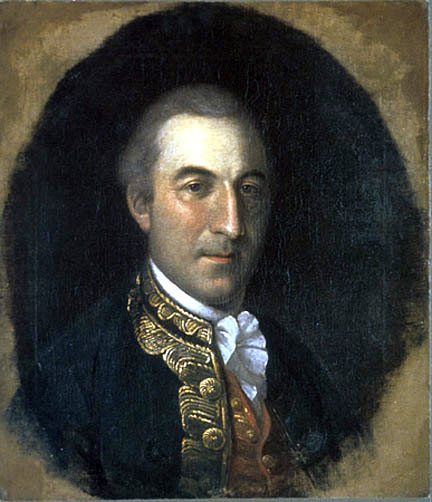
On April 18, 1782, while undertaking a journey through Virginia, Chastellux was directed to Steele’s tavern after staying with Thomas Jefferson at Monticello. He and his party took a meal with Steele and his wife before continuing their journey west. Although he only spent a few hours at the tavern, Chastellux was fascinated by Steele and recorded his story, one of the few times that he lent his pen to outline an ordinary American in such detail. Through Chastellux, David Steele was described as having a heroic and attractive appearance, “a young man, twenty-two years of age, whose charming face, fine teeth, red lips, and rosy cheeks” belied the horror he had witnessed only a year before.[24] Interestingly, Chastellux noted no scars or visible effects of Steele’s military service, only that “he appeared sluggish and inactive.” Steele explained this was a result of his military service: “[Steele] told me he had been in a languishing state ever since the battle of Guildford, in which he had received fifteen or sixteen wounds with a hanger.”[25]
Steele recounted the entire ordeal to Chastellux, who told his readers that Steele’s extensive wounds were not received in the heat of battle but once he had surrendered: “it was after he had received his first wound, and was made prisoner, that he had been thus cruelly slashed.”[26] In fact, Chastellux wrote that Steele had been so badly treated by the British that “beaten down and bathed in blood, [Steele] had still had presence of mind enough to think that his cruel enemies would not want to leave any witness or victim of their barbarity, and that there remained to him no other way of saving his life than to pretend to have lost it.”[27] According to Chastellux, it was only by playing dead that Steele escaped British captivity and bloodlust to reach safety.
Chastellux’s record also mentioned the macabre memento that Steele carried for the rest of his days. His almost poetic description uses the same commemorative language ascribed to Steele: “He had not, like the Romans, a crown to attest his valour; nor, like the French, either pension or certificate of honour; instead of them, he had a piece of his skull, which his wife brought to shew me.” This textual evidence is remarkable in several ways—not only does it confirm the existence of the bone fragment in 1781 but shows that both David and Mary Steele were actively engaged in showing it to visitors. It also records that just one year after the battle, the bone fragment was already being thought of as a type of “medal,” a symbolic and commemorative piece displayed for many to see.
Distribution & Reception
Whatever message David hoped to convey by retelling his story and sharing his medal, the Steeles probably got more than they bargained for in Chastellux. While he never intended to publish his account, Chastellux ultimately did so just five years after his visit to Steele’s Tavern, preserving Steele and his skull fragment in paper and ink for international readers to wonder at over two-and-a-half centuries. His primary audience was the French elite, recent supporters of the fight for American Independence who would have been intrigued by a story of American valor and British atrocity, and he also sent copies to his many American friends.[28]
While Chastellux planned for an American acquaintance to translate his book for an English-speaking audience, an unsanctioned translation was published in London in 1787 and quickly became the accepted English version.[29] An advertisement for this copy appeared in a London newspaper in November 1786, “translated from the French by an English Gentleman, who resided in America during that period; with Notes, by the Translator.”[30] Almost immediately, the book was subject to a rebuttal from British Officer John Graves Simcoe, who objected to Chastellux’s scathing account of the British army’s activities in the United States. Simcoe’s Remarks on the Travels of the Marquis de Chastellux in North America was published in 1787 and distributed widely to English readers for two shillings a copy. While he did not directly name Steele, Simcoe’s reference to the American veteran is unmistakable: he found the account of “a man pale in appearance, and whose wife shewed to [Chastellux] a piece of his skull that had been cut out” after his surrender to British troops deeply problematic.[31] Simcoe described his extensive doubts as to the credibility of Steele’s story, writing that “any ill usage of prisoners is certainly unwarrantable, and infamous to a degree; supposing it to be proved, and not depend upon this man’s own account, that he had surrendered.”[32]
Despite the criticism that it received in England, the translated copies of Chastellux’s Travels spread to the United States, reaching Philadelphia by May 1787 and sold by a “Joseph Crukshank in Market-Street.”[33] Excerpts were also published in American and English newspapers, mostly focused on descriptions of battles and American figures like John Adams and George Washington. The book was not popular in the United States, with imported copies scarce until 1827 when the book was finally reprinted by American publishers and sold on a larger scale.[34] Historian Howard C. Rice has suggested that while the book received praise from Chastellux’s friends like Thomas Jefferson and Benjamin Franklin, many others took offense to his often-degrading descriptions of famous persons and American customs.[35] In all, the book remained a relatively rare item in America until the mid-nineteenth century.[36]
It is curious to consider whether David Steele was aware that his story appeared in the writings of this French aristocrat or that it was disputed by a British officer. Steele was literate and a few of his letters to family members survive at the University of Virginia, but a country tavern-keeper probably did not have the income for a library of books or access to the latest publications. That said, some of his customers traveling on the Wagon Road or his well-read and well-connected neighbors like Thomas Jefferson and Archibald Stuart were probably aware of Steele’s literary persona. While Steele remained in Virginia for the rest of his life, people on both sides of the Atlantic would have encountered his story and wondered about the man who held a piece of his own skull. Perhaps Chastellux’s Travels even served as an early advertisement for the humble log tavern, directing individuals fascinated by his story and eager for a glimpse of the bone to visit for an afternoon, as Chastellux once did.
“Mr. Orleans” in America
One can imagine such a story capturing the attention of another young French aristocrat who found himself unexpectedly in America just fifteen years later. Louis Philippe, Duc D’Orleans (who later became King Louis Philippe I of France), came to the United States as a young exile in the mid-1790s during the French Revolution. Dubbed “Mr. Orleans,” he and his two brothers explored the new nation and met with many of the same American founders as Chastellux. In the spring of 1797, just a decade after the publication of Travels, Orleans undertook a similar journey through the Virginia backcountry—and Steele’s tavern appears on his itinerary.
Unlike Chastellux, who edited and published an account of his travels, the Duc kept his experience private. Only two notebooks from his trip survive and fortunately record his time in Virginia. They were published in French in 1976 under the title Journal de Mon Voyage d’Amerique, with an English translation released the following year, and document the observations of the young royal in the American backcountry.[37] While a generation younger than Chastellux, Orleans was certainly familiar with the elder aristocrat and his Travels. In his entry on Steele’s tavern, Orleans wrote: “M. de Chastellux stayed with [the Steeles] on his way to and from the Natural Bridge.”[38] It is even possible that the Duc owned a copy of Travels and carried it with him as he explored America.
After visiting the developing capital city of Washington, D. C. and staying with George Washington at Mount Vernon, Orleans and his brothers ventured deep into Virginia. While Chastellux had traveled west through Charlottesville, Orleans started his adventure in the northern city of Winchester and traveled south along the foothills of the Blue Ridge Mountains, likely following the path of the Wagon Road. He stopped at various small communities and on April 16—almost exactly fifteen years after Chastellux’s visit—the Duc arrived at Steele’s tavern. There, he spent an engaging afternoon with the former soldier listening to tales of his wartime experience and seeing Steele’s infamous medal:
This poor unfortunate was captured by Parleton’s [Tarleton’s?] corps, and after he had surrendered they fetched him two blows of the saber to the head, so he says, bashing out a piece of bone that his wife showed us. . . . Steel told us funny stories.[39]
Orleans’s journal entry follows a similar pattern to Chastellux’s account, confirming the story of Steele’s capture, surrender, and injury at the hands of British soldiers. This time, the culprits are named as Tarleton’s corps and the number of blows reduced from fifteen or sixteen down to two. Just as described by Chastellex, Mary Steele presented the fragment of her husband’s skull to the Duc and his party. The similarities between these accounts, combined with a more refined, dramatic narrative—including the regimental identities of the soldiers and two blows allegedly so severe that they broke off a piece of bone—suggest that by this time, the story of the Battle of Guilford was probably a well-rehearsed performance that the Steele family had sharpened over the years for maximum suspense and enjoyment by listeners.
A Macabre Legacy
Despite numerous literary allusions to its narrative and ceremonial role, there is no evidence that Steele ever wore his medal, on a ribbon or pinned to his jacket the way many others have presented the mementos to their achievements over time. Documentary records do suggest that Steele carried this fragment proudly, sharing it and his story with those who passed through his tavern. The lore of the “medal” has remained a key part of Steele’s legacy within his family’s genealogical records and has been preserved through its inclusion in Chastellux’s text, Simcoe’s rebuttal, and, nearly two centuries later, in the Duc D’Orleans’s rediscovered diary. With the deposition of this artifact at the University of Virginia, it continues to entrance students and researchers who stumble upon the bone in the library catalog, myself included.
But Steele’s life was much more than his war-time experience, even if his revolutionary stories provided him with notoriety during his lifetime and afterwards. He managed a tavern that served passengers traveling an important roadway along the frontier of a growing and complex nation. The tavern also became a hub for the spread of news and information as people addressed their letters and correspondence in the “care of Steele’s Tavern.” The site even became an official stop along the post road in 1825, with Steele’s son, John David, serving in the role of post-master.[40] David Steele also maintained his father’s flour mill, providing a place for local farmers to process their grain into food for their families and for export. He liked to work with his hands and dabbled in woodworking, producing furniture and wooden rifle stocks—perhaps even crafting some pieces used by his fellow militiamen at the Battle of Guilford Courthouse.[41] In the years after the war, he and his wife raised three new Americans, who in turn raised another generation, and so on. He carried on the stories of the Revolution and the opportunities and challenges of independence for nearly sixty years, finally passing away in 1843 at close to ninety years old.
The exact provenance of the medal is not known, but the accounts of Chastellux and Orleans suggest that Steele’s wife, Mary, was the esteemed keeper of Steele’s medal during her lifetime. There is something both touching and unnerving in the idea that Steele’s wife lovingly safeguarded this piece of her husband’s skull. Perhaps she even took a morbid glee in keeping it in her apron to show to unsuspecting strangers visiting the tavern while her husband told stories and filled the log structure with laughter. Most likely, she bequeathed the piece to one of her children, who in turn protected this grisly remnant of their father for the next generation. And so, Steele’s story lives on in the remnants that he left behind and those who chose to record and share his story—tantalizing clues into the life of this man, his livelihood, his family, and his sacrifice for America’s future.
[1] Mildred Searson Goeller, The Steeles of Steeles Tavern, Virginia and related families (FamilySearch, c. 1974), 7.
[2] Goeller, The Steeles of Steeles Tavern, 1.
[3] Goeller, The Steeles of Steeles Tavern, 8.
[4] Goeller, The Steeles of Steeles Tavern, 6. The tavern was torn down around 1870 and the logs were used to dam local creeks.
[5] Another David Steele, also from Virginia, was a captain in the Continental Army. These two Revolutionaries are often mistakenly conflated into one in genealogical records, despite different dates of birth and death and archival trails.
[6] Unlike enlisted men in the Continental Army who served for a set period and were given weapons and uniforms, militias were used only for specific conflicts. While they provided valuable support for the Army, militias were less reliable than enlisted soldiers and often did not have formal training. Library of Virginia, “Virginia Revolutionary War Service Records,” lva-virginia.libguides.com/revolutionary-war.
[7] Rev. William Henry Foote, Sketches of Virginia: Historical and Biographical, Second Edition (J.B. Lippincott and Co, 1856), 142, Foote published Houston’s diary as part of a book on Virginia religious history.
[8] Steele and Houston were close in age and lived in the same part of Virginia. Like Houston, Steele served as a private in the Virginia militia.
[9] Foote, Sketches of Virginia, 142-143.
[10] Family histories claim that the militia gathered at Steele’s Tavern in Midway before beginning their march to North Carolina, although no primary sources have been located to confirm this story. Goeller, The Steeles of Steeles Tavern, 26.
[11] “Patriots at the Battle of Guilford Courthouse,” National Park Service, www.nps.gov/guco/learn/historyculture/patriot-soldiers.htm.
[12] The captain who was killed was Captain Tate, who led David Steele’s militia. Steele’s cousin, Samuel Steele, narrowly escaped British capture. Foote, Sketches of Virginia, 146-147.
[13]“Frequently Asked Questions,” National Park Service, Guilford Courthouse National Military Park, www.nps.gov/guco/faqs.htm.
[14] Foote, Sketches of Virginia, 146.
[15] Foote, Sketches of Virginia, 144.
[16] “Letter from Archibald Stuart, September 20, 1838,” in the Revolutionary War Pension and Bounty Land Warrant Application File S. 7605, for David Steele, Virginia, National Archives, catalog.archives.gov/id/144255780?objectPage=49&objectPanel=transcription. Stuart’s account was submitted as a witness statement for Steele’s pension record in 1838. He was a commissary for the army, but joined in the battle as a common soldier. Foote, Sketches of Virginia, 147.
[17] “Surgeon’s Affidavit, February 11, 1831,” in the Revolutionary War Pension and Bounty Land Warrant Application File S. 7605, for David Steele, Virginia, National Archives, catalog.archives.gov/id/144255780?objectPage=52&objectPanel=transcription.
[18] National Archives, “Surgeon’s Affidavit, February 11, 1831.”
[19] Foote, Sketches of Virginia, 146-147.
[20] Marquis de Chastellux, Travels in North America in the Years 1780, 1781 and 1782 by the Marquis de Chastellux, Volume 2, English translation (1787), 78.
[21] Goeller, The Steeles of Steeles Tavern, 26-27.
[22] Goeller, The Steeles of Steeles Tavern, 26-27.
[23] Chastellux’s travels took him first to New England, then down to Philadelphia and on to Virginia, where he participated in the Siege at Yorktown in 1781. During a month-long sojourn in the spring of 1782, he journeyed west from Williamsburg to Charlottesville, where he stayed with Thomas Jefferson, and then deeper into Virginia to the famous geologic wonder, Natural Bridge. He eventually departed from Annapolis for France in January 1783.
[24] Chastellux, Travels in North America, 78. David Steele was at this time in his mid-twenties, so Chastellux’s record of his age appears to be incorrect.
[25] Chastellux, Travels in North America, 78.
[26] Chastellux, Travels in North America, 79.
[27] Chastellux, Travels in North America, 79.
[28] Revisions that Chastellux made to an earlier version of his text suggest that he softened or removed some of his more critical remarks of local figures to appeal to a more American audience. C. Howard Rice, Jr., “Introduction,” in Travels in North America in the Years 1780, 1781 and 1782 by the Marquis de Chastellux (The University of North Carolina Press, 1963), 28-29.
[29] Rice, “Introduction,” 34.
[30] The Public Advertiser, November 1, 1786. The translator was never named but is thought to have been George Grieve. Rice, “Introduction,” 30.
[31] John Graves Simcoe, Remarks on the Travels of the Marquis de Chastellux in North America (G & T Wilkie, 1787), 26.
[32] Simcoe, Remarks, 26.
[33] Poulson’s American Daily Advertiser, May 30, 1787.
[34] Rice, “Introduction,” 38-39.
[35] Rice, “Introduction,” 38-39.
[36] Copies were not cheap either. An 1811 advertisement in the Lancaster Intelligencer listed the book at $4.50, roughly equivalent to $125 dollars today. Lancaster Intelligencer, August 10, 1811.
[37] Louis Philippe, Diary of My Travels in America, trans. Stephen Becker (Delacorte Press, 1977).
[38] Philippe, Diary, 44. Orleans was slightly incorrect in this matter. Chastellux stayed with the Steeles on his way to Natural Bridge, but took a different route upon his return.
[39] Philippe, Diary, 44.
[40] “By Authority, An act to establish certain Post Roads, and to discontinue others,” The Raleigh Register, April 1, 1825.
[41] Goeller, The Steeles of Steeles Tavern, 27.

3 Comments
Excellent article. Most interesting. Well done.
Great story.
“There is something both touching and unnerving in the idea that Steele’s wife lovingly safeguarded this piece of her husband’s skull.”
Thank you for another fascinating read. If you think this is “touching and unnerving”, I refer you to Sir Walter Raleigh’s wife, Bess, keeping his embalmed head, following his execution for 29 years until her death.