

For the American Revolution enthusiast visiting England, the English Midlands offers a remarkable concentration of sites directly connected to the founding era. Within a twenty-one mile radius centred on the village of Ecton, Northamptonshire, stand the ancestral home of George Washington, the church where Benjamin Franklin’s family worshipped for five generations, the hall from which Thomas Hooker was sheltered before founding Hartford, Connecticut, the battlefield that sent the Washington family to Virginia, and the church where the Quincy family records connect directly to Abigail Adams and two Presidents. Twelve of the forty-five individuals ever to serve as President of the United States—more than one in four—have documented connections to sites within this circle.

The concentration is not coincidence. Northampton was the county town of one of England’s most heavily Puritan counties. The Nene valley was a corridor of dissenting networks, interconnected families, and Nonconformist patronage. The wool trade had built a prosperous middling class with the means and the motivation to emigrate. When the religious and political pressures of the seventeenth century forced that class to choose between conformity and departure, a remarkable number of them left. The proximity of the sites reflects the density of that network. It is a geographical fact, not a coincidence.
Most of these connections predate the Revolutionary era, but they are not incidental to it. The families who settled Virginia—whose descendants commanded the Continental Army, wrote the Declaration of Independence, and introduced the Constitution—came from this part of England. The constitutional arguments the colonists made in 1776 were shaped by Puritan theology developed and exported from this same county in the previous century. The Northamptonshire connections do not explain the Revolution, but they do explain who the founders were, where their ideas came from, and why the sites matter to anyone interested in the founding era.
The circle occupies the ground between three ancient roads. To the west, the A5—Watling Street, built by the Romans in AD 43—runs through the circle’s western half; the Puritan networks of Fawsley, Guilsborough, Wellingborough, and Ecton lay immediately to its east. To the east, the A1—the Great North Road—runs just outside the circle’s eastern perimeter; the founding families of Woburn, Massachusetts lived within a mile or two of its line in Bedfordshire. A third road, the A43, runs through the circle’s southern interior, connecting the Buckinghamshire villages of Stowe and Thornton Hall directly to London. Families within the circle could reach the capital within a day on any of the three routes. Between them, moving along Roman and medieval arteries toward the same ports, went the founders of New England—and the politicians who would one day have to answer for losing them.
The network extended beyond the circle’s boundary in two directions. To the west, Banbury, Oxfordshire—one of the most intensely Puritan towns in England, famous in the 1630s for its cheese, cakes, and zeal—sits approximately seven miles outside the western boundary. The Reverend Samuel Newman emigrated from Banbury to found Rehoboth, Massachusetts. Samuel Borman emigrated from Banbury to Ipswich, Massachusetts. At Broughton Castle, two miles south-west of Banbury, William Fiennes, 1st Viscount Saye-and-Sele—one of the staunchest Puritans of the age—was among the principal architects of the entire Great Migration to America. In 1600 he married Elizabeth Temple, daughter of John Temple of Stowe—connecting the two most politically significant families of the western arc of the circle by marriage. The leading Puritans of the age, including John Pym, met at Broughton Castle under the cover of Providence Island Company meetings to coordinate their opposition to Charles I. Fiennes obtained a patent for land on the Connecticut River in 1632 and established the colony of Saybrook—named after him—appointing John Winthrop the Younger as governor. Old Saybrook, Connecticut bears his name to this day.
To the south-east, Dunstable, Bedfordshire sits just outside the circle’s southern boundary. Dunstable, Massachusetts was named after Dunstable, Bedfordshire by Mrs Edward Tyng, who emigrated from there in 1661 and was among the town’s earliest settlers. The circle is the core. The network extended right up to its edges—and just beyond.
Most of these sites are unknown to American visitors and form no existing heritage trail. All are within a day’s drive of each other from a base at Northampton, Kettering, or Bedford. This article guides readers through the most significant—what survives, what can be seen, and why it matters to the history of the Revolution and the founding era. Distances are given from Ecton church—52°15′50″N, 0°47′14″W—the centre of the circle. The circle extends into Bedfordshire and Buckinghamshire; several of the most significant sites lie in those neighbouring counties.
I—Benjamin Franklin: The First American
One site connects directly to Benjamin Franklin—the man who signed both the Declaration of Independence and the United States Constitution, and who represented the American cause in Paris and London throughout the Revolutionary period:

St Mary Magdalene, Ecton, NN6 0QE—the centre of the circle
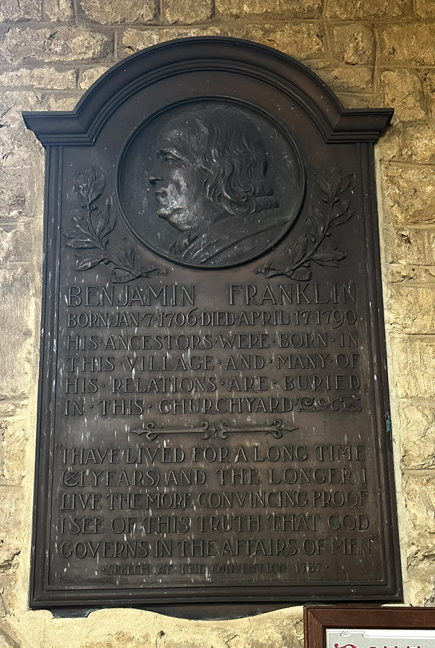
Five generations of Franklins—smiths, dyers, and freeholders—lived in Ecton from 1555 until Josiah Franklin left for Boston in 1683. Benjamin Franklin was born in Boston in 1706. His father came from Ecton.[1]
Franklin returned to Ecton in July 1758 and searched the parish register. He recorded what he found in his Autobiography: “I perceived that I was the youngest son of the youngest son for five generations back.”[2] Inside the church—open the first Saturday of each month, and at other times by arrangement—a bronze plaque placed in 1910 bears a bust of Franklin and words he spoke at the Constitutional Convention in 1787: that without divine assistance the delegates would “succeed in this political Building no better than the Builders of Babel.”[3] The plaque was sculpted by Fritz Roselieb and unveiled by the American Consul-General. In the churchyard, the Franklin family gravestones carry coins left by American visitors. Of the six people to sign both the Declaration of Independence and the United States Constitution, one had a father born in this village.
II—The Presidents
The circle contains direct ancestral connections to Washington, Jefferson, and the Adams-Quincy line, along with the battlefield that determined Washington’s family would settle in Virginia rather than remain in England.

George Washington
Sulgrave Manor Sulgrave, OX17 2SD—20 miles from Ecton (40 min)
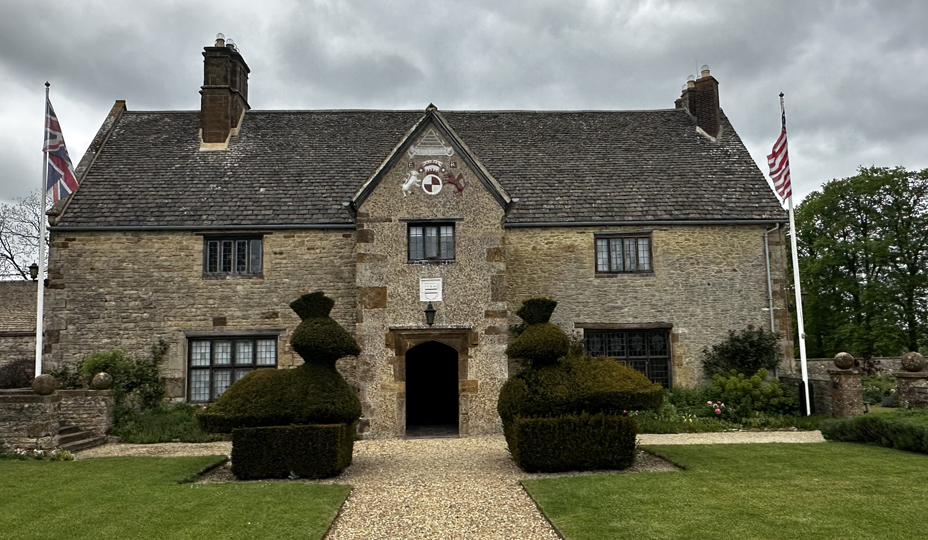
Lawrence Washington, a wool merchant, purchased the former priory lands at Sulgrave in 1539 and built the manor house that still stands there.[4] Above the main porch, carved in stone, is the Washington coat of arms: alternating rows of stars and stripes. The same design flew over the Continental Army two and a half centuries later. The manor is managed by the Sulgrave Manor Trust as an Anglo-American heritage site. The rooms are furnished to the Tudor period. The kitchen garden is planted with period herbs. The family connection to George Washington runs through four generations: Lawrence built Sulgrave, the estate passed through two more Lawrences, declined, and was sold. One branch settled in Virginia. John Washington crossed the Atlantic in 1657—great-grandfather of the first president.[5] Allow two hours. Check sulgrave-manor.org.uk for seasonal hours. The family that bought this land in 1539 produced the man whose face is on the dollar bill and whose name heads the list of signatories on the Constitution.
St Mary the Virgin Great Brington, NN7 4JA—12.6 miles from Ecton (22 min)
In the chancel floor, a worn stone slab bears the Washington coat of arms—stars and stripes, carved in stone, dated 1616, 160 years before the Declaration of Independence, marking the burial of Lawrence Washington.[6] Beside it lies Robert Washington, died 1622. The Spencer family—whose descendants include Diana, Princess of Wales—have worshipped here alongside the Washington monuments since the sixteenth century. Normally open during daylight hours. Allow one hour.
Naseby Battlefield NN6 6EU—14.3 miles from Ecton (28 min)
The decisive battle of the English Civil War was fought here on June 14, 1645. Lawrence Washington—rector of Purleigh, Essex, great-great-grandson of the Sulgrave builder—was a committed Royalist. Parliamentary forces expelled him from his living and sequestered his property. He died in relative poverty in 1653. His son John, stripped of prospects in Parliamentary England, made a tobacco voyage to Virginia in 1657 and never returned.[7] His grandson Augustine Washington fathered George. The battlefield is open farmland. A stone column marks the approximate Parliamentary line. Allow one hour. The family that lost at Naseby produced the general who won at Yorktown.

All Saints Church Cople, Bedfordshire, MK44 3TT—19.5 miles from Ecton (32 min)
Nicholas Spencer was born at Cople in 1633 and baptised in this church. He emigrated to Virginia in the 1650s and in 1674 co-patented 5,000 acres on the Potomac River with Lt. Col. John Washington—great-grandfather of the first president. That land became Mount Vernon. After Spencer’s death in 1689 the grant was divided between the two families; the Washingtons eventually bought out the Spencer share and George Washington consolidated the full estate by 1786. Spencer served as acting governor of Virginia in 1683–84. The Anglican parish of Westmoreland County, Virginia was renamed Cople Parish in his honour—a name it still bears.[8] The Spencer family of Cople were related to the Washington family and shared a coat of arms. A Grade I listed building with fabric dating from 1087, All Saints is one of the most beautiful churches in Bedfordshire. Normally open during daylight hours. Allow forty-five minutes. The land co-patented here in 1674 became the home from which Washington directed the war that secured American independence.
Thornton Hall Thornton, Buckinghamshire, MK18—18 miles from Ecton (32 min)
Thornton Hall, four miles north-east of Buckingham, was the ancestral seat of the Tyrrell baronets from the early sixteenth century. Sir George Tyrrell of Thornton Hall married Eleanor Montagu, daughter of Sir Edward Montagu, Chief Justice of England under Henry VIII. The Tyrrell baronetcy of Thornton, County Buckinghamshire, was created in 1627 and held the hall throughout the founding era until it became extinct in 1749. From this family came the founders of the entire American Tyrrell-Terrell family. Richmond Tyrrell settled in Virginia before 1650 and on November 28, 1656 was granted 640 acres in New Kent County by Gov. Sir William Berkeley for the transportation of thirteen persons. His brother William followed before 1657 and settled in Hanover County. A third brother emigrated to New England. Richmond and William became the ancestors of all the Tyrrells, Terrells, Tirrells, and Terrills in America—a family that spread across Virginia, the Carolinas, and New England. The connection is documented in primary colonial land grant records and in Joseph Henry Tyrrell’s genealogical history of 1910.[9] St Mary the Virgin church stands at the heart of the village and dates from the thirteenth century. Allow thirty minutes. The American Tyrrells spread through Virginia and the Carolinas—the colonial gentry class that produced many of the Revolution’s military officers and political leaders.
Thomas Jefferson
Thomas Jefferson’s ancestry runs through two Northamptonshire villages three miles apart. The Isham family of Pytchley and Lamport sent a cousin to Virginia whose daughter married a Randolph, and whose descendants produced Thomas Jefferson, who wrote the Declaration of Independence.
St Mary the Virgin Little Houghton, NN7 1AG—2.1 miles from Ecton (8 min)
Henry Randolph was born in Little Houghton in 1623 and emigrated to Virginia in 1642—the first of the Virginia Randolphs. Returning to England around 1669, it was Henry who brought out his young nephew William Randolph. William settled at Turkey Island and married Mary Isham, of the Lamport and Pytchley family (see below); their descendants were Thomas Jefferson, who wrote the Declaration of Independence, his cousin Edmund Randolph, who introduced the Virginia Plan to the Constitutional Convention in 1787, and Peyton Randolph, elected first President of the Continental Congress in 1774. Little Houghton is where the Randolph who opened that door was born. St Mary the Virgin is a small medieval church, normally open during daylight hours. Allow thirty minutes. The constitutional framework the Randolphs helped build in 1787 completed the Revolution that independence had begun eleven years earlier.
All Saints Church Pytchley, NN14 1EN—6.2 miles from Ecton (14 min)
Pytchley is the village where the Isham family were established before purchasing Lamport Hall in 1560. Sir Euseby Isham is buried here. His grandson Henry Isham emigrated to Virginia; Henry’s daughter Mary Isham married William Randolph of Turkey Island; their descendants produced Jane Randolph, who married Peter Jefferson, and Thomas Jefferson was their son. The church is normally open during daylight hours. Pytchley is four miles from Lamport and the two make a natural pairing. Allow thirty minutes.
Lamport Hall Lamport, NN6 9HD—8.6 miles from Ecton (18 min)
The seat of the Isham family since 1560. Henry Isham emigrated to Virginia after March 1659.[10] His daughter Mary Isham married William Randolph of Turkey Island. Their grandson Isham Randolph fathered Jane Randolph, who married Peter Jefferson. Thomas Jefferson was their son. The Isham-Randolph marriage became so foundational to Virginia’s colonial elite that the family was called the Adam and Eve of Virginia—every great dynasty of the colony seemed to trace back to it. Inside the hall, the Isham family portraits still line the walls. Open selected Sundays and bank holidays. The church of All Saints stands directly opposite, normally open during daylight hours. Allow ninety minutes. Thomas Jefferson wrote “all men are created equal” in 1776. The chain of descent that produced him began in this hall.
John Adams and the Quincy line
John Adams did not descend from the circle. His wife Abigail did. Edmund Quincy II was baptised at Lilford church on May 30, 1602.[11] His descendants produced Abigail Adams and two presidents. The town of Quincy, Massachusetts, birthplace of both John Adams and John Quincy Adams, takes its name from this family.
St John the Baptist Thorpe Achurch, PE8 5SA—15.4 miles from Ecton (30 min)
The hamlet of Wigsthorpe—where the Quincy family lived—is one mile away. The church of St John the Baptist stands on a rise above the River Nene. In 1633 Edmund sailed for Massachusetts. His descendants produced Abigail Adams—who wrote to her husband on March 31, 1776, “Remember the Ladies”—and two Presidents of the United States.[12] The church is normally locked but the churchyard is open. The setting—the river, the meadows, the quiet of the Nene valley—is worth the journey. Allow forty-five minutes.
Woburn, Bedfordshire—and Eight Presidents
St Mary’s Church Woburn, Bedfordshire, MK17 9PG—20.7 miles from Ecton (35 min)
Woburn, Massachusetts was named after Woburn, Bedfordshire in 1642 by Captain Edward Johnson, in honour of his friend Robert Sedgwick’s birthplace. The First Burial Ground of that town holds a separate and remarkable distinction. A commemorative plaque dedicated on May 29, 2017 by the Mayor of Woburn on the 375th anniversary of the town’s founding states that the burial ground holds “the ancestors of eight United States Presidents”: Franklin Pierce (14th), Grover Cleveland (22nd and 24th), Benjamin Harrison (23rd), Calvin Coolidge (30th), Herbert Hoover (31st), Franklin D. Roosevelt (32nd), George H.W. Bush (41st), and George W. Bush (43rd). The connecting families—the Richardsons, Wymans, Winns, and others—settled in Woburn, Massachusetts in the seventeenth century. Whether these families themselves originated in Bedfordshire is a separate question, currently under active genealogical investigation by the Woburn Historical Society.[13] St Mary’s Church in Woburn, Bedfordshire dates from the thirteenth century and is normally open during daylight hours. Allow forty-five minutes. Woburn Abbey, seat of the Dukes of Bedford, is half a mile away.
Stowe, Grenville, and the Philosophy of Liberty
Stowe Gardens and House Buckingham, MK18 5EH—19.6 miles from Ecton (35 min)
Stowe is where the intellectual case for American liberty was made in stone—thirty years before the Declaration of Independence was written. In 1734–35, Richard Temple, Viscount Cobham, commissioned the Temple of British Worthies, a curved stone monument in the gardens housing sixteen portrait busts of those he deemed the greatest Britons. Among the worthies: John Locke, Isaac Newton, Sir Francis Bacon, John Milton, John Hampden, Francis Drake, and William III. The inscription above Locke’s bust celebrated the man whose Two Treatises of Government provided the philosophical foundation of the Declaration of Independence. The inscription above Hampden’s bust reads that he began “a noble opposition to an arbitrary court, in defence of the liberties of his country”—the American Revolution described in stone, inside the circle, three decades before it happened.[14]
Stowe was the political nerve centre of eighteenth-century Whig Britain. The Temple-Grenville family produced four Prime Ministers. Richard Temple’s nephew George Grenville served as Prime Minister from 1763 to 1765 and passed the Stamp Act—the direct trigger of colonial resistance and the first link in the chain of events leading to independence. William Pitt the Elder—who began his political career as one of “Cobham’s Cubs” at Stowe—became the most eloquent defender of American rights in Parliament. The man who lit the fuse of the American Revolution and the man who most passionately defended the colonists’ position both owed their political formation to the same estate inside the circle.
The gardens are managed by the National Trust and open throughout the year. The Temple of British Worthies is accessible on foot from the visitor centre at the New Inn. The medieval parish church—over 800 years old, hidden by trees planted by Capability Brown—is open daily. Allow two hours for the gardens. Check nationaltrust.org.uk/stowe-gardens for seasonal opening times.
III—The Mayflower and the Puritan Network
The Puritan network centred on Northampton was the mechanism by which the founding theology of New England was developed, protected, and exported. Three sites trace that network.
Fawsley Hall Fawsley, NN11 3BA—16.3 miles from Ecton (30 min)
The former seat of the Knightley family, now a hotel, stands in a deer park sixteen miles from Ecton. Sir Richard Knightley (1533–1615) spent three decades sheltering and funding Puritan ministers across Northamptonshire in defiance of Archbishop Whitgift’s campaign against nonconformity. In the winter of 1588, the Marprelate press—the most seditious underground printing operation of the Elizabethan age—was hidden at Fawsley and used to print the second Marprelate tract. Sir Richard was arraigned before the Star Chamber and fined £2,000.[15] More significant for American history, Thomas Hooker—who founded Hartford, Connecticut, and framed the Fundamental Orders of Connecticut in 1639—was sheltered and funded by the Knightley network before sailing for New England in 1633. The grounds are accessible to non-residents. The church of St Mary the Virgin stands alone beside the hall—Sir Richard is buried inside. Allow one hour. Fawsley Hall is also an exceptional base for the western arc of the circle, with Sulgrave, Great Brington, Guilsborough, and Naseby all within thirty minutes. The Fundamental Orders Hooker framed in Connecticut in 1639—the first written constitution in American history—established the principle of government by consent that the Declaration of Independence invoked 137 years later.
St Etheldreda’s Church Guilsborough, NN6 8RD—11.7 miles from Ecton (22 min)
John Lucas was born here in 1627. He grew up a Quaker, endured the fines of the Quaker Act of 1662, and in August 1682 boarded Penn’s Welcome—the ship William Penn had chartered to carry Quaker settlers to Pennsylvania. Lucas founded the Byberry Meeting in Pennsylvania, one of the earliest Quaker meetings in the colony. The Quakers of Guilsborough and Wellingborough contributed to the drafting of the Concessions and Agreements of West Jersey in 1676 and 1677—the document establishing freedom of conscience, trial by jury, and government by consent, which flowed into Penn’s Frame of Government for Pennsylvania (1682) and ultimately into the First Amendment of the United States Constitution. Normally open during daylight hours. Allow forty-five minutes. The First Amendment—guaranteeing freedom of conscience, freedom of speech, and freedom of assembly—is the direct descendant of the principles drafted by these Quaker communities.
Friends Meeting House Wellingborough, NN8 4HY—4.6 miles from Ecton (10 min)
The Wellingborough Monthly Meeting of the Society of Friends was established in the 1650s and contributed to the drafting of the Concessions and Agreements of West Jersey in 1676 and 1677. The meeting house on St John Street is not open to visitors but is visible from the street—a plain ironstone building. Its significance sits in the constitutional thread running from this community through Penn’s Frame of Government into the First Amendment to the United States Constitution.
IV—The Constitution and the Revolution
Four sites connect directly to the constitutional and revolutionary story—the first election in the New World, the legal foundation of Virginia, the man whose enforcement of British law made revolution inevitable, and the Prime Minister who recognised American independence.
St Andrew’s Church Kimbolton, PE28 0HA—17 miles from Ecton (30 min)
Edward Maria Wingfield was born around 1550 at Stonely Priory, near Kimbolton, and was buried at St Andrew’s Church in 1631. On May 13, 1607, the Virginia council gathered in their new settlement on the James River and held an election—the first ever in the New World. Wingfield was chosen as president, the first elected head of government in the Americas, 169 years before the Declaration of Independence. A plain medieval church with a Norman tower, normally open during daylight hours. Kimbolton Castle—remodelled by Vanbrugh with painted interiors by Pellegrini—is now a school, open on selected days. Allow one hour. The Virginia colony Wingfield helped establish became the home of the Washington, Jefferson, and Randolph families—the dynasty that led the Revolution.
Castle Ashby NN7 1LQ—3 miles from Ecton (10 min)
The seat of the Compton family, Earls of Northampton. William Compton, 1st Earl of Northampton, is named as a signatory grantee on the Second Virginia Company Charter of 1609—the document that gave the Virginia Company its permanent legal authority to govern Jamestown. Without this charter, Jamestown almost certainly would have failed. The grounds, redesigned by Lancelot ‘Capability’ Brown from 1761, are open to the public. The house is not generally open. Allow ninety minutes. The permanent colony the Second Charter secured became the Virginia that produced Washington, Jefferson, Madison, and Monroe.
Abington Park Museum Northampton, NN1 5LW—3.4 miles from Ecton (12 min)
Abington Park Museum occupies the former manor house of the Bernard family. Sir Francis Bernard (1712–1779) was royal governor of Massachusetts from 1760 to 1769. He enforced the Stamp Act, dissolved the Massachusetts assembly when it refused to comply with the Townshend Acts, requested British troops be quartered in Boston and wrote secretly to London demanding military force be used against the colonists. He was recalled in 1769. The Boston Massacre followed in 1770.[16] His family were a cadet branch of the Bernards of Abington, documented in Sophia Elizabeth Higgins, The Bernards of Abington and Nether Winchendon (4 vols., 1903–04).[17] The museum is free to enter. The Bernard family monuments are in the adjacent church of St Peter and St Paul. Also in the museum: Elizabeth Hall, Shakespeare’s granddaughter, was buried at Abington in 1670. Allow ninety minutes.
Rockingham Castle Rockingham, LE16 8TH—17.6 miles from Ecton (35 min)
Rockingham Castle was the family seat of Charles Watson-Wentworth, 2nd Marquess of Rockingham—the British Prime Minister who repealed the Stamp Act in 1766, led parliamentary opposition to the American war for sixteen years, and in 1782 took office on the condition that the King recognise American independence. George III conceded. Rockingham died fourteen weeks into the job, but the process he had forced was unstoppable. The Treaty of Paris, signed in 1783, recognised the United States as a sovereign nation. Edmund Burke—his closest political ally and former private secretary—was the greatest parliamentary voice the American cause had in Britain. Rockingham Castle is open to the public on selected days from Easter to September. Allow two hours. Check rockinghamcastle.com.
V—Harvard, Yale, Amazing Grace, and The Pilgrim’s Progress
Four sites connect to the cultural institutions and works that shaped American life: the universities, the hymn sung at every American funeral, and the book the founding generation read more than any other after the Bible.
St Andrew’s Church Yardley Hastings, NN7 1ER—6.1 miles from Ecton (14 min)
Thomas Dudley was baptised here on October 12, 1576. In 1630 he sailed to America on the Arbella with John Winthrop. He helped found Cambridge, Massachusetts, served four times as governor of Massachusetts Bay Colony, and in 1650 signed Harvard’s founding charter.[18] His daughter Anne sailed with him at eighteen, already married to Simon Bradstreet, later governor of Massachusetts. In 1650, the same year her father signed Harvard’s charter, her poems were published in London under the title The Tenth Muse Lately Sprung Up in America—the first book of poetry published in the New World.[19] The baptismal font is still there. Normally open during daylight hours. Allow forty-five minutes. Dudley’s Harvard produced the ministers and lawyers who articulated the colonial case against British taxation; Anne Bradstreet’s example established that the new American world had its own literary voice.
St Mary and St Giles Church Stony Stratford, MK11 1NG—14 miles from Ecton (25 min)
Theophilus Eaton was baptised here on August 15, 1591. He sailed for New England in 1637, co-founded New Haven Colony on the Connecticut shore, and was elected its first governor in October 1639—re-elected every year until his death in 1658. His brother Nathaniel Eaton was the first Headmaster of Harvard College and his son Samuel Eaton was among its founding Fellows. His second wife Anne Yale brought her son David Yale to the marriage; David’s son was Elihu Yale, namesake and benefactor of Yale University. Two of the three great universities of colonial America trace directly to a man baptised in this church. Normally open during daylight hours. Allow forty-five minutes. Harvard and Yale together educated the generation of American leaders who carried the Revolution through.
Cowper and Newton Museum Olney, MK46 4AJ—12 miles from Ecton (22 min)
Between 1764 and 1780, the curate of Olney was John Newton—a former slave ship captain turned evangelical minister. In 1779, Newton and the poet William Cowper published the Olney Hymns—348 hymns written for the Olney congregation. One of them was Amazing Grace. It became, in America, the hymn of the abolitionist movement, of the civil rights marches, and of every American funeral. The museum occupies Orchard Side, where Cowper lived for nineteen years. It holds Newton’s writing desk, original manuscripts of the Olney Hymns, and Cowper’s summer house in the garden. Open Tuesday to Saturday. The church of St Peter and St Paul, where Newton preached, stands directly opposite. Allow half a day.
Elstow Abbey Church Elstow, MK42 9XT—17 miles from Ecton (30 min)
John Bunyan was baptised at Elstow Abbey Church on November 30, 1628.[20] He wrote The Pilgrim’s Progress in Bedford jail in 1678. After the Bible it was the most widely read book in American households for two centuries. Its first North American edition appeared in 1681. The abbey church stands on the site of the Benedictine abbey where Bunyan was baptised. The nave dates from the twelfth century. The Moot Hall in the village green houses a small Bunyan museum. Both normally open during daylight hours. Allow one hour. Bedford, two miles north, where Bunyan preached at the church on the site of St Paul’s, combines naturally with Elstow. The Pilgrim’s Progress shaped the moral imagination of the generation that fought the Revolution—its allegory of a man who refuses to submit to unjust authority and presses on regardless was read in every literate household in colonial America.
V—Practical Information
Getting there
London St Pancras to Northampton by train: 55 minutes. Car hire is available at Northampton station. All sites in Sections I–IV are within 35 minutes’ drive of Northampton. For Section V sites in Bedfordshire and Buckinghamshire, a base at Bedford or Milton Keynes reduces journey times. Most combinations of sites can be covered in a full day by car.
Where to stay
Two historic hotels within the circle suit the character of the tour. Fawsley Hall (NN11 3BA, handpickedhotels.co.uk) is the former Knightley family seat—the same family that sheltered Thomas Hooker. It is now a four-star hotel and spa in 2,000 acres of Capability Brown parkland, 16.3 miles from Ecton. Rushton Hall (NN14 1RR, rushtonhall.com) is a Grade I listed manor house dating from 1458, 8.8 miles from Ecton, with Rockingham Castle five miles away. Both are at the upper end of the price range. Northampton and Kettering both have good commercial hotels with straightforward access to the circle’s sites.
Opening hours
Sulgrave Manor: check sulgrave-manor.org.uk for seasonal hours. Ecton church: first Saturday of each month, 10am, or by arrangement. Abington Museum: Tuesday–Sunday, free entry. Lamport Hall: selected Sundays and bank holidays. Rockingham Castle: selected days Easter to September; check rockinghamcastle.com. Cowper and Newton Museum: Tuesday–Saturday. All other churches generally open during daylight hours; Ecton and Thorpe Achurch normally locked but churchyards accessible.
Northamptonshire Archives, Wootton Hall Park, Northampton, NN4 8BQ. Holds the parish registers, the Isham Correspondence (including IC.5110—a letter from Anne Washington sealed with the Washington armorial, c.1618), and the Franklin family documents. Open by appointment.
Conclusion
The sites described in this article span three English counties but sit within a twenty-one mile circle that can be covered in a long weekend. Twelve of the forty-five individuals ever to serve as president of the United States have documented connections to this ground. Several of the sites are well known—Sulgrave Manor, Stowe, Rockingham Castle. Most are not. None are connected by any existing heritage trail. All are within reach of each other, and of London, by car in a single day.
The parish churches are generally open during daylight hours. The battlefield sites are farmland with public access. The archive at Northampton holds the primary sources. Most of the sites are free to visit. For the American visitor interested in the founding era, this corner of the English Midlands offers more connections per square mile than anywhere else in Britain—and most of it has never been presented as a single trail before.
[1] Benjamin Franklin, The Autobiography of Benjamin Franklin, ed. Leonard W. Labaree et al. (New Haven: Yale University Press, 1964), 3.
[2] Ibid., 5.
[3] The bronze plaque at St Mary Magdalene, Ecton, was sculpted by Fritz Roselieb and unveiled by the American Consul-General in 1910. Franklin’s words were spoken at the Constitutional Convention, Philadelphia, June 28, 1787. See James Madison, Notes of Debates in the Federal Convention of 1787 (Athens: Ohio University Press, 1966), 209.
[4] Northamptonshire Record Office, Sulgrave Manor records; Victoria County History of Northamptonshire. Lawrence Washington purchased Sulgrave on 10 March 1539 for £324 14s 10d.
[5] Douglas Southall Freeman, George Washington: A Biography, vol. 1 (New York: Scribner’s, 1948), 1–15.
[6] The Washington burial slabs at Great Brington are primary sources. Lawrence Washington, died 1616; Robert Washington, died 1622.
[7] Freeman, George Washington, 1:8–11. Lawrence Washington, rector of Purleigh, was expelled from his living by Parliamentary sequestrators in 1643.
[8] Lyon G. Tyler, Encyclopedia of Virginia Biography, vol. 1 (New York: Lewis Historical Publishing, 1915), 53; Charles C. Wall, “Notes on the Early History of Mount Vernon,” William and Mary Quarterly, 2nd ser., 2:2 (1945), 174–75. For Spencer’s governorship see also the Virginia Colonial Records Project; Mount Vernon Ladies’ Association, “Ownership of Mount Vernon,” mountvernon.org. The Cople Parish of Westmoreland County, Virginia retains the name to this day.
[9] Joseph Henry Tyrrell, The Genealogy of Richmond and William Tyrrell or Terrell, Descended from the Family of Tyrrell of Thornton Hall, Buckinghamshire, England, Who Settled in Virginia in the Seventeenth Century (privately printed, 1910). Land grant confirmed in Virginia Colonial Land Grant Book 4, p. 12, November 28, 1656.
[10] Isham Correspondence, IC 482 and IC 483, Northamptonshire Archives and Heritage Service.
[11] Northamptonshire Archives and Heritage Service, correspondence with the author, April 2026.
[12] Abigail Adams letter, March 31, 1776: Adams Family Papers, Massachusetts Historical Society; reproduced in L.H. Butterfield et al., eds., Adams Family Correspondence, vol. 1 (Cambridge: Harvard University Press, 1963), 370.
[13] The text on the plaque reads: “Among the distinguished dead that are interred here are the ancestors of eight United States Presidents.” Kathleen Lucero, Woburn Historical Society, correspondence with the author, April 2026; American Ancestors / New England Historic Genealogical Society, Ask-a-Genealogist Reference Service, correspondence with the author, April 2026, citing Gary Boyd Roberts, Ancestors of American Presidents (New England Historic Genealogical Society), pp. 43–45, 76–77, 104–108, 113, 115, 122, 126, 185–196.
[14] National Trust, Stowe Gardens (nationaltrust.org.uk/stowe); History of Parliament Online, “George Grenville” (historyofparliamentonline.org); John Martin Robinson, Temples of Delight: Stowe Landscape Gardens (London: National Trust, 1994). The Temple of British Worthies was commissioned by Viscount Cobham c.1734–35, designed by William Kent. George Grenville was MP for Buckingham 1741–1770 and Prime Minister 1763–65.
[15] Calendar of State Papers Domestic, Elizabeth I, vol. 229. Sir Richard Knightley was arraigned before the Star Chamber on 31 January 1589 and fined £2,000.
[16] Colin Nicolson, The ‘Infamas Govener’: Francis Bernard and the Origins of the American Revolution (Boston: Northeastern University Press, 2001), 88–142.
[17] Sophia Elizabeth Higgins, The Bernards of Abington and Nether Winchendon (4 vols., London, 1903–04).
[18] Samuel Eliot Morison, The Founding of Harvard College (Cambridge: Harvard University Press, 1935), 168–172.
[19] Anne Bradstreet, The Tenth Muse Lately Sprung Up in America (London, 1650).
[20] Baptism of John Bunyan, November 30, 1628: register of St Mary and St John the Baptist, Elstow, Bedfordshire.

Recent Articles
Last Call for a Dram Seller on the Mohawk River
Payback: Attack on the DeLancey House
A Dear-Bought Victory: The Battle of Bunker Hill and the Siege of Boston, 1775-1776
Recent Comments
"Payback: Attack on the..."
Fascinating account and detailed illustration of how much the AWI also was...
"Shenandoah Martyr: Richard Campbell..."
My ancestry points to this being my grandfather on my mother’s paternal...
"Payback: Attack on the..."
Yes, indeed, a great read as previously commented. And a great fascination...