

In the eighteenth century, standards for decent citations, quotes, references and also for translations were less clear than they are for us, and certainly less strict. This is instantiated by The Federalist (Papers), the eighty-five essays that were published by Alexander Hamilton, James Madison and John Jay under the joint pen name of “Publius.” These essays were meant to motivate the citizenry of New York to ratify the new Constitution as it had been designed by the federal convention in Philadelphia in 1787.
The authors frequently referred to classical or contemporary texts to give historical evidence of the political phenomena they discussed or to support their arguments in favor of the projected federal Constitution. But none of these references would ever satisfy a modern editor. Authors of the referenced texts are generally mentioned, with one interesting exception to be addressed below, but book titles are often incomplete or abbreviated, and publishers, or places and dates of publication, are almost systematically ignored. Moreover, if the reference involved a citation from an ancient or foreign language text, say Latin or French, an existing English translation was offered without its source being checked or mentioned, and this can create misunderstandings.
An example is Hamilton’s long quote from Montesquieu’s De l’esprit des lois in essay no. 9, taken from the English translation by Thomas Nugent from 1752. But Thomas Nugent took the liberty to adopt a substantial phrase in his translation that is not in the French original. Probably he felt the passage wherein it was inserted needed clarification. It reads: “till they arrive to such a degree of power as to be able to provide for the security of the united body.”[1] I checked. But Hamilton, though he was fluent in French, did not. Therefore Nugent’s intervention remained undetected, uncorrected, and it is included without notification until this day within the quotation marks in The Federalist in all its (critical and annotated) editions that I have consulted, so that the Anglophone readers of it are led to believe they are reading a fully accurate English version of Montesquieu.
We find further evidence of some editorial ease in The Federalist where we would least expect it: in the treatment of the text of the proposed Constitution itself. It is only once in a while that the authors feel that their frequent quotations of it warrant a precise reference to Article, Section, and Provision. More troublesome is that the quotes themselves are somewhat inaccurate: sometimes they use different wordings than the original, often certain phrases are capitalized to add emphasis, sometimes they jumble together lines from distinct clauses in a single quote and very often the ordering of the words is altered.
To be sure, none of these instances where Publius proves to be slightly less than meticulous as an editor, or all of them combined, have a seriously disruptive effect on the integrity of these brilliant essays. Besides, we should in all fairness take into account the considerable time pressure under which these founding fathers had to deliver their twice-weekly newspaper articles. But I had to deal with them as the translator of The Federalist into Dutch. And I confess that my own sensitivities on this score may well be attributed to the good part of my career that I have been employed as a librarian.
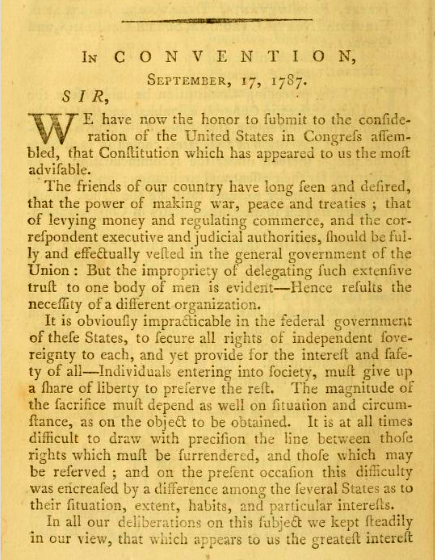
Yet if we can, let us, as we say in Dutch, “add the dots to the i.” Let me therefore make a positive but tiny contribution to the understanding of the literary embeddedness of these essays. No. 62, authored by Madison, undertakes to explain why the Philadelphia convention decided the Senate to have an equal representation of the States whereas for the House of Representatives the number of delegates would be proportional to population size. The proposal is basically defended as an inevitable compromise between the larger and smaller States. It is in this essay that we find one quote that is not referenced at all—sine auctore (“without author). It reports “of a spirit of amity, and that mutual deference and concession which the peculiarity of our political situation rendered indispensable.”[2]
It provoked my curiosity. Who is the author of this eloquent formula, characterizing the atmosphere at the Philadelphia convention? Again, none of the editions I consulted provided a clue or expressed to share my amazement about this mysterious blank in a text of some serious significance for America’s political history, except that J.R. Pole comments that “Publius omits to credit this quotation.”[3]
To my relief, modern technology—not at the disposal of the editors of previous generations—allows us to pin down the loose quote. To retrieve its origin we simply paste the text in the search function of a popular Internet machine, and we are guided to the source within a second. It is George Washington’s cover letter that he, chair of the convention, sent to Congress in September 1787 with the plan for the Constitution.[4]

Perhaps Madison trusted his readers to be so familiar with Washington’s epistle that he deemed a reference redundant. That, however, cannot be assumed about us.
[1] Alexander Hamilton, James Madison, John Jay, The Federalist, edited, with historical and literary annotations, and introduction, by J.R. Pole (Hackett, 2005), 44, lines 94–95.
[2] Ibid., 332, lines 41–43

[3] Ibid., 332n.
[4] George Washington to the President of Congress, September 17, 1787, Founders Online, National Archives, founders.archives.gov/documents/Washington/04-05-02-0306.


One thought on “Two Short Notes on The Federalist no. 9 and no. 62”
“Perhaps Madison trusted his readers to be so familiar with Washington’s epistle that he deemed a reference redundant.” There is an observation somewhat similar to that in I. Bernard Cohen’s book “Science and the Founding Fathers.” Cohen points out that in his “Notes on the State of Virginia,” Thomas Jefferson cites Isaac Newton’s “Principia” without acknowledgment. Cohen states that Jefferson “assumed that Newton… (was) so well known to his readers that to mention either Newton’s name or the title of his treatise would be supererogatory, a breach of good taste in rhetoric.” (p. 77).